
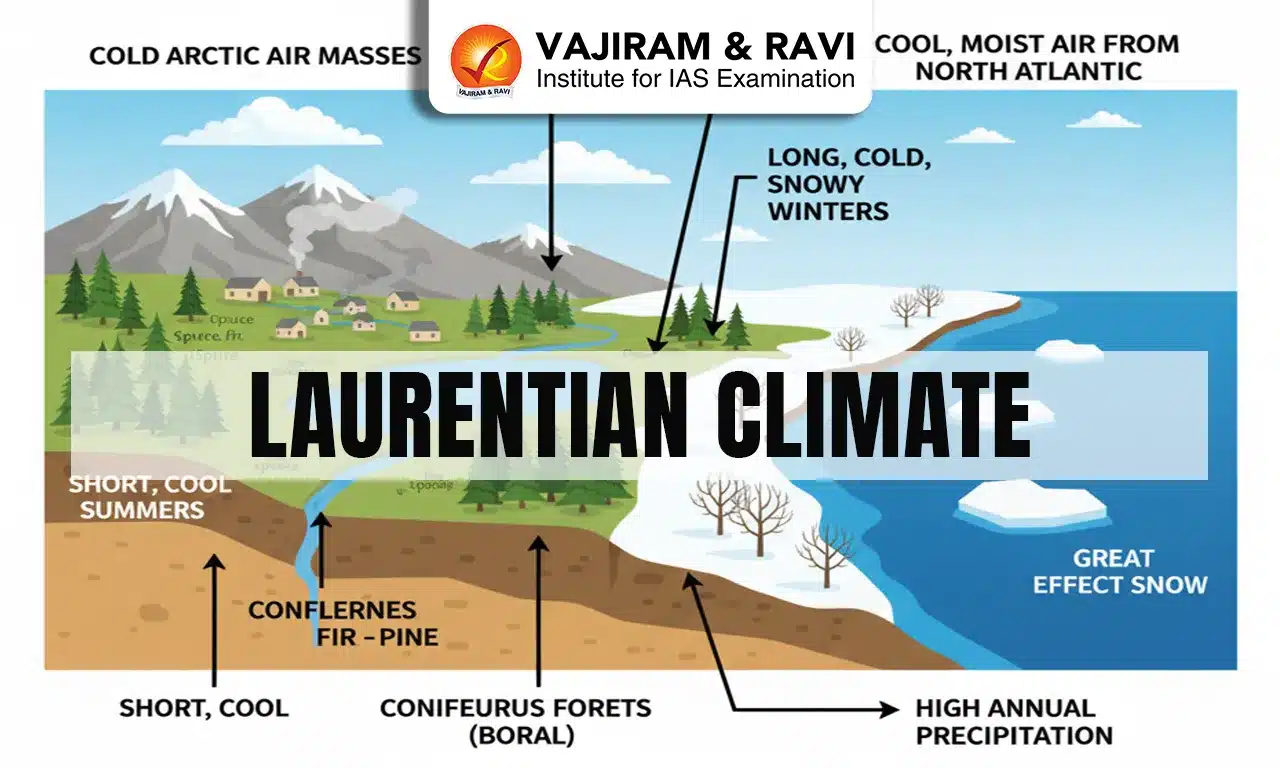
The Laurentian Climate, also called the Cool Temperate Eastern Margin Climate, occurs between 45° and 65° North. It is characterized by cold winters, warm summers, and moderate rainfall throughout the year. This climate is mainly found in the northern hemisphere around the St. Lawrence River basin in Canada, after which it is named.
Laurentian Climate
The Laurentian Climate represents a transitional climatic type between the temperate maritime (western margin) and continental (interior) climates. It is influenced by both oceanic and continental air masses, leading to sharp seasonal variations. The regions under this climate experience warm, short summers and long, severe winters. It is classified as Dfb in the Köppen Climate Classification, meaning a humid continental climate with warm summers.
Laurentian Climate Distribution
The Laurentian Climate occurs primarily on the eastern margins of temperate continents in the Northern Hemisphere. These areas lie between 4°N and 65°N latitudes, where the influence of both warm ocean currents and cold continental winds creates a distinct climatic balance. Major regions include:
- North America: St. Lawrence River valley, Great Lakes region, Nova Scotia, and New England.
- Asia: North-eastern China (Manchuria), North and South Korea, and northern Japan (Hokkaido region).
Read About: Equatorial Climate
Laurentian Climate Map
On a world map, the Laurentian Climate zones appear as narrow belts along the eastern coasts of continents. The St. Lawrence basin, north-eastern United States, north-eastern China, and northern Japan are the most prominent examples. These regions lie along the westerly wind belt, receiving moist air from nearby oceans, but are also affected by cold continental air in winter.
Laurentian Climate Characteristics
The Laurentian Climate displays strong seasonal contrasts due to its mid-latitude location and exposure to both maritime and continental influences.
- Temperature:
- Summer temperature: 15°C to 25°C.
- Winter temperature: often below 0°C, with heavy snowfall.
- Rainfall:
- Annual rainfall ranges between 750 mm and 1500 mm.
- Rainfall is evenly distributed but slightly higher in summer.
- Humidity: Moderate to high due to proximity to oceanic air masses.
- Winds: Dominated by westerlies, bringing moist maritime air from oceans.
- Precipitation Type: Rain during summer; snow in winter.
Factors Affecting Laurentian Climate
The Laurentian Climate is influenced by a combination of geographical, atmospheric, and oceanic factors that shape its distinct seasonal pattern and temperature range. These factors determine the rainfall, vegetation, and economic activities of the region.
- Latitude
-
- Located between 45° N and 65° N, this region receives moderate solar radiation, causing warm summers and cold winters.
- The tilt of the Earth’s axis leads to significant seasonal variations.
- Proximity to Oceans
-
- Coastal areas near the Atlantic and Pacific Oceans experience maritime influence, resulting in mild winters and cool summers.
- Inland areas like central Canada and northeastern China show continental characteristics with greater temperature extremes.
- Ocean Currents
-
- The meeting of warm Gulf Stream and cold Labrador Current near Newfoundland moderates coastal temperatures and enriches marine life, making it one of the world’s best fishing zones.
- Similar effects are seen in Japan, where the Kuroshio and Oyashio currents influence temperature and precipitation.
- Topography
-
- Mountain ranges like the Rockies and the Appalachians affect rainfall distribution, creating wet coastal and drier inland zones.
- Valleys and plains support settlements and agriculture due to fertile soils and moderate rainfall.
- Wind Systems and Air Masses
-
- Westerlies dominate this region, bringing moist oceanic air and precipitation throughout the year.
- Seasonal shifts in continental and maritime air masses cause noticeable temperature and weather variations.
- Human Influence
-
- Urbanization, deforestation, and industrialization have begun altering the local climate through urban heat islands and pollution, subtly modifying temperature and rainfall trends.
Read About: Tropical Climate
Laurentian Climate Vegetation
The Laurentian regions support mixed forests, a combination of deciduous and coniferous trees, due to varied temperature and precipitation.
- Plants and Trees
-
- Dominant deciduous trees: Oak, Maple, Birch, Elm.
- Coniferous trees: Pine, Spruce, Fir, Hemlock.
- Mixed forests change seasonally: deciduous trees shed leaves in winter, while conifers remain green.
- Herbs and Shrubs
-
- Understory vegetation includes ferns, mosses, and small flowering herbs.
- Shrubs like hazel and viburnum thrive in the moist forest floor.
- Species and Wildlife
-
- Common animals: Deer, fox, bear, rabbit, raccoon, and squirrel.
- Bird species: Woodpecker, robin, owl, and duck.
- In Asia, animals like sika deer and Japanese macaques are typical.
- Soil
-
- The soil is podzolic and brown forest soil, acidic and low in humus due to slow decomposition in cold weather.
- Fertility improves when mixed with organic matter and used for agriculture.
Economic Activity in Laurentian Climate Region
The regions under the Laurentian Climate are highly developed and economically significant due to their natural resources, industrialization, and favorable geographical conditions. The economy here is diversified:
- Lumbering: The vast mixed forests of North America and East Asia form the backbone of the timber and paper industries. Lumbering is a major occupation in Canada, Japan, and North-eastern China, where wood is used for pulp, furniture, and export.
- Fishing: Coastal regions such as Newfoundland (Canada) and the Japanese coast are among the world’s richest fishing grounds, benefiting from the meeting of warm and cold currents that encourage plankton growth. Cod, salmon, herring, and tuna are the main catches.
- Forestry: Large-scale timber extraction supports pulp and paper industries, especially in Nova Scotia, Ontario, and Hokkaido.
- Industry: Hydropower from rivers like the St. Lawrence drives industries such as steel, shipbuilding, automobiles, and chemicals.
- Trade and Ports: Ice-free ports like Halifax, Yokohama, and Boston facilitate international trade throughout the year.
Laurentian Climate Agriculture
Agriculture in the Laurentian region is limited by short growing seasons but remains productive through mechanization and scientific methods.
- Crops: Wheat, oats, barley, maize, potatoes, and vegetables.
- Dairy Farming: Highly developed due to availability of fodder crops and advanced infrastructure.
- Fruit Cultivation: Apples, cherries, and berries are common in temperate orchards.
- Livestock: Poultry and cattle farming are integral to rural economies.
- Technology Use: Greenhouse farming and irrigation improve yields despite climatic constraints.
Laurentian Climate Seasons
The Laurentian Climate experiences four well-defined seasons:
- Spring (March-May): Temperatures gradually rise, snow melts, and vegetation regrows. Rainfall increases, supporting crop planting.
- Summer (June-August): Warm and humid, with temperatures ranging 15-22 °C. Thunderstorms and occasional heatwaves occur, ideal for agriculture.
- Autumn (September-November): Cooling temperatures, trees shed leaves, and harvest occurs. Rainfall decreases, famous for colorful foliage and winds become stronger.
- Winter (December-February): Long, cold, and snowy; temperatures often fall below 0 °C. Rivers freeze, snowfall is heavy, and outdoor activities are limited.
Human Adaptations in Laurentian Climate
People living in the Laurentian Climate have developed unique adaptations to cope with cold winters, warm summers, and variable rainfall. Human settlements, industries, and lifestyles have evolved with the environment to ensure comfort, productivity, and sustainability.
- Housing and Infrastructure
-
- Houses are well-insulated with heating systems to withstand long, cold winters.
- Sloped roofs prevent snow accumulation, and double-glazed windows retain heat.
- Clothing and Lifestyle
-
- People wear layered woolen clothing in winter and lighter fabrics in summer.
- Seasonal lifestyles include winter sports like skiing and summer farming or fishing.
- Transportation and Energy
-
- Snow-clearing systems, heated roads, and underground transport ensure mobility.
- Widespread use of hydropower and renewable energy supports sustainable living.
- Economic and Agricultural Practices
-
- Adaptation through seasonal farming and greenhouse cultivation during cold months.
- Lumbering and fishing industries thrive year-round, adjusted to seasonal cycles.
Laurentian Climate Challenges
Regions under the Laurentian Climate face several environmental and socio-economic challenges due to extreme winters, short growing seasons, and human activity. Addressing these challenges requires sustainable practices, technological adaptation, and policy support.
- Severe Winters
-
- Challenge: Long, harsh winters limit agriculture, disrupt transport, and increase energy demand.
- Way Forward: Promote climate-resilient crops, greenhouse farming, and efficient heating systems to sustain productivity and daily life.
- Short Growing Seasons
-
- Challenge: Limited agricultural window restricts crop variety and yield.
- Way Forward: Use cold-tolerant crop varieties, extend cultivation with greenhouses, and adopt advanced farming techniques.
- Snowstorms and Blizzards
-
- Challenge: Heavy snowfall disrupts transport, trade, and daily activities.
- Way Forward: Develop infrastructure for snow removal, strengthen roads and railways, and implement disaster preparedness measures.
- Soil Erosion and Deforestation
-
- Challenge: Clearing forests for agriculture and urbanization causes soil degradation and reduces forest cover.
- Way Forward: Implement afforestation programs, sustainable logging practices, and soil conservation methods to protect ecosystems.
- Pollution and Industrial Impact
-
- Challenge: Industrialization and urban growth increase air and water pollution in cities like Montreal, Boston, and Sapporo.
- Way Forward: Enforce emission standards, promote green industries, and increase use of renewable energy like hydropower and wind.
- Overfishing and Resource Depletion
-
- Challenge: Excessive fishing threatens marine biodiversity in coastal areas.
- Way Forward: Regulate fishing zones, adopt sustainable fishing practices, and monitor marine ecosystems.
Laurentian Climate UPSC
In 2025, northeastern North America and eastern Canada have begun facing widespread drought; many cities recorded 50% or less of normal summer rainfall since June. Simultaneously, a record heatwave struck the Northeast U.S. and eastern Canada in June, with temperatures exceeding 35°C and made 2-5 times more likely by climate change.
| Also Check Other Posts | |
| Coastal Regulation Zone | Global Plastic Treaty |
| Nitrogen Cycle | Carbon Cycle |
Laurentian Climate FAQs
Q1: What is Laurentian Climate?
Ans: The Laurentian Climate is a cool temperate eastern margin climate with cold winters, warm summers, and moderate rainfall throughout the year.
Q2: Where is Laurentian Climate found?
Ans: It occurs in eastern North America, north-eastern China, Korea, and northern Japan, mainly between 45° and 65° latitude.
Q3: What are the main characteristics of Laurentian Climate?
Ans: Key features include four distinct seasons, heavy snowfall in winter, moderate summer rainfall, and mixed forest vegetation.
Q4: How does the Laurentian Climate affect agriculture?
Ans: Agriculture depends on short growing seasons, with crops like wheat, maize, oats, vegetables, and fruits such as apples and cherries.
Q5: What are the major species of plants found in Laurentian Climate?
Ans: The major plant species in Laurentian Climate include oak, maple, birch, pine, spruce, fir, hemlock, and mixed deciduous-coniferous trees.
