Pakistan-Occupied Kashmir (PoK), referred to by Pakistan as Azad Jammu & Kashmir (AJK) and Gilgit-Baltistan (GB), lies at the heart of the Kashmir dispute between India and Pakistan. PoK is administered by Pakistan and claimed in full by India, making it one of the most contested territories in South Asia. In 2025, especially after the tragic Pahalgam terror attack in April and escalating incidents along the Line of Control (LoC), renewed attention has fallen on PoK’s role as a terror hub, its strategic geography, and India’s ongoing stance on its reclamation. In this article, we are going to cover about Pakistan Occupied Kashmir, its historical background, India’s constitutional and legal position and strategic importance.
Pakistan Occupied Kashmir
Pakistan Occupied Kashmir is the area of the princely state of Jammu and Kashmir that came under Pakistani control following the first India-Pakistan war of 1947-48. It includes two administrative regions under Pakistan:
- Azad Jammu & Kashmir (AJK): The southern portion, with Muzaffarabad as its capital.
- Gilgit-Baltistan (GB): The northern region, which is geographically larger and borders China and Afghanistan.
Though Pakistan administers both, India maintains that they remain integral parts of the Indian union, and their control by Pakistan is illegal.
Pakistan Occupied Kashmir Historical Background
The dispute over PoK started during the time of partition period:
- In 1947, the princely state of Jammu & Kashmir agreed to join India.
- Between 1947 and 1948, India and Pakistan fought the first war over Kashmir. A UN-brokered ceasefire led to the establishment of the Line of Control (LoC), effectively splitting the formerly unified princely state.
- The Karachi Agreement (1949) between India and Pakistan formalized the ceasefire line.
- Subsequent wars in 1965 and 1971 did not significantly alter the Kashmir boundary.
- The eruption of insurgency in Indian-administered Kashmir since 1989 added complexity by inflaming separatist violence and cross-border militant activity.
- The Kargil conflict of 1999 was fought across high-altitude terrain in Jammu & Kashmir, again showing the fragility of peace along contested zones. To this day, the region known as PoK remains under Pakistani administration, though contested by India.
PoK Constitutional and Legal Position in India
India firmly holds that:
- PoK is an important part of India, a position enshrined in Indian political declarations and constitutional claims.
- In 1994, the Indian Parliament passed a unanimous resolution declaring PoK as sovereign Indian territory.
- India does not recognize any “Azad Kashmir” government, and considers elections, institutions, or laws instituted there by Pakistan to be null and void.
- Any Pakistani actions or developments in PoK are viewed by India as encroachments on its sovereignty.
PoK Strategic Importance
Pakistan Occupied Kashmir importance in the India-Pakistan equation is multifaceted:
- Gateway to China- CPEC: The China-Pakistan Economic Corridor (CPEC), a multibillion-dollar flagship project of China’s Belt and Road Initiative, passes through Gilgit-Baltistan. India has consistently objected, arguing that any infrastructure in PoK violates its sovereignty.
- Terror Launchpads: PoK is frequently cited as a safe zone for militant groups like Lashkar-e-Taiba (LeT), Jaish-e-Mohammed (JeM), and Hizbul Mujahideen, who are believed to run training camps in PoK’s varied terrain (e.g. Neelum Valley, Kotli, Bhimber).
- Geopolitical Leverage: Control over PoK gives Pakistan leverage in Kashmir, and its proximity to China gives strategic depth.
- Resource and terrain control: The region’s rivers, mountain corridors, and high-altitude terrain also hold military and hydrological advantages.
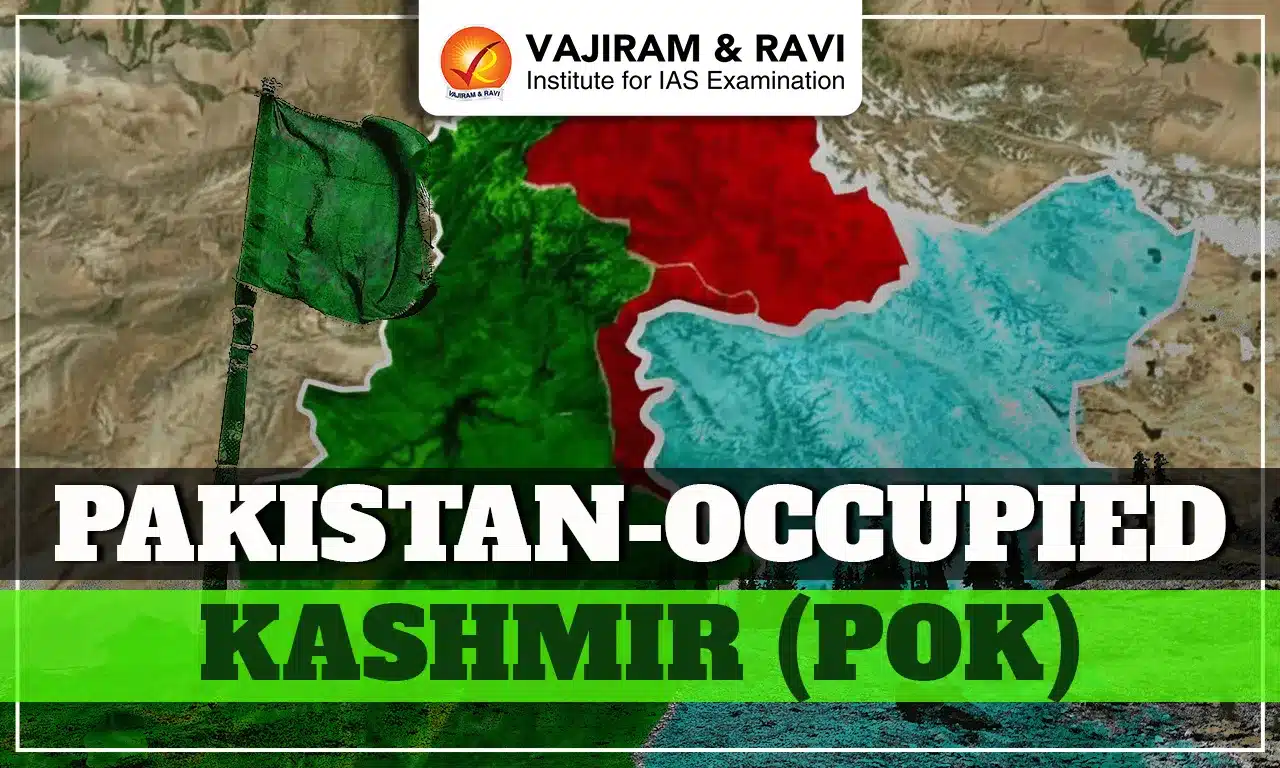
Pakistan Occupied Kashmir Map
Check out the Pakistan Occupied Kashmir map included here for a clear visual of the region and its boundaries.
Pakistan Occupied Kashmir (PoK) Developments in 2025
On 22 April 2025, terrorists struck in the Baisaran Valley, Pahalgam, killing 26 people, most of them tourists. The assailants reportedly used AK-47s and M4 carbines, infiltrating through adjacent forests. Investigations pointed to militants crossing from PoK, and Indian authorities held Pakistan responsible for providing sanctuary and infrastructure support to such groups. The Resistance Front, believed to be an offshoot of LeT, initially claimed responsibility.
India’s Renewed Assertiveness
In the wake of the attack, India intensified surveillance, drone operations, and counter-militant strikes near the LoC. In May 2025, India launched Operation Sindoor, targeting terror infrastructure in PoK, making airstrikes across nine locations. Indian leadership also sternly reiterated the objective of recovering PoK.
Diplomatic and Military Fallout
India summoned Pakistan’s High Commissioner and demanded dismantling of terrorist infrastructure. In response, Pakistan reportedly suspended key agreements, including aspects of the Shimla Accord, raising tensions at the diplomatic level. Pakistan, however, continues to portray PoK as a self-governing entity rather than an instrument of Pakistani control. Meanwhile, allegations of human rights suppression and lack of press freedom in Gilgit-Baltistan have drawn international criticism.
Internationally, the UN continues to classify Jammu & Kashmir as a disputed territory, calling for peaceful resolution via bilateral dialogue. Yet, no significant country recognizes PoK as an independent or sovereign Pakistani territory. China’s active presence in Gilgit-Baltistan through the CPEC further complicates the issue.
Pakistan Occupied Kashmir (PoK) FAQs
Q1: How did Pakistan occupy part of Kashmir?
Ans: Pakistan occupied part of Kashmir during the 1947–48 war following tribal invasions backed by its army after the Maharaja of Jammu and Kashmir acceded to India.
Q2: What is the difference between Pak and PoK?
Ans: Pakistan is a sovereign country, while Pakistan-Occupied Kashmir (PoK) is the region of Jammu and Kashmir illegally occupied and administered by Pakistan.
Q3: Are Azad Kashmir and Pakistan-Occupied Kashmir the same?
Ans: Yes, “Azad Jammu and Kashmir” is the term Pakistan uses for the part of Jammu and Kashmir under its occupation, commonly known in India as Pakistan-Occupied Kashmir (PoK).

