
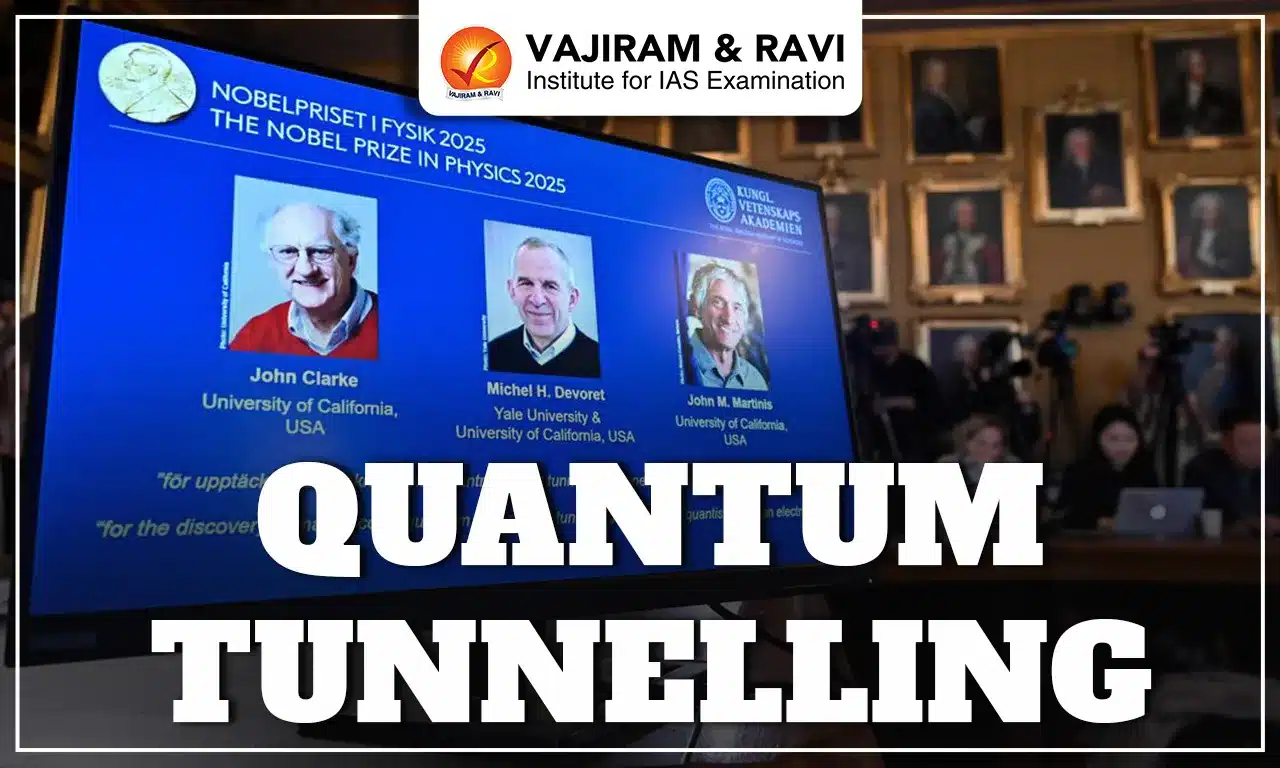
Nobel Physics 2025 Latest News
- The 2025 Nobel Prize in Physics went to John Clarke, Michel Devoret, and John Martinis for demonstrating that quantum tunnelling — where particles cross barriers they shouldn’t be able to — can occur not only in subatomic particles but also in macroscopic superconducting circuits.
- Their pioneering work proved that quantum phenomena, once thought to exist only at the atomic and subatomic scale, can also occur in man-made electrical circuits visible to the naked eye.
- It paved the way for technologies that could transform computing, sensing, and communication.
Quantum Tunnelling and Energy Quantisation Made Visible
- The Nobel laureates — John Clarke, Michel Devoret, and John Martinis — demonstrated two of quantum physics’ defining principles, tunnelling and energy quantisation, in a macroscopic electric circuit.
The Josephson Junction: Heart of the Discovery
- At the core of their experiments lies the Josephson junction, a device where two superconductors are separated by a thin insulating barrier.
- The researchers asked whether the phase difference — a measurable electrical property — across this junction could behave like a single quantum particle.
- By sending current through the circuit, they observed that when it was small, electrons (in Cooper pairs) were trapped, producing no voltage.
- Cooper pairs are pairs of electrons bound together by an attractive force, mediated by lattice vibrations called phonons, that occurs at low temperatures in superconducting materials.
- These pairs, which have opposite spins and total zero spin, behave as a single quantum unit called a boson and can flow through the material without resistance, enabling superconductivity.
- But sometimes, the current “tunnelled” through the barrier, suddenly flowing freely and generating a measurable voltage.
- This confirmed macroscopic quantum tunnelling — a quantum leap happening in an entire electrical circuit.
Solving the Fragility Problem
- Early efforts to detect quantum tunnelling failed because of environmental noise and microwave interference.
- The Berkeley team, led by Clarke, solved this by using special filters, shielding, and ultra-cold, stable setups to isolate the circuit.
- When cooled to near absolute zero, the system behaved exactly as quantum theory predicted — the rate of tunnelling became independent of temperature, confirming it wasn’t due to thermal noise but a true quantum process.
Revealing Quantum Energy Levels
- The team then looked for quantised energy states, a hallmark of quantum behaviour.
- By shining microwaves of varying frequencies on the junction, they saw that when the frequency matched the energy gap between two levels, the circuit “escaped” more easily from its trapped state.
- This showed that the circuit absorbed and emitted discrete packets of energy, behaving like a macroscopic atom.
- For the first time, scientists saw quantum behaviour in a system visible to the naked eye.
Blueprint for Quantum Control
- These experiments proved two key ideas:
- Macroscopic electrical circuits can exhibit quantum properties when isolated from noise.
- Their behaviour can be described using standard quantum mechanics.
- The work also established methods for controlling and reading macroscopic quantum states using bias currents and microwaves — techniques that became the foundation for superconducting qubits and quantum measurement systems.
Bridging the Quantum and the Everyday World
- For years, scientists questioned how large a system could be and still exhibit quantum effects. Normally, quantum behaviour disappears when many particles interact.
- But the Nobel laureates — John Clarke, Michel Devoret, and John Martinis — proved that with superconducting materials, extreme cooling, and precision engineering, even a visible electronic chip can display clear quantum phenomena.
Applications: From Quantum Chips to Sensors
- The laureates’ findings underpin many modern quantum technologies:
- Superconducting qubits: Circuits that act like artificial atoms and are the basis of quantum computers by Google, IBM, and others.
- Quantum sensors: Devices capable of detecting tiny magnetic fields or gravitational variations, useful in medical diagnostics and geophysical exploration.
- Quantum amplifiers: Boost faint signals without adding noise, vital for space exploration and dark matter detection.
- Metrology: Josephson junctions now define electrical standards like the volt and ampere with quantum-level precision.
- Microwave-to-optical converters: Link quantum processors to optical fibre networks for quantum communication.
Turning Fragility into Functionality
- Ultimately, these devices are powerful because even minute external changes cause large, measurable shifts in the circuit’s quantum state.
- The laureates’ work transformed this sensitivity — once a limitation — into a defining feature, creating tools that bridge quantum theory and real-world technology.
Nobel Physics 2025 FAQs
Q1: Who won the 2025 Nobel Prize in Physics?
Ans: John Clarke, Michel Devoret, and John Martinis won for demonstrating quantum tunnelling and energy quantisation in superconducting circuits visible to the naked eye.
Q2: What is quantum tunnelling?
Ans: Quantum tunnelling is when particles cross barriers they lack the energy to climb — a key quantum effect observed by the laureates in superconducting circuits.
Q3: What role does a Josephson junction play?
Ans: A Josephson junction, two superconductors separated by a thin insulator, enables electron pairs (Cooper pairs) to tunnel across, exhibiting macroscopic quantum behaviour.
Q4: Why is this discovery important?
Ans: Their experiments proved that large, man-made circuits can display quantum properties, linking microscopic quantum theory to macroscopic technology like quantum computers and sensors.
Q5: What technologies emerged from their work?
Ans: Their discoveries power superconducting qubits, quantum sensors, amplifiers, and metrology tools, forming the foundation of modern quantum computing and precision measurement systems.
