
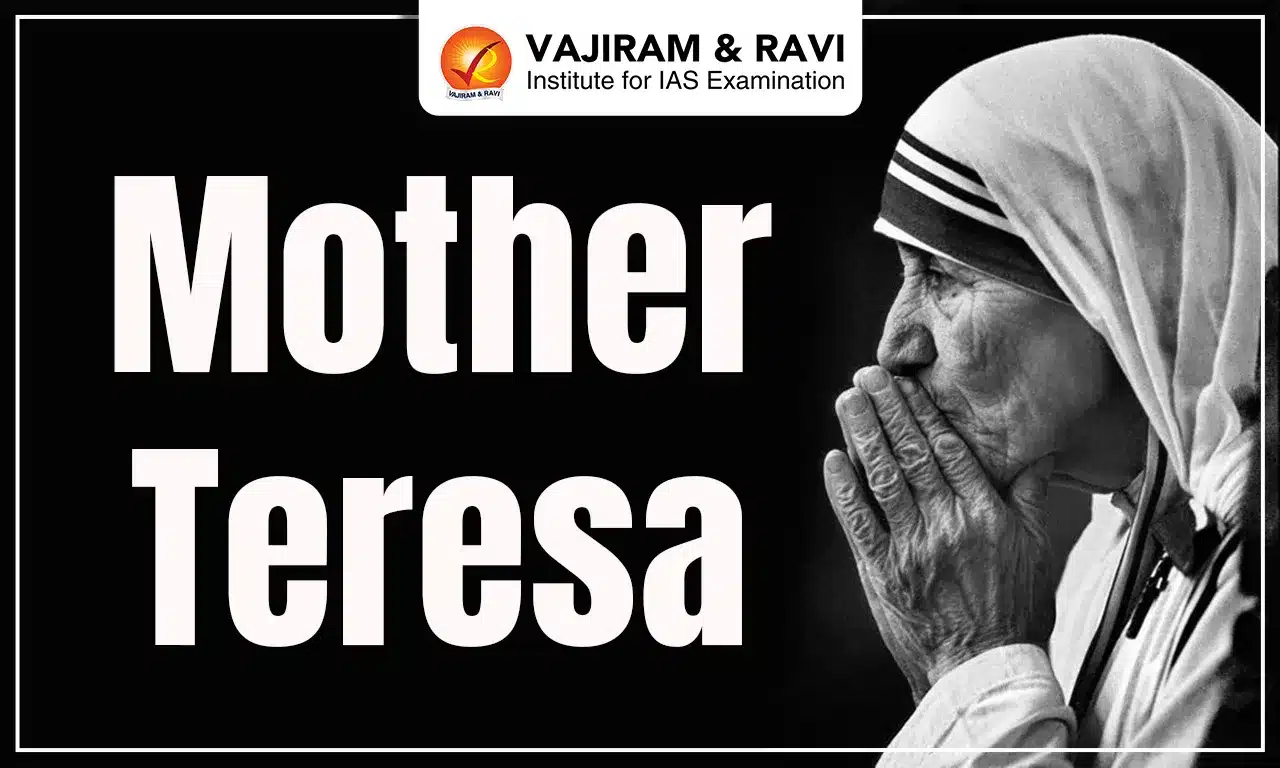
Mother Teresa, born Agnes Gonxha Bojaxhiu in 1910, is remembered worldwide for her compassion and lifelong service to the poor. She devoted herself to humanitarian work, especially in India, where she became a symbol of love and selflessness. Her deep faith and dedication transformed the lives of countless people. Through her Missionaries of Charity, she brought hope, care, and dignity to those abandoned by society.
Mother Teresa
Born in Skopje, in present-day North Macedonia, Mother Teresa joined the Sisters of Loreto at 18. She arrived in India in 1929 and began teaching at St. Mary’s High School, Calcutta. Deeply moved by poverty, she left the convent in 1948 to work among the poor. Her white sari with a blue border became her identity, symbolizing simplicity and purity, leading to her founding of the Missionaries of Charity.
Mother Teresa Biography
Mother Teresa’s life reflected service, simplicity, and devotion. Her personal details highlight her transformation from a teacher to a global humanitarian.
| Mother Teresa Biography | |
| Aspect | Details |
|
Full Name |
Agnes Gonxha Bojaxhiu |
|
Known As |
Mother Teresa / Saint Teresa of Calcutta |
|
Birth |
August 26, 1910, Skopje (Ottoman Empire) |
|
Nationality |
Albanian-Indian |
|
Death |
September 5, 1997, Kolkata, India |
|
Canonization |
September 4, 2016 |
|
Awards |
Nobel Peace Prize (1979), Bharat Ratna (1980) |
Mother Teresa Early Life
Mother Teresa was born into a Catholic family of Albanian descent. Her father’s charitable spirit deeply influenced her values. At age twelve, she felt a calling to serve humanity. In 1928, she joined the Sisters of Loreto and went to Ireland for training. By 1929, she was in India, beginning her novitiate in Darjeeling, marking the start of her lifelong journey of spiritual and humanitarian service.
Mother Teresa’s Order
In 1946, Mother Teresa felt a strong “call within a call” to dedicate her life to helping the poor and sick. In 1948, Leaving the Loreto convent, she began working in the slums of Calcutta. With Vatican approval in 1950, she founded the Missionaries of Charity, a Roman Catholic order of women. The order’s mission was simple yet powerful- to serve and care for “the poorest of the poor” with love and compassion
Mother Teresa Founding of the Missionaries of Charity
Mother Teresa’s “call within a call” in 1946 inspired her to serve the poorest of the poor. Key Points:
- Founded Missionaries of Charity in 1950 in Kolkata with Vatican approval.
- Began with 12 members, serving the destitute, sick, and dying.
- Sisters wore simple white saris with blue borders.
- By the 1990s, it had over 4,000 members worldwide.
- Focused on compassion, humility, and service without discrimination.
- This order became a symbol of global humanitarian care and mercy.
Mother Teresa in India
Mother Teresa became an Indian citizen in 1948 and dedicated her life to India’s poorest communities. Her compassion transformed India’s social care system and inspired countless Indians to serve humanity. Key Contributions:
- Established Nirmal Hriday (1952), a home for the dying in Kolkata.
- Set up Shishu Bhavan for orphaned children.
- Created Shanti Nagar for leprosy patients.
- Opened centers in Delhi, Mumbai, and Chennai.
- Worked during natural disasters and epidemics.
Global Influence of Mother Teresa
Mother Teresa’s work extended to over 130 countries across six continents. Her service turned compassion into a universal language of peace. Major Global Works:
- Opened centers in Rome, New York, and Addis Ababa.
- Helped famine victims in Ethiopia and war refugees in Lebanon.
- Established homes for AIDS patients in San Francisco.
- Missionaries of Charity spread across Asia, Africa, and Latin America.
- Her humanitarian model was recognized by world leaders and institutions.
Humanitarian Works of Mother Teresa
Mother Teresa’s humanitarian mission focused on uplifting the suffering and neglected. Major Initiatives:
- Nirmal Hriday (1952): Shelter for the dying and destitute.
- Shishu Bhavan: Home for abandoned and orphaned children.
- Leprosy Homes: Medical care and rehabilitation facilities.
- Relief Efforts: Support for flood and famine victims.
- Empowerment Programs: Skill development for poor women.
Mother Teresa Awards and Recognition
Mother Teresa received numerous awards for her extraordinary humanitarian service. These honors celebrated her lifelong devotion to humanity and her mission to uplift the poor and suffering.
| Mother Teresa Awards and Recognition | |||
| Award Name | Year | Country/ Organization | Purpose/ Recognition |
|
Padma Shri |
1962 |
Government of India |
Service to humanity and the poor |
|
Pope John XXIII Peace Prize |
1971 |
Vatican |
Promoting peace and compassion |
|
Jawaharlal Nehru Award for International Understanding |
1972 |
Government of India |
Strengthening international peace |
|
Templeton Prize |
1973 |
Templeton Foundation, UK |
Advancing spiritual awareness |
|
Balzan Prize |
1979 |
International Balzan Foundation |
Humanity, peace, and brotherhood |
|
Nobel Peace Prize |
1979 |
Norwegian Nobel Committee |
Service to the poor and suffering |
|
Bharat Ratna |
1980 |
Government of India |
Highest civilian honor for humanitarian work |
|
Order of Merit |
1983 |
UK |
For global humanitarian work |
Mother Teresa Philosophy and Teachings
Mother Teresa believed service to humanity was service to God. Her teachings centered on humility, love, and compassion. Her philosophy inspired millions to dedicate themselves to humanitarian causes.
- Love in Action: Helping others selflessly is the highest virtue.
- Human Dignity: Every person deserves respect.
- Faith and Simplicity: True greatness lies in small acts of love.
- Universal Compassion: Serve without barriers of religion or status.
Mother Teresa Nobel Laureate
In 1979, Mother Teresa received the Nobel Peace Prize for her tireless service to the poor. She refused the ceremonial banquet and directed the funds to India’s needy. In her acceptance speech, she emphasized love as the greatest force for peace. The Nobel Prize brought global attention to her work and further strengthened the Missionaries of Charity’s humanitarian outreach.
Canonization of Mother Teresa
Mother Teresa passed away on September 5, 1997, in Kolkata. The Vatican initiated her sainthood process in 1999. She was beatified in 2003 and canonized in 2016 by Pope Francis after two verified miracles. Her feast day, September 5, commemorates her life of selfless service. Today, Saint Teresa of Calcutta is venerated worldwide for her unwavering compassion and faith-driven mission.
Mother Teresa Legacy
Mother Teresa’s legacy continues through the Missionaries of Charity, which operates in over 130 countries. Her life inspired countless volunteers, religious workers, and NGOs. Schools, hospitals, and charitable institutions worldwide are named in her honor. Her example promotes peace, interfaith harmony, and empathy. She remains a global symbol of humility and compassion, proving that simple acts of kindness can change the world.
Mother Teresa FAQs
Q1: Who was Mother Teresa?
Ans: Mother Teresa, born Agnes Gonxha Bojaxhiu in 1910, was a Catholic nun and humanitarian devoted to serving the poor.
Q2: When was the Missionaries of Charity founded?
Ans: Mother Teresa founded the Missionaries of Charity in 1950 in Kolkata with Vatican approval to serve the poorest of the poor.
Q3: Which awards did Mother Teresa receive?
Ans: She received the Nobel Peace Prize (1979), Bharat Ratna (1980), Padma Shri (1962), and several international humanitarian awards.
Q4: When did Mother Teresa become an Indian citizen?
Ans: Mother Teresa became an Indian citizen in 1948 and dedicated her life to helping India’s poorest communities.
Q5: When was Mother Teresa canonized as a saint?
Ans: She was canonized by Pope Francis on September 4, 2016, after two verified miracles were recognized by the Vatican.

