
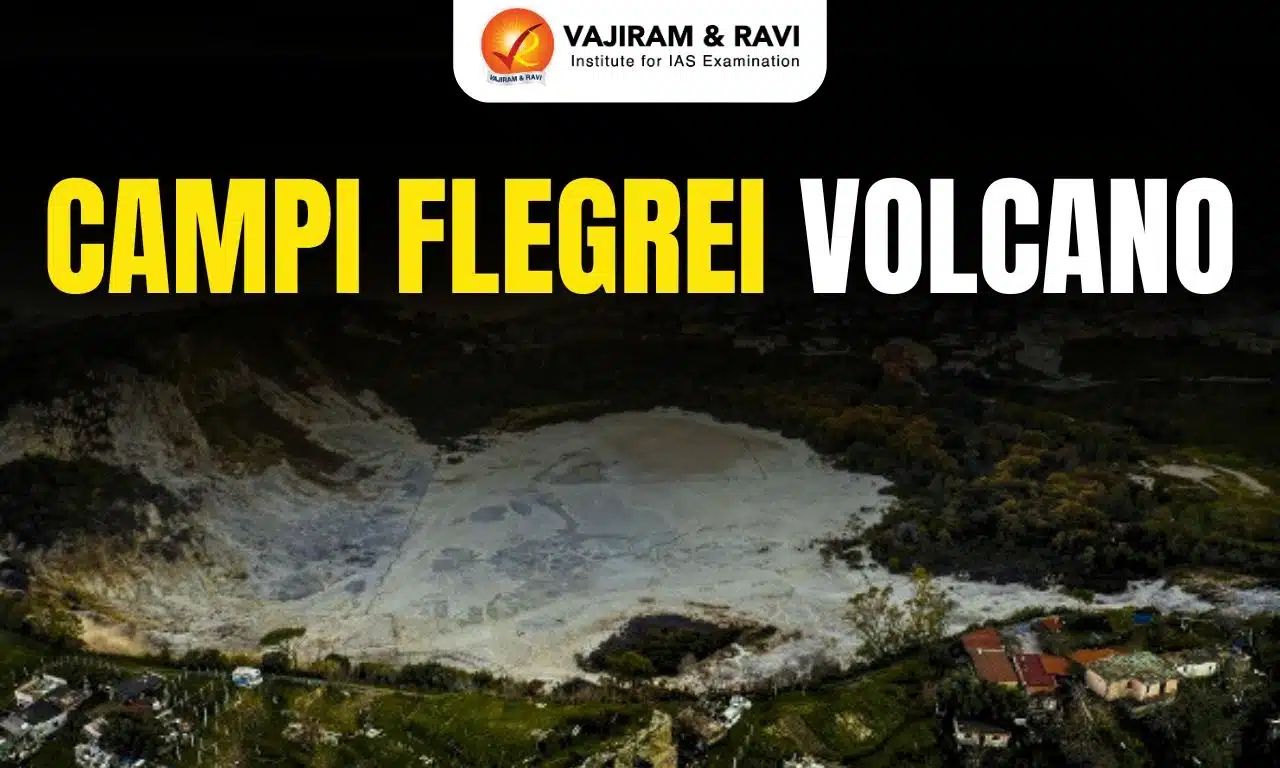
Campi Flegrei Volcano Latest News
An artificial intelligence (AI) model has revealed never-before-seen geological structures at Italy's Campi Flegrei volcano, including a clear "ring fault" that could unleash magnitude 5 earthquakes.
About Campi Flegrei Volcano
- Campi Flegrei, also known as the Phlegraean Fields, is an active volcanic region situated in the densely populated Bay of Naples in Italy, which is also home to the more famous Vesuvius Volcano.
- It differs from traditional volcanoes like Mount Vesuvius, as it is not a single volcano but a volcanic system spread across a large caldera.
- It is the largest active volcanic caldera in Europe, far larger and more active than Mount Vesuvius.
- The caldera, or volcanic depression, spans approximately 12–15 km in diameter and was created due to a massive eruption around 39,000 years ago.
- This eruption is hypothesized to have had such a climatic impact that it contributed to the decline of Neanderthals.
- One-third of Campi Flegrei lies beneath the Tyrrhenian Sea, between the Italian mainland and the island of Sardinia.
- The last recorded eruption was in 1538, forming Monte Nuovo and ending an interval of roughly 3000 years without eruptions.
- Campi Flegrei is categorised as a supervolcano, implying that a large-scale eruption could have global consequences, including climate disruption.
- The volcano has been showing signs of unrest since 2005.
- It is characterised by intense hydrothermal activity, episodes of localised ground deformation, and earthquake swarms.
Source: LS
Campi Flegrei Volcano FAQs
Q1: Where is the Campi Flegrei volcanic region located?
Ans: Bay of Naples, Italy
Q2: What is another name for the Campi Flegrei Volcano?
Ans: Phlegraean Fields
Q3: How does Campi Flegrei differ from traditional volcanoes like Mount Vesuvius?
Ans: It is a volcanic system spread across a large caldera rather than a single volcano.
Q4: Why is Campi Flegrei categorised as a supervolcano?
Ans: Because, large-scale eruption could have global consequences, including climate disruption.

