
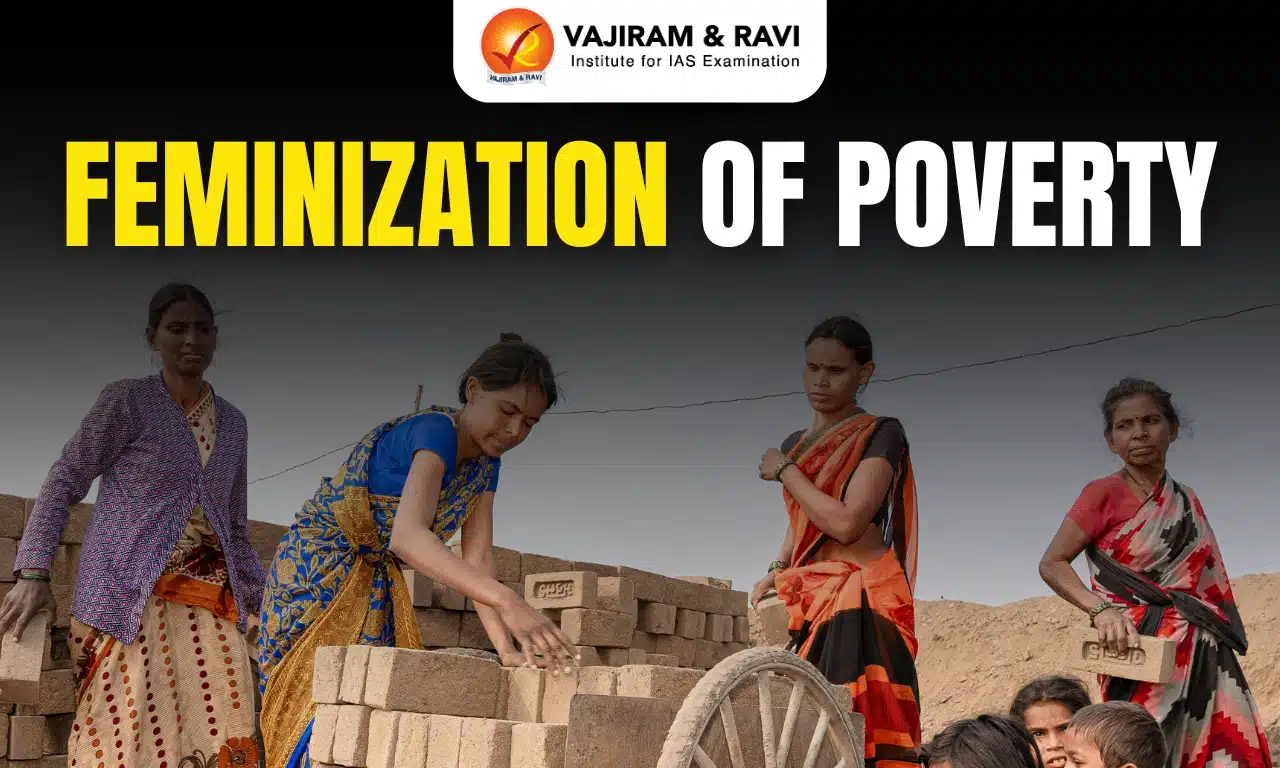
The feminization of poverty refers to the growing proportion of women among the world’s poor and the widening gap between men and women trapped in poverty. According to the United Nations, of the 1.5 billion people living on less than one dollar a day, the majority are women. Women earn slightly more than 50% of what men earn globally, and their access to education, credit, land, and inheritance remains limited. This deepens inequality and perpetuates poverty cycles.
Feminization of Poverty
The term “feminization of poverty” first emerged in the 1970s and gained prominence in the 1990s through UN documents highlighting gendered patterns of poverty. It is a relative concept that examines how poverty reduction affects women and men differently. For instance, if men’s poverty decreases but women’s poverty remains stagnant, it reflects feminization of poverty.
Feminization of Poverty in India
In India, women’s poverty is largely human poverty, encompassing inadequate food, housing, education, and healthcare rather than mere income deprivation. Despite economic growth, gender-based inequalities in access to opportunities persist, making this issue both a developmental and social concern.
Feminization of Poverty Causes
The feminization of poverty arises from interlinked social, economic, and environmental factors. Major factors responsible for the Feminization of Poverty are listed below:
- Gender Pay Gap: Women consistently earn less than men for similar work. According to the International Labour Organization (ILO), Indian women earn about 20–30% less than men on average, reducing their financial independence.
- Unpaid and Care Work: Women perform over 75% of unpaid domestic work, such as childcare, cooking, and household management. This work, though essential, remains unrecognized in GDP calculations, restricting women’s economic visibility.
- Education Disparities: As per UNESCO’s Global Education Monitoring Report (2023), India’s female literacy rate is 70.3%, compared to 84.7% for males. Limited education access reduces women’s ability to secure skilled and well-paid jobs, mainly due to early marriage, household responsibilities, or financial constraints.
- Land and Property Ownership: Only 13% of Indian women own agricultural land, as per the Agricultural Census 2020-21. Unequal inheritance laws and patriarchal customs restrict women’s control over assets.
- Patriarchy and Social Norms: Cultural expectations often confine women to domestic spaces. Early marriage and social restrictions limit their workforce participation and access to economic mobility.
- Employment in Informal Sector: Over 94% of women workers in India are engaged in informal, low-paying, and insecure jobs (Economic Survey 2023), leaving them more vulnerable to economic shocks.
- Impact of Climate Change: Climate change has deepened gendered poverty. A UNDP India Report (2022) highlights that women are more vulnerable to climate-induced disasters, droughts, and crop loss. In rural India, women often walk long distances to fetch water or fuel, increasing their unpaid workload. Crop failures due to erratic rainfall directly affect women’s livelihoods in agriculture and fisheries, reinforcing economic marginalization.
- Healthcare Inequality: Public health systems often neglect women’s needs. The National Family Health Survey (NFHS-5) found that over 57% of Indian women are anemic, and maternal mortality remains high in rural areas due to malnutrition and lack of access to facilities.
- Nutritional Disparity: Women, particularly in northern India, often eat last and least in households. NFHS-5 data reveals only 46% of women consume dairy or fruits daily, reflecting deep-rooted nutritional inequality.
Measures of Feminization of Poverty
To understand the multidimensional nature of gendered poverty, several indices are used as tabulated below. These indices help policymakers understand and track gender-based disparities in development outcomes.
| Measures of Feminization of Poverty | |||
| Index | Developed By | Focus Area | Relevance |
|
Gender-related Development Index (GDI) |
UNDP |
Adjusts Human Development Index for gender inequality |
Measures life expectancy, education, and income gaps |
|
Gender Empowerment Measure (GEM) |
UNDP |
Political and economic participation |
Highlights women’s role in decision-making |
|
Human Poverty Index (HPI) [Replaced with Multidimensional Poverty Index, 2011] |
UNDP and OPHI |
Multidimensional poverty (health, literacy, living standards) |
Captures human deprivation beyond income [replaced in 2010 by the Multidimensional Poverty Index (MPI)] |
|
Gender Inequality Index (GII) |
UNDP |
Gender disparity in reproductive health, empowerment, and economic status |
Replaced the HPI in 2010 and can be used to analyze gender biases within households |
Feminization of Poverty Impact
The major impacts of Feminization of Poverty based on the categories such as Economic, Social, Political, etc has been discussed below:
- Economic Impact: Women’s limited participation in the workforce lowers national productivity and economic growth potential.
- Social Impact: Higher female poverty rates perpetuate child malnutrition, low education levels, and health challenges across generations.
- Political Impact: Women’s underrepresentation in decision-making restricts policy formulation that addresses their needs effectively.
- Intergenerational Cycle: Poverty among women passes down to children through poor education, malnutrition, and health vulnerabilities.
- Environmental Impact: Women in agriculture and resource-based livelihoods suffer most during climate shocks, leading to economic displacement.
Government Policies Addressing Feminization of Poverty
To address gendered poverty, India has launched several welfare and empowerment programs that target economic, social, and educational upliftment of women.
| Government Policies Addressing Feminization of Poverty | ||
| Policy/ Programme | Objective | Impact |
|
National Rural Livelihoods Mission (NRLM) |
Promote women-led Self-Help Groups (SHGs) |
As of June 30, 2024, the government reported that 10.05 crore women had been organized into more than 90.86 lakh SHGs under the mission |
|
Improve girl child survival and education |
the Gross Enrollment Ratio (GER) for girls in secondary education saw a significant increase from 75.51% in 2014-2015 to 78% in 2023-2024 |
|
|
Pradhan Mantri Mudra Yojana (PMMY) |
Provide collateral-free loans for women entrepreneurs |
Over 68% of loans sanctioned to women |
|
Pradhan Mantri Matru Vandana Yojana (PMMVY) |
Maternity benefits to pregnant and lactating women |
Enhanced maternal health and nutrition |
|
One Stop Centre Scheme |
Support victims of gender-based violence |
Offered legal, medical, and counseling services nationwide |
|
Stand-Up India Scheme |
Financial inclusion of women and SC/ST entrepreneurs |
As of April 5, 2025, over 2.7 lakh loans have been sanctioned under the scheme, with more than 83% being granted to women. This has provided substantial financial backing for women to start new ventures. |
Feminization of Poverty Challenges
Despite several reforms, gendered poverty remains a persistent challenge due to social, economic, and institutional barriers.
Major Challenges:
- Gender Pay Disparity- Wage inequality continues across formal and informal sectors.
- Unrecognized Unpaid Labor- Household work remains outside economic accounting.
- Access to Resources- Women still face restrictions in land, credit, and inheritance.
- Education and Skill Gaps- Lower access to vocational and digital training limits employability.
- Weak Implementation- Welfare schemes often fail due to poor monitoring and targeting.
Way Forward:
- Gender-Responsive Budgeting- Integrate gender priorities into public expenditure frameworks.
- Skill Development Programs- Encourage women’s participation in STEM and digital industries.
- Inclusive Financial Systems- Expand credit access through microfinance and SHG networks.
- Awareness and Legal Literacy- Strengthen women’s understanding of property, labor, and social rights.
- Data-Based Policy Design- Collect gender-disaggregated data to shape effective interventions.
Feminization of Poverty Constitutional Provisions
India’s constitutional and legal framework provides strong protection for women’s social and economic rights, which are essential in addressing gendered poverty.
| Feminization of Poverty Constitutional Provisions | ||
| Article | Provision | Relevance to Poverty Feminization |
|
Article 14 |
Equality before law |
Ensures equal legal protection for women |
|
Article 15(3) |
Special provisions for women and children |
Allows gender-based affirmative action |
|
Article 16 |
Equal opportunity in employment |
Prevents workplace discrimination |
|
Article 39(a), (d) |
Equal pay for equal work |
Directs state to promote gender equality in wages |
|
Article 42 |
Just and humane working conditions |
Protects maternity and labor rights of women |
|
Article 46 |
Promotion of weaker sections |
Supports educational and economic interests of women. |
Feminization of Poverty Case Laws
These constitutional safeguards and judgments form the legal foundation to address poverty feminization through equality, protection, and empowerment. These case laws indirectly promote a pathway for eradication of Feminization of Poverty
- Air India vs Nergesh Meerza (1981)- The Supreme Court held that unequal retirement rules for women violated Article 14.
- C.B. Muthamma vs Union of India (1979)- The Court recognized gender discrimination in civil services and called for equal opportunity.
- Vishaka vs State of Rajasthan (1997)- Established guidelines for protection against workplace sexual harassment, ensuring women’s safe participation in the workforce.
- Charu Khurana vs Union of India (2015)- The Court upheld women’s right to equality in professional guilds and associations.
- Joseph Shine vs Union of India (2018)- Struck down Section 497 IPC, reinforcing gender equality as a fundamental right.
Feminization of Poverty Global Context
The Women press release states that 1 in every 10 women lives in extreme poverty. according to the UN (2024). Women in developing countries face double disadvantages- gender discrimination, economic deprivation, unequal distribution of unpaid care work, restrictive social norms, limited access to education, healthcare, finance, and land ownership, as highlighted by UN Women and the World Bank. A UN Women press release from March 2024 offers slightly more recent figures, stating that among people of prime working age, only 61% of women are in the labor force versus 90% of men.
Feminization of Poverty UPSC
In India, the situation mirrors these disparities. The Periodic Labour Force Survey (PLFS) 2022-23 reported female labor force participation at 37%, much lower than men’s 78.5%. The Global Gender Gap Report 2024 (World Economic Forum) ranked India 129th out of 146 countries, emphasizing the persistence of wage inequality and poor access to resources.
Feminization of Poverty FAQs
Q1: What is Feminization of Poverty?
Ans: Feminization of Poverty refers to the increasing proportion of women among the poor, highlighting gender-based inequalities in income, education, employment, and access to economic resources.
Q2: What are the main causes of Feminization of Poverty?
Ans: Major causes include wage disparity, unpaid domestic labor, lack of education, limited land rights, patriarchal norms, and women’s concentration in informal, insecure employment sectors.
Q3: How does Feminization of Poverty affect society?
Ans: It deepens social inequality, lowers women’s participation in the economy, perpetuates intergenerational poverty, and weakens overall national productivity and inclusive development outcomes.
Q4: What government schemes address Feminization of Poverty in India?
Ans: Key schemes include NRLM, Beti Bachao Beti Padhao, PM Mudra Yojana, PM Matru Vandana Yojana, and Stand-Up India promoting women’s empowerment and economic inclusion.
Q5: Which constitutional provisions support women against poverty?
Ans: Articles 14, 15(3), 16, 39, 42, and 46 guarantee equality, equal pay, humane conditions, and special measures ensuring women’s economic and social upliftment.
