
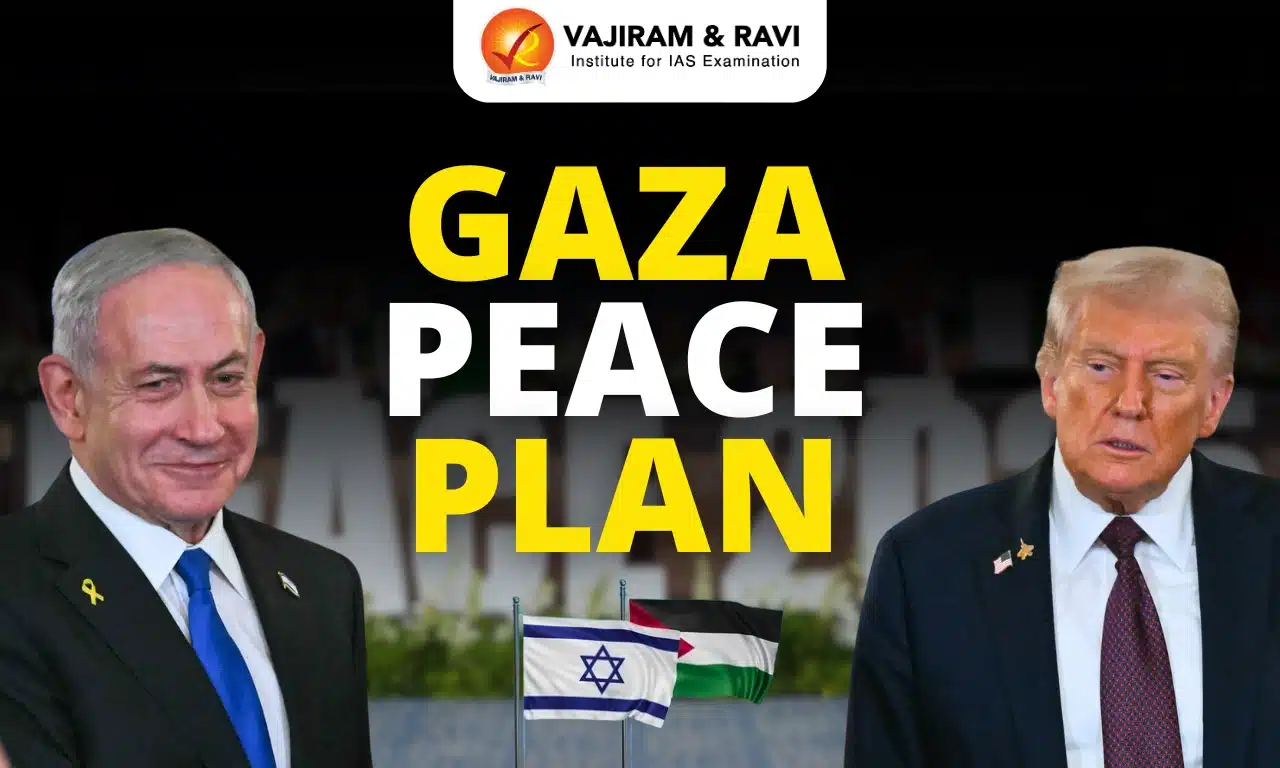
Gaza Peace Plan Latest News
- US President Donald Trump has declared the Gaza war “over” as he arrives in Sharm El-Sheikh, Egypt, for a peace summit marking the release of Israeli hostages and Palestinian detainees.
- Under the deal, Hamas will release 20 hostages and 28 bodies, while Israel will free about 2,000 Palestinian detainees.
- However, key issues — including Gaza’s post-war governance and reconstruction — remain unresolved.
- Analysts note that while the hostage exchange was the easiest phase, Hamas has now lost its main leverage, and sustaining peace will be the real challenge ahead.
Trump’s Gaza Peace Plan Faces Its Real Test After Hostage Swap
- The hostage exchange, the opening move in Trump’s 20-point Gaza peace plan, has been completed.
- But the real challenges now lie ahead — disarming Hamas, ensuring security guarantees for Gaza, and rebuilding a war-ravaged enclave reduced to rubble.
- The next phase involves rehabilitating displaced residents, restoring aid flows, and reconstructing infrastructure.
- Yet, the key question remains unresolved — who will govern Gaza?
- Neither Hamas nor the Palestinian Authority has been clearly assigned that role, and the text offers only a vague nod to Palestinian statehood.
A Peace Summit Without Consensus
- At Sharm El-Sheikh, world leaders appear united mainly in following Trump’s lead, not in crafting a shared vision.
- The Palestinians were excluded from the negotiations entirely, leaving the core issue of occupation and representation untouched.
- Critics warn the summit risks becoming a political spectacle rather than a step toward real peace.
- Analysts argue that without Hamas disarmament, the current truce is only a temporary ceasefire.
- They warn that once the summit ends, the region may revert to conflict because Trump’s plan sidesteps the core grievances — occupation and self-determination.
Fragile Prospects for Peace
- The proposed international stabilisation force of Arab and Muslim states hinges entirely on Hamas’s cooperation — something it has not agreed to.
- Without its disarmament or consent, Trump’s ambitious peace framework risks stalling, leaving Gaza’s future uncertain and peace elusive.
Trump’s Leverage Over Netanyahu: Power, Politics and the Fragile Gaza Peace
- US President Donald Trump wields extraordinary leverage over Israeli Prime Minister Benjamin Netanyahu.
- Unlike previous US administrations, Trump has compelled Netanyahu to comply with his directives — from halting an airstrike on Iran mid-air to apologising to Qatar after an Israeli attack in Doha.
- Such direct presidential influence over Israel is unparalleled in US-Israel relations.
- Netanyahu, once adept at exploiting American political divisions under Democratic administrations, cannot apply the same tactics with Trump.
- This power dynamic has enabled Trump to push through key components of his Gaza peace plan, including earlier hostage releases, giving the US unprecedented control over Israeli decision-making during the conflict.
Trump’s Waning Interest
- Despite this leverage, doubts remain about Trump’s long-term commitment to his 20-point Gaza peace plan.
- Reports indicate that he has expressed disappointment over not receiving the Nobel Peace Prize.
- This may reduce his inclination to remain actively engaged in overseeing the full implementation of the plan once its initial diplomatic momentum subsides.
Netanyahu’s Political Calculus
- For Netanyahu, a lasting peace is politically inconvenient.
- The ongoing conflict distracts from his domestic crises — including corruption charges and a bitter judicial standoff.
- A permanent ceasefire could reignite public anger over Israel’s security failures from October 7 and embolden calls for his resignation or prosecution.
The Road Ahead: A Deal at Risk
- Analysts foresee a scenario in which Netanyahu may accuse Hamas of breaching the pact, providing a pretext to withdraw from the peace deal.
- By then, both leaders’ attention may have shifted elsewhere, leaving Trump’s peace initiative stalled amid political expediency and fading global focus.
India’s Response to Gaza Ceasefire
- Prime Minister Narendra Modi welcomed the release of all hostages after over two years of captivity and praised the “unwavering peace efforts” of US President Donald Trump.
- He also commended Israeli Prime Minister Benjamin Netanyahu’s resolve, expressing India’s full support for Trump’s peace initiative in Gaza.
- The Ministry of External Affairs (MEA) reaffirmed India’s commitment to a negotiated two-State solution and to promoting dialogue and diplomacy for lasting peace in the Middle East.
- India also acknowledged the roles of Egypt and Qatar in facilitating the agreement.
Gaza Peace Plan FAQs
Q1: What marked the beginning of Trump’s 20-point Gaza peace plan?
Ans: The release of Israeli hostages and Palestinian detainees marked the plan’s first phase, symbolising progress but leaving deeper issues unresolved.
Q2: Why is Gaza’s governance a major challenge after the truce?
Ans: Neither Hamas nor the Palestinian Authority was assigned control, creating uncertainty over who will administer Gaza’s reconstruction and future governance.
Q3: How does Trump maintain leverage over Netanyahu?
Ans: Trump’s unique influence has compelled Netanyahu to follow directives — from halting airstrikes to issuing rare diplomatic apologies, an unprecedented U.S.-Israel dynamic.
Q4: What is India’s stance on the Gaza ceasefire?
Ans: India welcomed the hostage release, reaffirmed support for a negotiated two-State solution, and praised Trump’s efforts alongside Egypt and Qatar’s mediation roles.
Q5: Why do analysts doubt lasting peace under Trump’s plan?
Ans: Experts argue that without Hamas disarmament and Palestinian representation, Trump’s framework risks collapsing once global attention fades.
