
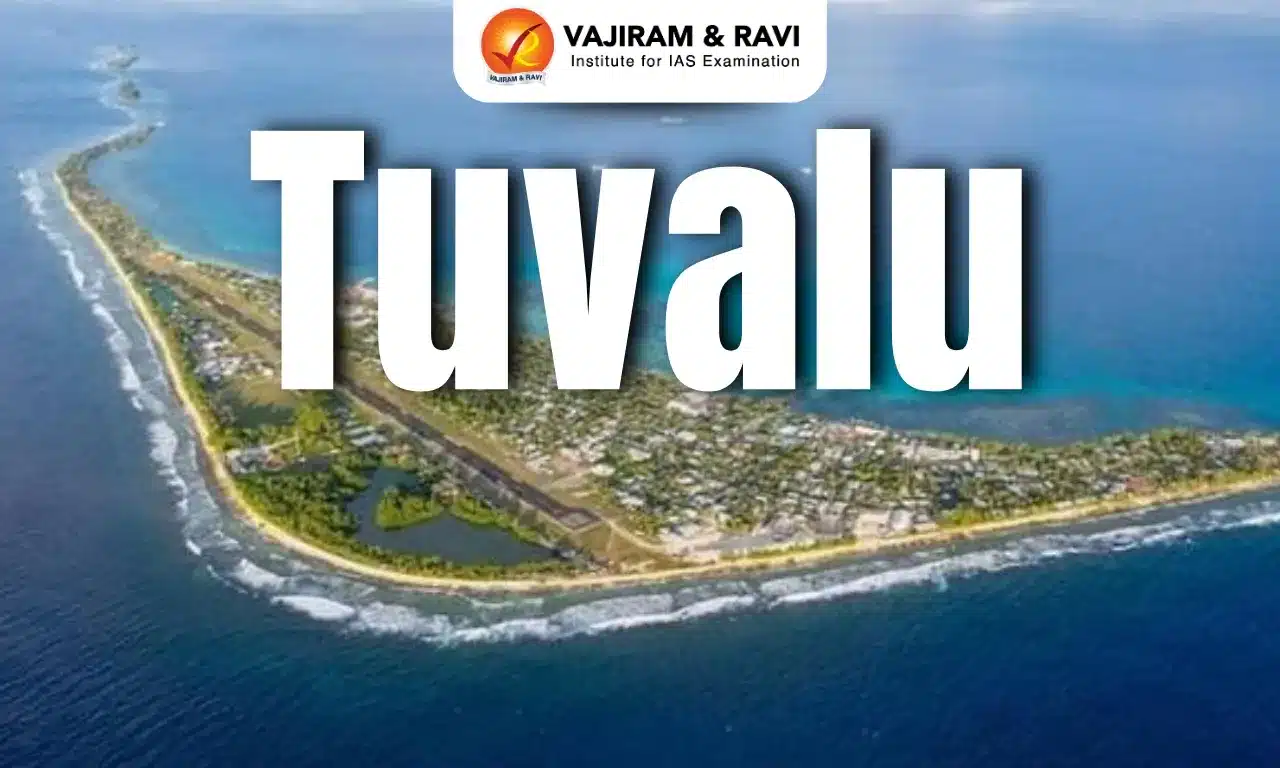
Tuvalu Latest News
The Government of Tuvalu has officially become the 90th State Member of the International Union for Conservation of Nature (IUCN) recently.
About Tuvalu
- Tuvalu, formerly known as the Ellice Islands, is an island country in the west-central Pacific Ocean.
- It is the 4th smallest country in the world with 26 sq.km. of land.
- It sits about halfway between Australia and Hawaii.
- Its neighbours include Kiribati, to the north, and Fiji, to the south.
- It is a collection of small islands and atolls largely made out of coral reefs and volcanic rock.
- All islands are low-lying, with no point on Tuvalu being higher than 4.5 m above sea level. Thus, the islands are threatened by any future sea level rise.
- There are no rivers. Tuvalu’s climate is hot and rainy.
- With the exception of tiny Vatican City, Tuvalu has the fewest inhabitants of any other independent nation.
- Capital: Funafuti
- Languages: Most people speak a language called Tuvaluan. English is widely used.
- Currency: Tuvalu dollar (equivalent to the Australian dollar)
- Political System:
- Tuvalu became independent from the United Kingdom in October 1978.
- It operates as a parliamentary democracy under a constitutional monarchy.
- It is part of the Commonwealth Realm, with King Charles III recognized as King of Tuvalu. He is represented by a Governor-General, who is appointed upon the advice of the Prime Minister.
- There are no political parties: the prime minister is chosen by and from the legislature.
- Economy:
- Most people are subsistence farmers and are aided by remittances from relatives working overseas.
- A small quantity of copra is produced for export, the sale of stamps accounts for modest earnings, and fees are collected from foreign fishing fleets.
Source: IUCN
Tuvalu FAQs
Q1: Where is Tuvalu located?
Ans: West-central Pacific Ocean.
Q2: What is the capital of Tuvalu?
Ans: Funafuti
Q3: Tuvalu operates under which form of government?
Ans: It operates as a parliamentary democracy under a constitutional monarchy.
