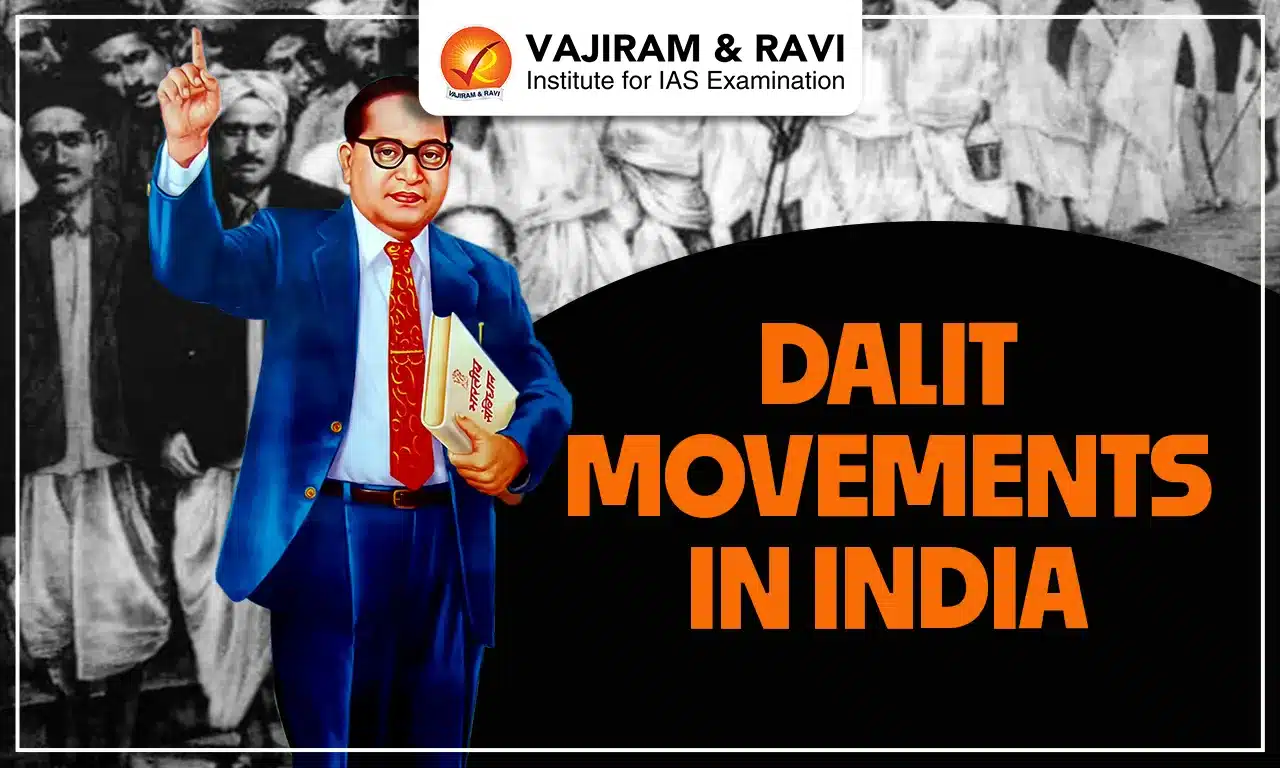
The Dalit movements in India represent one of the most powerful struggles for social justice, equality, and human dignity in modern Indian history. Emerging as a response to centuries of caste-based oppression, these movements aimed to dismantle untouchability, secure equal rights, and ensure access to education and public resources. From colonial-era reformist initiatives to post-independence political mobilization, the Dalit movement has continuously evolved, shaping India’s democratic and social discourse.
Dalit Movements in India
The Dalit movements in India have been both social and political in nature, aimed at transforming India’s deeply entrenched caste hierarchy. The word Dalit, meaning “oppressed” or “broken”, became widely recognized during the 20th century to describe communities previously labeled as “untouchables.” Their struggle for dignity has been marked by protests, legal reforms, and social mobilization across regions and decades.
The Dalit movement draws its intellectual and moral foundation from leaders such as Dr. B.R. Ambedkar, Jyotirao Phule, and Periyar E.V. Ramasamy, who advocated for annihilation of caste and equal citizenship. The movement has taken various forms: religious reform, socio-political assertion, and constitutional activism, culminating in a continuous quest for justice.
Dalit Movements in India Historical Background
The Dalit Movement in India has evolved through centuries of struggle against caste-based discrimination, untouchability, and social exclusion. Its roots trace back to the 19th century when social reformers began challenging Brahmanical dominance and advocating for equality and dignity of marginalized castes. Major Events:
- 1827-Mahatma Jyotirao Phule’s Reform Initiatives: Jyotirao Phule founded the Satyashodhak Samaj (Truth Seekers’ Society) in 1873, promoting education and social upliftment for the oppressed castes.
- 1892- Adi Dharm Movement Begins in Punjab: Originating among the Chamars, it rejected the Brahmanical order and called for spiritual and cultural assertion of Dalits.
- 1917- Non-Brahmin Movement in South India: Led by Periyar E.V. Ramasamy, this movement aimed to end caste hegemony and demanded reservation and self-respect for backward communities.
- 1920s-1930s- Ambedkar’s Political Mobilization: Dr. B.R. Ambedkar led organizations like the Bahishkrit Hitakarini Sabha (1924) and Scheduled Castes Federation (1942) to secure political and social rights.
- 1932- Poona Pact: Ambedkar and Gandhi signed the pact ensuring separate political representation through reserved seats for Dalits within the Hindu fold.
- 1935: Government of India Act of 1935 provided separate electorates for depressed classes based on the ideals of Communal Award and Poona Pact, 1932.
- 1956- Dalit Buddhist Movement: Ambedkar converted to Buddhism with over 5 lakh followers in Nagpur, symbolizing rejection of caste-based Hindu hierarchy.
- 1972- Dalit Panthers Movement: Formed in Maharashtra, inspired by the Black Panthers of the U.S., this radical youth-led organization fought caste violence and oppression.
- 1980s-1990s- Political Assertion: Rise of parties like the Bahujan Samaj Party (BSP) under Kanshi Ram and Mayawati strengthened Dalit representation in governance.
- 2000s-Present- New-Age Dalit Movements: Movements like Bhim Army and Dalit Human Rights Campaigns now combine social media activism, education, and legal reform to assert equality.
Dalit Movements in India Leaders
The major activists and leaders who ignited the Dalit Movements in India are:
Jyotirao Phule
- Founded Satyashodhak Samaj (1873) to challenge caste dominance.
- Advocated for women’s education and widow remarriage.
- His work inspired later anti-caste thinkers and influenced Ambedkar’s ideology.
Dr. B.R. Ambedkar
- Led the Dalit political mobilization and founded the Independent Labour Party (1936) and Scheduled Castes Federation (1942).
- Architect of the Indian Constitution, ensuring fundamental rights and affirmative action for Dalits.
- Initiated the mass conversion to Buddhism in 1956, rejecting caste hierarchy within Hinduism.
Periyar E.V. Ramasamy
- Leader of the Self-Respect Movement in Tamil Nadu, which fought Brahmanical patriarchy and caste discrimination.
- Emphasized rationalism, social justice, and gender equality.
Babu Jagjivan Ram
- Advocated for political representation of Dalits in post-independence India.
- Served in multiple Union Cabinets and promoted constitutional safeguards for Scheduled Castes.
Mahatma Gandhi
- Worked for Dalit rights, calling them Harijans.
- Fought untouchability, supported Dalit education, and promoted social equality.
- In 1932, he launched the Harijan Sevak Sangh to improve Dalit welfare, integrating them into India’s freedom movement.
Dalit Movements in India Phases
Scholars generally divide the Dalit movement into three major phases:
- Reformist Phase (Pre-1920): Focused on education and religious reform by figures like Phule and Narayana Guru.
- Pre-Independence/ Political Phase (1920-1950): Marked by Ambedkar’s leadership, the formation of independent Dalit political parties, and advocacy for constitutional rights.
- Post-Independence Phase (1950-2010): Characterized by socio-political assertion through movements like the Dalit Panthers and Bahujan Samaj Party (BSP), focusing on power and representation.
- Dalit Movements in Contemporary India (2010-Present): This phase is marked by digital, political and social development of activism in the contemporary modern era.
Dalit Movements in India Reformist Phase
The Reformist Phase of Dalit Movements in the 19th century marked the beginning of organized efforts against caste-based discrimination and social inequality.
- Jyotirao Phule founded the Satyashodhak Samaj in 1873, opposing Brahmanical dominance and promoting education among lower castes and women.
- He viewed caste hierarchy as an exploitative tool linked to Hindu society’s social and economic structures.
- Sri Narayana Guru in Tamil Nadu and Kerala preached “One Caste, One Religion, One God for Man,” rejecting ritual purity and caste barriers.
- His ideas inspired the Vaikom Satyagraha (1924-25), one of India’s first organized temple entry movements.
- The colonial government, through the Hunter Commission (1882) and Government of India Act (1919), encouraged education and political participation among lower castes.
- These reformist initiatives were largely social and religious but laid the foundation for political mobilization later led by Dr. B.R. Ambedkar.
Pre-Independence Dalit Movements in India
Before India’s independence, Dalit movements emerged across regions, driven by local leadership and social conditions to challenge caste-based discrimination and inequality.
- Depressed Classes Conference (1917) and All India Depressed Classes Association (1920): United Dalit voices at the national level.
- Ambedkar-Gandhi Conflict (1932): The Poona Pact replaced separate electorates with reserved seats, ensuring representation but limiting Dalit autonomy.
- Adi Dravida and Adi Andhra Movements (Tamil Nadu and Andhra Pradesh): Promoted education and employment for social mobility and identity assertion.
- Ad-Dharm Movement (Punjab, 1926): Led by Mangoo Ram Mugowalia, emphasized a distinct Dalit religious identity.
- Justice Party (Madras Presidency): Advocated non-Brahmin representation and caste-based reservations in government jobs.
Post-Independence Dalit Movements in India
After India’s independence, Dalit activism shifted from social reform to political mobilization and identity assertion. Despite constitutional guarantees, caste violence, discrimination, and socio-economic marginalization persisted, prompting new organizations, ideologies, and forms of protest.
- 1950s-1960s: Inspired by B.R. Ambedkar, groups like the Republican Party of India (RPI) were formed to consolidate Dalit political power, though internal divisions weakened their impact.
- 1960s-1970s: Radical movements, notably the Dalit Panthers (1972) in Maharashtra, emerged. Influenced by the Black Power Movement in the US, they demanded cultural and political revolution, focusing on land rights, caste atrocities, and education.
- Dalit Literature: Writers like Namdeo Dhasal, Omprakash Valmiki, and Bama used literature as resistance, exposing the harsh realities of caste oppression.
- 1980-1990s: The Mandal Commission Report (1980) and its implementation in 1990 broadened the social justice debate. While targeting Other Backward Classes (OBCs), it reignited discussions on caste inequality and reservation policies.
- North India Politics: In Uttar Pradesh, the Bahujan Samaj Party (BSP) led by Kanshi Ram and Mayawati reshaped Dalit politics. Their “Bahujan” ideology united Dalits, OBCs, and minorities, creating a powerful political force. Mayawati’s tenure as Chief Minister symbolized Dalit empowerment in governance.
Dalit Movements in Contemporary India
In post-liberalization India, Dalit movements entered a new phase characterized by political assertion, digital activism, and global solidarity. Dalit-led parties, civil society organizations, and social media advocacy transformed how caste issues are debated and addressed.
- 21st Century Politics: Dalit identity became central to electoral politics and public discourse. Movements like the Una Dalit Uprising (2016) in Gujarat, protesting cow vigilante violence, and the Bhima Koregaon movement (2018) in Maharashtra highlighted renewed activism against caste atrocities. These events exposed the gap between constitutional ideals and ground realities.
- Youth Engagement: Dalit youth increasingly participate in education, urban activism, and legal rights awareness. Social Platforms amplify voices often ignored by mainstream media. Activists like Jignesh Mevani and organizations such as the Ambedkar Students’ Association (ASA) exemplify this assertive generation.
- Caste Atrocities and Legal Awareness: According to NCRB (2022), over 50,000 cases are registered annually under the SC/ ST (Prevention of Atrocities) Act, 1989, showing both increased reporting and continued discrimination. Despite affirmative action, Dalits remain underrepresented in higher bureaucracy and face high dropout rates in education.
- Multifaceted Movements: Contemporary Dalit activism combines legal awareness, grassroots mobilization, and cultural assertion, reflecting an evolved approach to social justice and equality.
Dalit Movements in India List
Major Dalit Movements in India include Adi-dharma movement, Dalit Buddhist Movement, etc as led by the significant Dalit Activists:
The Adi-Dharma Movement (Punjab, 1892)
The Adi Dharm Movement began in Punjab in 1892 among the Chamar community, emphasizing self-respect and rejection of caste-based inferiority. It emerged under the leadership of Mangoo Ram Mugowalia, drawing from Arya Samaj and reformist ideologies. According to colonial census records, Ad-Dharm followers reached nearly 4 lakh by 1931. It established schools and promoted Dalit identity as “original people” of India, asserting equality in religion and society.
The Temple Entry Movements
Movements like the Vaikom Satyagraha (1924-25) and Guruvayur Temple Movement in Kerala fought for Dalit access to temples and public spaces, symbolizing social equality.
The Mahad Satyagraha (1927)
Led by Ambedkar, this movement demanded Dalits’ right to access public water tanks in Mahad, Maharashtra. It became a symbol of equality and civil rights.
Non-Brahmin Movement (1917)
The Non-Brahmin Movement began in Madras Presidency led by Periyar E.V. Ramasamy and earlier by leaders like Dr. T.M. Nair and C. Natesa Mudaliar. It challenged Brahmanical monopoly over education and jobs, leading to the formation of the Justice Party (1916). The movement influenced future reservation policies under the Communal G.O. of 1921, ensuring fair representation for backward and Dalit communities in South India’s governance.
Harijan Sevak Sangh (1932)
The Harijan Sevak Sangh was founded by Mahatma Gandhi in 1932 to eliminate untouchability and uplift Dalits socially and economically. The organization focused on promoting education, healthcare, and social equality among marginalized communities. It ran schools, hostels, and vocational training centers for Dalits, empowering them to participate in mainstream society. Over decades, it has played a key role in fostering social justice, inclusion, and awareness against caste discrimination in India.
Dalit Buddhist Movement (1956)
Dr. B.R. Ambedkar launched the Dalit Buddhist Movement on October 14, 1956, at Deekshabhoomi, Nagpur, where lakhs of Dalits converted to Buddhism. This was a spiritual and political act against caste oppression within Hinduism. The movement revitalized Buddhist philosophy in India and led to formation of organizations like the Bharatiya Bauddha Mahasabha. Census data later reflected rising Buddhist populations in Maharashtra, symbolizing Dalit self-liberation.
Dalit Panthers Movement (1972)
Formed in Maharashtra in 1972 by Namdeo Dhasal and J.V. Pawar, the Dalit Panthers was inspired by the American Black Panther Party. It aimed to counter growing atrocities against Dalits, particularly in rural Maharashtra. The Panthers published a manifesto in 1973 calling for annihilation of caste and redistribution of wealth. Their activism influenced later Dalit literature, art, and political identity in post-Ambedkarite India.
Bahujan Samaj Movement (1980s-1990s)
The Bahujan Samaj Movement, founded by Kanshi Ram in 1984, led to the creation of the Bahujan Samaj Party (BSP). Its philosophy was based on Ambedkar’s “Bahujan Hitay, Bahujan Sukhay”- welfare for the majority. Under Mayawati’s leadership, the BSP formed governments in Uttar Pradesh multiple times. The movement redefined Dalit politics, emphasizing representation, education, and empowerment through electoral strength.
Bhim Army and Contemporary Dalit Activism (2015-Present)
Founded by Chandrashekhar Azad ‘Ravan’ in 2015 in Saharanpur, Uttar Pradesh, the Bhim Army represents modern Dalit assertion. Using social media, it promotes education, self-defense, and constitutional rights. According to NHRC (2023) data, crimes against Scheduled Castes increased by over 13% between 2019 and 2022, making Bhim Army’s grassroots activism vital for contemporary Dalit rights. It reflects the digital transformation of Ambedkarite mobilization.
Issues Addressed by Dalit Movements in India
Majors issues that were addressed by the activists and reformers that led to the revolutionary Dalit Movements in India were:
- Untouchability and social exclusion in public places, education, and employment.
- Denial of property rights and land ownership, leading to economic marginalization.
- Discrimination in temples, schools, and workplaces, reinforcing social hierarchy.
- Caste-based violence, including atrocities recorded under the Scheduled Castes and Scheduled Tribes (Prevention of Atrocities) Act, 1989.
- Unequal access to education and resources, especially in rural India.
Dalit Movements in India Impact
Dalit movements have profoundly reshaped India’s social and political fabric.
- Constitutional Democracy: These movements embedded social justice as a core constitutional value, influencing the Preamble and Directive Principles.
- Political Empowerment: The rise of Dalit-led parties like BSP and leaders like Mayawati demonstrated that historically marginalized groups could hold power democratically.
- Social Awareness: Campaigns for temple entry, land rights, and education dismantled social taboos and expanded the idea of equality.
- Educational Progress: SC literacy rose from very low levels in the 1960s to around 66% by 2011 (Census), reflecting long-term gains of reform.
- Legal Development: Progressive laws like the Prevention of Atrocities Act (1989) and constitutional amendments arose from decades of Dalit activism.
- Cultural Assertion: Dalit literature, cinema, and art created new spaces for self-expression and historical reinterpretation.
- Global Solidarity: The Dalit cause gained international recognition, with global forums like the UN Human Rights Council (UNHRC) addressing caste discrimination as a human rights issue.
Legal Safeguards for Dalits in India
These safeguards encompass fundamental rights, directive principles, special laws, and affirmative action policies. The Government has enacted a series of special laws and schemes to prevent caste-based atrocities, promote social justice, ensure accountability for discrimination and to support the upliftment of the class.
Constitutional Provisions:
- Article 14- Guarantees equality before law and equal protection to all citizens.
- Article 15(4)- Permits special provisions for advancement of socially and educationally backward classes, including Scheduled Castes.
- Article 16(4)- Enables reservation in public employment for Scheduled Castes and Scheduled Tribes.
- Article 17- Abolishes untouchability and forbids its practice in any form; violation is a punishable offence under law.
- Article 46- Directs the State to promote educational and economic interests of Scheduled Castes and protect them from exploitation.
- Article 330-334- Provide for reservation of seats for Scheduled Castes in the Lok Sabha and State Legislative Assemblies.
- Article 338- Establishes the National Commission for Scheduled Castes (NCSC) to investigate and monitor safeguards for Dalits.
Legal Frameworks for Protection of Dalits:
- Protection of Civil Rights Act, 1955
- Enacted to operationalize Article 17 (abolition of untouchability).
- Punishes denial of access to public spaces, services, or institutions based on caste.
- Administered by the Ministry of Social Justice and Empowerment.
- Scheduled Castes and Scheduled Tribes (Prevention of Atrocities) Act, 1989
- Known as the PoA Act, this law prevents atrocities against SCs and STs.
- Provides for special courts, witness protection, and rehabilitation schemes for victims.
- In 2018, following protests, Parliament restored key provisions that had been diluted by a Supreme Court ruling (Subhash Kashinath Mahajan vs. State of Maharashtra, 2018).
- According to NCRB 2022 data, over 57,000 cases were registered under this Act.
- Employment and Education Reservation Laws
- Central and State Services (SC Reservation) Orders mandate 15% reservation for Scheduled Castes in public employment.
- Central Educational Institutions (Reservation in Admission) Act, 2006 reserves 15% of seats for SC students.
- SC/ ST (Prevention of Atrocities) Amendment Rules, 2016
- Expanded the list of offences to 47 and introduced exclusive Special Courts for faster trial of caste-based crimes.
- Legal Aid and Representation
- National Legal Services Authority (NALSA) and SC/ ST Protection Cells ensure free legal aid and speedy justice to Dalit victims of violence.
Government Policies and Initiatives for Dalit Empowerment:
- Scheduled Castes Sub-Plan (SCSP) (1979): Ensures earmarking of budgetary resources in proportion to the SC population in all ministries and states.
- National Scheduled Castes Finance and Development Corporation (NSFDC) (1989): Provides concessional loans and training programs for entrepreneurship among SC youth.
- Pradhan Mantri Adarsh Gram Yojana (PMAGY) (2009): Develops villages with over 50% SC population into model villages with better infrastructure and social amenities.
- Stand-Up India Scheme (2016): Encourages entrepreneurship by providing bank loans between ₹10 lakh-₹1 crore to SC/ ST and women entrepreneurs.
- Ambedkar Social Innovation and Incubation Mission (ASIIM) (2020): Promotes innovation and start-ups among SC students in higher education institutions.
- National Action Plan for SCs (2022): Consolidates education, skill development, and entrepreneurship programs under a single monitoring framework by the Ministry of Social Justice & Empowerment.
Landmark Case Laws
- State of Karnataka v. Appa Balu Ingale (1993): Recognized that untouchability is a grave social evil and a continuing constitutional violation of Article 17.
- Indra Sawhney v. Union of India (1992): Upheld reservation policy and clarified the “creamy layer” concept, reinforcing equity principles.
- State of Uttar Pradesh v. Rajesh Gautam (2020): Reaffirmed the need for strict enforcement of the PoA Act.
International Coordination and Global Commitments:
- Universal Declaration of Human Rights (1948): Guarantees equality and dignity irrespective of birth or social status.
- UN Convention on the Elimination of Racial Discrimination (CERD, 1965): Though caste is not explicitly mentioned, India reports to CERD regarding its anti-discrimination laws.
- UN Special Rapporteur Reports (2011, 2016): Highlighted continued caste-based discrimination and recommended stronger enforcement of the PoA Act and equitable education access.
- ILO Conventions on Equal Remuneration and Discrimination: India ratified key conventions promoting fair labor rights for marginalized communities, including Dalits engaged in manual or informal work.
- Sustainable Development Goals (SDG-5 and SDG-10): India’s Dalit welfare policies directly support SDG targets on reducing inequality and ensuring gender justice among marginalized groups.
Misuse of Dalit Movements in India
While protective laws are essential, concerns have been raised about occasional misuse or overreach of these provisions. However, experts emphasize that the extent of misuse is minimal compared to the vast underreporting of genuine atrocities, and the need remains to strengthen justice delivery mechanisms rather than dilute protections.
- The Supreme Court (2018) in Subhash Kashinath Mahajan vs. State of Maharashtra noted instances where false complaints were filed under the PoA Act for personal or political motives.
- The judgment introduced preliminary inquiry before arrest, later nullified by Parliament through the 2018 Amendment to restore deterrence.
- NCRB data (2022) shows a conviction rate of 32.4% under the PoA Act, indicating challenges in proving genuine cases due to poor investigation, fear among witnesses, and misuse concerns.
- Political misuse: In some cases, provisions are invoked during local or electoral conflicts.
- Administrative delays: Weak implementation of SCSP funds and low conviction rates hinder justice delivery.
- Social stigma: Many genuine victims hesitate to file complaints due to social backlash.
Dalit Movements in India Ideologies
The ideological foundation of Dalit movements draws from multiple schools of thought- social reform, Marxism, Ambedkarite philosophy, and identity politics.
- Ambedkarism: Central to Dalit ideology, Ambedkarism promotes education, rationalism, and constitutionalism. It emphasizes annihilating caste through social and moral reform rather than mere economic progress.
- Phule-Ambedkar Legacy: Jyotirao Phule’s anti-Brahmanical ideology inspired Ambedkar’s political philosophy, linking caste with material exploitation.
- Periyar’s Rationalism: In the South, E.V. Ramasamy Periyar’s Self-Respect Movement (1925) encouraged Dalits to reject Hindu orthodoxy and patriarchy.
- Marxist Influence: In states like Kerala and West Bengal, Marxist frameworks connected caste oppression with class struggle, though with limited success in addressing caste-specific discrimination.
- Dalit Feminism: Emerging in the 1990s, Dalit feminism addressed the intersectionality of caste, class, and gender oppression. Thinkers like Ruth Manorama and Gail Omvedt expanded the discourse beyond patriarchy, arguing that Dalit women face “triple discrimination.”
Dalit Movements in India Challenges
Despite legal protections, Dalit empowerment remains incomplete due to deep-seated socio-economic barriers and institutional weaknesses.
Key Challenges:
- Caste-Based Violence: Reports show rise in atrocities against SCs, highlighting persistent social hostility.
- Economic Inequality: 71% of Dalits are landless laborers and that 58.4% of rural Dalit households own no land (Census 2011).
- Educational Gaps: Dropout rates among SC students remain high at secondary level (Unified District Information System for Education).
- Underrepresentation: Dalits hold less than 10% of top administrative posts despite reservation policies.
- Cultural Marginalization: Dalit voices often remain excluded from mainstream media and academia.
Way Forward:
- Effective Implementation: Strengthen monitoring of SC/ ST Sub-Plans and ensure accountability in fund utilization.
- Educational Reforms: Enhance quality of education and ensure residential facilities for Dalit students.
- Economic Empowerment: Expand land reforms and entrepreneurship opportunities through targeted credit schemes.
- Legal Protection: Ensure faster investigation and trial under the PoA Act to curb atrocities.
- Social Reconciliation: Promote inter-caste harmony through community engagement, media sensitization, and inclusive curriculum.
- Digital Inclusion: Use technology to create awareness of rights and legal recourse mechanisms.
Dalit Movements in India UPSC
- The Ministry of Social Justice and Empowerment launched “Ambedkar Social Innovation and Incubation Mission” on September 30 2020, operating under the Venture Capital Fund for Scheduled Castes (VCF-SC), established in 2015 with an initial fund of ₹500 crore. The ASIIM initiative provides equity funding of up to ₹30 lakh per startup
- Supreme Court (2023) directed all states to ensure the functional efficiency of Special Courts for Atrocity Cases.
- Majority of Scheduled Caste households are engaged in casual labor, indicating persistent poverty.
- 2011 Census reported the overall SC literacy rate at 66% but still lag behind the national average.
- According to NCRB 2023, over 57,000 cases of crimes against Scheduled Castes were reported, showing a 0.4% rise over the previous year.
- Dalit women remain the most vulnerable, facing intersectional discrimination in both caste and gender domains.
- The Union Budget for 2023-24 announced a total allocation of ₹1,59,126.22 crore for the welfare of Scheduled Castes.
Dalit Movements in India FAQs
Q1: What Are Dalit Movements In India?
Ans: Dalit Movements In India are social justice struggles aiming to end caste discrimination and ensure equality, dignity, and constitutional rights.
Q2: Who Led The Dalit Movements In India?
Ans: Dalit Movements In India were led by Dr. B.R. Ambedkar, Jyotirao Phule, and Periyar E.V. Ramasamy promoting equality and education.
Q3: What Was The Purpose Of Dalit Movements In India?
Ans: Dalit Movements In India aimed to abolish untouchability, secure political representation, and achieve social, educational, and economic empowerment.
Q4: What Are Major Dalit Movements In India?
Ans: Major Dalit Movements In India include Satyashodhak Samaj, Dalit Panthers, Dalit Buddhist Movement, Adi-Dharm Movement, and Bahujan Samaj Movement.
Q5: What Is The Impact Of Dalit Movements In India?
Ans: Dalit Movements In India transformed social equality, increased literacy, political participation, and strengthened laws protecting Scheduled Castes’ rights.