
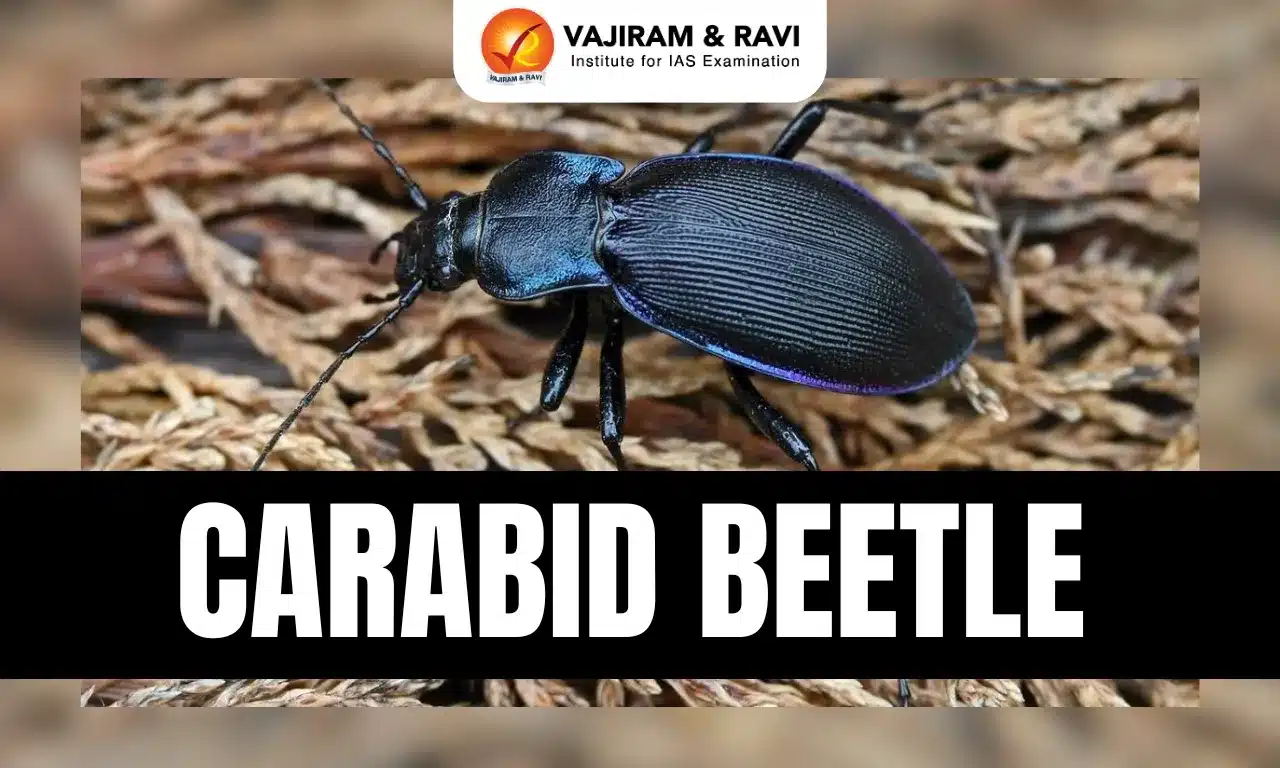
Carabid Beetle Latest News
Recently, researchers found that carabid ground beetles act as potential bio indicators to track soil micro plastics.
About Carabid Beetle
- They are commonly known as ground beetles due to their habitat and behavior.
- Ground beetles (Carabidae) are an important family of invertebrates known to strongly influence food web structure, often as key predators or prey species.
- It belongs to the family Carabidae.
- Habitat: Carabid beetles are found in a wide variety of habitats, including forests, grasslands, agricultural fields, wetlands, and even urban areas.
- They are adapted to diverse climatic conditions, from temperate to tropical regions.
Features of Carabid Beetle
- Appearance: They are known for their long legs and powerful mandibles which enable them to be voracious predators.
- They are infamous for their pungent smell, which they emit when they’re threatened.
- Diet: They are mainly dependent on garden pests, including snails, caterpillars, slugs, and other small invertebrates.
- Life cycle: Ground beetles have four distinct life stages: egg, larva, pupa, and adult.
- Reproduction: Reproduction in carabids is typically sexual, with internal fertilization.
- Ecological Role: They are important for the biological control of insect pests on farms.
Source: TH
Carabid Beetle FAQs
Q1: What is the primary characteristic of Carabid Beetles?
Ans: They are predators that feed on insects and other small invertebrates.
Q2: What is the ecological role of Carabid Beetles?
Ans: Biological control of pests

