
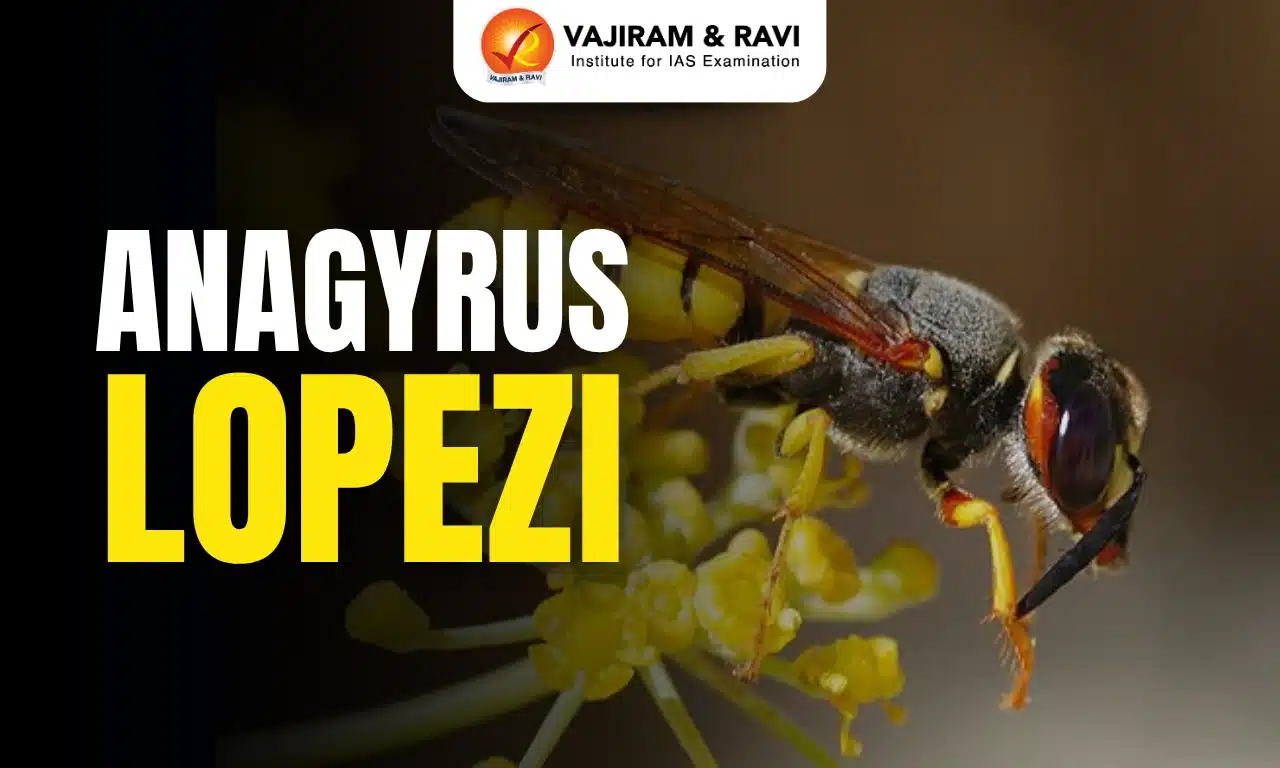
Anagyrus lopezi Latest News
Two years after scientists from the National Bureau of Agricultural Insect Resources (NBAIR), released a tiny parasitic wasp Anagyrus lopezi into South India’s tapioca fields, the crop that once faced near devastation from an invasive pest is now thriving again.
About Anagyrus lopezi
- It is a tiny parasitic wasp which specifically targets the cassava mealybug.
- Working: The wasp lays its eggs inside the pest, and the developing larvae consume it from within, naturally reducing mealybug numbers without harming other crops.
- The parasitoids spread naturally beyond the release points, up to 30–40 km, gradually bringing the mealybug population under control.
- It was imported from the International Institute of Tropical Agriculture (IITA), Benin, West Africa.
Key Facts about Tapioca (Cassava)
- It is a major horticulture crop cultivated in Tamil Nadu, Kerala, and Puducherry.
- It is cultivated throughout the tropical world for its tuberous roots, from which cassava flour, breads, tapioca, a laundry starch, and an alcoholic beverage are derived.
Climatic Conditions Required for Tapioca
- Soil: Any well-drained soil, preferably red lateritic loamy soil.
- Climate: It thrives best in a tropical, warm, humid climate
- Rainfall: Well-distributed rainfall of over 100 cm per annum.
- This crop can be cultivated upto an elevation of 1000 m.
- All parts of cassava/tapioca – leaves, stem, tuber and rind – contain the compounds called cyanogenic glucosides (CNGs).
Source: TH
Anagyrus lopezi FAQs
Q1: What is the primary use of Anagyrus lopezi?
Ans: To control the population of a specific pest.
Q2: Which pest does Anagyrus lopezi primarily target?
Ans: Cassava mealybug
