
The Millennium Summit was organized from 6th to 8th September 2000 at the United Nations Headquarters in New York. It was one of the largest gatherings of world leaders, held to redefine the UN’s role in the 21st century. The Summit was co-chaired by Tarja Halonen, President of Finland, and Sam Nujoma, President of Namibia, with Kofi Annan serving as the Secretary-General of the United Nations. During this summit, Resolution 55/2 was adopted on 8 September 2000, and it came to be known as the United Nations Millennium Declaration. The declaration identified six fundamental values central to international cooperation: Freedom, Equality, Solidarity, Tolerance, Respect for Nature, and Shared Responsibility. It also reaffirmed that nations share the responsibility of safeguarding human dignity and promoting fairness and justice globally. In this article, we are going to cover the Millennium Development Goals.
Millennium Development Goals United Nations
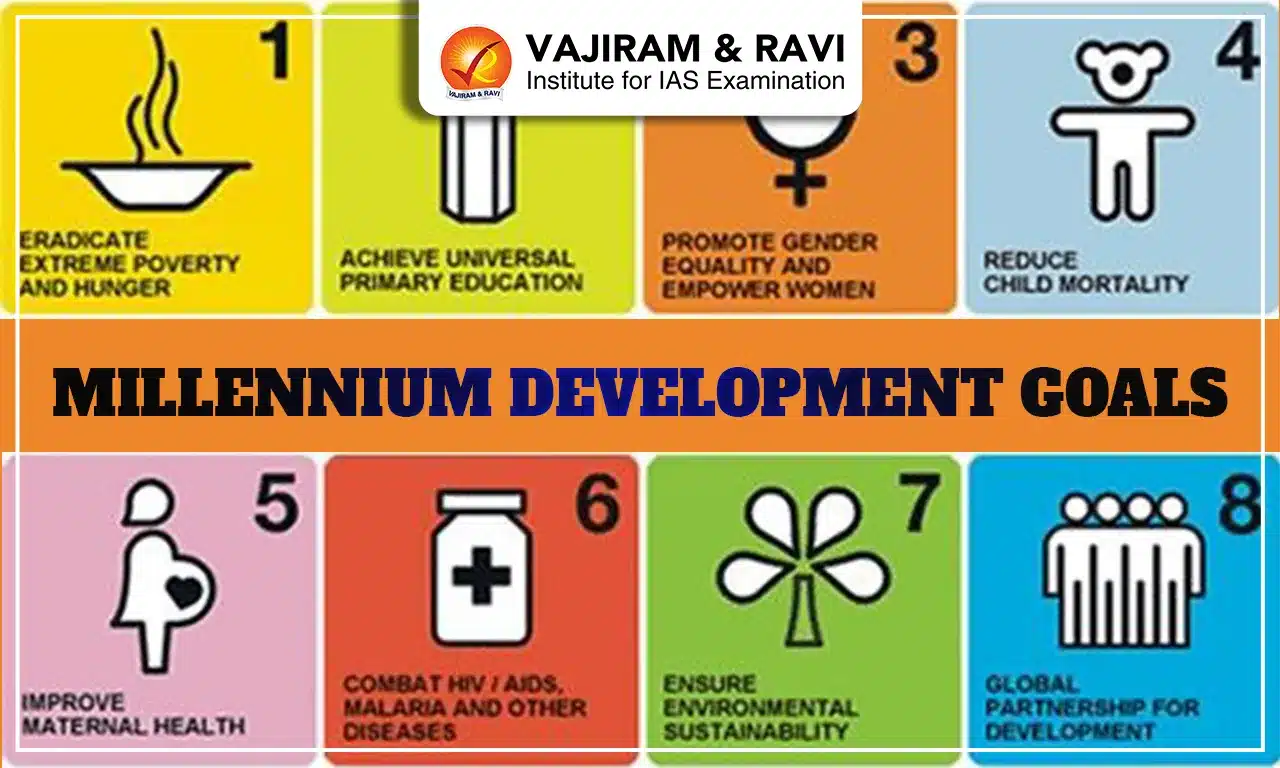
The Millennium Development Goals were a set of eight targets formed on the basis of the Millennium Declaration. A total of 191 UN member states and various international organizations endorsed these goals. The MDGs were influenced by the OECD’s Development Assistance Committee’s agenda for improving the effectiveness of international aid. The 1996 report titled “Shaping the 21st Century” had already highlighted six priority goals similar to those later adopted as MDGs. The final MDG framework aimed at achieving progress in poverty reduction, health, education, gender equality, environmental sustainability, and global partnerships.
1. Eradicate Extreme Poverty and Hunger
The goal targeted reducing by half the proportion of people living on less than $1.25 per day and decreasing global hunger levels between 1990 and 2015. It included the objective of creating productive employment opportunities. Considerable success was achieved, as poverty in developing regions declined from almost 50 percent to around 14 percent during the MDG period.
2. Achieve Universal Primary Education
This goal aimed at ensuring that all children, irrespective of gender or background, complete primary education by 2015. Progress was visible worldwide as the primary school enrollment rate rose significantly, and gender gaps in access to education narrowed in most regions.
3. Promote Gender Equality and Empower Women
The objective was to eliminate gender disparity in primary and secondary education by 2005 and across all levels by 2015. Women’s participation in education and non-agricultural employment witnessed improvement. However, political representation continued to remain limited, as women held only a small percentage of parliamentary seats globally.
4. Reduce Child Mortality
The MDGs aimed to reduce the under-five mortality rate by two-thirds between 1990 and 2015. Substantial progress was recorded with the global child mortality rate dropping from 90 deaths per 1,000 live births in 1990 to around 43 deaths in 2015.
5. Improve Maternal Health
The goal sought to reduce maternal mortality by three-quarters and ensure universal access to reproductive healthcare. Since 1990, maternal deaths worldwide have reduced by nearly 45 percent, with significant improvements noted after 2000.
6. Combat HIV/AIDS, Malaria, and other Diseases
The effort was to halt and reverse the spread of HIV/AIDS by 2015 and make treatment accessible to all. New HIV infections fell sharply, and efforts in malaria and tuberculosis control saved millions of lives.
7. Ensure Environmental Sustainability
This goal emphasized adopting sustainable development practices, protecting environmental resources, and ensuring access to safe drinking water and sanitation. By 2015, over 90 percent of the world population had access to improved drinking water sources, though concerns over biodiversity and climate remained major challenges.
8. Develop a Global Partnership for Development
The focus was on strengthening international trade, supporting least developed countries, enhancing debt relief initiatives, and improving access to affordable medicines. International official development assistance increased notably during the MDG implementation period.
Sustainable Development Goals
Following the conclusion of the MDG timeline in 2015, the United Nations adopted a new and expanded development framework to address persistent gaps and emerging challenges. The Sustainable Development Goals (SDGs) were introduced with a more comprehensive and inclusive vision that aimed to ensure prosperity while simultaneously protecting the planet. The SDGs were adopted by all UN member states in September 2015 and were presented within the UN Resolution known as Agenda 2030. Unlike earlier efforts, mechanisms such as the SDG tracker were introduced to evaluate and report measurable progress across countries. The SDG framework consists of 17 goals, further broken down into 169 targets, monitored using 232 global indicators. The target year for achieving SDGs is 2030. The SDGs serve as a roadmap for building a more equitable, sustainable, and peaceful world for current and future generations.
Millennium Development Goals FAQs
Q1: What are the main differences between MDGs and SDGs?
Ans: MDGs focused mainly on developing countries with eight goals, whereas SDGs are universal with 17 broader, inclusive goals covering social, economic, and environmental aspects.
Q2: How many targets are in MDG?
Ans: The MDGs had 21 measurable targets.
Q3: Who made the 8 Millennium Development Goals?
Ans: The MDGs were adopted by 191 UN member states during the UN Millennium Summit in 2000.
Q4: Which came first, MDG or SDG?
Ans: The MDGs came first and were replaced by the SDGs in 2015.
Q5: What are the 3 pillars of sustainability?
Ans: The three pillars of sustainability are economic, social, and environmental sustainability.
