
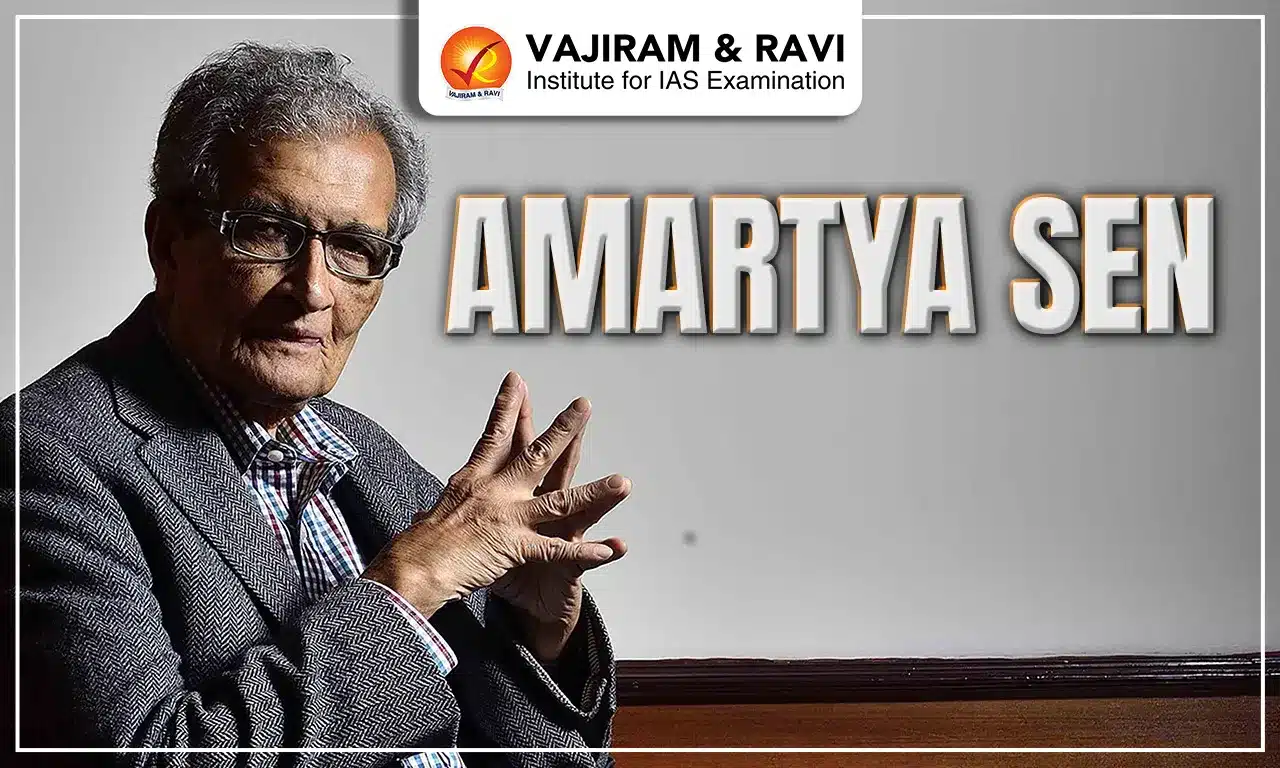
Amartya Sen is one of India’s most respected economists, philosophers, and public intellectuals whose work reshaped global understanding of poverty, welfare, and human development. He won the Nobel Prize in Economic Sciences in 1998 for his contributions to welfare economics and social choice theory. Sen’s ideas bridged economics with ethics, focusing on freedom, justice, and equality. His theories continue to influence Indian policymaking, especially in education, health, and poverty alleviation programs.
Amartya Sen
Amartya Kumar Sen was born on 3 November 1933 in Santiniketan, West Bengal. He studied at Presidency College (Calcutta), and later at Trinity College, Cambridge, where he earned his Ph.D. in economics. Deeply inspired by Bengal’s social realities and the 1943 Bengal Famine, Sen developed a lifelong interest in inequality, hunger, and human capability. Over his career, he taught at renowned institutions such as the London School of Economics, University of Oxford, and Harvard University.
Amartya Sen Career
Amartya Sen’s academic career spans more than six decades, influencing both economic theory and public policy. He served as the Master of Trinity College, Cambridge (1998-2004) and taught at Harvard University as Thomas W. Lamont University Professor. Sen has also worked with international organizations like the World Bank, UNDP, and UNESCO on issues of development and welfare. His interdisciplinary approach combined philosophy, ethics, and economics to address practical concerns like poverty, gender inequality, and social justice. Key roles:
- Professor of Economics at Jadavpur University (1956-58)
- Lecturer and Fellow at Trinity College, Cambridge
- Professor at Delhi School of Economics (1963-71)
- Visiting professor at London School of Economics, University of Oxford, Harvard University
- UNDP Human Development Report contributor and advisor
Amartya Sen Contributions
Amartya Sen’s intellectual contributions span various fields of economics and philosophy. His theories have transformed how nations measure welfare and human progress.
- Capability Approach: Sen’s Capability Approach argues that development should be evaluated by people’s ability to live the lives they value, not just by income. It became the foundation for the UNDP’s Human Development Index (HDI), first introduced in 1990, developed by Mahbub ul Haq.
- Welfare Economics: Sen expanded welfare economics by incorporating ethical dimensions. He criticized the idea that GDP alone measures well-being and instead proposed measuring individual freedom, access, and opportunities.
- Poverty and Famine Studies: His book “Poverty and Famines: An Essay on Entitlement and Deprivation” (1981) explained that famine occurs due to lack of access to food, not its shortage. This theory transformed famine prevention policies globally.
- Gender Inequality and Social Justice: Sen’s works such as “More Than 100 Million Women Are Missing” (1990) highlighted gender discrimination in developing countries, drawing global attention to women’s empowerment.
- Democracy and Development: He argued that no major famine has ever occurred in a functioning democracy, emphasizing the role of transparency and political freedom in preventing human suffering.
Amartya Sen Books
Amartya Sen’s writings are widely read by scholars, policymakers, and students worldwide. His work emphasize freedom, rational debate, and moral responsibility in governance and economics. Some of his most influential books include:
- Poverty and Famines (1981)
- Development as Freedom (1999)
- The Idea of Justice (2009)
- Identity and Violence: The Illusion of Destiny (2006)
- The Argumentative Indian (2005)
- Collective Choice and Social Welfare (1970)
Amartya Sen Awards and Honours
Amartya Sen has received numerous prestigious awards for his groundbreaking contributions to economics, ethics, and social sciences. Major National and International Awards:
- Nobel Prize in Economic Sciences (1998) for welfare economics and social choice theory
- Bharat Ratna (1999), India’s highest civilian award, for his contributions to economic thought
- Order of Companion of Honour (UK, 2000)
- National Humanities Medal (USA, 2011)
- Eisenhower Medal (2010) and Leontief Prize (2000)
- Honorary doctorates from over 90 universities worldwide, including Harvard, Oxford, and Delhi University
- Named among the “World’s 100 Most Influential Thinkers” by Foreign Policy
Amartya Sen’s Philosophy
Sen’s philosophy integrates economics with human values. He believes that development is not merely about income growth but about enhancing human freedoms- political, social, and economic. His framework emphasizes public reasoning, education, and healthcare as essential for achieving equality. Key ideas include:
- Freedom is both a means and an end of development.
- Democracy ensures accountability and prevents disasters like famines.
- Gender equality is central to human progress.
- Ethical reasoning must guide economic policy.
Amartya Sen’s Impact on Indian Policies
Amartya Sen’s theories have deeply influenced India’s social and economic policy.
- His ideas inspired India’s Human Development Reports and state-level HDI assessments.
- The Right to Education Act (2009) and National Rural Health Mission (2005) reflect Sen’s advocacy for human capability enhancement.
- His focus on public goods encouraged policies like mid-day meals and women’s empowerment programs.
- His critique of market inequality influenced NITI Aayog’s inclusive growth strategy.
- Sen’s debates with economist Jagdish Bhagwati on “growth vs. welfare” shaped India’s policy discourse.
Amartya Sen’s Influence on Development
Sen’s emphasis on human development has guided several government initiatives. These programs reflect Sen’s belief that social investment drives economic growth by expanding people’s real freedoms:
- National Food Security Act (2013): Ensures access to subsidized food grains.
- Integrated Child Development Services (ICDS): Focus on nutrition and early childhood care.
- Sarva Shiksha Abhiyan (2001): Universal elementary education.
- Mahatma Gandhi National Rural Employment Guarantee Act (MGNREGA, 2005): Promotes livelihood security.
- Ayushman Bharat (2018): Focuses on affordable healthcare.
Amartya Sen Criticism
Amartya Sen’s ideas have not been without criticism. Some economists argue that his focus on welfare over market efficiency slows growth. Others suggest that his ideal of democracy as a famine deterrent may not fit authoritarian but efficient economies like China. Despite this, his moral economics remains widely respected for addressing inequality and human dignity. Despite his influence, Sen’s ideas face practical challenges in implementation.
- India’s welfare schemes often suffer from corruption and bureaucratic delays.
- Regional disparities in health and education persist despite human development programs.
- Data measurement issues make it difficult to assess capability enhancement accurately.
- Critics argue that focusing on rights and welfare sometimes overshadows economic competitiveness.
However, Sen himself advocates that economic efficiency must be balanced with ethical responsibility and inclusiveness.
Amartya Sen’s International Contributions
Amartya Sen played a vital role in shaping the UNDP Human Development Reports, which assess development beyond GDP. He collaborated with Mahbub ul Haq to design the Human Development Index (HDI), used by the UN since 1990. Sen’s advisory work with the World Health Organization (WHO) and International Labour Organization (ILO) has guided global poverty reduction, health equity, and education reforms.
Amartya Sen UPSC
Amartya Sen’s work continues to inspire economists, policymakers, and students across the world. His ideas shaped a new moral dimension in economics, blending compassion with logic. In India, his influence remains visible in debates on welfare, education, and social equity. Sen’s emphasis on dialogue, democracy, and justice ensures his relevance in contemporary policy discussions. His intellectual legacy endures as a guiding light for creating an equitable and humane world economy.
In a recent address to students in Kolkata on 22 August 2025, Sen emphasised that migration is essential for globalisation and human progress. He cited the fact that global migration reached approximately 281 million people in 2020, about 3.6% of the world’s population, underscoring how people-mobility underpins economic, cultural and scientific exchange.
Sen also stressed that India, with over 18 million citizens living abroad, stands as the largest country of origin for international migrants, illustrating the scale of movement and remittances in shaping development.
He argued that migration is not a problem to be controlled but a force to be harnessed: remittances, skill-flows and diversity enrich societies and sustain welfare systems.
Amartya Sen FAQs
Q1: Who is Amartya Sen?
Ans: Amartya Sen is an Indian economist and philosopher known for his work on welfare economics and human development.
Q2: What did Amartya Sen win the Nobel Prize for?
Ans: He received the 1998 Nobel Prize in Economics for his contributions to welfare economics and social choice theory.
Q3: What is the Capability Approach?
Ans: Sen’s Capability Approach measures development by people’s real freedoms and choices, not merely income or GDP.
Q4: How did Amartya Sen influence Indian policies?
Ans: His ideas inspired welfare policies like MGNREGA, Right to Education, and National Food Security Act.
Q5: Which book of Amartya Sen is most famous?
Ans: His book Development as Freedom (1999) is among his most influential works on economics and ethics.
