
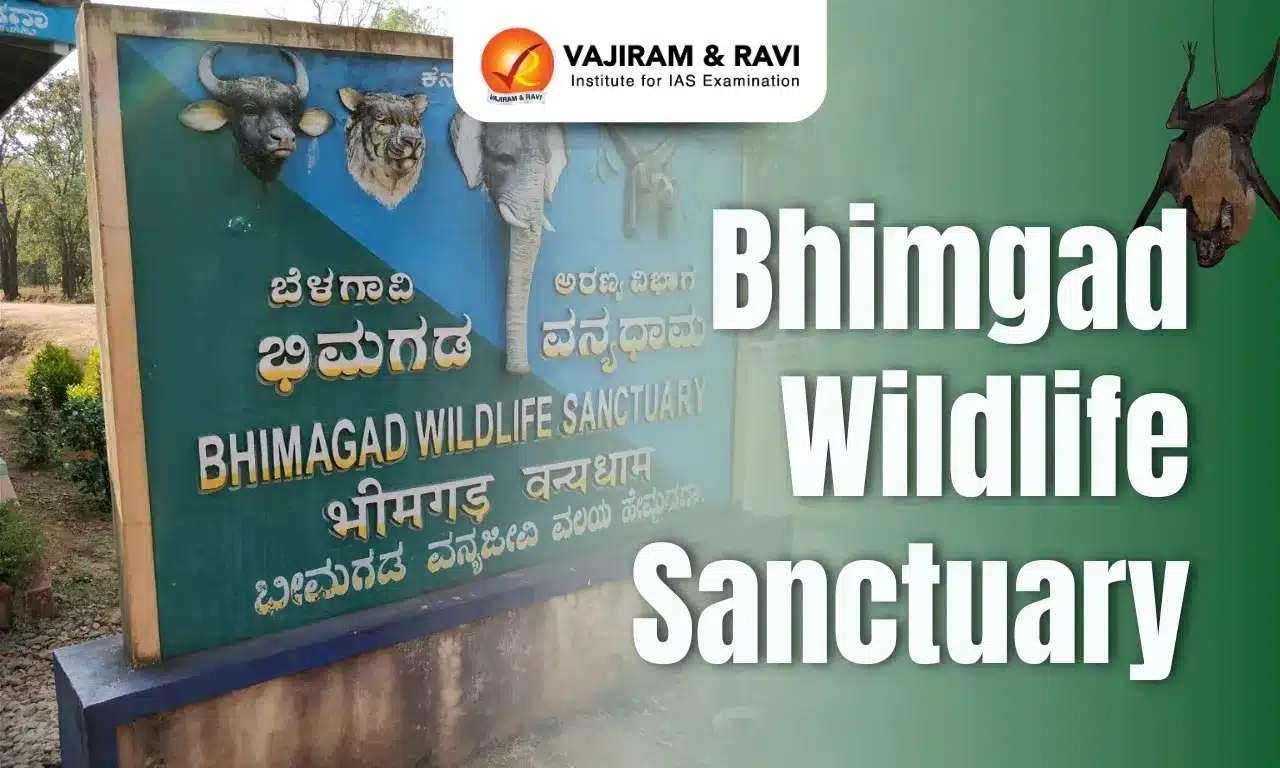
Bhimgad Wildlife Sanctuary Latest News
The forest department's relocation drive at Bhimgad Wildlife Sanctuary (BWS) in Khanapur taluk has hit a hurdle, as residents of Amagaon village have set several conditions before agreeing to move out.
About Bhimgad Wildlife Sanctuary
- It spans over the Western Ghats in the Belgaum district of Karnataka.
- It is spread across an area of 190 sq.km.
- The sanctuary has been named after the Bhimgad Fort, constructed by Chhatrapati Shivaji Maharaj in the 17th century as a strategic outpost to guard against Portuguese expansion from Goa.
- It shares its boundary with the north of Dandeli Wildlife Sanctuary, north-west of the Bhagwan Mahaveer Sanctuary and Mollem National Park, north of Netravali Wildlife Sanctuary, and east of Mhadei Wildlife Sanctuary.
- BWS forms the headwaters of a number of rivers like Tillari, Malaprabha, and Mhadei and several perennial streams.
- The sanctuary is most famous for the Barapede Caves, the only known breeding ground of the Wroughton’s Free-tailed Bat, a threatened species on the verge of extinction.
- Vegetation: The dominant vegetation of the forest comprises tropical and subtropical moist broadleaf forests.
- Flora:
- Forests are dominated by towering trees like Malabar teak, rosewood, and various species of dipterocarps
- It also hosts a number of medicinal plants.
- Fauna:
- It provides habitat for several endangered species, such as the Indian sloth bear, Indian pangolin, and the elusive black panther.
- Other notable residents include the Malabar giant squirrel, gaur, sambar deer, and a plethora of bird species, including the Malabar trogon and the great Indian hornbill.
- One of the unique features of Bhimgad is the presence of large, isolated rock formations that serve as ideal breeding grounds for the King Cobra, the world’s longest venomous snake.
Source: TOI
Bhimgad Wildlife Sanctuary FAQs
Q1: Bhimgad Wildlife Sanctuary is located in which Indian state?
Ans: Karnataka
Q2: Bhimgad Wildlife Sanctuary derives its name from a fort constructed by which historical ruler?
Ans: Chhatrapati Shivaji Maharaj
Q3: Which rivers have their headwaters originating in the Bhimgad Wildlife Sanctuary?
Ans: It forms the headwaters of a number of rivers like Tillari, Malaprabha, and Mhadei and several perennial streams.
Q4: What is the dominant type of vegetation found in Bhimgad Wildlife Sanctuary?
Ans: Tropical and subtropical moist broadleaf forest.
