
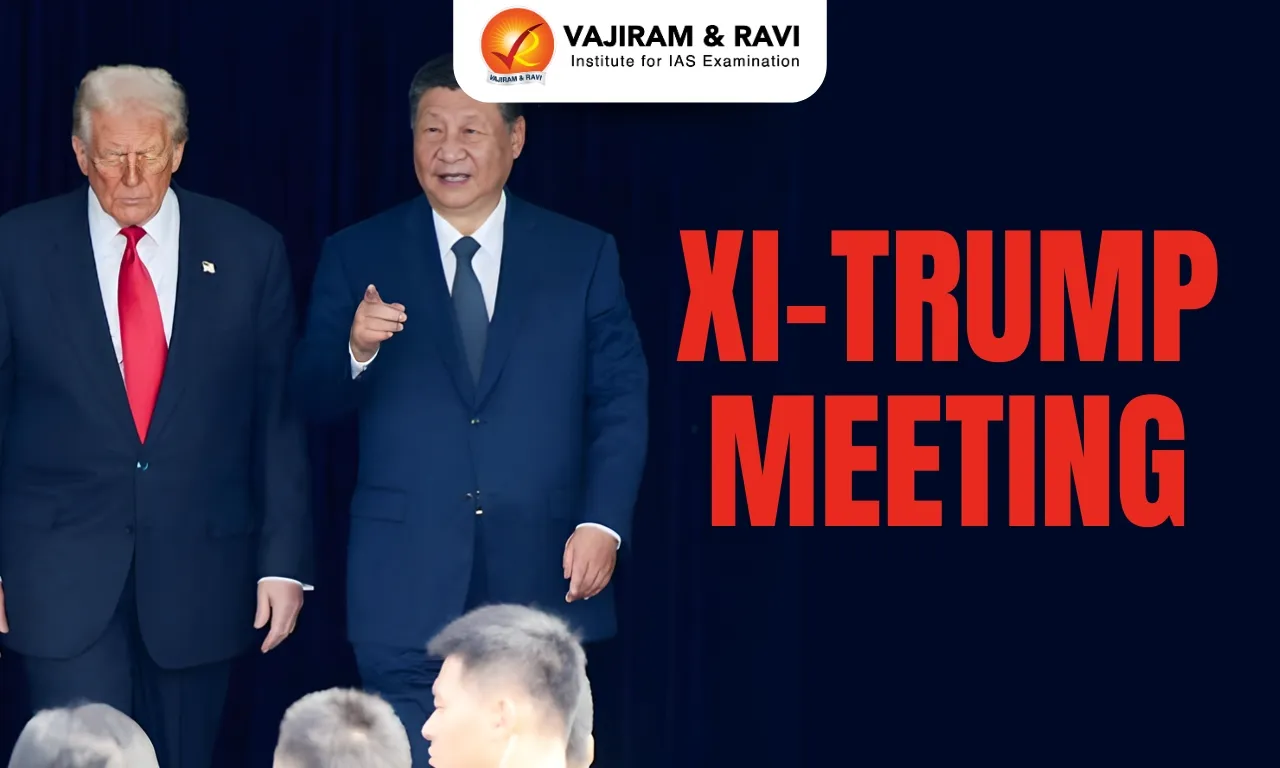
Xi–Trump Meeting Latest News
- At the Asia-Pacific Economic Cooperation (APEC) summit in South Korea, US President Donald Trump and Chinese President Xi Jinping met for the first time since Trump’s return to office.
- Trump announced that China agreed to maintain global exports of rare earth minerals under a one-year deal, calling it a “worldwide solution.” He said this would remove supply worries for industries dependent on these materials.
- Additionally, the US will reduce tariffs on China—cutting the penalty on fentanyl-related trade from 20% to 10%, bringing the overall tariff rate down from 57% to 47%.
Key Highlights of the Xi-Trump Meeting
- The meeting was its carefully managed optics. Unlike his usual confrontational style, President Trump adopted a polite and diplomatic tone, showing awareness of China’s global influence.
- Interestingly, China did not immediately release an official account of the meeting, highlighting its cautious approach.
Trump’s Recognition of China’s Power
- Trump referred to the meeting as “G-2”, equating the US–China relationship to elite global groupings like the G-7 and G-20.
- This was seen as a symbolic recognition of China’s global power, something no previous US president had done publicly — a clear diplomatic win for Beijing.
Controlled Diplomacy Over Confrontation
- Both leaders showed mutual deference and restraint, a departure from Trump’s usual brashness.
- Their conduct reflected a shared understanding of the delicate balance between the world’s two largest economies and the global impact of their relationship.
Deal on Rare Earth Exports
- The key takeaway from the Trump–Xi meeting was about rare earth exports.
- President Trump announced that China had agreed to continue exporting rare earth minerals for one year — a relief for global industries that depend on them.
- In return for China’s cooperation, Trump cut tariffs on Chinese goods by 10%, lowering total US tariffs from 57% to 47%.
- This move was meant to ease pressure on Chinese businesses and encourage Beijing to compromise.
- While the agreement eased tensions, it only postponed the core issue — China still dominates the rare earth supply chain.
- The deal gives the US and its allies more time to diversify sources and reduce dependency on China.
Implication for India in the G-2 world
- In his first term (2017), Trump took a hard stance on China, calling it a strategic rival, strengthening alliances, and supporting frameworks like the Quad and Indo-Pacific strategy, where India played a central role.
- Now, in his second term, Trump’s approach is commercial, focusing on trade deals and domestic investments, even pressuring allies like Japan and South Korea to invest heavily in the US.
- After the meeting, US President left behind a sense of uncertainty about America’s future with China — the world’s two largest powers.
- Calling his meeting with Xi Jinping a “G-2” summit, Trump sparked concern among allies that the US is leaning toward a China-first, business-focused policy.
Implications for India and the Region
- For India, the message was clear: the US focus remains on managing China.
- The question now is whether Trump prefers working with allies like India, Japan, and Australia (under the Quad) or handling China alone.
- For India and other Asian nations, this marks a new phase in US–China relations — a mix of competition and cooperation.
Trade Disadvantage for India
- After Trump reduced tariffs on China to 47%, India now has the highest tariff rate at 50%, putting it at a trade disadvantage.
- This makes a US–India trade deal more urgent, especially since Trump said one could be finalized en route to South Korea.
- Until then, a US rival (China) enjoys better trade terms than a US partner (India).
India’s Strategic Path Forward
- As Trump’s trade-driven strategy reshapes the region, India must rethink its assumptions about both American intent and Chinese ambition, while identifying space for its own strategic autonomy.
- For India, the challenge is to navigate this shifting US–China balance with agility.
- Delhi must:
- Engage the US where interests align,
- Explore economic opportunities with China where possible, and
- Deepen partnerships with Asia and Europe to strengthen its independent position.
Xi–Trump Meeting FAQs
Q1: What was the key outcome of the Xi–Trump meeting?
Ans: China agreed to continue rare earth exports for a year, while the US reduced tariffs on Chinese goods by 10%.
Q2: Why is the rare earth deal significant?
Ans: It temporarily eases global supply concerns but leaves China’s dominance in critical minerals largely intact.
Q3: How did Trump describe the meeting?
Ans: He called it “G-2,” signaling acknowledgment of China’s global power — a symbolic win for Beijing.
Q4: What does this meeting mean for India?
Ans: India must adapt to a new US–China balance of competition and cooperation, rethinking its strategic and trade assumptions.
Q5: Why are allies cautious about Trump’s approach?
Ans: His business-first stance and reduced tariffs for China create doubts about America’s reliability as a strategic partner in Asia.
