National Disaster Response Force, Roles, Structure, Operations

National Disaster Response Force

Disasters, whether natural or human-induced, pose major challenges to India’s safety and development. To address these effectively, India established a specialized force capable of rapid deployment and professional disaster management. The National Disaster Response Force (NDRF) stands at the forefront of India’s emergency response system, ensuring quick, coordinated, and efficient rescue and relief operations across the country. Over the years, NDRF has evolved into one of the most trained and reliable disaster management forces in the world.

National Disaster Response Force (NDRF)

The National Disaster Response Force (NDRF) is a specialized, multi-skilled disaster response agency raised under the Ministry of Home Affairs (MHA). It was constituted under the Disaster Management Act, 2005, and the NDRF was formally raised and became operational in 2006 (raising day: 19 January 2006).

NDRF is administratively under the Ministry of Home Affairs; the National Disaster Management Authority (NDMA) issues policy/ guidelines and coordinates at the national level, but administrative control and raising of NDRF rests with MHA. Its motto, “Aapda Sewa Sadaiv Sarvatra” (To serve during disasters, always and everywhere), reflects its commitment to saving lives and minimizing suffering.

National Disaster Response Force Organizational Structure

The NDRF functions as an independent disaster response agency but draws its personnel from various central paramilitary forces. Its organizational framework ensures coordination between central and state disaster management authorities.

  • Parent Ministry: Ministry of Home Affairs (MHA)
  • Controlling Authority: National Disaster Management Authority (NDMA)
  • Head: Director General (DG), NDRF
  • Composition: Personnel deputed from BSF, CRPF, ITBP, CISF, and SSB 

As of 2025, NDRF comprises 16 battalions strategically located across India to ensure rapid deployment. Each battalion includes 1149 personnel specializing in disaster response, search and rescue, communication, and medical assistance.

National Disaster Response Force Roles and Responsibilities

The NDRF has a broad mandate that goes beyond immediate rescue operations. Its roles cover preparedness, response, mitigation, and capacity building.

  • Disaster Response: Conducts search, rescue, and relief operations during natural calamities such as floods, cyclones, landslides, and earthquakes.
  • CBRN Response: Trained to handle Chemical, Biological, Radiological, and Nuclear emergencies.
  • Capacity Building: Provides disaster management training to State Disaster Response Forces (SDRFs) and community volunteers.
  • Awareness Programs: Conducts public awareness campaigns on disaster preparedness.
  • International Missions: Participates in humanitarian assistance operations abroad under UN coordination.

National Disaster Response Force Operations

The NDRF’s operational efficiency lies in its rapid deployment strategy. Teams are pre-positioned in disaster-prone areas and mobilized immediately after early warnings from the India Meteorological Department (IMD) or National Centre for Seismology. Major Operations Conducted:

  • 2008 Bihar Floods: Rescued over 1.3 lakh people from Kosi River floods.
  • 2013 Uttarakhand Flash Floods: Conducted one of India’s largest rescue missions, saving over 10,000 lives.
  • 2018 Kerala Floods: Deployed 58 teams; rescued over 5,000 people and evacuated 10,000.
  • 2020 Cyclone Amphan: Over 40 NDRF teams deployed across West Bengal and Odisha.
  • 2023 Turkey-Syria Earthquake: India sent NDRF teams under “Operation Dost” for international rescue support, showcasing global capability.

National Disaster Response Force Training

Training is the backbone of NDRF’s operational excellence. Personnel undergo rigorous physical, technical, and psychological training to handle extreme conditions. By 2024, more than lakhs of civilians and officials have received disaster response training under NDRF-led initiatives. Key Training Institutions:

  • National Institute of Disaster Management (NIDM)- Delhi
  • College of Disaster Management- Nagpur
  • State Training Centers- located in all disaster-prone states

Training Focus Areas:

  • Collapsed structure search and rescue (CSSR)
  • Rope rescue, flood rescue, and underwater diving operations
  • Chemical and radiological decontamination
  • First aid and trauma care
  • Community-based disaster risk management

National Disaster Response Force Technological Advancements

To enhance operational efficiency, NDRF continuously upgrades its technology and equipment. In 2023, NDRF integrated drones for aerial surveillance and AI-based early warning systems, enabling faster and data-driven decision-making during rescue missions.

  • Boats and Hovercrafts: Used for flood rescue operations.
  • CBRN Vehicles and Drones: For chemical disasters and surveillance.
  • Communication Equipment: Satellite phones and GPS-based tracking systems.
  • Medical Kits and Protective Gear: Advanced equipment for first responders.

National Disaster Response Force Coordination

Disaster response requires multi-agency coordination. This collaboration ensures seamless integration from local preparedness to national-level coordination. NDRF collaborates closely with:

  • National Disaster Management Authority (NDMA) for strategic planning.
  • Indian Armed Forces for logistics and airlifting operations.
  • India Meteorological Department (IMD) for early warnings.
  • National Remote Sensing Centre (NRSC) for satellite-based disaster mapping.
  • State Disaster Response Forces (SDRFs) for localized operations.

National Disaster Response Force Legal Framework

The Disaster Management Act, 2005, provides the legal foundation for NDRF’s creation and functioning. It outlines roles for NDMA, NDRF, SDRF, and other authorities in disaster risk reduction and response. Key legal provisions related to NDRF include:

  • Section 44: Establishment of NDRF for prompt response.
  • Section 45: Defines NDRF’s control, training, and deployment framework.
  • Section 46: Establishment of the National Disaster Response Fund (NDRF) for financing operations.
  • Additionally, NDMA guidelines ensure coordination between central, state, and district authorities.

National Disaster Response Force Funding

The NDRF receives financial support from the National Disaster Response Fund (NDRF) under the Ministry of Home Affairs.

  • Budget Allocation: Public records indicate that the 15th Finance Commission allocated a total corpus of ₹54,770 crore to the National Disaster Response Fund (NDRF) for the entire award period of 2021-22 to 2025-26. An amount of ₹5,000 crore from this corpus was specifically earmarked for the Expansion and Modernization of Fire Services across the states..
  • World Bank Partnership: Supports capacity building through the National Cyclone Risk Mitigation Project (NCRMP).
  • UNDP Collaboration: Enhances community resilience and early warning systems.

National Disaster Response Force Achievements

NDRF has earned global recognition for its professionalism, speed, and compassion.

  • Conducted over 6,800 rescue operations since inception.
  • Assisted in international missions like the Nepal Earthquake (2015) and Turkey-Syria Earthquake (2023).
  • Recognized by UNDRR (United Nations Office for Disaster Risk Reduction) for community-based disaster management excellence.
  • Awarded the Subhash Chandra Bose Aapda Prabandhan Puraskar 2023 for outstanding disaster response efforts.

National Disaster Response Force Challenges

Despite its success, NDRF faces several operational and institutional challenges.

  1. Resource Constraints: Limited funds restrict modernization.
    • Way Forward: Increase budget allocation and public-private partnerships.
  2. Coordination Issues: Overlapping jurisdiction with state forces.
    • Way Forward: Streamline command structures between NDRF and SDRF.
  3. Staff Shortage: High turnover due to deputation model.
    • Way Forward: Establish permanent cadre and incentivize long-term postings.
  4. Technological Gaps: Limited access to advanced rescue tools.
    • Way Forward: Invest in AI, robotics, and GIS-based disaster mapping.
  5. Climate-Induced Disasters: Rising frequency of floods and cyclones.
    • Way Forward: Develop predictive disaster models and preventive infrastructure.
  6. Public Awareness: Low community preparedness.
    • Way Forward: Strengthen community-based disaster management training.
  7. Training Infrastructure: Regional disparities in training standards.
    • Way Forward: Establish regional disaster training academies.
  8. Post-Disaster Rehabilitation: Focus often ends after rescue.
    • Way Forward: Expand NDRF’s role to include post-disaster livelihood recovery.
  9. Equipment Maintenance: Short shelf life of rescue gear.
    • Way Forward: Regular audits and replacement cycles.
  10. Mental Health of Personnel: Psychological toll after major disasters.
    • Way Forward: Provide counseling and stress management programs.

National Disaster Response Force International Operations

The NDRF has increasingly become a symbol of India’s humanitarian diplomacy by taking part in global disaster relief efforts. In 2023, NDRF earned international acclaim for its swift response during the Turkey-Syria Earthquake under “Operation Dost,” rescuing several survivors and providing medical aid. Earlier, NDRF teams had participated in the 2011 Japan Earthquake, 2015 Nepal Earthquake, and Bhutan flood response operations. These missions highlight India’s commitment to the Sendai Framework for Disaster Risk Reduction (2015-2030) and its growing leadership in global disaster response under the principle of “Vasudhaiva Kutumbakam” - One Earth, One Family. 

National Disaster Response Force Battalions

The National Disaster Response Force (NDRF) operates through 16 specialized battalions located across India, strategically placed based on the country's disaster vulnerability profile. These battalions are equipped to respond rapidly to floods, earthquakes, cyclones, industrial accidents, and other natural or man-made calamities. Each unit is drawn from different Central Armed Police Forces (CAPFs) and maintains a defined Area of Responsibility (AOR) for effective disaster response and preparedness.

National Disaster Response Force Area of Responsibility

These battalions work in coordination with State Disaster Response Forces (SDRFs) and the National Disaster Management Authority (NDMA) to ensure timely and effective response during calamities. Their strategic distribution enables faster mobilization, reducing response time significantly in high-risk zones. The deployment and area of responsibilities for the NDRF battalions is given here:

  • 1st Battalion NDRF, Guwahati (Assam)- BSF: Covers the North-Eastern states, focusing on floods, landslides, and earthquakes. It is one of the first responders for Brahmaputra basin disasters.
  • 2nd Battalion NDRF, Nadia (West Bengal)- BSF: Responsible for eastern India, including West Bengal and Sikkim, with emphasis on cyclones, riverine floods, and industrial accidents.
  • 3rd Battalion NDRF, Cuttack (Odisha)- CISF: Focuses on Odisha, Jharkhand, and Chhattisgarh, frequently responding to cyclones like Fani and Amphan, and mining-related disasters.
  • 4th Battalion NDRF, Vellore (Tamil Nadu)- CISF: Covers Tamil Nadu, Kerala, and Puducherry, addressing cyclones and coastal flooding in the Bay of Bengal and Arabian Sea regions.
  • 5th Battalion NDRF, Pune (Maharashtra)- CRPF: Handles Western India (Maharashtra, Goa, and Karnataka) with key roles in urban flood rescue and industrial response.
  • 6th Battalion NDRF, Vadodara (Gujarat)- CRPF: Focuses on Gujarat and Rajasthan, known for earthquake preparedness (Bhuj) and flood management.
  • 7th Battalion NDRF, Bathinda (Punjab)- ITBP: Responsible for Punjab, Haryana, and Himachal Pradesh, dealing with flash floods, landslides, and industrial hazards.
  • 8th Battalion NDRF, Ghaziabad (Uttar Pradesh)- ITBP: Covers Delhi NCR and Uttar Pradesh, frequently responding to building collapses, urban flooding, and accidents.
  • 9th Battalion NDRF, Patna (Bihar)- BSF: Focuses on Bihar and Jharkhand, handling recurrent floods in the Ganga basin and rescue during monsoon disasters.
  • 10th Battalion NDRF, Vijayawada (Andhra Pradesh)- CRPF: Covers Andhra Pradesh and Telangana, addressing cyclones from the Bay of Bengal and dam-related emergencies.
  • 11th Battalion NDRF, Varanasi (Uttar Pradesh)- SSB: Handles eastern UP and northern Madhya Pradesh, focusing on flood rescue and earthquake response.
  • 12th Battalion NDRF, Itanagar (Arunachal Pradesh)- SSB: Responsible for Arunachal Pradesh and nearby states, focusing on landslides, earthquakes, and mountain rescue operations.
  • 13th Battalion NDRF, Samba (Jammu and Kashmir)- Assam Rifles: Covers Jammu, Kashmir, and Ladakh, focusing on avalanches, landslides, and earthquake preparedness in Himalayan terrain.
  • 14th Battalion NDRF, Mandi (Himachal Pradesh)- ITBP: Deployed in Himachal Pradesh and adjoining northern regions, dealing with flash floods, landslides, and glacier bursts.
  • 15th Battalion NDRF, Haldwani (Uttarakhand)- ITBP: Responsible for Uttarakhand and Western UP, with expertise in mountain search and rescue and flood operations.
  • 16th Battalion NDRF, Najafgarh (New Delhi)- BSF: Covers the National Capital Region and nearby states, handling chemical, biological, radiological, and nuclear (CBRN) emergencies, along with urban disasters.

NDRF

The National Disaster Response Force (NDRF) symbolizes India’s commitment to saving lives and ensuring resilience against disasters. From responding to floods and cyclones to handling international emergencies, NDRF has built trust and credibility worldwide. Going forward, strengthening technology, capacity building, and coordination will make it not only India’s shield during calamities but also a global model for effective disaster management.

National Disaster Response Force UPSC

In recent years, the National Disaster Response Force has expanded its operational strength and technological readiness. As of 2025, NDRF operates 16 battalions with enhanced logistical support and regional coordination. The force has introduced AI-based disaster prediction tools, drones for real-time surveillance, and satellite-linked communication systems for efficient data sharing. The NDRF has also increased its community outreach programs, training over 12 lakh citizens in disaster preparedness through mock drills and awareness campaigns nationwide.

National Disaster Response Force FAQs

Q1: When was the National Disaster Response Force established?

Ans: The NDRF was established in 2006 under the Disaster Management Act, 2005, following the 2004 Tsunami.

Q2: How many National Disaster Response Force battalions are there in India?

Ans: As of 2025, there are 16 NDRF battalions strategically positioned across the country.

Q3: Which ministry controls the National Disaster Response Force?

Ans: The NDRF operates under the Ministry of Home Affairs (MHA) and functions under the NDMA.

Q4: What types of disasters does the National Disaster Response Force handle?

Ans: NDRF handles natural disasters like floods, cyclones, earthquakes, and man-made incidents like CBRN emergencies.

Q5: What is the motto of the National Disaster Response Force?

Ans: The motto of NDRF is “Aapda Sewa Sadaiv Sarvatra”- to serve during disasters, always and everywhere.


Indian Institute of Packaging (IIP)

Indian Institute of Packaging

Indian Institute of Packaging Latest News

The Indian Institute of Packaging (IIP) opened its Bengaluru Centre recently.

About Indian Institute of Packaging 

  • It is an autonomous body in the field of packaging and working under the administrative control of the Ministry of Commerce and Industry, Government of India. 
  • It was established on 14th May, 1966, with its headquarters and principal laboratories in Mumbai. 
  • The Institute set up its first branch office at Chennai in 1971, followed by branches at Kolkata, Delhi, and Hyderabad in 1976, 1986, and 2006, respectively. 
  • The main objective of the Institute is to promote the export market by way of innovative package design and development as well as to upgrade the overall standards of packaging in the country.
  • The Institute is involved in various activities like testing and evaluation of packaging materials and packages, consultancy services, and research & development related to packaging. 
  • Besides this, the Institute is involved in training and education in the field of packaging. 
  • It imparts training in innovative and aesthetic packaging to the artisans, weavers, exporters, stakeholders, etc.
  • It is closely working with various commodity boards and export promotion councils such as APEDA, Spices Board, MPEDA, Tea Board, MoFPI, and others.
  • The Institute has linkages with international organisations and is a founding member of the Asian Packaging Federation (APF); a member of the Institute of Packaging Professionals (IOPP), USA; the Institute Packaging (IOP), UK; Technical Association of Pulp and Paper Industry (TAPPI), USA.
  • The Institute organizes a biannual event i.e. International Packaging Exhibition, i.e., INDIAPACK, and a national contest for excellence in packaging, i.e., INDIASTARA.

Source: TH

Indian Institute of Packaging FAQs

Q1: Under which Ministry does the Indian Institute of Packaging (IIP) function?

Ans: Ministry of Commerce and Industry

Q2: When was the Indian Institute of Packaging (IIP) established?

Ans: 1966

Q3: Where is the headquarters of the Indian Institute of Packaging located?

Ans: Mumbai

Ayni Air Base

Ayni Air Base

Ayni Air Base Latest News

India has rounded off its operation at the strategic Ayni Air Base in Tajikistan after helping it run since 2002.

About Ayni Air Base

  • It is located in Tajikistan.
  • It is the first overseas military facility operated by India.
  • Located just west of Dushanbe, the capital of Tajikistan, the base had been a neglected Soviet-era facility before India stepped in to modernize it.
  • India began developing the Ayni airbase in the early 2000s under an agreement with Tajikistan. 
  • India invested close to $100 million in the development and modernization of the airbase. 
  • It extended the runway to 3,200 metres and upgraded facilities for refuelling, repairs, and hangars. 
  • At times, India even stationed around 200 personnel from the army and air force at the site.
  • India temporarily deployed Su-30MKI fighter jets and helicopters to the base roughly a decade ago. 
  • India withdrew from the airbase after a bilateral agreement on stationing Indian personnel at the location ended in 2022.

Why the Ayni Air BaseMattered for India?

  • The base enabled India to maintain contact with anti-Taliban forces before 2001 and later provided a route for humanitarian aid to Afghanistan. 
  • Ayni’s location gave India a unique advantage. The base is just about 20 kilometres from Afghanistan’s Wakhan Corridor, which borders Pakistan-occupied Kashmir (PoK). 
  • From there, Indian forces could theoretically target key Pakistani cities such as Peshawar. 
  • Ayni served as a gateway for India to enhance its presence in Central Asia, a region traditionally dominated by Russia and increasingly influenced by China.
  • The airbase was also used in 2021 to evacuate Indian nationals and officials from Afghanistan after the Taliban takeover.

Source: FP

Ayni Air Base FAQs

Q1: Where is the Ayni Air Base located?

Ans: Tajikistan

Q2: Which country developed the Ayni Air Base under an agreement with Tajikistan?

Ans: India

Q3: When did India begin developing the Ayni Air Base?

Ans: Early 2000s.

Q4: When did India withdraw from the Ayni Air Base?

Ans: 2022

Difference between NSE and BSE, Indices, Market Share, Segments

Difference between NSE and BSE

The Indian stock market is primarily dominated by two major exchanges- the National Stock Exchange (NSE) and the Bombay Stock Exchange (BSE). Both play a vital role in India’s financial ecosystem, enabling investors to trade securities, raise capital, and access transparent market data. While they share a common goal of promoting investment and economic growth, they differ in several aspects, including history, technology, market share, and indices. This article explains the key differences between NSE and BSE in a simple, detailed manner.

Difference between NSE and BSE

The Bombay Stock Exchange (BSE) is the oldest stock exchange in Asia, established in 1875, while the National Stock Exchange (NSE) was founded much later, in 1992, to bring electronic and transparent trading systems to India. Both exchanges are regulated by the Securities and Exchange Board of India (SEBI) and offer a wide range of financial products like equities, derivatives, mutual funds, bonds, and ETFs.

Despite operating in the same financial space, NSE and BSE differ in trading volume, technological advancement, listing criteria, and benchmark indices. Investors often prefer one over the other depending on their investment strategy and trading needs.

Difference between NSE and BSE Overview

Both exchanges have contributed immensely to India’s financial modernization, but NSE’s advanced electronic system and efficient trading mechanism have made it the preferred platform for active traders and institutional investors.

Difference between NSE and BSE Overview
Particulars NSE (National Stock Exchange) BSE (Bombay Stock Exchange)

Established Year

1992

1875

Headquarters

Mumbai

Mumbai

Benchmark Index

NIFTY 50

SENSEX

Ownership

Public Limited Company

Public Limited Company

Number of Listed Companies (as of 2025)

~2,720

~5,595

Average Daily Turnover (Equity Segment)

Higher than BSE

Lower than NSE

Website

www.nseindia.com

www.bseindia.com

Technology

NEAT System

BOLT System

Liquidity

Higher

Lower

Market Share (Equity Derivatives)

~90%

~10%

Focus Area

Institutional and High-volume Trading

Retail and SME Market

Preferred by

Active Traders

Long-term Investors

Difference between NSE and BSE History

BSE, founded by Premchand Roychand in 1875, started as an informal group of brokers under a banyan tree near Mumbai’s Town Hall. Over time, it evolved into a structured exchange and became Asia’s first stock exchange. It introduced SENSEX in 1986, India’s first equity index, representing the top 30 performing companies listed on the BSE.

On the other hand, NSE was established in 1992 by leading financial institutions to promote a fully automated, screen-based trading system. In 1994, it became India’s first exchange to offer electronic trading, reducing human errors and ensuring faster trade execution. NSE launched the NIFTY 50 index in 1996, which tracks 50 of the largest and most liquid companies across sectors.

Difference between NSE and BSE Indices

Stock indices serve as indicators of market performance. NSE and BSE both have their own benchmark indices that help investors track overall market trends and sectoral growth. While NSE’s NIFTY 50 and BSE’s SENSEX are the most tracked indices in India, global investors use them as benchmarks for evaluating the Indian market’s growth and stability.

Major NSE Indices

  • NIFTY 50: Tracks the top 50 large-cap companies.
  • NIFTY Next 50: Covers companies ranked 51-100.
  • NIFTY 500, NIFTY Midcap 100, NIFTY Smallcap 250: Represent broader and segmental indices.
  • NIFTY Bank and NIFTY IT: Track performance of banking and IT sectors respectively.

Major BSE Indices

  • SENSEX: Represents the top 30 large and stable companies.
  • BSE 100, BSE 200, and BSE 500: Broad-based indices covering different market segments.
  • BSE Midcap and BSE Smallcap: Track mid-sized and smaller firms.
  • BSE Sectoral Indices: Include BSE Bankex, BSE FMCG, and BSE IT.

Difference between NSE and BSE Market Share

NSE dominates in terms of trading volume and liquidity. According to SEBI and NSE data (2024-25), over 90% of the total equity derivatives trading in India happens on NSE. Its advanced electronic trading system ensures faster execution, which attracts institutional investors and high-frequency traders.

BSE, despite being the oldest exchange, has a lower trading volume but a larger number of listed companies. It caters more to small and medium enterprises (SMEs) through platforms like BSE SME.

Difference between NSE and BSE Market Share
Category NSE BSE

Equity Derivatives Share

Around 90%

Around 10%

Average Daily Turnover (2024-25)

₹1.8 lakh crore

₹0.3 lakh crore

Total Market Capitalization (2025) 

~ ₹410.87 lakh crore (≈ US $4.8 trillion) in FY 2024-25 - (till 31 March 2025)

“₹461 lakh crore” (~US$5.5 trillion) in June 2025

Difference between NSE and BSE Trading Mechanism

The NSE revolutionized India’s stock market by introducing screen-based electronic trading in 1994, replacing the traditional open-outcry system. Its NEAT (National Exchange for Automated Trading) system allows high-speed order matching and transparent price discovery.

The BSE, after initially using manual trading methods, adopted electronic trading in 1995 with the BOLT (BSE On-Line Trading) system. While both exchanges use advanced technology today, NSE’s early automation and robust risk management systems give it a technological edge.

Difference between NSE and BSE Market Segments

Both exchanges provide a wide variety of financial products and operate in several market segments. While both exchanges offer similar products, NSE handles most of India’s derivatives trading, while BSE focuses more on retail investors and SMEs.

NSE Market Segments:

  • Capital Market (Equities and ETFs)
  • Futures & Options (Derivatives)
  • Currency Derivatives
  • Debt Market
  • Mutual Fund and Commodity Derivatives

BSE Market Segments:

  • Equity and SME Platform
  • Debt Instruments
  • Derivatives
  • Mutual Funds and ETFs
  • Commodity Derivatives and Corporate Bonds

Difference between NSE and BSE Listing Process

BSE has more relaxed listing norms and hosts the largest number of listed companies, especially smaller and regional firms. NSE, on the other hand, follows stricter financial and governance standards, making it suitable for large and well-established companies.

Difference between NSE and BSE Listing Process
Parameter NSE BSE

Listing Norms

Stricter

Relatively lenient

Ideal for

Large-cap companies

SMEs and regional companies

Number of Listed Companies (2025)

~2,720

~5,595

Difference between NSE and BSE Investor Accessibility

Both exchanges cater to retail and institutional investors, but NSE is preferred for active trading due to its liquidity, tight spreads, and speed. BSE is popular among long-term investors and beginners who focus on smaller or dividend-paying companies.

Difference between NSE and BSE Regulation

Both NSE and BSE operate under the supervision of the Securities and Exchange Board of India (SEBI), ensuring transparency and investor protection. They also comply with international standards for clearing, settlement, and corporate governance.

Difference between NSE and BSE UPSC

Both NSE and BSE are pillars of India’s stock market, contributing significantly to economic growth and financial inclusion. While BSE holds historical significance as Asia’s oldest exchange, NSE leads in technological innovation, trading volume, and efficiency.

For investors, the choice between NSE and BSE depends on their trading goals, liquidity preferences, and risk appetite. Both provide safe, regulated, and transparent platforms for investing in India’s growing capital market.

Difference Between NSE and BSE FAQs

Q1: What is the full form of NSE and BSE?

Ans: NSE stands for National Stock Exchange, and BSE stands for Bombay Stock Exchange.

Q2: Which is the oldest stock exchange in India?

Ans: BSE, established in 1875, is the oldest stock exchange in India and Asia.

Q3: Which exchange has a higher trading volume?

Ans: The NSE has a higher trading volume and market share, especially in derivatives trading.

Q4: What are the benchmark indices of NSE and BSE?

Ans: The benchmark index of NSE is NIFTY 50, while that of BSE is SENSEX.

Q5: Which is better for investors- NSE or BSE?

Ans: Both are safe and regulated. NSE is better for active traders, while BSE suits long-term and retail investors.

Know Your Vehicle

Know Your Vehicle

Know Your Vehicle Latest News

Recently, the National Highways Authority of India (NHAI) has simplified the Know Your Vehicle (KYV) process for FASTag users.

About Know Your Vehicle

  • It is a system where all FASTag users submit images of their vehicle and registration certificate to verify that the tag is linked to the correct vehicle.
  • Purpose: It was implemented in 2024, in an attempt to prevent the leakages in the FASTag system.
  • The whole process has to be repeated every three years to ensure no misuse.
  • It is an initiative of the National Highways Authority of India (NHAI), KYV was notified by National Payments Corporation of India (NPCI). 
  • Know Your Vehicle Ensures
    • The 'One Vehicle One FASTag' rule: KYV supports the idea that each vehicle should have its own valid FASTag account.
    • Preventing fraud or misuse: verifying images and documents helps reduce fake tags, mis-linked vehicles.
    • Ensuring smooth toll travel: without a verified KYV your FASTag may be blocked or flagged, causing delays and extra costs.

What is FASTag?

  • It is a device that employs Radio Frequency Identification (RFID) technology for making toll payments directly while the vehicle is in motion. 
  • It is a tag used for making toll payments directly from the customers linked prepaid or savings/current account.
  • It is also vehicle specific and once it is affixed to a vehicle, it cannot be transferred to another vehicle.
  • FASTag can be purchased from any of the National Electronic Toll Collection (NETC) Member Banks.

Source: IE

Know Your Vehicle FAQs

Q1: Which government agency is responsible for implementing the "Know Your Vehicle" scheme?

Ans: Ministry of Road Transport and Highways

Q2: What is the primary function of the National Highways Authority of India (NHAI)?

Ans: To develop and maintain national highways

Doctrine of Party Autonomy

Doctrine of Party Autonomy

Doctrine of Party Autonomy Latest News

The Supreme Court recently held that the Doctrine of Party Autonomy is not limitless, and the same is the bedrock of arbitration.

About Doctrine of Party Autonomy

  • The fundamental principle governing arbitration is party autonomy. 
  • The freedom of the parties to choose the process of resolving disputes is known as party autonomy. 
  • It confers on the parties the freedom to determine laws, place of arbitration, selection of arbitrators, etc.
  • Almost all international arbitration laws, rules, and conventions recognize the principle of party autonomy. 
    • The concept is recognised under the New York Convention, the UNCITRAL Model Law, the Indian Arbitration and Conciliation Act, 1996, the International Chamber of Commerce (ICC) Arbitration Rules, etc.
  • However, party autonomy is not unlimited, and it may be subject to certain legal or public policy constraints depending on the jurisdictions involved.
  • The Supreme Court of India (SC), in the April 2021 judgment, ruled that “Party autonomy is the guiding spirit of arbitration”.
  • The SC also held that such autonomy must be exercised on an equal footing, with both parties having a meaningful participation in the arbitrator appointment process.
  • Any imbalance, where one party has disproportionate control, risks undermining the arbitrator’s independence and impartiality.

Source: VERD

Doctrine of Party Autonomy FAQs

Q1: What does the Doctrine of Party Autonomy primarily relate to?

Ans: Freedom of parties to choose their dispute resolution process.

Q2: The Doctrine of Party Autonomy is most closely associated with which field of law?

Ans: Arbitration Law

Q3: The Doctrine of Party Autonomy is recognized under which Indian legislation?

Ans: Indian Arbitration and Conciliation Act, 1996

SC Safeguards Lawyer-Client Privilege

Lawyer-Client Privilege

Lawyer-Client Privilege Latest News

  • The Supreme Court of India has reinforced the lawyer-client confidentiality privilege under Section 132 of the Bharatiya Sakshya Adhiniyam (BSA), 2023.
  • The apex court issued directions to prevent investigating agencies from summoning advocates representing accused persons—except under specific legal exceptions. 
  • This judgment upholds constitutional protections against self-incrimination and ensures that professional confidence between advocates and clients remains sacrosanct.

Background and Case Origin

  • The case stemmed from an appeal against a Gujarat High Court order which refused to quash a police summons to a lawyer in a loan dispute.
  • The issue gained prominence after the Enforcement Directorate (ED) summoned senior advocates in cases involving their clients, prompting a suo motu intervention by the Supreme Court.
  • The ED later withdrew its notices, but the Court chose to address the recurring problem of investigating agencies summoning advocates.

Key Judicial Observations

  • Upholding the advocate-client privilege:
    • The Court emphasized that the facts or circumstances of a crime or the content of an FIR cannot be sought from an advocate representing an accused.
    • Such attempts reflect the failure of the investigating agency to independently gather evidence.
    • Section 132 of BSA mirrors constitutional protection under Article 20(3) — protection against self-incrimination.
  • Role of the investigating agencies:
    • The onus lies on investigators to find independent evidence of guilt.
    • Summoning lawyers to disclose client information violates professional confidence and infringes fundamental rights.
  • Judicial criticism of the High Court:
    • The Gujarat High Court’s refusal to quash the summons was termed “flawed and erroneous”, amounting to abdication of inherent powers.
    • The SC cautioned “gallant investigating officers” against impulsive transgressions into privileged communication.

Statutory References and Legal Basis

  • Section 132, BSA 2023: Protects professional communication between advocate and client; privilege belongs to the client.
  • Sections 175 and 179, Bharatiya Nagarik Suraksha Sanhita (BNSS) 2023: Do not empower authorities to compel disclosure of privileged lawyer-client communication.
  • Section 94, BNSS 2023: Governs production of digital devices—must be produced before the jurisdictional court.
  • Section 528, BNSS 2023: Allows judicial review of summons issued to advocates.
  • Section 134, BSA 2023: Protects communications to legal advisors (applicable to in-house counsels).

Supreme Court’s Key Directions

  • Protection from summons: Investigating Officers or SHOs cannot summon advocates representing accused persons to obtain case details, except under valid exceptions of Section 132.
  • Conditions for valid summons: Any summons must -
    • Explicitly state the exception invoked under Section 132.
    • Receive written consent and satisfaction of a superior officer (SP rank or above).
    • Be subject to judicial review under Section 528 of BNSS.
  • Digital device protocol: If a digital device is required - 
    • It must be produced before the jurisdictional court.
    • The court must hear the advocate and client, protecting data of other clients.
    • Examination shall occur in the presence of the advocate, client, and technical expert.
  • Scope of privilege:
    • The privilege extends to advocates engaged in litigation or non-litigious matters.
    • In-house counsels are not covered under Section 132 but protected under Section 134 for employer-legal advisor communications.
    • Documents in the possession of an advocate are not privileged unless they contain confidential communications.

Significance of Judgment

  • Reinforcement of constitutional morality:
    • Strengthens Article 20(3) protections against self-incrimination.
    • Upholds Rule of Law and due process in criminal investigation.
  • Recognition of the advocate’s role: 
    • The judgment highlights the “sublime and profound role” of advocates in defending individual liberty and maintaining justice.
    • Reaffirms the sanctity of the legal profession as an essential component of democracy.

Way Forward

  • Training for investigating officers: Regular sensitization on legal privileges and constitutional limits to ensure lawful investigation.
  • Codified SOPs for digital evidence: Clear guidelines for obtaining and handling lawyers’ digital devices to prevent privacy breaches.
  • Judicial oversight mechanisms: Strengthening pre-approval processes for issuing summons under exceptions to maintain accountability.
  • Protection for legal professionals: Bar Councils and legal associations should monitor misuse of summons and intervene proactively.

Conclusion

  • The Supreme Court’s verdict in this case marks a significant reaffirmation of the lawyer-client privilege as a cornerstone of India’s criminal justice system
  • By insulating advocates from undue pressure and illegal summons, the Court safeguards both professional ethics and the constitutional rights of accused persons. 
  • The decision not only reinforces faith in the rule of law but also sets a precedent ensuring that investigations respect the dignity and independence of the legal profession.

Source: IE

Lawyer-Client Privilege FAQs

Q1: How does Section 132 of the BSA, 2023, reinforce the constitutional protection against self-incrimination under Article 20(3)?

Ans: Section 132 protects confidential communications between advocate and client, ensuring that no lawyer is compelled to disclose privileged information.

Q2: What is the significance of the SC’s recent judgment in preventing the misuse of investigative powers against advocates?

Ans: The judgment curbs arbitrary summons to lawyers by enforcing procedural checks, protecting legal privilege, preserving the independence of the legal profession.

Q3: What are the implications of the SC’s directions on digital evidence handling by advocates under the BNSS, 2023?

Ans: The Court mandated that digital devices of advocates must be produced before courts, not police, ensuring judicial oversight and clients’ confidentiality.

Q4: Why did the SC find the Gujarat HC’s stance “flawed and erroneous” in refusing to quash the police summons to a lawyer?

Ans: Because the HC failed to uphold the rule against non-disclosure and neglected its inherent powers to protect the lawyer-client privilege under Section 132 of BSA.

Q5: In what ways does the SC judgment strengthen the role of advocates as a pillar of justice and civil liberty in India?

Ans: By reaffirming lawyer-client privilege, the Court upheld their essential role in defending individual rights and ensuring fair trial standards.

The Aabhar Collection

The Aabhar Collection

The Aabhar Collection Latest News

Indian Railways will patronise the newly launched ‘Aabhar’ online store that will showcase a range of exquisite gift items manufactured by indigenous tribes, handloom weavers.

About The Aabhar Collection

  • It is an online store on the Government e-Marketplace (GeM) portal dedicated to showcasing exquisite gift items and hampers.
  • The collection, which currently features over 150 items, is part of GeM's mandate to promote social inclusion.
  • Products in the collection are select One District One Product (ODOP) and Geographical Indication (GI) items. 
  • They are sourced exclusively from:
    • Central Cottage Industries Emporium (CCIE)
    • Khadi and Village Industries Commission (KVIC)
    • Various Central and State Handicraft and Handloom Emporiums

Key Facts about Government e-Marketplace (GeM)

  • It is the Public Procurement Portal for procurement of goods and services for all Central Government and State Government Ministries, Departments, Public Sector Units (PSUs), and affiliated.
  • The portal was launched in August 2016 by the Ministry of Commerce & Industry.
  • GeM endeavours to make the public procurement process transparent, efficient, and inclusive. 
  • The purchases through GeM by government users have been authorized and made mandatory by the Ministry of Finance by adding a new Rule No. 149 in the General Financial Rules, 2017.

Source: TH

The Aabhar Collection FAQs

Q1: What is The Aabhar Collection?

Ans: An online store on the Government e-Marketplace (GeM) showcasing gift items and hampers.

Q2: Approximately how many items are featured in The Aabhar Collection?

Ans: ODOP (One District One Product) and GI (Geographical Indication) items.

Q3: What type of items are mainly displayed in The Aabhar Collection?

Ans: Exquisite gift items and hampers.

National Marine Fisheries Census 2025

National Marine Fisheries Census 2025

National Marine Fisheries Census 2025 Latest News

Recently, the union Minister of State, Ministry of Fisheries, Animal Husbandry and Dairying, launched the Marine Fisheries Census (MFC) 2025.

About National Marine Fisheries Census 2025

  • It is the fifth edition of the Marine Fisheries Census. 
  • It is a coast-wide activity fully funded by the Department of Fisheries, Government of India.
  • Nodal Agency: ICAR-Central Marine Fisheries Research Institute (CMFRI) as the nodal agency and Fishery Survey of India (FSI) as the operational partner.

Features of National Marine Fisheries Census 2025

  • Coverage: 13 coastal States and Union Territories, including the Andaman & Nicobar Islands and Lakshadweep,
  • Time Period: The core household data collection is scheduled for an extended period of 45 days.
  • Digital Architecture: It is powered by a suite of custom-made, multilingual Android applications—VyAS–NAV (for validation of fishing villages and harbours), VyAS–BHARAT (household and infrastructure enumeration) and VyAS–SUTRA (for real-time supervision and monitoring of households and enumerators) developed by the the ICAR–Central Marine Fisheries Research Institute (CMFRI).
  • Expanded Socio-economic Data: For the first time, census includes detailed information on crucial indicators like total family income, homeownership, outstanding liabilities, and sources of credit.
  • Focus on Vulnerability: It covers data on insurance status, major losses or disabilities, the specific socio-economic impacts of the COVID-19 pandemic on fisher families, and the receipt of benefits from schemes like PMMSY/PM-MKSSY.
  • Institutional Mapping: New schedules focusing on Fish Farmer Producer Organizations (FFPOs) and Self-Help Groups (SHGs) are introduced to facilitate collectivization and strengthen the value chain.

Source: PIB

National Marine Fisheries Census 2025 FAQs

Q1: What is the primary objective of the National Marine Fisheries Census 2025?

Ans: To collect socio-economic data of fisher households

Q2: What is the duration of the National Marine Fisheries Census 2025?

Ans: 45 days

Kunming Biodiversity Fund

Kunming Biodiversity Fund

Kunming Biodiversity Fund Latest News

Recently, seven countries have secured $5.8 million from the Kunming Biodiversity Fund to enhance nature-friendly agriculture.

About Kunming Biodiversity Fund

  • It is a Multi-Partner Trust Fund (MTPF) launched in 2021 during Part 1 of the COP 15 of Convention of Biological Diversity.
  • It aims to facilitate the successful implementation of the Kunming-Montreal Global Biodiversity Framework (KMGBF) at regional, national, subnational and local level.
  • Initial contribution: 1.5 billion yuan (about $200 million) from China.
  • It was established under the leadership of the Ministry of Environment and Ecology (MEE) of China and the United Nations Environment Program (UNEP), with the Secretariat of the Convention on Biological Diversity (SCBD) and United Nations Development Programme (UNDP).
  • Focus area: It supports developing countries to accelerate and upscale their actions for the National Biodiversity Strategies and Action Plans (NBSAPs).

What is Kunming-Montreal Global Biodiversity Framework?

  • It was adopted during the 15th meeting of the Conference of the Parties to the UN Convention on Biological Diversity in December 2022.
  • It aims to support the achievement of sustainable development goals and build on previous strategic plans.
  • It sets a bold path towards global harmony with nature by 2050.
  • Goals and targets: The GBF consists of 23 targets (set for 2030) and four global goals (set for 2050) to preserve biodiversity for current and future generations.

Source: DTE

Kunming Biodiversity Fund FAQs

Q1: What is the primary objective of the Kunming Biodiversity Fund (KBF)?

Ans: To assist developing nations in implementing the Kunming-Montreal Global Biodiversity Framework .

Q2: What is the initial contribution to the Kunming Biodiversity Fund?

Ans: $200 million

Kunar River

Kunar River

Kunar River Latest News

New Delhi recently extended its support to Afghanistan to build a dam over the Kunar River, which it shares with Pakistan, at a time when the two nations are at loggerheads.

About Kunar River

  • The Kunar River, also known as the Kama River, is a long and important river. 
  • It flows for about 480 kilometers (298 miles) through northern Khyber Pakhtunkhwa in Pakistan and eastern Afghanistan. 
  • This river starts high up in the Hindu Kush mountains
  • Its waters come from melting glaciers and snow.
  • In Pakistan, this river is known as the Chitral River.
  • It is a tributary of the Kabul River.
  • The Kabul River then flows into the much larger Indus River. This makes the Kunar River part of the Indus watershed.
  • Course:
    • The Kunar River begins just south of the Broghil Pass. This area is in the upper part of the Chitral District in Khyber Pakhtunkhwa, Pakistan. 
    • It is very close to the border with Afghanistan, known as the Durand Line.
    • As the river flows, it passes through different regions.
    • It eventually reaches Jalalabad in Afghanistan. Here, the Kunar River joins the Kabul River.
  • Tributaries
    • On its left side, the Shishi River joins it.
    • On its right side, rivers like the Lotkoh River, the Landai Sin River, and the Pech River add their waters.

Source: FP

Kunar River FAQs

Q1: Through which two countries does the Kunar River flow?

Ans: Afghanistan and Pakistan

Q2: What is the approximate length of the Kunar River?

Ans: 480 km

Q3: The Kunar River originates from which mountain range?

Ans: Hindu Kush Mountains

Q4: The Kunar River is a tributary of which major river?

Ans: Kabul River

Kendriya Grihmantri Dakshata Padak

Kendriya Grihmantri Dakshata Padak

Kendriya Grihmantri Dakshata Padak Latest News

Recently, the ‘Kendriya Grihmantri Dakshata Padak’ has been awarded for the year 2025.

About Kendriya Grihmantri Dakshata Padak

  • It has been instituted by the Ministry of Home Affairs, Government of India in 2024.
  • The award aims to encourage professional standards and boost the morale of officers and officials across the country.
  • It is given to recognize excellent work, promote high professional standards and boost the morale of the concerned official/officer in the following four fields:
    • Special Operation
    • Investigation
    • Intelligence
    • Forensic Science
  • It was created by merging the 4 previously existing MHA awards
    • The Special Operation Medal,
    • The Medal for Excellence in Investigation,
    • The Exceptional Intelligence Efficiency Medal, and
    • The Union Home Minister's Award for Meritorious Service.
  • Eligibility: It is conferred on members of the Police Forces, Security Organization, Intelligence Wing/Branch/Special Branch of State/Union Territories/Central Police Organizations (CPOs)/Central Armed Police Forces (CAPFs) and Forensic Science (Central / State / Union Territories) throughout the Indian Union.
  • The medal is announced on 31st of October every year, on the occasion of the Birth Anniversary of Sardar Vallabhbhai Patel.

Source: PIB

Kendriya Grihmantri Dakshata Padak FAQ's

Q1: What is the Kendriya Grihmantri Dakshata Padak awarded for?

Ans: Outstanding service in police and security organizations

Q2: What are the fields in which the Kendriya Grihmantri Dakshata Padak recognizes excellence?

Ans: Special Operations, Investigation, Intelligence, and Forensic Science

Daily Editorial Analysis 1 November 2025

Daily Editorial Analysis

The Case for a Board of Peace and Sustainable Security

 Context

  • As the United Nations marks its eightieth anniversary, the gap between its founding ideals and its institutional reality has become stark.
  • Created to prevent catastrophic conflict and safeguard global peace, the UN now struggles to fulfil these aspirations.
  • Diplomacy has become reactive and episodic, fading after crises pass.
  • To address this, a bold yet realistic innovation has been proposed: the creation of a Board of Peace and Sustainable Security (BPSS) to ensure continuous political engagement throughout the peace process.

The Structural Deficit in UN Peace Architecture

  • The UN’s peace system suffers from a mismatch between mandate and mechanism. The UN Security Council (UNSC) is designed for crisis response but is episodic and reactive.
  • Peacekeeping missions stabilise but rarely operate with a comprehensive political strategy.
  • Meanwhile, the Peacebuilding Commission (PBC) lacks authority to shape transitions during critical post-conflict phases.
  • The result is weak follow-through, loss of momentum, and institutional amnesia, undermining peace agreements and leaving fragile states vulnerable to relapse.

Functional Reform Before Structural Reform

  • While UNSC structural reform is long overdue, waiting for it has stalled innovation.
  • Under Article 22 of the UN Charter, the General Assembly can establish subsidiary bodies, a pathway for functional reform without altering global power structures.
  • The BPSS represents a practical and urgent reform, strengthening the UN’s ability to act within existing legal authority.

A Dedicated Space for Sustaining Peace

  • The BPSS would occupy a clearly defined institutional space: supporting political transitions during and after conflict.
  • It would not challenge UNSC authority or state sovereignty, nor act as an early-warning or intervention tool. Instead, it would:
    • Reinforce nationally-led political dialogue
    • Support peace agreement implementation
    • Coordinate regional diplomatic efforts
    • Align peacekeeping operations with political goals
    • Ensure continuity of engagement over time
  • By absorbing and strengthening the Peacebuilding Commission, it would transform diplomacy into a sustained, structured process.

Representation, Credibility, and Mandate

  • The BPSS requires legitimacy through representation without becoming unwieldy.
  • A rotating body of around two dozen elected states, with guaranteed regional balance, would avoid elite clubs and veto systems.
  • Regional organisations (e.g., AU, ASEAN) would serve as active participants, reflecting the reality that peace is shaped beyond New York.
  • Civil society would participate consultatively, ensuring local insight without procedural gridlock.

Embedding the Concept of Sustainable Security

  • Central to the proposal is sustainable security, the idea that lasting peace requires governance, inclusion, and legitimacy, not just ceasefires. Sustainable peace emerges through:
    • Gradually implemented political settlements
    • Inclusive and responsible governance
    • Strengthened public trust
    • Nationally owned processes
  • The BPSS would ensure the UN remains engaged long after crises fade, providing continuity, memory, and discipline in peace efforts.

A Realistic Path Toward Meaningful Reform

  • The UN faces a false choice: accept stagnation or pursue radical, unattainable reform.
  • The BPSS demonstrates that institutions can evolve responsibly.
  • It would not redistribute geopolitical power, but would correct a critical weakness, the absence of political continuity between war and stable peace.
  • This reform revives core principles: diplomacy must be disciplined, peace must be sustained, and institutions must evolve to endure.

Conclusion

  • The BPSS is not a miracle solution, but a pragmatic and principled innovation.
  • By ensuring continuous political engagement, it strengthens the UN where failures are most costly.
  • As the UN enters its ninth decade, meaningful renewal begins not with rewriting the system but with innovating where authority already exists.
  • With the BPSS, the UN can reclaim its founding purpose: to ensure that peace is not just achieved, but sustained.

The Case for a Board of Peace and Sustainable Security FAQs

Q1. What main problem does the UN face in sustaining peace?
Ans. The UN struggles to sustain peace because its systems are reactive and lack continuous political engagement after conflicts ease.

Q2. Why is functional reform considered urgent?
Ans. Functional reform is urgent because it strengthens the UN’s ability to act immediately using existing Charter powers, without waiting for difficult structural changes.

Q3. What is the purpose of the proposed Board of Peace and Sustainable Security?
Ans. The proposed Board of Peace and Sustainable Security aims to provide continuous political support during and after conflict to ensure lasting peace.

Q4. How would the BPSS differ from the current UN Security Council?
Ans. The BPSS would focus on long-term political accompaniment rather than crisis-driven action and would not rely on permanent seats or veto power.

Q5. What principle underlies the idea of “sustainable security”?
Ans. Sustainable security rests on the principle that lasting peace depends on good governance, inclusion, and legitimate political processes.

Source: The Hindu

Daily Editorial Analysis 1 November 2025 FAQs

Q1: What is editorial analysis?

Ans: Editorial analysis is the critical examination and interpretation of newspaper editorials to extract key insights, arguments, and perspectives relevant to UPSC preparation.

Q2: What is an editorial analyst?

Ans: An editorial analyst is someone who studies and breaks down editorials to highlight their relevance, structure, and usefulness for competitive exams like the UPSC.

Q3: What is an editorial for UPSC?

Ans: For UPSC, an editorial refers to opinion-based articles in reputed newspapers that provide analysis on current affairs, governance, policy, and socio-economic issues.

Q4: What are the sources of UPSC Editorial Analysis?

Ans: Key sources include editorials from The Hindu and Indian Express.

Q5: Can Editorial Analysis help in Mains Answer Writing?

Ans: Yes, editorial analysis enhances content quality, analytical depth, and structure in Mains answer writing.

India Signs 10-Year Defence Framework with the U.S.

Defence Framework

Defence Framework Latest News

  • India and the United States have entered a new phase in their strategic and defence partnership with the signing of a 10-year “Framework for the India-U.S. Major Defence Partnership”.
  • The agreement was formalised on the sidelines of the 12th ASEAN Defence Ministers’ Meeting-Plus (ADMM-Plus) in Kuala Lumpur.

Background of India-U.S. Defence Cooperation

  • Defence cooperation between India and the U.S. has been one of the strongest pillars of their bilateral relationship, evolving steadily over the past two decades. 
  • The partnership began taking concrete shape with the 2005 Defence Framework Agreement, renewed in 2015, which emphasised joint military exercises, maritime security, and defence trade.
  • Since then, both countries have established foundational agreements to enhance interoperability and information sharing:
    • LEMOA (2016): Enabled reciprocal access to military facilities for logistics support.
    • COMCASA (2018): Facilitated secure communications between the two militaries.
    • BECA (2020): Enabled the exchange of geospatial intelligence and mapping data.
    • SOSA (2024): Ensured the security of supply chains in critical defence materials.
  • The signing of the 2025 Framework extends this cooperation into the next decade, institutionalising long-term collaboration in defence manufacturing, joint technology development, and strategic coordination in the Indo-Pacific.

Highlights of the 10-Year Defence Framework

  • The newly signed framework outlines an ambitious roadmap for comprehensive defence collaboration between India and the United States. Key highlights include:
    • Unified Policy Direction: The framework provides a structured policy roadmap to enhance collaboration across military, industrial, and technological domains.
    • Technology and Industrial Cooperation: Both sides have agreed to expand cooperation in co-production and co-development of advanced defence systems, with an emphasis on indigenous manufacturing in India under the “Make in India, Make for the World” initiative.
    • Information and Intelligence Sharing: Strengthening intelligence exchange and coordination mechanisms to counter emerging security threats, including cyber and maritime challenges.
    • Joint Military Exercises: Continuation and expansion of regular bilateral and multilateral exercises such as Yudh Abhyas, Malabar, and Tiger Triumph.
    • Regional Security Commitment: Reinforcing a joint vision for a free, open, and rules-based Indo-Pacific, with deterrence against coercive activities in the region.

Significance of the Defence Partnership

  • The new defence framework comes at a crucial juncture in global geopolitics. 
  • The Indo-Pacific has become the epicentre of strategic competition, with China’s assertive posturing and growing influence prompting deeper security cooperation among like-minded nations. The framework thus serves multiple strategic purposes:
    • Enhancing Regional Stability: Reinforces India’s position as a net security provider in the Indo-Pacific.
    • Boosting Defence Technology Transfer: Encourages U.S. firms to invest and collaborate in India’s defence production ecosystem, particularly under the Initiative on Critical and Emerging Technology (iCET).
    • Mitigating Supply Chain Risks: Reduces dependence on singular sources of defence imports by diversifying technology and production partnerships.
    • Countering Trade Tensions: Despite Washington’s imposition of 50% tariffs on Indian goods, both countries have demonstrated that strategic and defence cooperation remain insulated from trade-related friction.

The Indo-Pacific and Strategic Convergence

  • The 10-year defence roadmap aligns closely with the shared vision of maintaining peace, freedom of navigation, and sovereignty in the Indo-Pacific region
  • Both nations, along with partners in the Quad (India, U.S., Japan, and Australia), aim to ensure that the region remains free from coercive dominance.
  • By integrating India more deeply into global defence supply chains and security dialogues, the framework enhances New Delhi’s strategic leverage while contributing to the U.S. vision of integrated deterrence in Asia.

Source: TH | IE

Defence Framework FAQs

Q1: What is the new India-U.S. Defence Framework about?

Ans: It is a 10-year roadmap to enhance cooperation in defence technology, joint production, and strategic coordination between India and the U.S.

Q2: Where was the 10-year Defence Framework signed?

Ans: The agreement was signed in Kuala Lumpur during the 12th ASEAN Defence Ministers’ Meeting-Plus (ADMM-Plus).

Q3: What are the key focus areas of the framework?

Ans: The framework focuses on co-production, information sharing, joint exercises, and ensuring a free and open Indo-Pacific.

Q4: How does the framework impact India’s defence industry?

Ans: It will promote technology transfer and boost indigenous manufacturing under India’s “Make in India” initiative.

Q5: How does this framework strengthen the Indo-Pacific strategy?

Ans: It reinforces collaboration for regional stability and counters coercive actions in the Indo-Pacific through joint deterrence mechanisms.

MGNREGS in West Bengal: Why It Was Halted and How It Could Restart

MGNREGS

MGNREGS Latest News

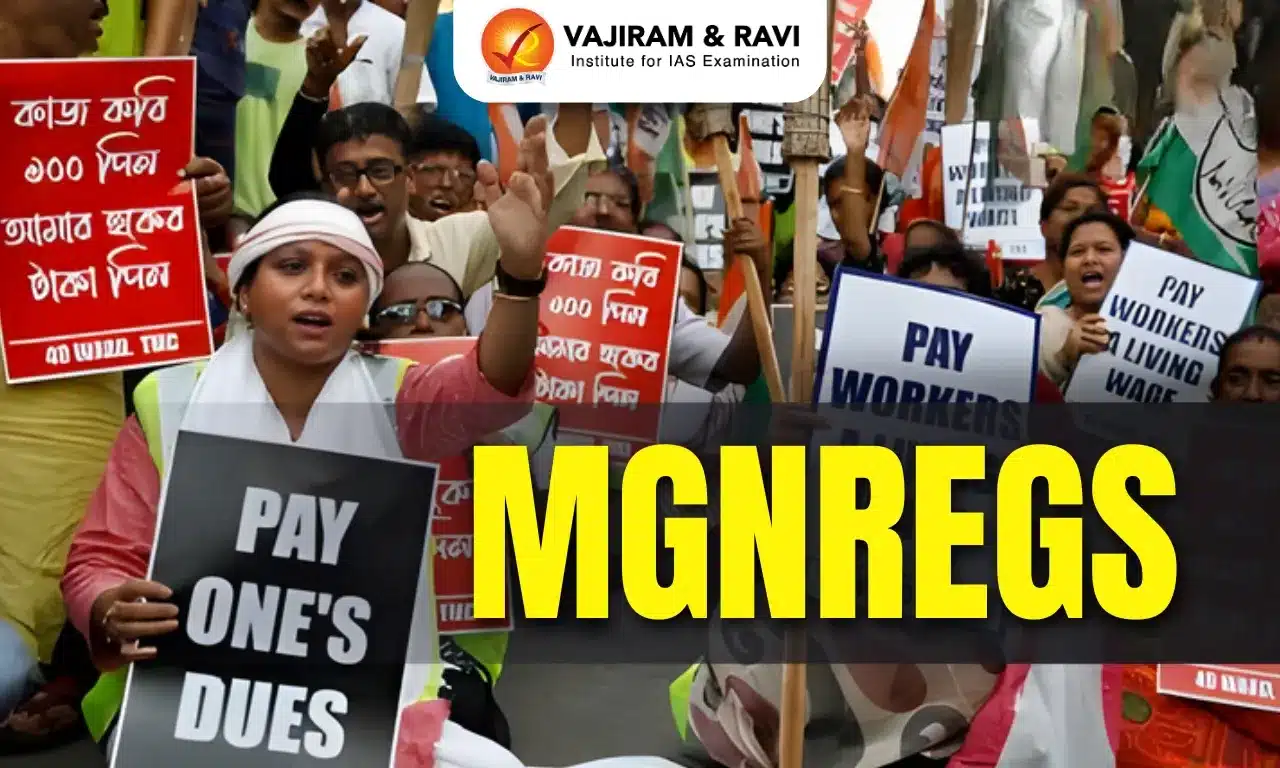
  • The Supreme Court has allowed the resumption of the Mahatma Gandhi National Rural Employment Guarantee Scheme (MGNREGS) in West Bengal after a suspension of three and a half years.
  • Under the MGNREGA Act, 2005, rural adults willing to do unskilled manual work are legally entitled to 100 days of wage employment annually, with funding shared in a 90:10 ratio between the Centre and the State, and the Centre covering all wages.
  • Before the Centre suspended the scheme in 2022, West Bengal ranked among the top-performing states, with 51–80 lakh families benefiting from it each year between 2014-15 and 2021-22.
  • The Supreme Court dismissed the Centre’s plea challenging the Calcutta High Court’s order that directed the scheme to resume from August 1, 2025, clearing the way for its implementation to restart.

Why MGNREGS Was Stopped in West Bengal

  • The Centre suspended MGNREGS funds to West Bengal from March 2022, citing “non-compliance with central directives” under Section 27 of the MGNREGA Act, 2005.
  • According to the Ministry of Rural Development, inspections revealed financial irregularities, execution of non-permissible works, splitting of projects, and a lack of transparency and accountability in implementation
  • Despite repeated warnings, no significant improvement was observed.
  • The state government persistently demanded resumption of the scheme. When the Centre refused, the state moved the Calcutta High Court, which ordered MGNREGS to resume from August 1, 2025.
  • The Centre appealed to the Supreme Court, but recently, a bench of Justices Vikram Nath and Sandeep Mehta dismissed the plea, clearing the way for the scheme’s restart in the state.

MGNREGS Likely to Resume Soon in West Bengal After SC Order

  • With the Supreme Court dismissing the Centre’s plea, the Ministry of Rural Development (MoRD) now has no option but to restart MGNREGS in West Bengal.
  • The ruling is a major setback for the ministry, which had earlier resisted resuming the scheme.
  • In December 2024, MoRD had stated that West Bengal must meet compliance requirements before funds for MGNREGS and PMAY-G could be released. 
    • The Centre had halted funding for both schemes in 2022, citing corruption in implementation.
  • Now, after the SC’s decision, the ministry is expected to begin procedural steps to restore funds and resume MGNREGS operations in the state.

Labour Budget Clearance Key to Restarting MGNREGS in West Bengal

  • The first step toward restarting MGNREGS in West Bengal is the approval of the state’s labour budget by the Ministry of Rural Development (MoRD). The state has already approached the ministry for this clearance.
  • The labour budget outlines the expected demand for unskilled work and lists projects to be undertaken in a financial year. It is approved by an Empowered Committee headed by the Union Rural Development Secretary.
  • Once approved, states can generate fund requests through NREGASoft, the scheme’s Management Information System (MIS). 
  • The MoRD then releases funds based on the agreed labour budget.
  • Normally, these approvals are completed by January each year, but West Bengal’s labour budget has not been cleared since 2021-22, when funding was suspended. 
  • Approval of this budget is therefore essential for resuming MGNREGS operations in the state.

West Bengal’s Pending Dues Under Rural Development Schemes

  • According to West Bengal government sources, about ₹18,000 crore in dues are pending from the Centre under three major rural development schemes:
    • MGNREGS, 
    • Pradhan Mantri Awas Yojana-Gramin (PMAY-G), and 
    • Pradhan Mantri Gram Sadak Yojana (PMGSY).
  • However, the Central government reports a lower figure. 
    • In a Rajya Sabha reply in December 2023, then Rural Development Minister stated that ₹13,965 crore was pending as the Central share for MGNREGS and PMAY-G combined.
  • The gap between the two estimates highlights the ongoing disagreement between the Centre and the state over the exact amount owed to West Bengal under these key welfare programmes.

Source: IE

MGNREGS FAQs

Q1: Why was MGNREGS suspended in West Bengal?

Ans: The Centre stopped funds in 2022 citing financial irregularities, non-compliance, and lack of transparency under Section 27 of the MGNREGA Act.

Q2: What did the Supreme Court decide?

Ans: The SC dismissed the Centre’s plea, upholding the Calcutta HC’s order to resume MGNREGS from August 1, 2025.

Q3: What is required to restart MGNREGS in West Bengal?

Ans: The first step is approval of the state’s labour budget by the Rural Development Ministry, after which funds can be released.

Q4: How much money is owed to West Bengal?

Ans: The state claims ₹18,000 crore in pending dues, while the Centre acknowledges about ₹13,965 crore under MGNREGS and PMAY-G.

Q5: What happens next after the SC order?

Ans: The Rural Development Ministry must now complete procedural steps to restore funds and restart work under MGNREGS in the state.

How India Could Become a $30 Trillion Economy by 2048

$30 Trillion Economy

$30 Trillion Economy Latest News

  • At the Berlin Global Dialogue, Commerce and Industry Minister Piyush Goyal asserted that India will be a $30 trillion economy within 20–25 years, shaping how the country negotiates trade deals.
  • Goyal argued that while the US economy is currently eight times larger, the gap will narrow significantly over the next 25 years
  • His statement underlines India’s growing economic confidence and its aim to negotiate trade agreements from a position of strength, aligned with its long-term growth trajectory. 

Understanding the Size of an Economy

  • The size of an economy is measured by its Gross Domestic Product (GDP) — the total market value of all goods and services produced within a country in a year.
  • GDP reflects a nation’s economic strength and global influence, much like a scoreboard that tracks overall performance. A larger GDP indicates greater production, spending, and prosperity.
  • As of end-2024, the US GDP stood at $29.2 trillion, while India’s GDP in the 2023–24 financial year was $3.9 trillion
    • To compare, the US state of California alone had a GDP of $4.1 trillion.
  • An easy analogy: GDP is like the total runs scored by a cricket team over a season — the higher the runs (output), the stronger and more successful the team (economy).

How a Country’s GDP Is Used For Comparison

  • Globally, GDP is expressed in US dollar terms to allow easy comparison between countries.
  • To calculate this, a nation’s GDP in local currency (rupees, in India’s case) is divided by the rupee–dollar exchange rate.
  • The GDP discussed internationally is usually the nominal GDP, which includes the effect of inflation — unlike real GDP, which adjusts for it.
  • Projecting future GDP, therefore, depends on two factors:
    • India’s nominal GDP in rupees, and
    • The rupee–dollar exchange rate.
  • For example, India’s GDP in 2024 was about Rs 330 trillion. If the exchange rate had remained ₹65 per US dollar (as in 2014), India would have been a $5 trillion economy.
  • However, since the rate weakened to ₹84 per dollar, the GDP in dollar terms was only $3.9 trillion.

Assessing the Validity of $30 Trillion Projection

  • The Minister’s projection of India becoming a $30 trillion economy in the next 25 years appears realistic, based on past trends.
  • Looking back, from 2000 to 2024, India’s nominal GDP grew at a compounded annual growth rate (CAGR) of 11.9%, while the rupee depreciated against the US dollar at a CAGR of 2.7%.
  • If India maintains the same growth and currency depreciation rates over the next 25 years, its GDP would surpass $30 trillion by 2048 — around 27 years from now, which aligns closely with Goyal’s prediction.

Why $30 Trillion Target Faces Challenges

  • While projecting future growth using past trends seems reasonable, India’s economic momentum has slowed since 2014.
  • Over the past 11 years, India’s nominal GDP has grown at a CAGR of 10.3%, lower than the 11.9% average of the previous 25 years.
  • Meanwhile, the rupee’s depreciation has slightly accelerated to 3.08%, compared to 2.7% earlier.
  • This means slower economic growth combined with faster currency weakening.
  • If these recent trends continue, India’s GDP would reach $30 trillion only around 2055, not by 2048, pushing Goyal’s target back by nearly a decade.

The Real Impact of a Slower Growth Rate

  • The timeline difference between India reaching a $30 trillion economy by 2048 or 2055 may appear small — just 7 to 8 years — but the financial impact is huge.
  • If India continues growing at the pace of the past 25 years, by 2055 its economy would be 75% larger than what it would be if it grew at the slower rate of the past 11 years.
  • In short, even a slight dip in growth momentum over time can lead to massive differences in economic size when projected over decades.

India Must Sustain Higher Growth to Realize Its $30 Trillion Vision

  • The analysis shows that each decade’s performance matters — even small changes in growth rates can cause huge long-term differences in economic size.
  • Although it’s normal for growth to slow as economies mature, India is still relatively small compared to the US and China and cannot afford a slowdown yet.
  • To make the $30 trillion goal credible, India must accelerate its growth rate and maintain strong, consistent economic momentum over the coming decades.

Source: IE | BS

$30 Trillion Economy FAQs

Q1: What did Piyush Goyal say about India’s economy?

Ans: He said India will become a $30 trillion economy in 20–25 years, emphasizing long-term confidence in the country’s growth potential.

Q2: What does GDP measure?

Ans: GDP represents the total value of goods and services produced within a country, reflecting its overall economic size and global influence.

Q3: How is GDP calculated in dollar terms?

Ans: GDP in rupees is divided by the rupee–dollar exchange rate. A weaker rupee lowers GDP’s dollar value even if domestic output rises.

Q4: Is the $30 trillion target realistic?

Ans: Yes, if India maintains a 11.9% GDP growth and 2.7% rupee depreciation, the economy could cross $30 trillion by 2048

Q5: What could delay India’s $30 trillion milestone?

Ans: Slower growth since 2014 and a faster rupee decline could push the goal to 2055, showing how small rate shifts have large effects.

Enquire Now