
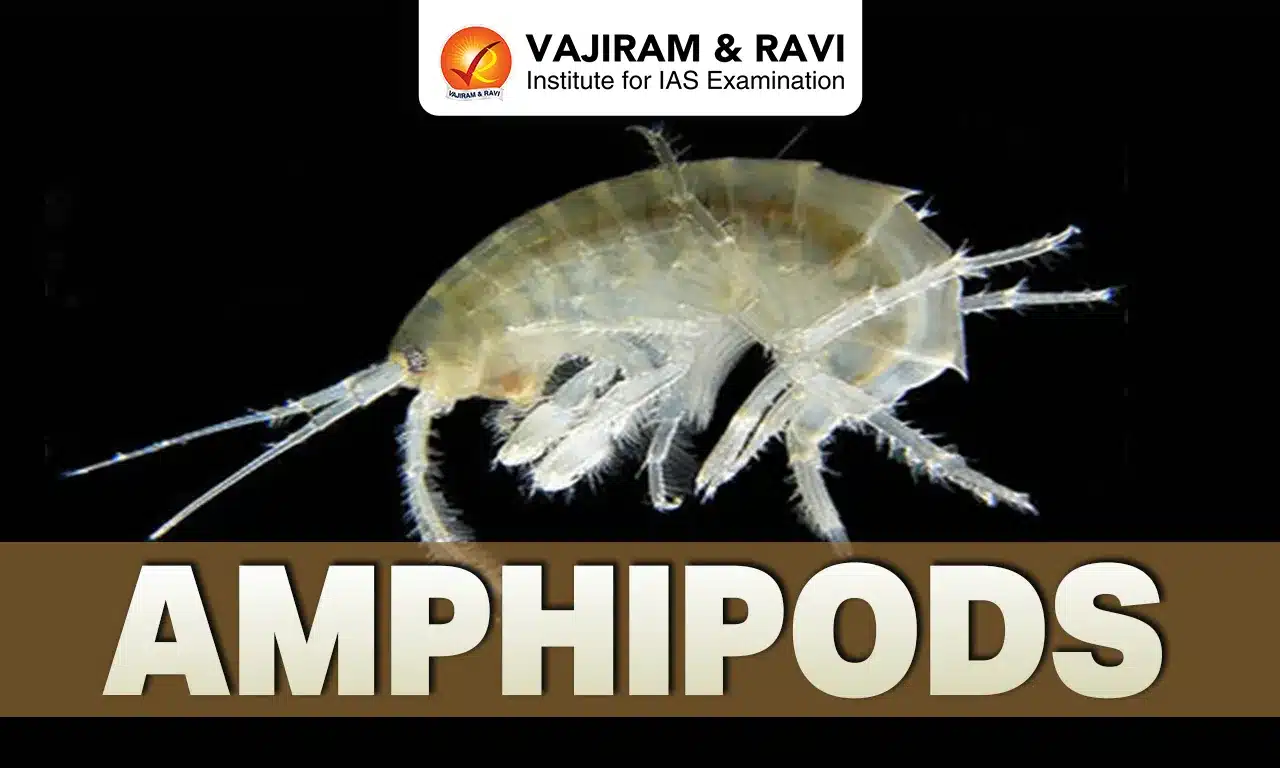
Amphipods Latest News
Two new species of marine amphipods, Grandidierella geetanjalae and Grandidierella khambhatensis, have been found by a team of researchers from Chilika and the Gulf of Khambhat, recently.
About Amphipods
- They are a type of small crustacean.
- They are related to crabs, lobsters, and shrimp.
- They can be found in almost all water environments.
- They live in the ocean, in fresh water, and even on land.
- The name ‘amphipoda’ means "different-footed."
- This is because they have many different kinds of legs.
- Unlike some other crustaceans, their legs are not all the same.
- There are over 7,000 known species of amphipods. Most of them belong to a group called Gammaridea.
- Amphipods can be very tiny, about 0.1 centimeters (0.04 inches) long. But some can grow quite large, up to 34 centimeters (13 inches).
- Most amphipods eat tiny bits of dead plants and animals. Some are also scavengers, eating what they find.
- They live in many places.
- About 750 species live in caves.
- Some amphipods are terrestrial animals, like sandhoppers.
- The largest amphipods live deep down on the sea floor. They can be found seven kilometers (about 4.3 miles) deep.
About Grandidierella Geetanjalae and Grandidierella Khambhatensis
- They are two new species of marine amphipods.
- Grandidierella geetanjalae was collected from the Chilika lagoon near Rambha in Ganjam district, Odisha.
- Grandidierella khambhatensis was collected from the Gulf of Khambhat, Gujarat.
- Both species measure between 5.5 and 6 mm in length.
- They are detritivorous, feeding primarily on organic matter and playing an important role in maintaining ecosystem health by contributing to natural cleaning processes.
Source: TOI
Amphipods FAQs
Q1: Amphipods belong to which group of animals?
Ans: Crustaceans
Q2: The name ‘Amphipoda’ refers to what special feature?
Ans: Having different types of legs.
Q3: Amphipods can be found in which type of environment?
Ans: Marine, freshwater, and terrestrial habitats.

