
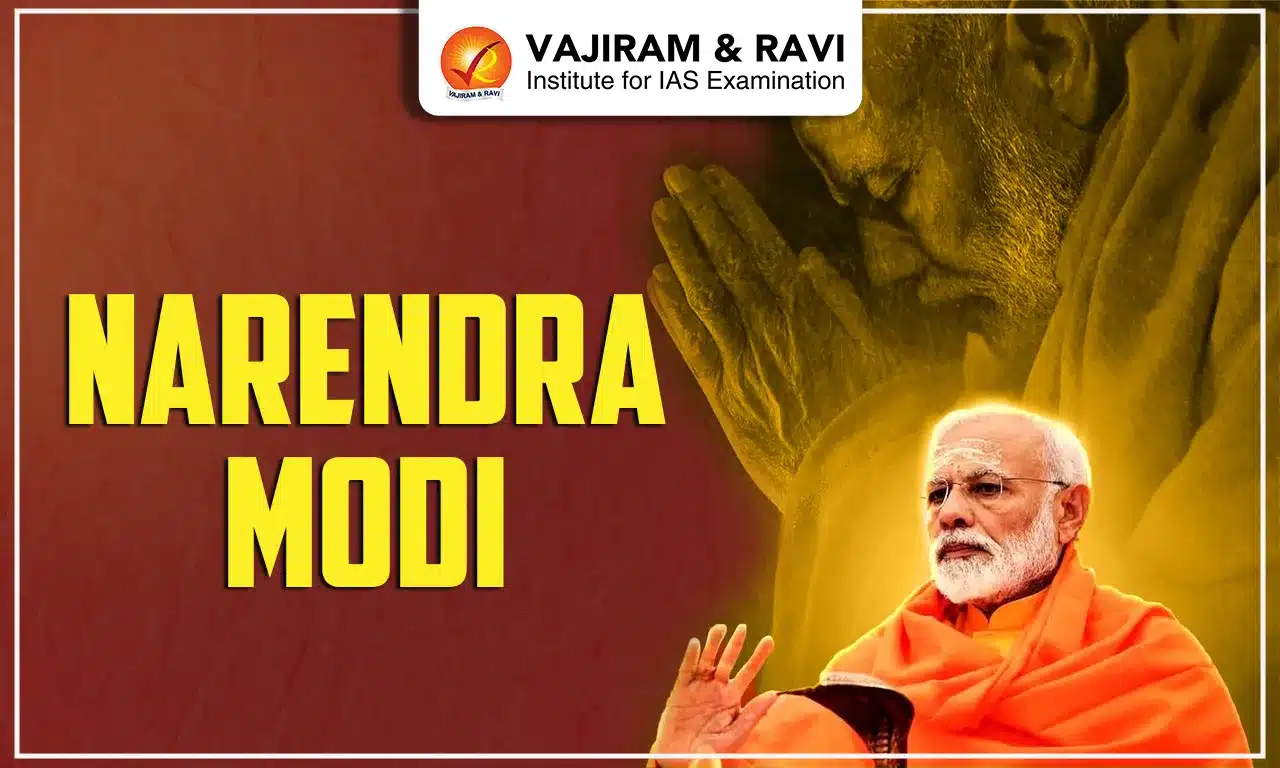
Narendra Modi, born on 17 September 1950 in Vadnagar, Gujarat, is the Current Prime Minister of India. Rising from humble beginnings, he became an RSS member and later joined the BJP. He served as Chief Minister of Gujarat (2001-2014) before becoming India’s 14th Prime Minister in 2014, known for his dynamic leadership and development-focused governance.
An early member of the Rashtriya Swayamsevak Sangh (RSS), Modi later joined the Bharatiya Janata Party (BJP), where his organisational skills and leadership quickly gained recognition. He holds a degree in Political Science, which laid the foundation for his deep interest in governance and public policy.
Narendra Modi Birthday
Narendra Modi, born on September 17, 1950, has turned 75 on Wednesday, September 17, 2025. His birthday is observed as Sewa Diwas by the BJP and its supporters through social service activities like health camps, cleanliness drives, and blood donation. This year, a special Sewa Pakhwada (Sept 17-Oct 2) will be launched, focusing on Swadeshi and Aatmanirbhar Bharat. On his birthday, Narendra Modi will inaugurate a mega textile park in Dhar, Madhya Pradesh.
Narendra Modi Biography
Narendra Modi, born on September 17, 1950, in Vadnagar, Gujarat, is an Indian politician serving as the Prime Minister of India since May 2014. He represents the Bharatiya Janata Party (BJP), one of the major national parties known for its right-of-center ideology. Modi’s life story reflects a journey from modest beginnings to national leadership. His rise in politics, shaped by discipline, organizational skills, and strong oratory, has made him one of the most prominent and influential figures in contemporary Indian politics.
Narendra Modi Facts
Narendra Modi’s journey from a small town in Gujarat to becoming the Prime Minister of India has been remarkable. Below is a quick overview of Narendra Modi Facts and political details about him.
| Narendra Modi Facts | |
|
Date of Birth |
PM Modi was born on September 17, 1950. |
|
Age |
In Vadnagar, Gujarat, on September 17, 1950, the current Prime Minister, Narendra Modi, was born; hence, PM Modi’s Age is 75 years. |
|
Full Name of Narendra Modi |
His full name is Narendra Damodardas Modi. |
|
Constituency |
He serves as the Lok Sabha representative for the Varanasi constituency and is recognised as a strong party strategist. |
Narendra Modi Early Life
Narendra Modi, the Current Prime Minister of India, was born and raised in a small village in northern Gujarat. He went on to pursue higher education at Gujarat University in Ahmedabad, where he earned a Master’s degree in Political Science.
In the early 1970s, Modi became associated with the Rashtriya Swayamsevak Sangh (RSS), a pro-Hindu nationalist organisation. He quickly became active in the Akhil Bharatiya Vidyarthi Parishad (ABVP), the student wing of the RSS, and soon began climbing the organisation’s ranks. His long association with the RSS played a key role in shaping his ideological foundation and proved instrumental in his later political rise.
By 1987, Modi transitioned to formal politics when he joined the Bharatiya Janata Party (BJP). Within the same year, he was appointed General Secretary of the Gujarat unit of the party. Over the next decade, he was deeply involved in expanding the BJP’s influence in Gujarat.
Modi’s organisational skills and political strategy helped the BJP secure a major win in the Gujarat Legislative Assembly Elections 1995, enabling the party to form its first-ever government in the state. Earlier, in 1990, he had also been part of the BJP’s role in forming a coalition government in Gujarat. However, the BJP’s hold on the state was short-lived, lasting only until September 1996.
Narendra Modi Education
Narendra Damodardas Modi, born on 17 September 1950 in Vadnagar, Gujarat, comes from a humble background. He grew up in a lower-middle-class family of grocers, where financial struggles were part of daily life. His early years instilled in him the values of hard work, perseverance, and discipline.
Primary and Secondary Education: Modi completed his primary and higher secondary schooling in Vadnagar. Teachers recall him as a bright and curious student with a deep interest in debates and theatre.
Higher Education:
- Bachelor’s Degree (BA): Modi pursued Political Science at the University of Delhi, earning his degree in 1978.
- Master’s Degree (MA): He continued his academic journey at Gujarat University in Ahmedabad, where he completed a Master’s in Political Science in 1983.
After completing his studies, Modi dedicated himself to public service. He became a pracharak (campaigner) for the Rashtriya Swayamsevak Sangh (RSS), where he developed his organisational skills and political ideology. His active involvement in the RSS eventually paved the way for his political career in the Bharatiya Janata Party (BJP).
Narendra Modi Political Timeline
The journey of Narendra Modi of becoming the Longest-Serving Prime Minister outside the Congress party, is marked by significant milestones. The timeline below highlights the key events in his life and career, showcasing how he rose through the ranks, took on leadership roles in Gujarat, and eventually emerged as a national leader.
| Narendra Modi Political Timeline | |
|
Years |
Events |
|
2024 |
After another strong electoral performance, Narendra Modi was sworn in for a third consecutive term as Prime Minister on June 9, 2024. |
|
2019 |
Narendra Modi, the prime minister of India, has been elected for a second five-year term. |
|
2014 |
The 14th and current Prime Minister of India is Narendra Modi. On May 26, 2014, Modi took the oath of office as India’s prime minister. After India gained its independence from the British Empire, he became the country’s first prime minister. |
|
2012 |
Modi won re-election in Maninagar. This time, he won by 34097 votes over Bhatt Shweta Sanjiv. In his fourth stint as chief minister, he again took the oath. Later, in 2014, he left the assembly. |
|
2007 |
The third term of Modi’s leadership as CM began on December 23, 2007, and it ended on December 20, 2012. Once more, he prevailed over Maninagar. Dinsha Patel of Congress lost to him. |
|
2002 |
The assembly election was won by him, who ran from Maninagar. By 38256 votes, he defeated Congressman Oza Yatinbhai Narendrakumar. He continued to serve as Gujarat’s chief minister (his second term). |
|
2001 |
Keshubhai Patel’s health was deteriorating, and the BJP suffered a couple of losses in by-elections for state assembly seats. Modi took over as Gujarat’s Chief Minister after Patel was ousted by the BJP’s national leadership. Modi took his oath as Gujarat’s chief executive on October 7, 2001. He won the Rajkot II constituency’s by-election on February 24, 2002. By 14,728 votes, he defeated Ashwin Mehta of the INC. This was his first and only temporary position. |
|
1995 |
He moved to New Delhi after being appointed the BJP national secretary. He oversaw the Himachal Pradesh and Haryana electoral campaigns. In 1996, Modi was allowed to become the BJP’s general secretary. |
|
1990 |
Modi participated in the planning of L. K. Advani’s 1990 Ram Rath Yatra and Murli Manohar Joshi’s 1991–1992 Ekta Yatra. |
|
1987 |
Modi was chosen to serve as the Gujarat branch of the BJP’s organising secretary. |
|
1986 |
Modi succeeded L. K. Advani as BJP president. At that time, the RSS decided to give its members key posts within the BJP. |
|
1985 |
Modi was given to the BJP by RSS. Modi assisted in planning the BJP’s campaign for the Ahmedabad municipal election later in 1987. The BJP won that election. |
|
1979 |
He relocated to Delhi and started working with the RSS, where he was assigned to write and do research for the RSS’s account of the Emergency. |
|
1978 |
He became an “RSS sambhag pracharak,” associated with RSS activity in the Surat and Vadodara regions. |
|
1975 |
The RSS chose Narendra Modi to be the organisation’s general secretary, or “Gujarat Lok Sangharsh Samiti”. In order to avoid being arrested during the Emergency, Modi was compelled to hide. Printing pamphlets critical of the government was something he did. |
Narendra Modi as Chief Minister of Gujarat
Narendra Modi as Chief Minister of Gujarat branded Gujarat as “Vibrant Gujarat,” highlighting economic growth and infrastructure development. Critics, however, point to persistent poverty, malnutrition, and low literacy in the state. According to data in 2014, Gujarat ranked 18th in literacy and 14th in poverty as of 2013. While women’s education and maternal health showed improvement, rural and lower-caste communities reportedly saw little benefit from the state’s progress.
| Narendra Modi as Chief Minister of Gujarat | ||||
|
Term |
Period |
Key Events & Initiatives |
Achievements |
Controversies / Criticism |
|
First Term |
2001-2002 |
Took oath as CM on 7 Oct 2001; organized BJP for 2002 elections |
Initiated privatization of small government institutions |
2002 Godhra train incident & subsequent anti-Muslim riots; SIT later found no evidence against Modi, though allegations of concealed evidence emerged |
|
Second Term |
2002-2007 |
Focused on economic development and investment promotion; Vibrant Gujarat Summit 2007 |
Established financial and technological parks; signed real estate investments worth Rs. 6,600 billion; served 2,063 consecutive days as CM |
Critics argued benefits mainly went to urban areas; rural and marginalized communities less affected |
|
Third Term |
2007-2012 |
Strengthened agriculture & rural infrastructure; micro-irrigation; power supply improvements; Sadbhavana Mission launched |
500,000 infrastructure projects including 113,738 check dams; normalized groundwater in 60 tehsils; Bt cotton production increased; agriculture growth rate 9.6%; CAGR 10.97% |
Critics highlighted continuing rural poverty and marginalization of Dalit & tribal communities; growth seen as benefiting mostly urban middle class |
|
Fourth Term |
2012-2014 |
Elected from Maninagar by a large margin; continued infrastructure & investment focus |
Prepared Gujarat for economic growth & smooth transition to national politics |
Limited time for term-specific controversies; ongoing criticism about uneven development across social groups |
Narendra Modi Major Achievement
The following table provides a detailed overview of the major milestones, initiatives, and achievements of Narendra Modi throughout his political career. It covers his tenure as Chief Minister of Gujarat and as the Prime Minister of India, highlighting key economic reforms, social programs, infrastructure projects, legislative decisions, foreign policy actions, and environmental initiatives. The table is organised chronologically and categorically to give a clear and comprehensive picture of his contributions to India’s development and governance.
| Narendra Modi Major Achievement | |||
|
Category |
Initiative / Reform |
Launched / Implemented |
Objective / Significance |
|
Economic Reforms |
Goods and Services Tax (GST) |
July 1, 2017 |
Streamline India’s tax structure into a unified system; improve compliance and ease of doing business |
|
Make in India |
September 25, 2014 |
Encourage domestic & international manufacturing; boost jobs and industrial growth |
|
|
Digital India |
July 1, 2015 |
Build digitally empowered society; improve e-governance and digital literacy |
|
|
Atmanirbhar Bharat |
May 12, 2020 |
Promote self-reliance; reduce import dependence, especially post-COVID-19 |
|
|
Social Initiatives |
Swachh Bharat Mission |
October 2, 2014 |
Improve sanitation and cleanliness; eliminate open defecation; manage solid waste |
|
Pradhan Mantri Jan Dhan Yojana (PMJDY) |
August 28, 2014 |
Financial inclusion; provide banking services for the unbanked, including zero-balance accounts |
|
|
Ayushman Bharat |
September 23, 2018 |
Health insurance coverage of ₹5 lakh per family/year; improve healthcare access for economically weaker sections |
|
|
Infrastructure Development |
Pradhan Mantri Awas Yojana (PMAY) |
June 25, 2015 |
Provide affordable housing to urban poor; ensure basic amenities for every family |
|
Ujjwala Yojana |
May 1, 2016 |
Free LPG connections for BPL women; improve health and reduce use of traditional fuels |
|
|
Foreign Policy & Diplomacy |
Strengthening Global Relations |
Ongoing |
Enhance trade, strategic partnerships, and cooperation with US, Japan, Russia, and others |
|
Act East Policy |
Ongoing |
Strengthen strategic & economic ties with Indo-Pacific countries, especially ASEAN nations |
|
|
Legislative / Policy Decisions |
Abrogation of Article 370 |
August 5, 2019 |
Revoke special status of Jammu & Kashmir; reorganize it into two Union Territories |
|
Citizenship Amendment Act (CAA) |
December 12, 2019 |
Provide citizenship pathway for non-Muslim refugees from Pakistan, Bangladesh, Afghanistan |
|
|
COVID-19 Response |
Vaccine Rollout |
January 16, 2021 |
Phase-wise vaccination starting with healthcare workers and high-risk groups |
|
Economic Stimulus Packages |
2020–2021 |
Financial support for businesses, workers, and healthcare during pandemic |
|
|
Environmental / Climate Initiatives |
International Solar Alliance (ISA) |
November 30, 2015 |
Promote global solar energy use; promotes international collaboration in solar power |
|
Bharat Stage VI (BS-VI) Emission Norms |
April 1, 2020 |
Improve air quality; mandate stricter vehicle emission standards |
|
Narendra Modi Books
Narendra Modi is not only a political leader but also a prolific writer. Over the years, he has authored several books and collections of stories that reflect his thoughts, experiences, and values. These works provide insight into his personal philosophy, social beliefs, and formative influences from his early days as a labourer and RSS pracharak to his vision for education, social harmony, and leadership. The following table summarises his notable literary contributions.
|
Book Title |
Theme / Focus |
Key Highlights |
|
Jyotipunj |
Inspirational figures |
Modi describes the people who inspired him and shaped his life, including reflections from these individuals themselves. |
|
Abode of Love |
Short stories on love |
A collection of eight stories highlighting the tender, compassionate side of Modi; explores motherly love as the root of all other forms of love. |
|
Premtirth |
Maternal feelings |
A heartfelt portrayal of maternal emotions through simple yet impactful storytelling. |
|
Kelve Te Kelavani |
Education and knowledge |
Focuses on the importance of nurturing education, presenting Modi’s vision for a knowledge revolution in Gujarat. |
|
Sakshibhav |
Personal reflections |
A collection of letters to Jagat Janani Maa, revealing Modi’s emotional journey and inner self during his time with the RSS. |
|
Samajik Samarasata |
Social harmony |
Papers and talks on social reform, caste equality, and Modi’s encounters with Dalits, reflecting his belief in social peace and action-oriented principles. |
Narendra Modi FAQs
Q1: What is the salary of Modi?
Ans: The Prime Minister of India earns ₹2,80,000 per month (basic salary plus allowances), excluding perks and official residence.
Q2: Where is Narendra Modi's birthday?
Ans: Narendra Modi was born on 17 September 1950 in Vadnagar, Gujarat.
Q3: Who is India's Prime Minister in 2025?
Ans: As of 2025, Narendra Modi continues as India’s Prime Minister.
Q4: What is the qualification of Modi?
Ans: Narendra Modi holds a Master’s degree in Political Science from Gujarat University (correspondence program).
Q5: Whose salary is highest in India?
Ans: The Chief Justice of India and the President of India receive higher salaries than the Prime Minister, approximately ₹2.5-5 lakh/month plus allowances.
