
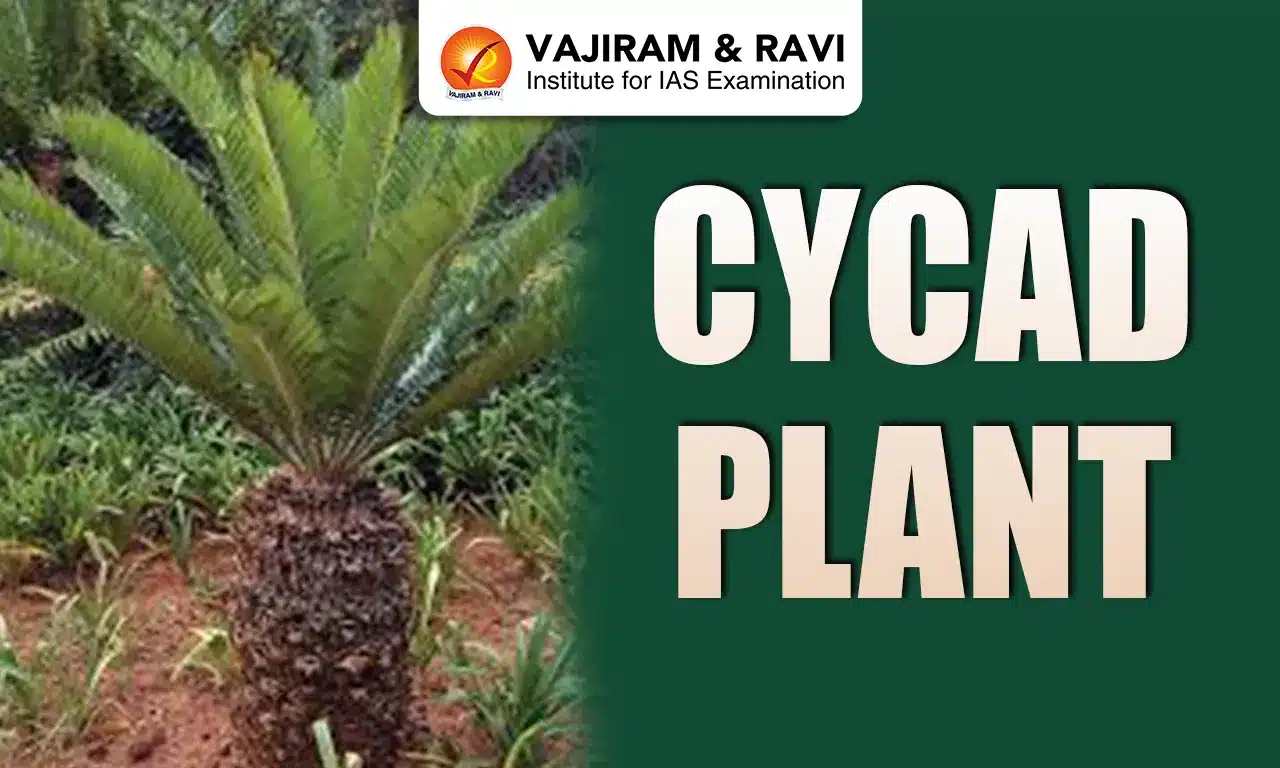
Cycad Plant Latest News
The All India Institute of Medical Sciences (AIIMS), Bhubaneswar has initiated a research on Cycad, over concerns that the plant contains BMAA, a potential neurotoxin.
About Cycad Plant
- It is the palmlike woody gymnospermous plants.
- It is an ancient plant species that is believed to have coexisted with dinosaurs for over 300 million years.
- Habitat: They occupy a variety of habitats. Some are native to wet rainforests while others are from semidesert climates; others grow in grasslands or seasonally dry forests.
- Distribution: Tropical and subtropical latitudes in the Americas, Caribbean, sub-Saharan Africa, Madagascar, eastern India, China, Japan, southeast Asia, Oceania and Australia.
Features of Cycad Plant
- They are woody, long-lived, unisexual plants and their main roots thickened, fleshy and often tuberous.
- They are distinguished by crowns of large pinnately compound leaves and by cones.
- Cycads in general are fire-adapted, losing leaves to the blaze but soon restoring them in a growth flush.
- Soil: They may be found growing in rich, organic soils, sand, or rock, in swampy soils or even in halophytic (salty) soils.
- Cycads are long-lived, don’t reproduce frequently, and most populations are small, putting them at risk of extinction.
- Threats: Habitat conversion through agriculture or development, illegal removal of wild plants for horticultural collection, and climate change.
Source: TOI
Cycad Plant FAQs
Q1: What is the primary habitat of Cycad plants?
Ans: Tropical and subtropical regions
Q2: What is a characteristic feature of Cycad plants?
Ans: They are gymnosperms

