
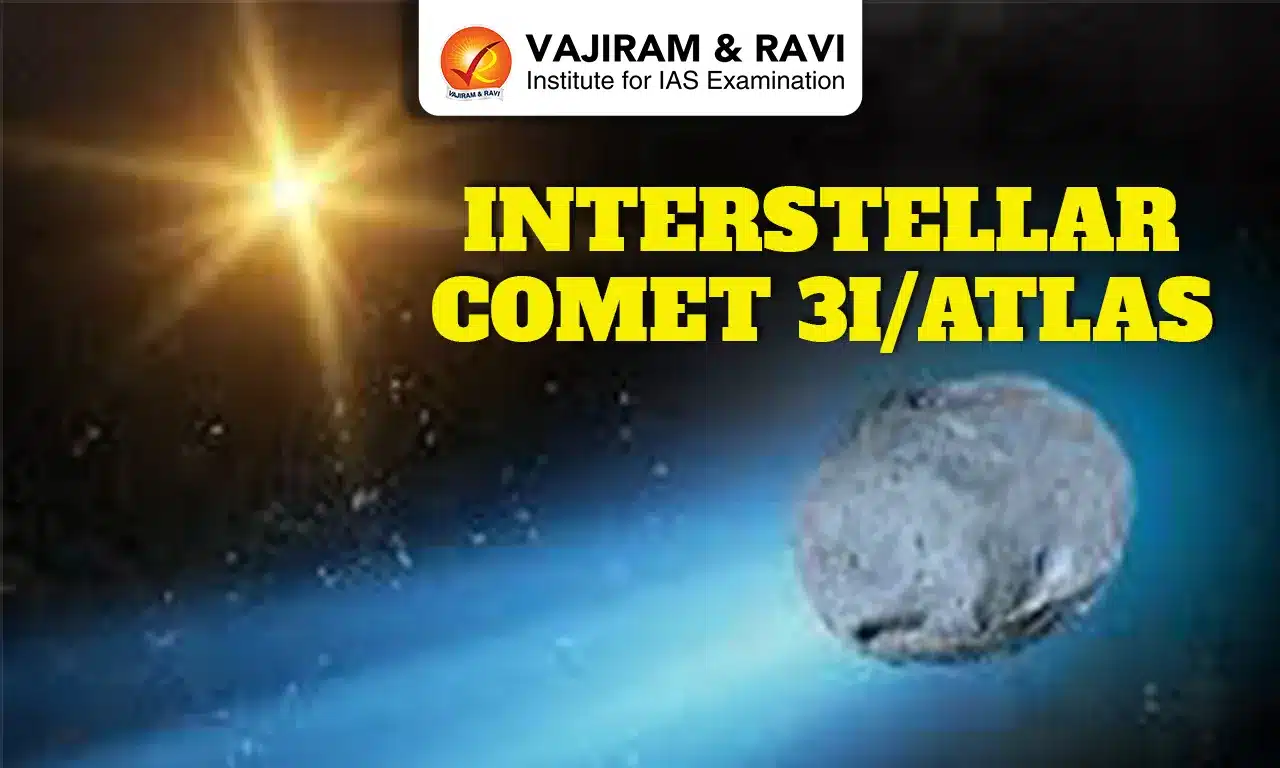
Interstellar Comet 3I/ATLAS Latest News
Recently, NASA astronomers have confirmed the detection of water’s chemical fingerprint on the interstellar comet 3I/ATLAS.
About Interstellar Comet 3I/ATLAS
- It is the third known interstellar object from outside our solar system after 1I/ʻOumuamua(2017) and 2I/Borisov (2019).
- It has hyperbolic orbit and travels at 57–68 km/s speed relative to the Sun.
- It will exit the solar system permanently after a brief interaction with the Sun.
- This interstellar comet was first seen by a NASA-supported telescope in Rio Hurtado, Chile, which is part of the ATLAS (Asteroid Terrestrial-impact Last Alert System) survey.
Physical Characteristics of Interstellar Comet 3I/ATLAS
- 3I/ATLAS is confirmed to be an active comet, with a visible coma, a cloud of ice particles and dust surrounding the nucleus.
- As it nears the Sun, it is expected to develop a tail, a characteristic cometary feature formed by solar heating.
- Photometric analysis shows a reddish hue suggests the surface may be rich in complex organic compounds or water ice.
- The nucleus is estimated to be 10–30 km wide.
What are interstellar Objects?
- These are celestial bodies that originate outside the solar system, and travel through it. These objects are not gravitationally bound to a star.
- They can come from other solar systems and be thrown into interstellar space (the area between the stars) due to collisions or be slingshotted by a planet’s or star’s gravity.
- The trajectory of these objects is basically open-ended hyperbolic orbit, where there is a perihelion point (closest to the Sun) but no aphelion.
Source: ET
Interstellar Comet 3I/ATLAS FAQs
Q1: What is the origin of the Interstellar Comet 3I/ATLAS?
Ans: Outside our solar system
Q2: What is unique about the orbit of 3I/ATLAS?
Ans: It is hyperbolic.
