
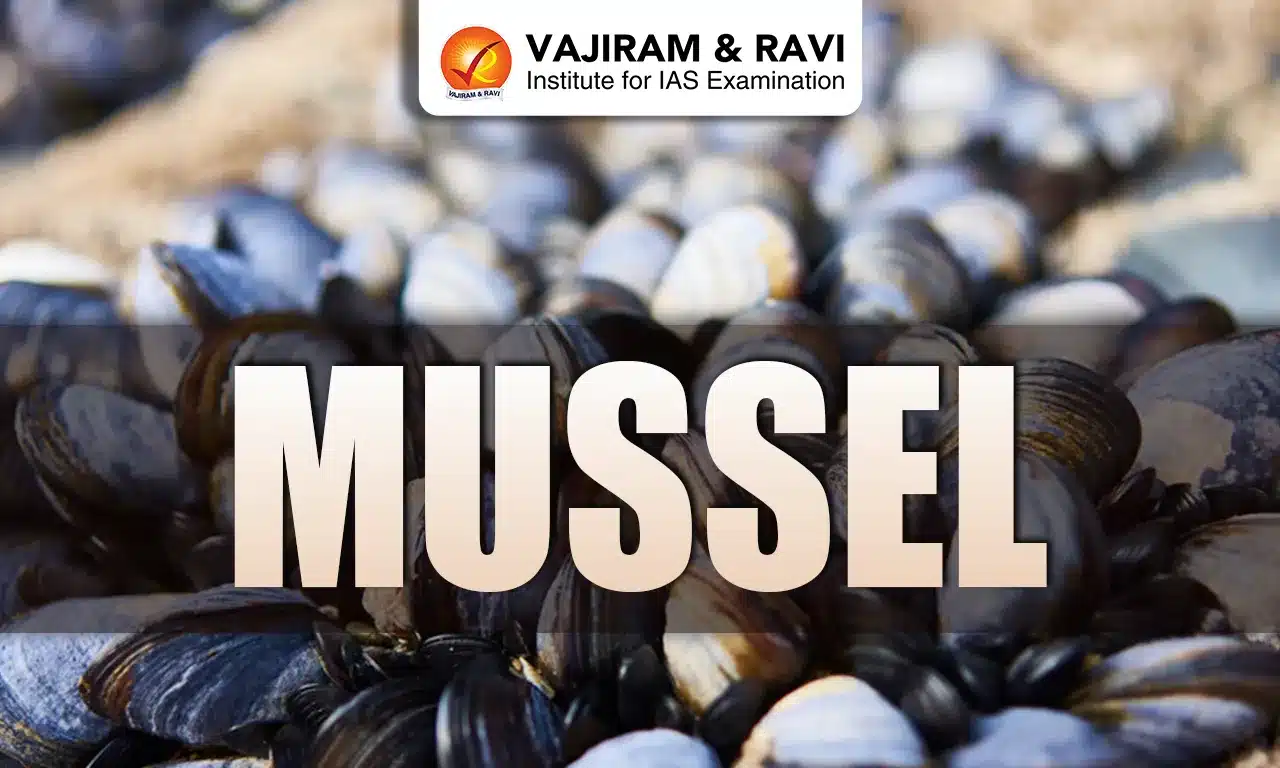
Mussel Latest News
Recently, Greek scientists have deployed thousands of mussels on the seafloor to help detect microplastics.
About Mussel
- It is a bivalve of mollusks belonging to the marine family Mytilidae and to the freshwater family Unionidae.
- Distribution: They are most common in cool seas. Freshwater mussels known as naiads inhabit streams, lakes, and ponds over most of the world.
Features of Mussel
- Appearance: Marine mussels are usually wedge-shaped or pear-shaped and range in size from about 5 to 15 centimetres.
- They may be smooth or ribbed and often have a hairy covering.
- The shells of many species are dark blue or dark greenish brown on the outside; on the inside they are often pearly.
- They attach themselves to solid objects or to one another by proteinaceous threads called byssus threads.
- They often occur in dense clusters.
- Ecological Role: These species are filter-feeding organisms that absorb a range of contaminants into their tissue, including invisible microplastics.
- They have been used globally for decades as a barometer of marine pollution.
Benefits of Mussel
- Food Source: They are edible and considered nutritious, rich in protein, omega-3 fatty acids, and various vitamins and minerals.
- Pearl Production: Freshwater mussels are used for pearl cultivation.
- Ecological Role: These species are filter-feeding organisms that absorb a range of contaminants into their tissue, including invisible microplastics.
- They have been used globally for decades as a barometer of marine pollution.
Source: Reuters
Mussel FAQs
Q1: What type of creature is a mussel?
Ans: Mollusk
Q2: What is the term for the process by which mussels filter water to obtain food?
Ans: Filter feeding

