Second World Summit for Social Development 2025

Second World Summit for Social Development 2025

Second World Summit for Social Development 2025 Latest News

The Minister for Labour & Employment is representing India at the World Summit for Social Development (WSSD-2) held in Doha, Qatar.

About Second World Summit for Social Development 2025

  • It is a United Nations convened summit which reaffirms to eradicate poverty, promote full and productive employment and decent work for all, and foster social inclusion.
  • It is designed to align with other recent global processes, such as the 2023 SDG Summit Political Declaration, the Pact of the Future and the forthcoming Fourth International Conference on Financing for Development (FfD4).
  • History: The first World Summit for Social Development was held in Copenhagen in March 1995.
  • The second World Summit for Social Development is held in Doha, Qatar.

Main Objectives of Second World Summit for Social Development 2025

  • Global solidarity and accelerate action on social development by assessing progress, addressing gaps.
  • Strengthening implementation of the 2030 Agenda for Sustainable Development and the Sustainable Development Goals.
  • Reaffirm the 10 Commitments of the Copenhagen
    Declaration
  • Promote equality, inclusion, and well-being for all
  • Strengthen global solidarity and cooperation

Source: DD News

Second World Summit for Social Development 2025 FAQs

Q1: What is the theme of the Second World Summit for Social Development?

Ans: "Putting People First: Advancing Global Social Development and Social Justice"

Q2: Where is the Second World Summit for Social Development being held?

Ans: Doha, Qatar

Q3: What is the primary objective of the Second World Summit for Social Development?

Ans: To reaffirm global commitment to social development and the 2030 Agenda.
Emissions Gap Report 2025

Emissions Gap Report 2025

Emissions Gap Report 2025 Latest News

Emissions Gap Report 2025 assessment has found that updated global climate pledges have resulted in only marginal progress towards limiting global warming.

About Emissions Gap Report 2025

  • Emissions Gap Report is an annual report published by the United Nations Environment Programme (UNEP).
  • The EGR series tracks our progress in limiting global warming well below 2°Cand pursuing 1.5°C in line with the Paris Agreement.
  • It is launched every year ahead of the UN Climate Change Conference of the Parties (COP).
  • The EGR is co-produced by UNEP, the UNEP Copenhagen Climate Centre (UNEP-CCC) and partners.

Key Highlights of Emissions Gap Report 2025

  • Even after countries fully implement their latest Nationally Determined Contributions (NDC) under the Paris Agreement, global temperatures are projected to rise by 2.3-2.5 degrees Celsius (°C) this century.
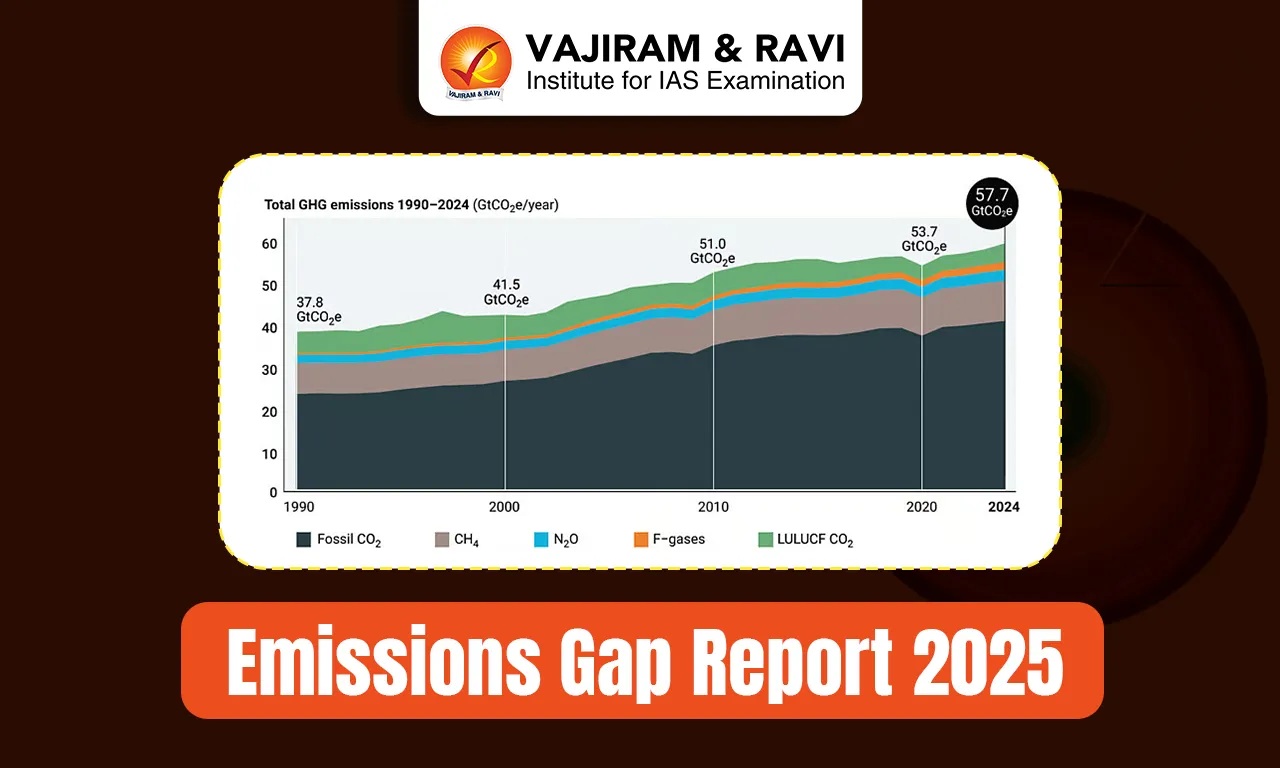
  • Global GHG emissions rose 2.3% in 2024, reaching 57.7 gigatonnes of CO₂ equivalent.
  • Only 60 Parties, covering 63% of global emissions, have submitted new NDCs for 2035.
  • To align with the 1.5°C target, emissions would need to fall by 55 per cent by 2035. 

Source: DTE

Emissions Gap Report 2025 FAQs

Q1: What is the primary objective of UNEP?

Ans: To promote sustainable development and protect the environment

Q2: Where is the headquarters of UNEP located?

Ans: Nairobi, Kenya

Q3: Which organization publishes the Emissions Gap Report?

Ans: United Nations Environment Programme

Project Suncatcher

Project Suncatcher

Project Suncatcher Latest News

Recently, Google announced a new research initiative called Project Suncatcher.

About Project Suncatcher

  • It is a research initiative exploring how constellations of solar-powered satellites could host data centres in space. 
  • It is an initiative of Google.
  • Google aims to deploy high-performance AI accelerators in space and build a space-based infrastructure.

Features of Project Suncatcher

  • Project Suncatcher will build modular satellite arrays linked by high-speed free-space optical communication, supporting data transfer at tens of terabits per second.
  • It will send AI data centers into space by launching solar-powered satellites equipped with its Tensor Processing Units (TPUs), specialised AI chips.
  • The plan includes launching two prototype satellites in partnership with Planet Labs by early 2027 to test the hardware’s durability and performance in space.
  • The proposed system consists of a constellation of networked satellites, likely operating in a dawn–dusk sun-synchronous low earth orbit.
  • Early tests have shown Google’s Trillium-generation TPUs withstand radiation at levels similar to those found in space.

Source: TH

Project Suncatcher FAQs

Q1: What is the primary objective of Google's Project Suncatcher?

Ans: To explore scalable AI computing systems in space

Q2: When does Google plan to launch its prototype satellites for Project Suncatcher?

Ans: Early 2027

Alprazolam

Alprazolam

Alprazolam Latest News

Recently, the Directorate of Revenue Intelligence (DRI) has busted a clandestine factory manufacturing alprazolam in Valsad under “Operation White Cauldron”.

About Alprazolam

  • Alprazolam is a psychotropic substance under the Narcotics, Drugs and Psychotropic Substances (NDPS) Act 1985.
  • This drug falls under the benzodiazepines class of drugs, and is a tranquillizing agent used in the treatment of anxiety disorders.
  • Benzodiazepines belong to the group of medicines called central nervous system (CNS) depressants, which are medicines that slow down the nervous system.
  • It is used to treat anxiety disorders, panic disorders, and anxiety caused by depression.

Key Facts about Narcotics, Drugs and Psychotropic Substances (NDPS) Act 1985

  • It prohibits any individual from engaging in any activity consisting of the production, cultivation, sale, purchase, transport, storage, and/or consumption of any narcotic drug or psychotropic substance.

Objectives of  NDPS Act 1985

  • To take measures for preventing, combating, and regulating operations relating to narcotic drugs and psychotropic substances.
  • To provide for the forfeiture of property derived from or used in, illicit traffic in narcotic drugs and psychotropic substances.
  • To implement the provisions of the international conventions on Narcotic Drugs and Psychotropic Substances and for all relevant matters.
  • To add or omit the list of psychotropic substances.

Source: PIB

Alprazolam FAQs

Q1: What is the primary use of Alprazolam?

Ans: Anti-anxiety medication

Q2: What is a common side effect of Alprazolam?

Ans: Drowsiness

National Cooperative Development Corporation

National Cooperative Development Corporation

National Cooperative Development Corporation Latest News

The National Cooperative Development Corporation remains a cornerstone of India’s cooperative growth and has demonstrated its pivotal role in fostering self-reliance and inclusive development.

About National Cooperative Development Corporation

  • It is a statutory organisation established in 1963, under the Ministry of Cooperation, Government of India.

Functions of National Cooperative Development Corporation

  • Promoting and strengthening farmer cooperatives: It aims to increasing production, productivity by developing farmer cooperatives and instituting post-harvest facilities
  • Postharvest Facilities: It provides assistance for developing processing, storage, cold chain and marketing of agricultural produce and the supply of seeds, fertilizer and other agricultural inputs etc.
  • It also supports income-generating cooperatives across various non-farm sectors such as weaker section activities which include dairy, livestock, handloom, sericulture etc.
  • It provides financial assistance to the cooperative sector for their economic development and social upliftment through NCDC Sponsored schemes and various GoI schemes implemented by NCDC

Initiatives of National Cooperative Development Corporation

  • Yuva Sahakar-Cooperative Enterprise Support and Innovation Scheme
    • It is designed to promote cooperative start-ups across diverse sectors by supporting newly formed cooperatives with innovative ideas.
    • It gives preferential support extended to cooperatives in the North Eastern Region, those operating in Aspirational Districts  and cooperatives comprising exclusively women, SC, ST, or PwD members.
  • Ayushman Sahakar: It adopts a holistic approach to strengthening the healthcare ecosystem through cooperative institutions.

Source: PIB

National Cooperative Development Corporation FAQs

Q1: What is the primary objective of the National Cooperative Development Corporation (NCDC)?

Ans: To support the growth of cooperative societies

Q2: What is the primary function of NCDC?

Ans: Supporting the growth of cooperative societies

State of Food and Agriculture (SOFA) Report 2025

State of Food and Agriculture (SOFA) Report 2025

State of Food and Agriculture (SOFA) Report 2025 Latest News

According to the State of Food and Agriculture (SOFA) Report 2025 land degradation affects 1.7 billion people, threatening food security and ecosystems.

About State of Food and Agriculture (SOFA) Report 2025

  • It is published by the Food and Agriculture Organization of the United Nations (FAO).
  • It provides the most comprehensive analysis about human-driven land degradation impacts crop yields, identifies global vulnerability hotspots, and examines where these losses intersect with poverty, hunger and other forms of malnutrition.

Key Highlights of State of Food and Agriculture (SOFA) Report 2025

  • It stated that agricultural expansion remained the primary driver of global deforestation, accounting for nearly 90 per cent of forest loss.
  • It has reshaped global land use and transformed land-use patterns across the planet over centuries.
  • The largest affected populations were concentrated in eastern and southern Asia regions burdened by extensive degradation and high population density.
  • India had some of the highest yield gaps due to human-induced land degradation. 
  • It highlighted that around 3.6 mha of croplands were abandoned annually, with land degradation likely playing a significant role in these losses. 

Source: DTE

State of Food and Agriculture (SOFA) Report 2025 FAQs

Q1: What is the primary focus of the State of Food and Agriculture (SOFA) Report 2025?

Ans: Sustainable Land Use

Q2: What is the primary driver of land degradation, according to the SOFA Report 2025?

Ans: Anthropogenic causes like deforestation, overgrazing, and unsustainable cropping practices.

Striped Hyena

Striped Hyena

Striped Hyena Latest News

Recently, a rare striped hyena (Hyaena hyaena) was spotted in the Kali Tiger Reserve in Uttara Kannada district, Karnataka.

About Striped Hyena

  • The Striped hyena (Hyaena hyaena) is a mammal belonging to the family Hyaenidae.
    • The Hyaenidae family has four members: Striped hyenas, Spotted hyenas, Brown hyenas, and the aardwolf (which is not a wolf).
  • Appearance: It is a bit smaller than the spotted hyenas and has stripes all over their bodies. 
  • Distribution: It is mainly found in South Asia (India, Nepal, Afghanistan), North Africa, Sub-Saharan Africa, Western Asia, and Central Asia.
  • Habitat: It lives in open savannas, grasslands, and scrub woodlands in arid to semi-arid environments.

Characteristics of Striped Hyena

  • They are territorial creatures and scent-mark their territorial boundaries as a warning to their rivals.
  • Food Habit: Striped hyenas are primarily scavengers and eat mainly carrion and human refuse
  • Adult Striped hyena females are dominant over males and aggressive toward other females.
  • The striped hyena is generally considered solitary, but has some social organization.

Conservation Status of Striped Hyena

  • IUCN: Near Threatened.
  • Wildlife Protection Act, 1972: Schedule I

Source: TOI

Striped Hyena FAQs

Q1: What is the scientific name of the Striped Hyena?

Ans: Hyaena hyaena

Q2: What is the primary diet of the Striped Hyena?

Ans: Scavenger

Pradhan Mantri Kaushal Vikas Yojana

Pradhan Mantri Kaushal Vikas Yojana

Pradhan Mantri Kaushal Vikas Yojana Latest News

Recently, there are glaring irregularities found in the execution of Pradhan Mantri Kaushal Vikas Yojana (PMKVY) and the skill Ministry blacklisted 178 training partners. 

About Pradhan Mantri Kaushal Vikas Yojana

  • It is a skill development programme launched by the government of India in 2015.
  • It aims to empower the youth of India to engage in industry relevant skill training and secure a better livelihood.
  • Implementing Agency: It is being implemented by the National Skill Development Corporations in partnership with multiple stakeholders.

Eligibility Criteria of Pradhan Mantri Kaushal Vikas Yojana

  • Age Limit: Candidates aged 14 to 35 years are generally eligible for PMKVY training programs.
  • Nationality: Applicants must be Indian citizens to qualify for the scheme.
  • Educational Qualifications: PMKVY caters to individuals from diverse educational backgrounds, including those without formal education.
  • Employment Status: Priority is given to unemployed or underemployed individuals to enhance their employability.
  • Aadhar Card: An Aadhar card is often a mandatory requirement for applying to PMKVY programs.

Features of Pradhan Mantri Kaushal Vikas Yojana

  • Industry experts are consulted regularly in order to ensure that updated skill training is provided according to industry demands. 
  • Short term training courses make it easy for people to acquire new skills within a short period of time. 
  • Recognition to Prior Learning is also acknowledged through certification without undergoing the same training. 
  • The scheme also aims to provide placement assistance for all the candidates trained in a certain skill.

Source: IE

Pradhan Mantri Kaushal Vikas Yojana FAQs

Q1: Which ministry is responsible for implementing Pradhan Mantri Kaushal Vikas Yojana ?

Ans: Ministry of Skill Development and Entrepreneurship

Q2: What is the primary objective of PMKVY?

Ans: To promote skill development and employability

Chronic Obstructive Pulmonary Disease

Chronic Obstructive Pulmonary Disease

Chronic Obstructive Pulmonary Disease Latest News

According to the World Health Organization, Chronic Obstructive Pulmonary Disease (COPD) is the fourth-leading cause of death worldwide, causing 3.5 million deaths in 2021. 

About Chronic Obstructive Pulmonary Disease

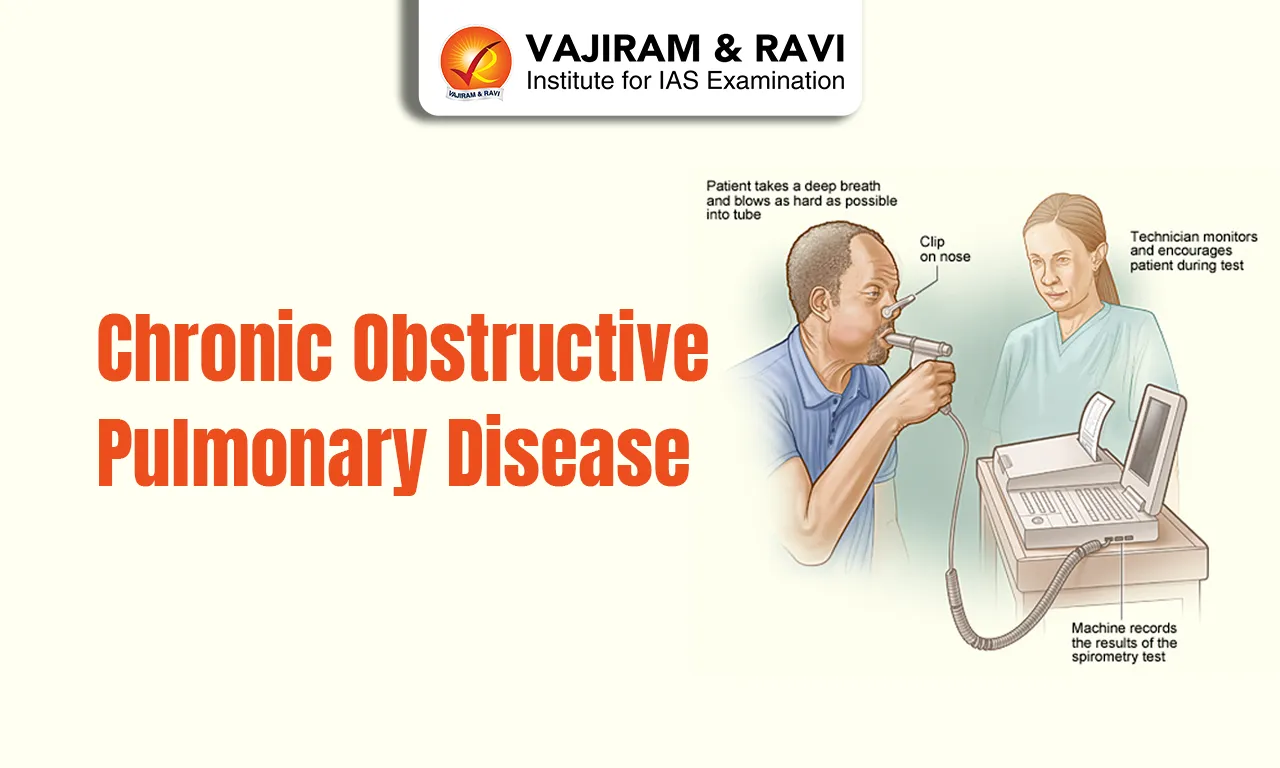
  • It is a condition caused by damage to the lungs that results in breathing difficulties.
  • The damage, which is inflammation and scarring, can be in the airways to the lungs, in the air sacs of the lungs, or both.
  • Causes: One of the main causes of COPD is smoking. And another is indoor air pollution.

Types of Chronic Obstructive Pulmonary Disease

  • Chronic bronchitis: It is caused by inflammation of the lining of the airways, or the tubes that bring air into your lungs.
    • When these bronchi, are inflamed, they become narrower, leading to restricted airflow, and causing the formation of extra, thick mucus.
  • Emphysema: It develops when the air sacs of the lungs, known as alveoli, are damaged. This makes it difficult for the lungs to pass adequate oxygen into the bloodstream, causing shortness of breath.

Symptoms of Chronic Obstructive Pulmonary Disease

  • A cough with mucus that lasts for three months or more at a time;
  • Experiencing tightness in the chest;
  • Shortness of breath especially during physical activities;
  • Wheezing or whistling sounds in the breath;
  • Frequent chest infections and fatigue or extreme tiredness.
  • Treatment: There is no cure for COPD. Treatment is based on the severity and is focused on managing symptoms and reducing flare ups.

 Source: TH

Chronic Obstructive Pulmonary Disease FAQs

Q1: What is the primary cause of COPD?

Ans: Smoking

Q2: What is the purpose of pulmonary rehabilitation in COPD management?

Ans: To improve exercise tolerance and quality of life.

VAIBHAV Fellowship Programme

VAIBHAV Fellowship Programme

VAIBHAV Fellowship Programme Latest News

Recently, the Union Minister of State for Science and Technology interacted with Vaishvik Bhartiya Vaigyanik (VAIBHAV) Fellows from across the world.

About VAIBHAV Fellowship Programme

  • It is awarded to outstanding scientists/technologists of Indian origin (NRI/OCI/PIO) who are engaged in research activities in their respective countries.
  • The VAIBHAV Fellow would identify an Indian Institution for collaboration and may spend up to two months in a year for a maximum of 3 years.
  • Funding: The government offers the researchers an amount of INR 4,00,000 per month for the entire period.
  • Aim: Improving the research ecosystem of India’s Higher Educational Institutions by facilitating academic and research collaborations between Indian Institutions and the best institutions in the world.
  • It connects Indian diaspora scientists with Indian institutions by simplifying travel, extending fellowships, and creating structured student mobility. 
  • Eligibility:
    • Researchers from institutions featuring in the top 500 QS World University Rankings will be eligible for the fellowship.
    • The applicant must have obtained a Ph.D/M.D/M.S degree from a recognized University.
  • The 75 selected fellows would be invited to work in 18 identified knowledge verticals including quantum technology, health, pharma, electronics, agriculture, energy, computer sciences, and material sciences amongst others.
  • Nodal Ministry: Department of Science and Technology, Ministry of Science and Technology.

Source: DD News

VAIBHAV Fellowship Programme FAQs

Q1: What is the primary objective of the VAIBHAV Fellowship Programme?

Ans: To promote research collaboration between Indian diaspora and Indian academic institutions.

Q2: Which department is responsible for implementing the VAIBHAV Fellowship Programme?

Ans: Department of Science and Technology (DST)

Enquire Now