Khangchendzonga National Park Latest News
The International Union for Conservation of Nature (IUCN) recently rated Khangchendzonga National Park as “good” in its latest global review of natural World Heritage sites.
About Khangchendzonga National Park
- It is located in the north of Sikkim.
- It is a part of the Khangchendzonga Biosphere Reserve (KBR).
- KBR is India’s first “mixed” UNESCO World Heritage Site, recognised in 2016 for its combination of natural beauty and cultural importance.
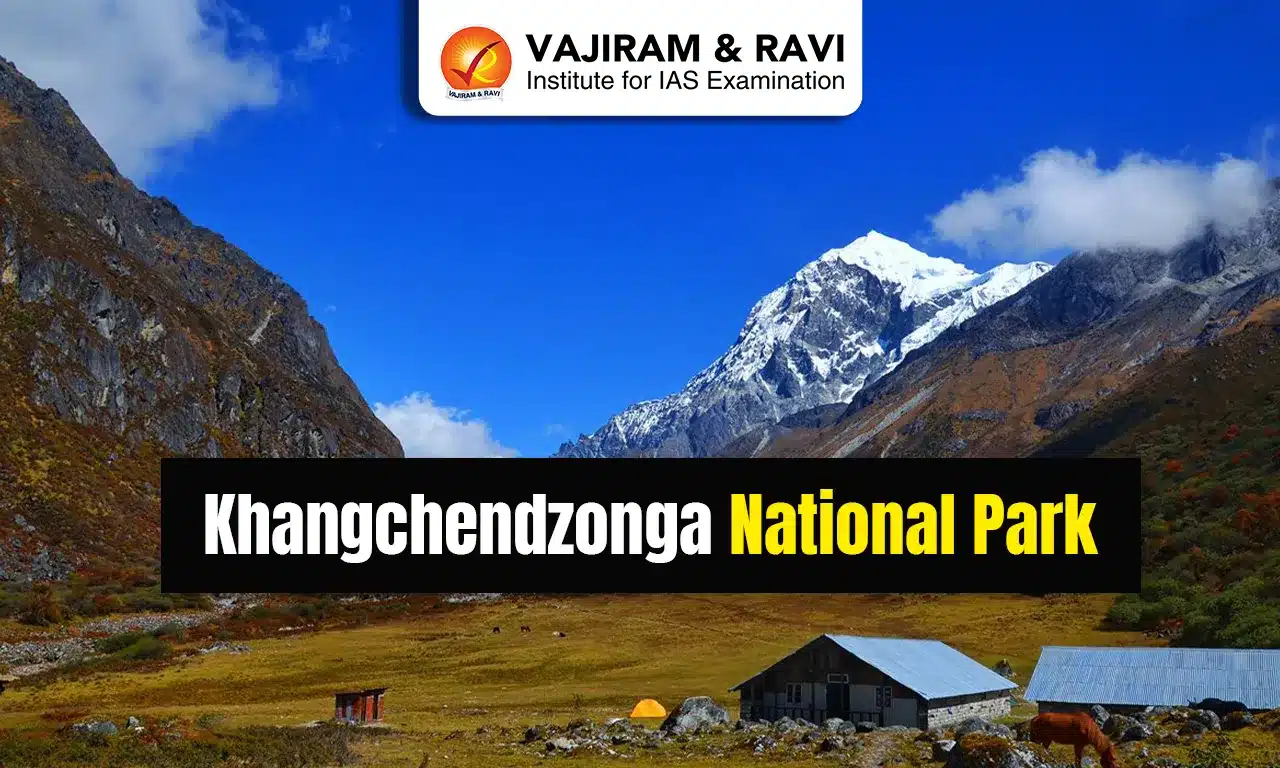
- It is home to Mt. Khangchendzonga, the third highest peak in the world.
- It lies entirely along the Sikkim-Nepal border.
- It is a part of the Himalaya global biodiversity hotspot.
- It encompasses an area covering 1784 sq.km.
- It exhibits one of the widest altitudinal ranges of any protected area worldwide. The park has an extraordinary vertical sweep of over 7 kilometres (1,220 m to 8,586 m).
- It has a unique diversity of plains, valleys, lakes, glaciers, and spectacular, snow-capped mountains covered with ancient forests.
- It has, in total, 18 glaciers, the largest one being Zemu Glacier, one of the largest glaciers in Asia.
- It is one of the very few places where you will find the Lepcha tribal settlements.
- Flora: Subtropical to alpine vegetation; includes oak, fir, birch, maple, and rhododendron.
- Fauna:
- It is home to important flagship species such as the snow leopard, Tibetan wolf, red panda, blue sheep, Himalayan Tahr, and mainland serow, among many.
- It is home to nearly half of India's bird diversity.
Source: NOA
Khangchendzonga National Park FAQs
Q1: In which Indian State is the Khangchendzonga National Park located?
Ans: Sikkim
Q2: Which country shares an international boundary with Khangchendzonga National Park?
Ans: Nepal
Q3: What is the altitudinal range of Khangchendzonga National Park?
Ans: 1,220 m to 8,586 m
Q4: Which is the largest glacier found in Khangchendzonga National Park?
Ans: Zemu Glacier