Khangchendzonga National Park

Khangchendzonga National Park

Khangchendzonga National Park Latest News

The International Union for Conservation of Nature (IUCN) recently rated Khangchendzonga National Park as “good” in its latest global review of natural World Heritage sites.

About Khangchendzonga National Park

  • It is located in the north of Sikkim.
  • It is a part of the Khangchendzonga Biosphere Reserve (KBR).
    • KBR is India’s first “mixed” UNESCO World Heritage Site, recognised in 2016 for its combination of natural beauty and cultural importance. 
  • It is home to Mt. Khangchendzonga, the third highest peak in the world. 
  • It lies entirely along the Sikkim-Nepal border.
  • It is a part of the Himalaya global biodiversity hotspot.
  • It encompasses an area covering 1784 sq.km. 
  • It exhibits one of the widest altitudinal ranges of any protected area worldwide. The park has an extraordinary vertical sweep of over 7 kilometres (1,220 m to 8,586 m).
  • It has a unique diversity of plains, valleys, lakes, glaciers, and spectacular, snow-capped mountains covered with ancient forests.
  • It has, in total, 18 glaciers, the largest one being Zemu Glacier, one of the largest glaciers in Asia. 
  • It is one of the very few places where you will find the Lepcha tribal settlements. 
  • Flora: Subtropical to alpine vegetation; includes oak, fir, birch, maple, and rhododendron.
  • Fauna:
    • It is home to important flagship species such as the snow leopard, Tibetan wolf, red panda, blue sheep, Himalayan Tahr, and mainland serow, among many.
    • It is home to nearly half of India's bird diversity.

Source: NOA

Khangchendzonga National Park FAQs

Q1: In which Indian State is the Khangchendzonga National Park located?

Ans: Sikkim

Q2: Which country shares an international boundary with Khangchendzonga National Park?

Ans: Nepal

Q3: What is the altitudinal range of Khangchendzonga National Park?

Ans: 1,220 m to 8,586 m

Q4: Which is the largest glacier found in Khangchendzonga National Park?

Ans: Zemu Glacier

Vedanthangal Bird Sanctuary

Vedanthangal Bird Sanctuary

Vedanthangal Bird Sanctuary Latest News

The Vedanthangal Bird Sanctuary has come alive with the arrival of thousands of migratory birds marking the start of the season.

About Vedanthangal Bird Sanctuary

  • It is located in the Chengalpattu District of Tamil Nadu
  • It is one of the oldest bird protected areas in the country as well as in the State of Tamil Nadu.
  • This freshwater wetland is a people-protected water bird area.
    • The history of which goes back to centuries where local people have been protecting this heronry (Breeding ground of Herons) and in return, have been benefited by the manure-rich water from the lake that increases the agriculture yield multifold–Liquid Guano Effect.
  • This site is also recognized internationally, as an Important Bird and Biodiversity Area (IBA). It belongs to the Coromandel Coast biotic province.
  • It was designated as Ramsar Site in 2022.
  • Flora: It includes Alangium salviflorum trees, Acacia nilotica, thorn forests and dry evergreen scrub.
  • Fauna: It is home to black-headed ibis (Threskiornis melanocephalus), Eurasian spoonbill (Platalea leucorodia), black-crowned night heron (Nycticorax nycticorax) and painted stork (Mycteria leucocephala)

Source: TOI

Vedanthangal Bird Sanctuary FAQs

Q1: Where is the Vedanthangal Bird Sanctuary located?

Ans: Tamil Nadu

Q2: When is the best time to visit Vedanthangal Bird Sanctuary?

Ans: November to March

Baliyatra Festival

Baliyatra Festival

Baliyatra Festival Latest News

Recently, the President of India extended greetings on the occasion of the historic ‘Baliyatra’ festival and ‘Boita Bandana’ to all the countrymen.

About Baliyatra Festival

  • It is celebrated annually in Cuttack, Odisha.
  • The term Bali Jatra literally means ‘Voyage to Bali’.
  • It is celebrated every year on Kartika Purnima that marks the day that the seafaring traders departed for the Indonesian islands.

Historical Significance of Baliyatra Festival

  • It is organised every year to commemorate the 2,000-year-old maritime and cultural links between ancient Kalinga (today’s Odisha) and Bali and other South and Southeast Asian regions like Java, Sumatra, Borneo, Burma (Myanmar) and Ceylon (Sri Lanka).

Celebration of Baliyatra Festival

  • The celebration features grand fairs, elaborate rides, food and dance.
  • Indian women perform ‘Boita Bandana’, they make boats of paper or banana leaf (sholapith) with lighted lamps inside and float them down the Mahanadi as a part of the celebrations.
  • The Bali Jatra celebrates the ingenuity and skill of those expert sailors who made Kalinga, one of the most prosperous empires of its time.

Source: News On Air

Baliyatra Festival FAQs

Q1: Where is the Baliyatra Festival celebrated?

Ans: Cuttack, Odisha

Q2: Which occasion is commemorated by the Baliyatra Festival?

Ans: Maritime trade and cultural exchange between Odisha and Southeast Asian countries.

Black-Headed Ibis

Black-Headed Ibis

Black-Headed Ibis Latest News

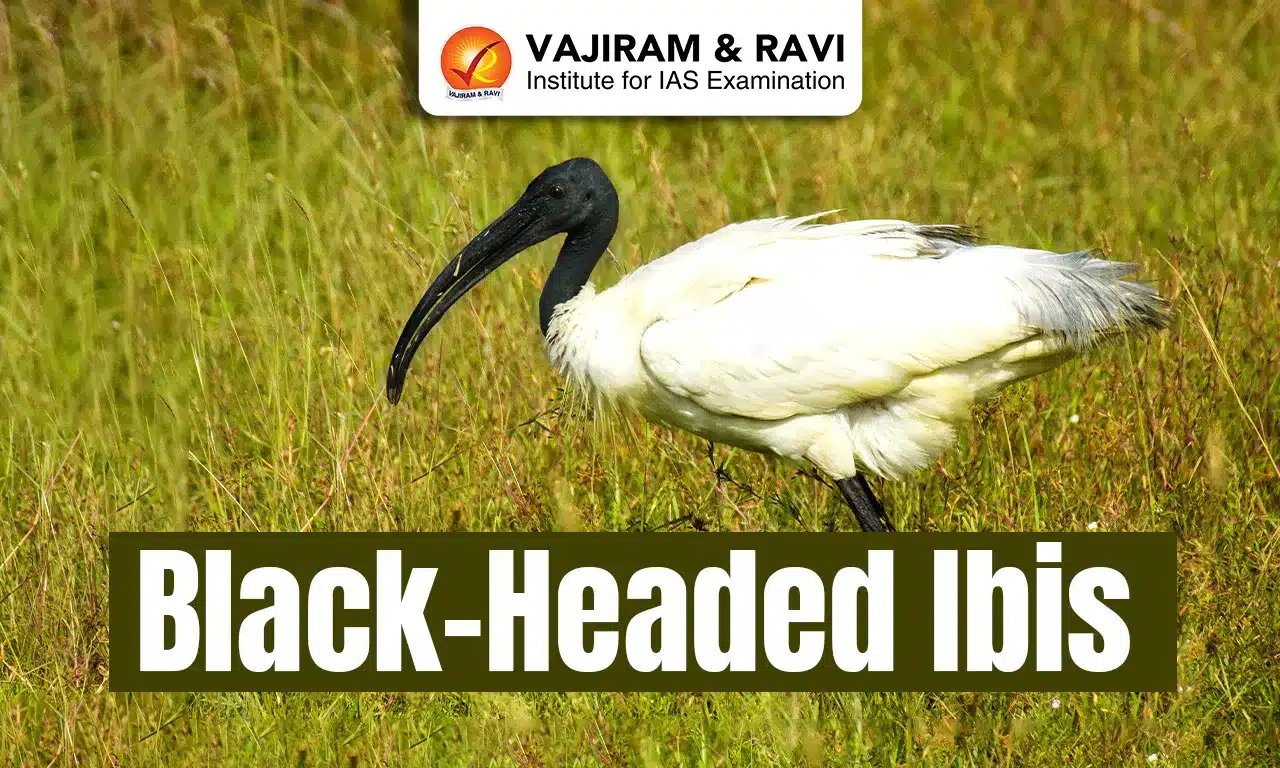
A flock of rare White Ibis, commonly known as Black-headed Ibis, was recently sighted in the salt pan regions of Thoothukudi district, Tamil Nadu.

About Black-headed Ibis

  • The black-headed ibis, also known as the Oriental white ibis, Indian white ibis, and black-necked ibis, is a species of wading bird of the ibis family Threskiornithidae.
  • Scientific Name: Threskiornis melanocephalus
  • These are called wader birds due to their adaptability to a wide variety of aquatic environments.

Black-headed Ibis Habitat and Distribution

  • It is found in South- and Southeast Asia from India to the west and as far east as Japan.
  • Found primarily around wetlands including agricultural fields and occasionally around coastal areas, but also seen foraging in dry fields and human-modified landscapes.

Black-headed Ibis Features

  • It is a large wader bird,  with adults measuring 65–76 cm in length. 
  • It is the only native ibis species in its range that has an overall white plumage with a black neck and head. 
  • Males and females look similar and both have greyish tail feathers. 
  • Tails of adults bear light grey ornamental feathers that turn jet black during the breeding season. 

Black-Headed Ibis Conservation Status

It is classified as 'Least Concern' under the IUCN Red List. 

Source: ANI

Black-Headed Ibis FAQs

Q1: What is the scientific name of the Black-headed Ibis?

Ans: Threskiornis melanocephalus

Q2: Is the black-headed ibis found in India?

Ans: It is found in South- and Southeast Asia from India to the west and as far east as Japan.

Q3: What is the IUCN status of the black-headed ibis?

Ans: Least Concern

National Technical Textiles Mission (NTTM)

National Technical Textiles Mission (NTTM)

National Technical Textiles Mission Latest News

Recently, the National Technical Textiles Mission supported the development of Indigenous Thermal Testing Instruments for Protective Textiles in association with Northern India Textile Research Association (NITRA).

About National Technical Textiles Mission

  • It was launched in 2020 by the Ministry of Textiles to boost technical textiles in India.
  • It was launched for a period from 2020-21 to 2025-26 with an outlay of Rs.1,480 crores. 

Components of the National Technical Textiles Mission

  • Research, Innovation and Development: It supports R&D in technical textiles, inviting proposals to develop new materials and processes.
  • Promotion and Market Development: It aims to increase technical textile adoption in India through market promotion and international collaborations.
  • Export Promotion: Focuses on boosting exports of technical textiles with a dedicated export council. Outlay
  • Education, Training, and Skill Development: Promotes technical textiles education, skill training, and internships in top institutes and industries.

What are Technical Textiles?

  • Technical textiles are defined as textile materials and products used primarily for their technical performance and functional properties rather than their aesthetic or decorative characteristics. 
  • Other terms used for defining technical textiles include industrial textiles, functional textiles, performance textiles,engineering textiles, invisible textiles, and hi-tech textiles.
    • These products are broadly classified into 12 different categories- Agrotech, Oekotech, Buildtech, Meditech, Geotech, Clothtech, Mobiltech, Hometech, Sportstech,Indutech, Protech, Packtech.
  • Applications: They are used in products that help protect people, improve machinery, and solve practical problems, such as in car parts, building materials, medical equipment, and safety gear.

Source: PIB

National Technical Textiles Mission FAQs

Q1: Which Ministry launched the National Technical Textiles Mission (NTTM)?

Ans: Ministry of Textiles

Q2: What is the primary objective of the NTTM?

Ans: To increase the domestic market size of technical textiles to $40-50 billion.

UN Water Convention

UN Water Convention

UN Water Convention Latest News

Bangladesh became the first country in South Asia to join the U.N.’s Water Convention earlier. 

About UN Water Convention

  • It is also known as the Convention on the Protection and Use of Transboundary Watercourses and International Lakes which was adopted in Helsinki in 1992 and entered into force in 1996.

History of UN Water Convention

  • It was originally negotiated as a regional framework for the pan-European region.
  • Following an amendment procedure, since March 2016 all UN Member States can accede to it.

Features of UN Water Convention

  • It is a unique legally binding instrument promoting the sustainable management of shared water resources, the implementation of the Sustainable Development Goals, the prevention of conflicts, and the promotion of peace and regional integration.
  • It requires Parties to prevent, control and reduce transboundary impact, use transboundary waters in a reasonable and equitable way and ensure their sustainable management.
  • Parties bordering the same transboundary waters have to cooperate by entering into specific agreements and establishing joint bodies.
  • As a framework agreement, the Convention does not replace bilateral and multilateral agreements for specific basins or aquifers; instead, it fosters their establishment and implementation, as well as further development.
  • The United Nations Economic Commission for Europe (UNECE), which services the UN Water Convention.
  • Significance: It is a powerful tool to promote and operationalize the achievement of the 2030 Agenda for Sustainable Development and its SDGs.

Source: DTE

UN Water Convention FAQs

Q1: What is the primary objective of the UN Water Convention?

Ans: To promote sustainable development and protect the environment

Q2: When was the UN Water Convention came into force?

Ans: 1996

Minuteman III Missile

Minuteman III Missile

Minuteman III Missile Latest News

The US Air Force successfully launched an unarmed Minuteman III ICBM, a test scheduled months in advance.

About Minuteman III Missile

  • The LGM-30G Minuteman III is an American-made intercontinental ballistic missile (ICBM).
  • “L” in LGM is the US Department of Defense designation for silo-launched;G” means surface attack; and “M” stands for guided missile.
  • Introduced in the early 1970s, the Minuteman III was the first missile in the US arsenal to feature multiple independently targetable reentry vehicles (MIRVs).
  • It is the sole land-based component of the U.S. nuclear triad.
  • It was developed for the United States by Douglas Aircraft Company, which later became part of McDonnell Douglas and then Boeing
  • Originally, it was only supposed to be kept in service for about ten years, but instead, it has been modernized as its replacement, the Ground-Based Strategic Deterrent (GBSD), is due to become available for use in 2029.
  • The United States currently has an estimated 440 Minuteman III missiles in its arsenal.

Minuteman III Missile Features

  • It weighs more than 30 tons and measures 18 meters long.
  • Propulsion: Three-stage solid fuel rocket motors; post-boost stage for positioning re-entry vehicle is liquid-fueled.
  • Speed: Approximately 15,000 mph (Mach 23 or 24,000 kph) at burnout (Hypersonic).
  • Range: It has a maximum range of approximately 13,000 kilometres.
  • It is capable of carrying a payload of three re-entry vehicles.
  • Originally capable of carrying three nuclear warheads, current configurations carry a single warhead, in compliance with arms control agreements between the United States and Russia.
  • Each missile is housed in a hardened underground silo, connected to a launch control center via reinforced cables.
  • It has a fast launch time, nearly 100 percent testing reliability, and backup airborne launch controllers to preserve retaliatory capabilities.

Source: TOI

Minuteman III Missile FAQs

Q1: What type of missile is the Minuteman III?

Ans: Intercontinental ballistic missile.

Q2: When was the Minuteman III missile first introduced?

Ans: Early 1970s

Q3: What is the approximate maximum range of the Minuteman III missile?

Ans: 13,000 km

Q4: What is the top speed of the Minuteman III missile?

Ans: Mach 23

GPS Spoofing

GPS Spoofing

GPS Spoofing Latest News

Delhi's Indira Gandhi International Airport faced massive disruptions recently when the flight operations witnessed GPS spoofing.

What is a Spoofing Attack?

  • A “spoofing attack” is a broad category of cyberattack where fake data is disguised as originating from a trusted source to deceive systems or users. 
  • Kinds of spoofing include GPS Spoofing, IP spoofing—often used to avoid detection while performing Distributed Denial of Service (DDoS)—as well as SMS spoofing and caller ID spoofing, where messages or calls appear to be from another number or caller ID.

About GPS Spoofing

  • GPS spoofing involves manipulating navigation data with malicious intent. 
  • Unlike jamming, which blocks GPS signals, spoofing involves transmitting fake satellite signals to override genuine ones.
  • The aircraft’s navigation systems pick up these counterfeit signals and calculate wrong data for position, altitude, time, and speed.
  • The aim is for the target to act on false navigation information. 
  • The fake signals over-ride the genuine satellite signals using specialised hardware or software.  
  • Since GPS satellite signals are weaker, the receiver considers the amplified spoofed signals as authentic.
  • Aircraft may end up flying blind, or even worse, dangerously off-course. 
  • Spoofing is often reported in:
    • Conflict zones like the Black Sea region
    • West Asia and the Middle East
    • Military action areas or electronic warfare zones
  • Globally, spoofing and jamming of GPS signals have become a growing menace for airlines.
  • The International Air Transport Association (IATA) recorded 4.3 lakh cases of GPS jamming or spoofing over conflict zones in 2024, up 62 percent from 2023.

Source: INDIATV

GPS Spoofing FAQs

Q1: What does GPS spoofing involve?

Ans: Transmitting fake GPS signals to deceive receivers.

Q2: How does GPS spoofing differ from GPS jamming?

Ans: Spoofing transmits fake signals, jamming blocks genuine ones.

Q3: What is the primary goal of GPS spoofing?

Ans: o force targets to act on false navigation information.

Q4: Why are GPS receivers vulnerable to spoofed signals?

Ans: Genuine GPS signals are weak and spoofed signals are stronger.

Karni Mata Temple

Karni Mata Temple

Karni Matha Temple Latest News

A recent viral video has once again brought global attention to one of India's most unusual temples - the Karni Mata Temple, also known as the 'Rat Temple' of Rajasthan.

About Karni Matha Temple

  • Karni Mata Temple, also known as the Madh Deshnoke, is a prominent Hindu shrine located in the town of Deshnoke, 30 km south of Bikaner, in Rajasthan.
  • The temple is dedicated to Karni Mata, who the locals believe is an incarnation of Goddess Durga.
    • Karni Mata was a Hindu warrior sage from the Charan caste who lived in the fourteenth century. 
    • Living the life of an ascetic, Karni Mata was highly revered by the locals and earned many followers too. 
    • Having received requests from the Maharajas of Jodhpur and Bikaner, she even laid the foundation stones of the Mehrangarh and Bikaner Forts.
  • Although there are many temples dedicated to her, this temple in the town of Deshnoke is the most widely recognized.
  • It is also known as the Temple of Rats.
    • It is home to over 20,000 revered rats, called kaba, making it one of the most unique spiritual landmarks in India.
    • Out of all the rats, white rats are held specifically sacred as they are believed to be the incarnations of Karni Mata and her sons.
  • Architecture:
    • The present structure of the Karni Mata Temple was completed in the early 20th century under Maharaja Ganga Singh of Bikaner. 
    • Built entirely of marble, the temple's design bears Mughal architectural influences. 
    • Its silver doors are intricately carved with scenes from the goddess's legends, while the sanctum houses a 75-centimetre idol of Karni Mata holding a trident and adorned with a silver crown and garlands.

Source: NDTV

Karni Mata Temple FAQs

Q1: Where is the Karni Mata Temple located?

Ans: Deshnoke, near Bikaner, Rajasthan

Q2: Karni Mata is known to have laid the foundation stones of which famous forts?

Ans: Mehrangarh Fort and Bikaner Fort

Q3: What is the Karni Mata Temple popularly known as?

Ans: Temple of Rats

Q4: Under which ruler was the present structure of Karni Mata Temple completed?

Ans: The present structure of the Karni Mata Temple was completed in the early 20th century under Maharaja Ganga Singh of Bikaner.

Enquire Now