
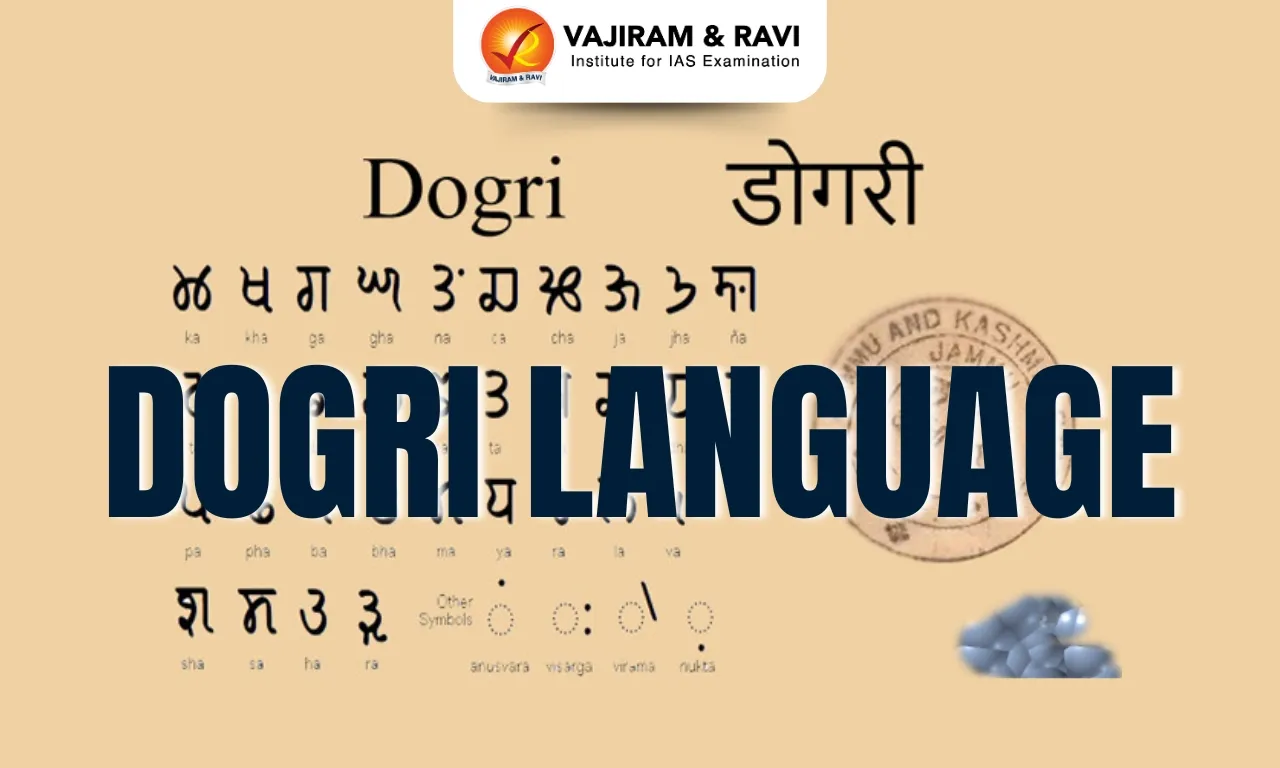
Dogri Language Latest News
In recent years, growing concern has emerged over the gradual decline of the Dogri language in the Jammu region.
About Dogri Language
- It is an Indo-Aryan language, part of the larger Indo-European family of languages.
- It is spoken in India, chiefly in the Jammu region of Jammu and Kashmir.
- It is also spoken in the state of Himachal Pradesh and in northern Punjab, other parts of Jammu and Kashmir, and elsewhere.
- The earliest written reference to Dogri (using the paleonym Duggar) is found in the Nuh sipihr (“The Nine Heavens”), written by the poet Amir Khosrow in 1317 CE.
- It has its origin in the old Indo-Aryan language, i.e., language of the Vedas and Laukik Sanskrit.
- Like other modern Indo-Aryan languages, Dogri has also passed through Old Indo-Aryan (Sanskrit) and Middle Indo-Aryan (Pali, Prakrit, and Apabhramsha) stages of development and entered the modern Indo-Aryan stage around the 10th century A.D.
- Hence, it shows its three-fold process of development of its sound structure, expressing its affinity with Shaurseni Prakrit.
- Initially written in the Takri script, Dogri now uses the Devanagari script, which is also utilized by several other Indian languages.
Source: TH
Dogri Language FAQs
Q1: Dogri language belongs to which branch of the Indo-European family of languages?
Ans: Indo-Aryan
Q2: In which region of India is Dogri language chiefly spoken?
Ans: Jammu region of Jammu and Kashmir.
Q3: The earliest written reference to Dogri (as Duggar) is found in which work?
Ans: The earliest written reference to Dogri is found in the Nuh sipihr (“The Nine Heavens”), written by the poet Amir Khosrow in 1317 CE.
Q4: Which script is used to write the Dogri language?
Ans: Initially written in the Takri script, Dogri now uses the Devanagari script.
