United Nations Framework Convention on Climate Change (UNFCCC)

United Nations Framework Convention on Climate Change

United Nations Framework Convention on Climate Change Latest News

The world has gathered at the city of Belem in the Brazilian state of Para for the 30th Conference of the Parties (COP30) to the United Nations Framework Convention on Climate Change (UNFCCC).

About United Nations Framework Convention on Climate Change

  • UNFCCC is the principal global treaty for coordinating international responses to climate change. 
  • It provides the foundation for subsequent legal instruments, including the Kyoto Protocol and the landmark Paris Agreement.
  • The purpose of the UNFCCC is to harness international cooperation to limit the rise of average global temperatures to minimize the impacts of climate change to enable timely adaptation, avoid threats to food production, and ensure sustainable economic development. 
  • It is one of three conventions that was adopted at the Rio Earth Summit in 1992 to promote a sustainable planet for future generations. 
  • Its sister Rio Conventions are the UN Convention on Biological Diversity and the Convention to Combat Desertification.
  • The UNFCCC has 198 Parties, comprising 197 States and the European Union, making it one of the most widely ratified international treaties.
  • Every year, parties to the Convention meet in Conference of the Parties (COPs), as well as in technical meetings throughout the year, to advance the aims and ambitions of the Paris Agreement and achieve progress in its implementation. 
  • The UNFCCC relies on the scientific assessments of the Intergovernmental Panel on Climate Change (IPCC) to inform its decisions and guide negotiations. 
    • The IPCC is the United Nations body for assessing the science related to climate change. 
    • It was established by the United Nations Environment Programme (UNEP) and the World Meteorological Organization (WMO) in 1988.

What is the Kyoto Protocol?

  • Adopted in 1997 as part of the UNFCCC, the Kyoto Protocol outlines individual quantitative emission reduction targets for developed countries. 
  • The Protocol required these countries to reduce their emissions by 5% in 2008-2012 compared to 1990 levels.
  • One of the key elements of the Protocol was the implementation of market mechanisms to achieve these commitments. 
  • These include the Clean Development Mechanism (CDM), allowing the development of cost-effective projects to reduce greenhouse gas (GHG) emissions, ensuring mitigation benefits, and creating sustainable economic benefits.

What is the Paris Agreement?

  • The Paris Agreement, adopted in December 2015 at the 21st Conference of the Parties (COP21), highlighted the key role of the Framework Convention (UNFCCC) that it is connected to.
  • The Agreement stresses the principles of the UNFCCC and introduces three goals: 
    • to keep the global temperature increase well below 2°C, with efforts to limit it to 1.5°C; 
    • to strengthen adaptation and resilience capacities; and 
    • to align financial flows with the other goals of the Agreement.
  • The Paris Agreement also innovated by requiring all countries, both developed and developing, to regularly submit "Nationally Determined Contributions" (NDCs). 
  • In the NDCs, each country explains what actions it intends to take to respond to climate change. The implementation of these actions will be accompanied by an enhanced transparency regime.
  • As NDCs are defined by each country, they respect the national reality and sovereignty of each nation.

Source: DTE

United Nations Framework Convention on Climate Change FAQs

Q1: What does UNFCCC stand for?

Ans: United Nations Framework Convention on Climate Change.

Q2: When was the UNFCCC adopted?

Ans: 1992

Q3: What is the principal aim of the UNFCCC?

Ans: To limit the rise of average global temperatures and ensure sustainable development.

Q4: Which scientific body provides assessments to support UNFCCC decisions?

Ans: Intergovernmental Panel on Climate Change (IPCC)

Financial Sector Assessment (FSA) Report

Financial Sector Assessment (FSA) Report

Financial Sector Assessment (FSA) Report Latest News

The latest Financial Sector Assessment (FSA) report has stated that India is achieving its vision to become a $30 trillion economy by 2047. 

About Financial Sector Assessment (FSA) Report

  • It was published by the World Bank.

Key Highlights of the Report

  • India’s financial system has become more resilient, diversified, and inclusive.
  • It acknowledges that financial sector reforms helped India recover from various distress episodes of the 2010s as well as the pandemic.
  • India's 'world class' digital public infrastructure and government programmes have significantly improved access to a wider range of financial services for men and women. 
  • WB welcomed the scale-based regulation for NBFCs which recognises the different needs of this diverse industry.
  • India’s capital markets (equity, government bonds and corporate bonds) have increased from 144 percent to about 175 percent of GDP since the last Financial Sector Assessment Program. 

What is the Financial Sector Assessment Program?

  • It is a joint program of the International Monetary Fund (IMF) and World Bank established in 1999.
  • It is a comprehensive and in-depth assessment of a country’s financial sector.
  • FSAPs in advanced economies are conducted with a focus on assessing the resilience of the financial sector, the quality of the regulatory and supervisory framework, and the capacity to manage and resolve financial crises. 

Source: TH

Financial Sector Assessment (FSA) Report FAQs

Q1: What is the purpose of the Financial Sector Assessment (FSA) Report?

Ans: To evaluate the financial sector's stability and resilience.

Q2: The Financial Sector Assessment (FSA) Report is part of which program?

Ans: Financial Sector Assessment Program (FSAP)

Visible Emission Line Coronagraph

Visible Emission Line Coronagraph

Visible Emission Line Coronagraph Latest News

Recently, scientists at the Indian Institute of Astrophysics (IIA) have collaborated with NASA to estimate the crucial parameters of a coronal mass ejection (CME) by using Visible Emission Line Coronagraph (VELC) payload onboard India’s Aditya-L1 mission.

About Visible Emission Line Coronagraph

  • It is the primary payload of the Aditya-L1 Mission–India’s first mission to observe the Sun from a vantage point 1.5 million kilometres from the earth.

Features of Visible Emission Line Coronagraph

  • It is an internally occulted solar coronagraph capable of simultaneous imaging, spectroscopy, and spectro-polarimetry close to the solar limb.
  • It consists of a coronagraph, spectrograph, polarimetry module, and detectors, aside from auxiliary optics.
  • It is built by the Indian Institute of Astrophysics (IIA) at its CREST (Centre for Research and Education in Science and Technology) campus at Hosakote, Karnataka.

Objectives of Visible Emission Line Coronagraph

  • It will observe the solar corona, which is the tenuous, outermost layer of the solar atmosphere. 
  • VELC can image the solar corona down to 1.05 times the solar radius, which is the closest any such payload has imaged.
  • It will analyze the coronal temperature, plasma velocity, density, etc.
  • It will also study Coronal Mass Ejections (CMEs) and the solar wind.

Source: TH

Visible Emission Line Coronagraph FAQs

Q1: What is the primary objective of the Visible Emission Line Coronagraph (VELC)?

Ans: To observe the solar corona

Q2: What is unique about VELC's imaging capability?

Ans: It can image the solar corona down to 1.05 times the solar radius.

Ricin

Ricin

Ricin Latest News

The Gujarat Anti-Terrorist Squad recently busted a suspected terror syndicate by arresting a 'doctor', who was allegedly preparing the highly lethal chemical poison, 'Ricin', and whose handler is associated with the Islamic State Khorasan Province, and two others.

About Ricin

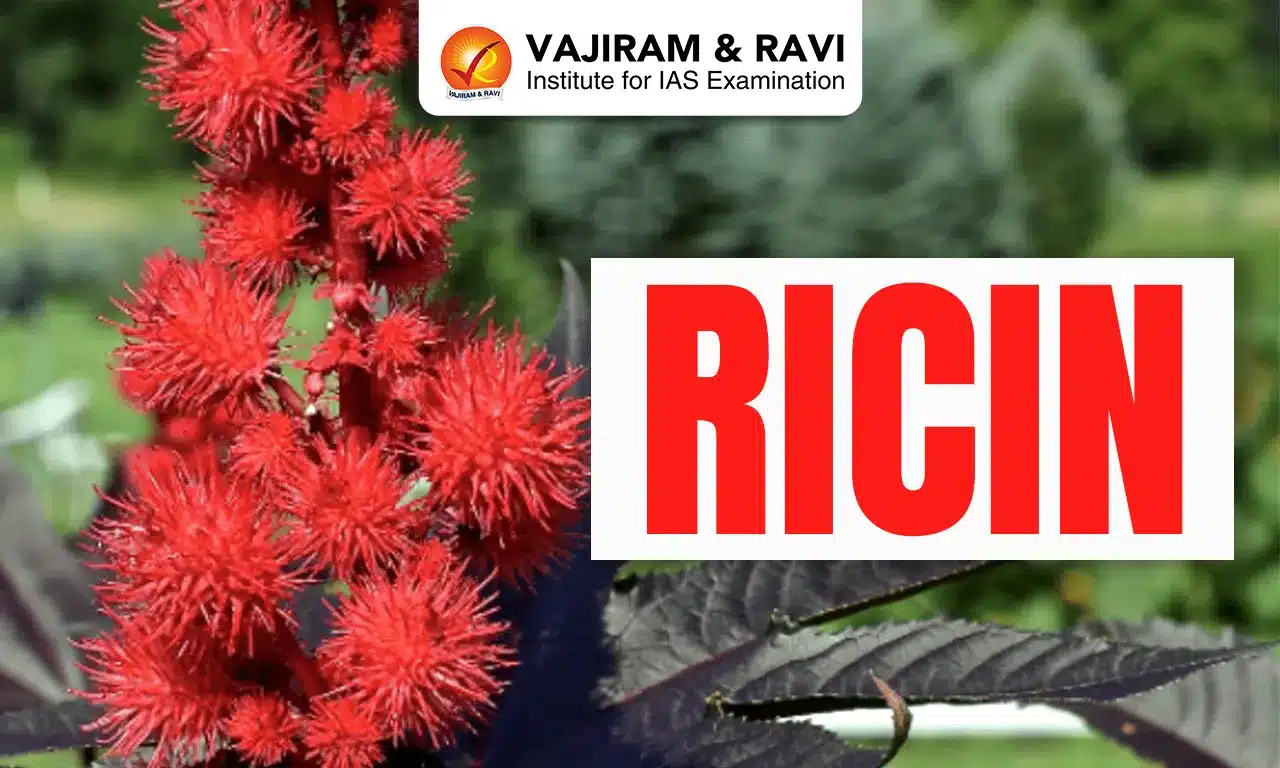
  • Ricin is a poison found naturally in castor beans. 
  • If castor beans are chewed and swallowed, the ricin that comes out can cause injury. 
  • Ricin can be made from the waste material left over from processing castor beans.
  • Ricin can be in the form of a powder, a mist, or a pellet. 
  • It can also be dissolved in water or weak acid.
  • It is stable under normal conditions. However, it will not work if temperatures are over 80 degrees centigrade (176 degrees Fahrenheit).
  • It is toxic when inhaled, ingested, or injected. 
  • As few as five to ten micrograms per kilogram can be lethal.
  • How Does It Work?
    • Ricin works by getting inside the cells of a person's body and preventing the cells from making the proteins they need. Without the proteins, cells die.
    • Eventually this is harmful to the whole body, and death may occur.
  • It is of special concern because of its potential use as a biological weapon. 
  • Accidental exposure to ricin is rare and results primarily from the ingestion of castor seeds.
  • Treatment
    • No antidote exists for ricin. 
    • Symptomatic ricin poisoning is treated by providing supportive medical care to minimize the effects of the poisoning.

Source: NDTV

Ricin FAQs

Q1: What is the natural source of ricin?

Ans: Castor bean

Q2: What is the primary way ricin harms the human body?

Ans: It prevents cells from making proteins.

Q3: In which physical forms can ricin be found?

Ans: Ricin can be in the form of a powder, a mist, or a pellet.

National Board for Wildlife (NBWL)

National Board for Wildlife

National Board for Wildlife Latest News

The Standing Committee of the National Board for Wildlife (NBWL) recently recommended 13 defence and paramilitary projects, most of them in high-altitude protected areas of Ladakh and one in Arunachal Pradesh.

About National Board for Wildlife

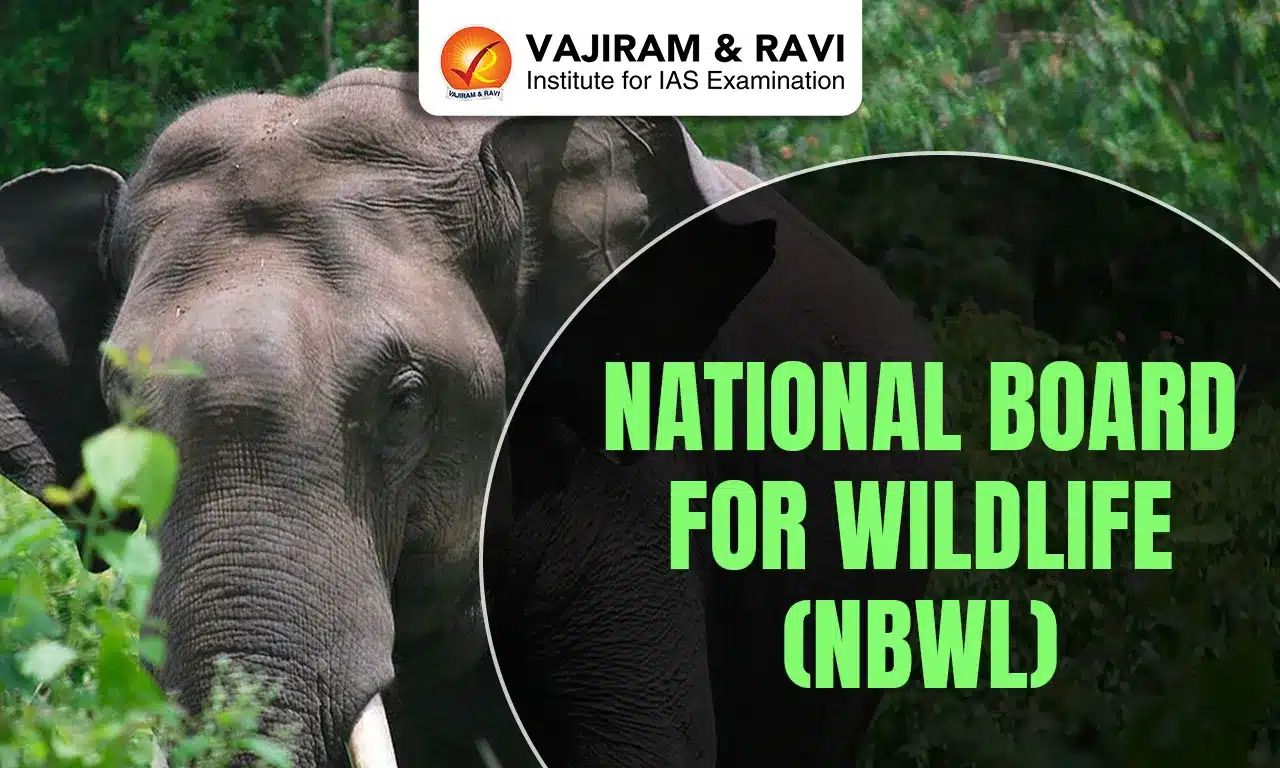
  • It is a statutory body constituted by the Central Government in 2022 under Section 5A of the Wildlife (Protection) Act, 1972.  
  • NBWL is India’s top-level advisory body to the government on matters pertaining to wildlife conservation, particularly within Protected Areas (PAs).
  • It is responsible for guiding the government’s decisions on matters related to wildlife conservation and issuing approvals for projects in PAs.

National Board for Wildlife Organisation Structure

  • It is a 47-member committee, headed by the Prime Minister and the Minister of Environment, Forest, and Climate Change as vice chairperson.
  • In addition to offices and institutions directly involved in conservation and protection of wildlife, the NBWL also has the chief of army staff, defence secretary, expenditure secretary to the Government of India as members.
  • Further, the central government nominates 10 members who are eminent conservationists, ecologists, and environmentalists.
  • The Additional Director General of Forests (WL) & Director, Wildlife Preservation is the Member-Secretary to the Board. 

National Board for Wildlife Functions

  • The major function of the National Board is to promote the conservation and development of wildlife and forests.
  • NBWL advises both Central and State Governments on the matters of promoting wildlife conservation and protection.
  • Effectively controlling poaching and illegal trade of wildlife and its products.
  • Making recommendations on the setting and managing national parks, sanctuaries and other protected areas.
  • NBWL carries out Environmental Impact Assessment of projects and activities on wild life or its habitat.
  • Reviewing the progress in the field of wildlife conservation in the country and suggesting measures for improvement to the Government.
  • Preparing and publishing a status report at least once in two years on wildlife in the country.

Standing Committee of National Board for Wildlife

  • It is an independent body under NBWL.
  • It comprises not more than 10 members of the NBWL.
  • The Minister of Environment, Forest, and Climate Change chairs the Standing Committee.
  • The difference between the standing committee and the National Board is that the Standing Committee regulates land diversion within protected areas and eco-sensitive zones, making it a purely project clearance body. 
  • The NBWL, on the other hand, has the power to deal with policy-level decisions on wildlife.

Source: TH

National Board for Wildlife FAQs

Q1: Under which Act was the National Board for Wildlife (NBWL) constituted?

Ans: Wildlife (Protection) Act, 1972

Q2: What is the National Board for Wildlife's (NBWL’s) primary role?

Ans: To advise the government on wildlife conservation and approve projects in protected areas.

Q3: Who is the Chairperson of the National Board for Wildlife (NBWL)?

Ans: Prime Minister of India

Q4: Who serves as the Vice-Chairperson of the NBWL?

Ans: Minister of Environment, Forest, and Climate Change.

Angola

Angola

Angola Latest News

Recently, the President of India is on a four-day state visit to Angola, the first by an Indian President. 

About Angola

  • Location: It is located on the southwestern Atlantic Coast of Africa.
  • Bordering Countries: It is bordered by the Republic of the Congo (Northwest), Democratic Republic of the Congo (North & Northeast), Zambia (Southeast) and Namibia (South)
  • Maritime Boundary: It shares a border with the Atlantic Ocean.
  • Capital City: Luanda

Geographical Features of Angola

  • Major rivers: Cuango River and Cuanza River, vital for hydropower and inland water transport.
  • Water Falls:  The largest is the Calandula Waterfalls (also known as the Kalandula Falls) on the Lucala River. 
  • Highest peak: Mount Moco, the tallest mountain in Angola.
  • Climate: It has a tropical climate with a marked dry season. The climate is largely affected by the northward flow of the cold Benguela Current off the coast, and elevation.
  • Natural Resources: Petroleum, diamonds, iron ore, phosphates, copper, feldspar, gold, bauxite, uranium.

Source: News On Air

Angola FAQs

Q1: What is the capital of Angola?

Ans: Luanda

Q2: What is the official language of Angola?

Ans: Portuguese

Canary Island

Canary Islands

Canary Islands Latest News

Three people were killed and 15 others injured after powerful waves struck Tenerife, the largest of Spain’s Canary Islands and a popular holiday destination.

About Canary Islands

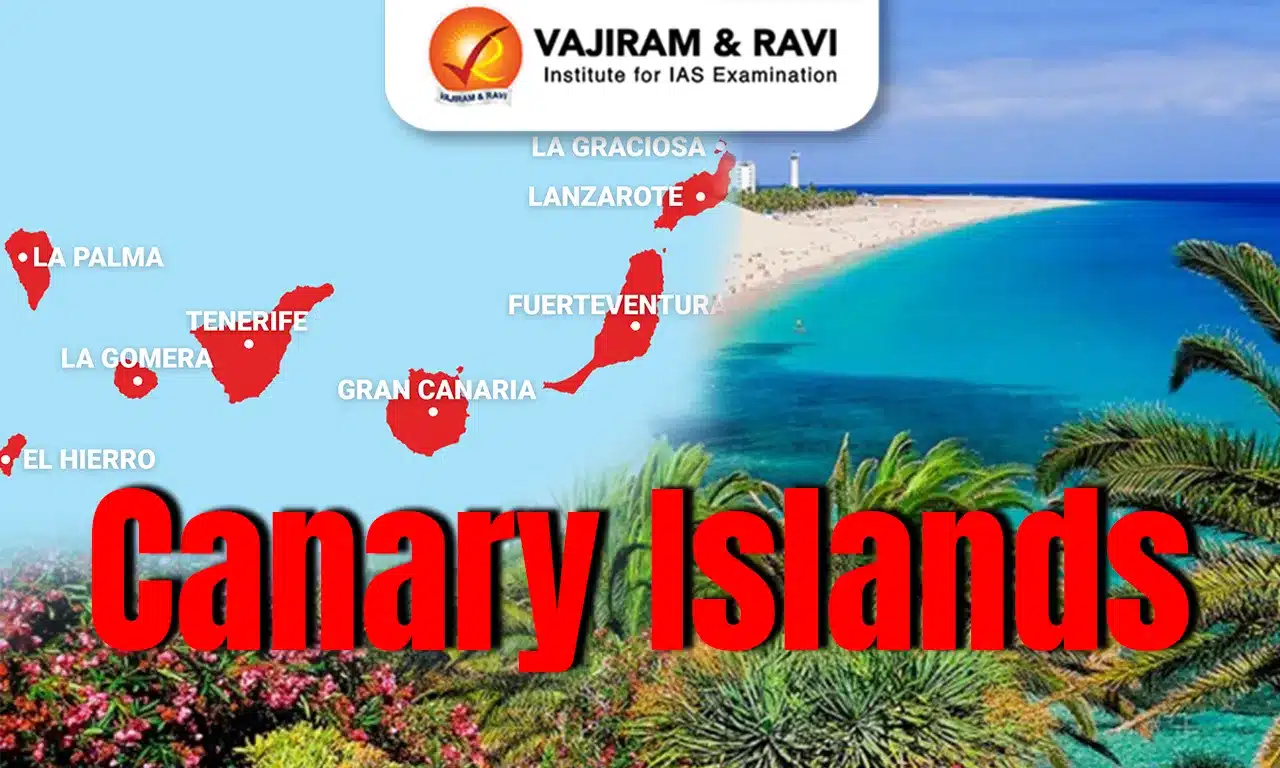
  • The Canary Islands are an archipelago located off the northwest coast of Africa in the Macaronesia region of the North Atlantic Ocean.
  • Geographically, the archipelago is part of continental Africa, but politically and economically it is part of Europe.
  • The archipelago is a Spanish territory and is its southernmost autonomous community. 
  • It is approximately 100 km from Morocco and southwest of Spain.
  • It is Macaronesia’s largest and most populated archipelago. 
  • Some of the largest islands in the archipelago are Lanzarote, Fuerteventura, Gran Canaria, and Tenerife.
  • Tenerife is the largest island of the Canary Archipelago, spanning 2,034 sq.km.
  • Capital: Santa Cruz de Tenerife
  • Area: 7,447 sq.km.
  • The Canary Islands formed millions of years ago through volcanic eruption, and some of the volcanoes are still active. 
  • The highest point in Spain, Teide Peak, located on Tenerife, rises to 3,718 m.
  • Climate: Desertic and tropical, moderated by trade winds and the surrounding sea.
  • The islands’ location in the Atlantic Ocean and their proximity to four continents (Africa, Europe, and the Americas) make them a popular tourist destination.

Source: BBC

Canary Islands FAQs

Q1: Where are the Canary Islands located?

Ans: The Canary Islands are an archipelago located off the northwest coast of Africa in the Macaronesia region of the North Atlantic Ocean.

Q2: Politically and economically, the Canary Islands belong to which country?

Ans: Spain

Q3: Which is the largest island in the Canary Archipelago?

Ans: Tenerife

Q4: What is the capital of the Canary Islands?

Ans: Santa Cruz de Tenerife

Q5: What is the highest point in Spain located in the Canary Islands?

Ans: Mount Teide

Konark Sun Temple

Konark Sun Temple

Konark Sun Temple Latest News

The Archaeological Survey of India (ASI) has prohibited tourists from entering the 'Nata Mandap' of the Konark Sun Temple in Odisha's Puri district.

About Konark Sun Temple

  • It is located on the coastline of Odisha in the Puri district.
  • Also called the Surya Devalaya, the temple is dedicated to the Hindu sun god Surya.
  • Textual evidence indicates that Narasimha I (who reigned between 1238 and 1264) of the Eastern Ganga dynasty built the temple in 1250 CE
  • It was designated a UNESCO World Heritage Site in 1984.

Konark Sun Temple Features

  • It is a classic example of the Odisha style of architecture, or Kalinga architecture.
  • The height of the Sun Temple at Konark is estimated to be around 227 feet, making it one of the tallest temples ever built in the country.
  • The temple complex has the appearance of a 100-foot-high solar chariot, with 24 wheels and pulled by six horses, all carved from stone.
  • It is oriented towards the east so that the first rays of the sunrise strike the main entrance.
  • The wheels of the temple are sundials, which can be used to calculate time accurately to a minute.
  • Around the base of the temple, there are images of animals, foliage, warriors on horses, and other interesting structures.
  • The temple also features elaborate stone carvings depicting scenes from Hindu mythology.
  • The temple was constructed using three types of stones – the laterite stone for the boundary walls, flooring, and staircase; Khondalite for the structure; and Chlorite stone for the door jams and lintel. 
  • The use of iron strips to hold the structure together can be seen amongst the ruins of the temple.
  • The temple was called Black Pagoda, attributed to its dark facade, by the Europeans who used it for navigation for their ships. 
  • It is said that the temple could draw ships to the shore due to its magnetic powers.
  • The temple remains a site of contemporary worship for Hindus, during the annual Chandrabhaga Festival, around the month of February.

Source: ITV

Konark Sun Temple FAQs

Q1: Where is the Konark Sun Temple located?

Ans: Puri district, Odisha

Q2: Which ruler built the Konark Sun Temple?

Ans: Narasimhadeva I of the Eastern Ganga dynasty

Q3: The Konark Sun Temple is an example of which architectural style?

Ans: Kalinga (Odisha) architecture

Q4: The temple complex of Konark is designed in the form of which structure?

Ans: A solar chariot.

Q5: Why was the Konark Temple called the “Black Pagoda” by Europeans?

Ans: It appeared dark and was used as a navigation landmark.

Exercise Malabar

Exercise Malabar

Exercise Malabar Latest News

Indian Naval Ship (INS) Sahyadri is at Guam in the Northern Pacific for participation in the multilateral Exercise Malabar-2025.

About Exercise Malabar

  • It was started in 1992 as a bilateral naval exercise between India and US navy.
  • The first Malabar Exercise in the Bay of Bengal took place in 2007.
  • It was expanded into a trilateral format with the inclusion of Japan in 2015.
  • In 2020, the Australian Navy joined the Malabar Exercise, making it a quadrilateral naval exercise.
  • It takes place annually in the Indian Ocean and Pacific Oceans alternatively.
  • It has evolved into a key multilateral event aimed at enhancing interoperability, fostering mutual understanding, and addressing shared maritime challenges in the Indian Ocean and Indo-Pacific region.

Key Facts about Exercise Malabar-2025

  • It involves two phases
    • Harbour Phase: It will feature operational planning and discussions, alignment on communication protocols, familiarisation visits between participating nations, and sports fixtures.
    • Sea Phase: Following the harbour phase, all participating units will proceed in this phase, wherein ships and aircraft will take part in naval drills, focusing on joint fleet operations, anti-submarine warfare, gunnery serials and flying operations.

Source: PIB

Exercise Malabar FAQs

Q1: Exercise Malabar is a naval exercise between which countries?

Ans: India, US, Japan, and Australia

Q2: What is the objective of Exercise Malabar?

Ans: To strengthen cooperation and security in the Indo-Pacific region.

Sal Tree

Sal Tree

Sal Tree Latest News

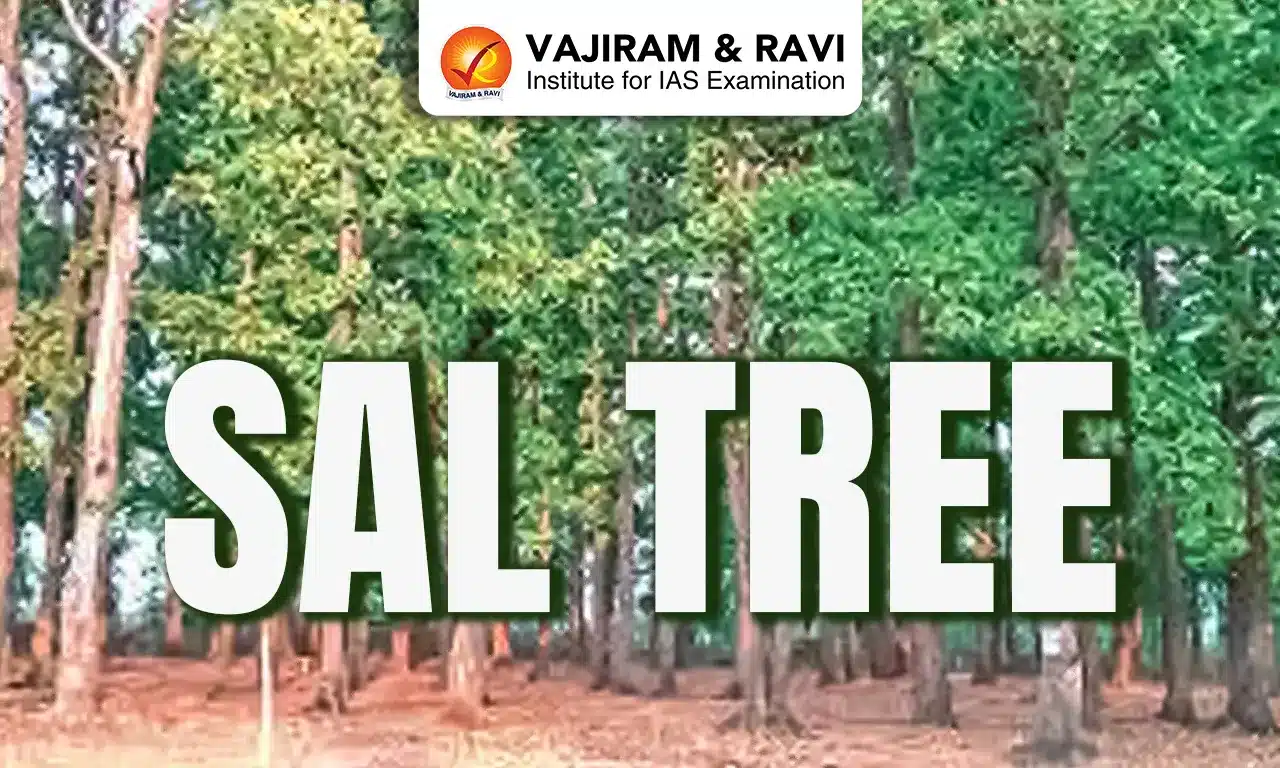
Scientists of the Environment Department of Himachal Pradesh University (HPU) at Shimla have revealed that the Sal tree (Shorea robusta) is the best air purifier to deal with the menace of pollution.

About Sal Tree

  • It is one of the oldest and strongest trees found in India.
  • It's called the ‘Sentinel of the Forests’ because it can live for dozens of years and has the ability to withstand environmental changes.
  • Distribution: It is also found naturally in Uttarakhand, Terai region of Uttar Pradesh, Jharkhand, Odisha, Madhya Pradesh, Chhattisgarh and West Bengal.

Required Climatic Conditions for Sal Tree

  • Temperature: It can tolerate temperatures as high as 40-45°Celcius in summers and as low as 5°Celcius in winters.
  • Soil: It can be grown in the plains, provided there is light loamy soil with good drainage and the area receives approximately 1000 mm - 3000 mm of annual rainfall.
  • Climate: It requires a warm and humid climate and can thrive at altitudes up to 1500 metres above the sea level.
  • This tree can live up to 100 years and doesn't require frequent watering or care.
  • It's especially suitable for hilly areas.

How can Sal Trees Control Pollution?

  • Dust and Particle Trapping: Its leaves are thick and waxy that can trap dust, carbon and fine particles in the air on their surface.
  • Air Purification: It has a higher chlorophyll content which gives it the strength to withstand harmful gases such as carbon monoxide and sulphur dioxide present in vehicle exhaust.
  • Natural Filter: It also has a very dense canopy that acts as a natural filter while trapping pollutants in the air.

Source: ETV Bharat

Sal Tree FAQs

Q1: What is the temperature range that Sal Trees can tolerate?

Ans: 5°C to 40-45°C

Q2: Where is the Sal Tree naturally found in India?

Ans: Uttarakhand, Terai region of Uttar Pradesh, Jharkhand, Odisha, Madhya Pradesh, Chhattisgarh, and West Bengal

Enquire Now