
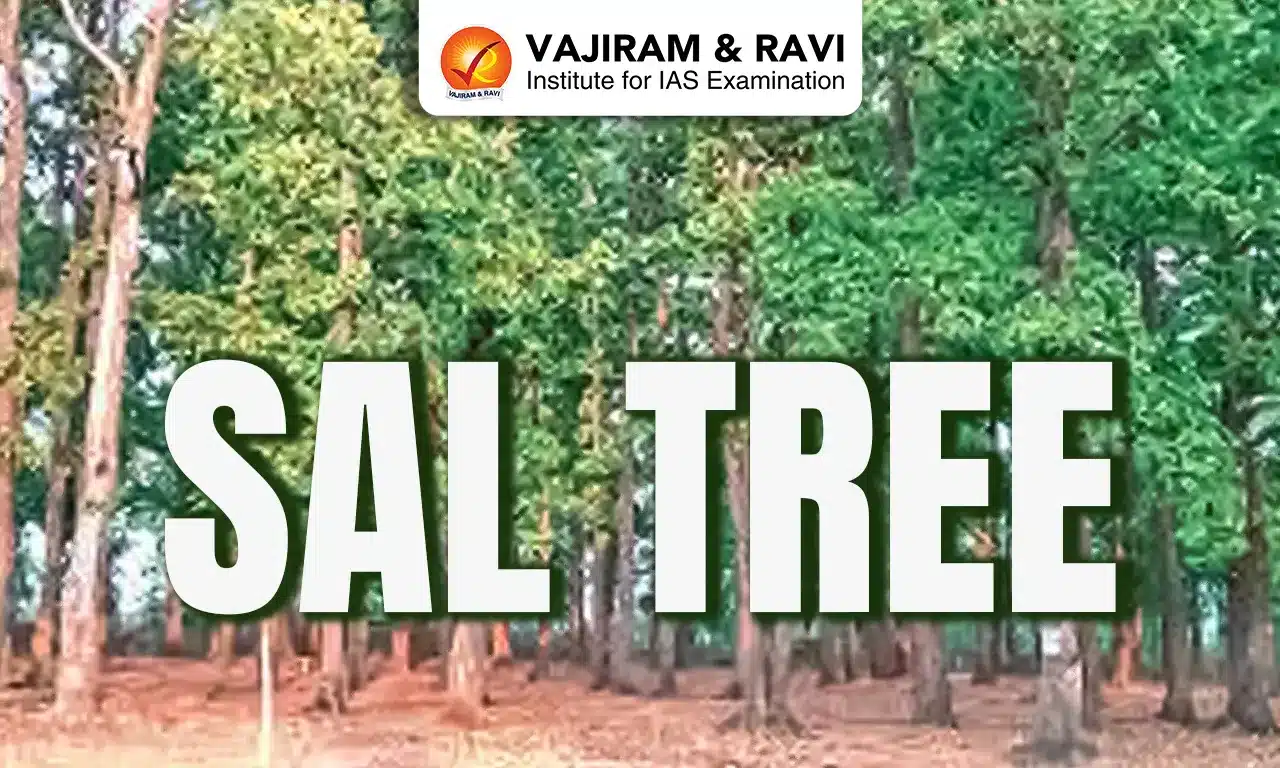
Sal Tree Latest News
Scientists of the Environment Department of Himachal Pradesh University (HPU) at Shimla have revealed that the Sal tree (Shorea robusta) is the best air purifier to deal with the menace of pollution.
About Sal Tree
- It is one of the oldest and strongest trees found in India.
- It's called the ‘Sentinel of the Forests’ because it can live for dozens of years and has the ability to withstand environmental changes.
- Distribution: It is also found naturally in Uttarakhand, Terai region of Uttar Pradesh, Jharkhand, Odisha, Madhya Pradesh, Chhattisgarh and West Bengal.
Required Climatic Conditions for Sal Tree
- Temperature: It can tolerate temperatures as high as 40-45°Celcius in summers and as low as 5°Celcius in winters.
- Soil: It can be grown in the plains, provided there is light loamy soil with good drainage and the area receives approximately 1000 mm - 3000 mm of annual rainfall.
- Climate: It requires a warm and humid climate and can thrive at altitudes up to 1500 metres above the sea level.
- This tree can live up to 100 years and doesn't require frequent watering or care.
- It's especially suitable for hilly areas.
How can Sal Trees Control Pollution?
- Dust and Particle Trapping: Its leaves are thick and waxy that can trap dust, carbon and fine particles in the air on their surface.
- Air Purification: It has a higher chlorophyll content which gives it the strength to withstand harmful gases such as carbon monoxide and sulphur dioxide present in vehicle exhaust.
- Natural Filter: It also has a very dense canopy that acts as a natural filter while trapping pollutants in the air.
Source: ETV Bharat
Sal Tree FAQs
Q1: What is the temperature range that Sal Trees can tolerate?
Ans: 5°C to 40-45°C
Q2: Where is the Sal Tree naturally found in India?
Ans: Uttarakhand, Terai region of Uttar Pradesh, Jharkhand, Odisha, Madhya Pradesh, Chhattisgarh, and West Bengal
