
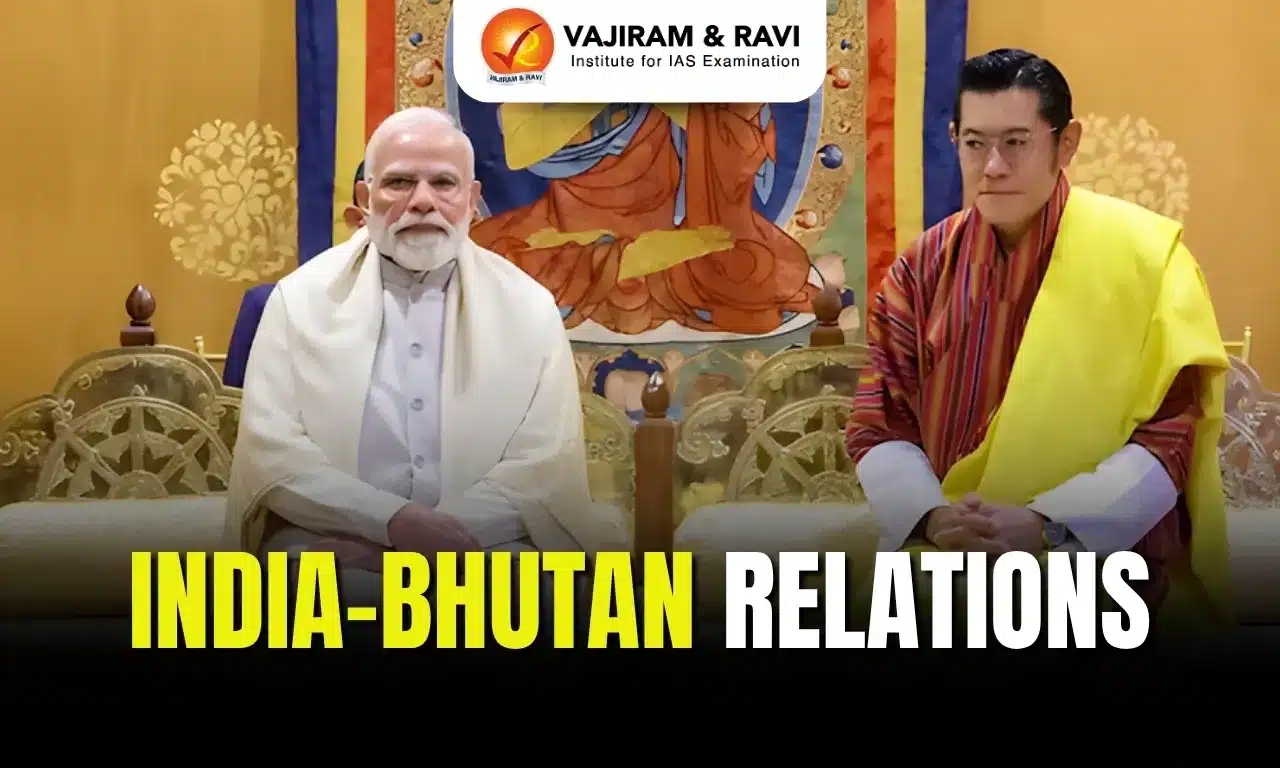
Indian-Bhutan Relations Latest News
- The Prime Minister of India’s two-day state visit to Bhutan marks a momentous occasion — the 70th birthday celebrations of the Fourth King, Jigme Singye Wangchuck (K4), father of the current monarch King Jigme Khesar Namgyel Wangchuck.
- The visit reaffirms the India-Bhutan special partnership, rooted in mutual trust, shared spiritual heritage, and developmental cooperation under India’s Neighbourhood First Policy.
India-Bhutan Relations - Historical Depth and Enduring Friendship
- Early foundations:
- The Fourth King, Jigme Singye Wangchuck, ascended the throne in 1972 at age 16, continuing his father’s policy of close ties with India.
- Appointed Chairman of Bhutan’s Planning Commission (1971), he coordinated the first Five-Year Plans modeled on India’s planning framework with Indian support since 1961.
- Pegged Bhutan’s currency (Ngultrum) to the Indian Rupee at a 1:1 rate (1974), ensuring stable bilateral trade and financial integration.
- Diplomatic and global outreach:
- Expanded Bhutan’s diplomatic footprint while keeping India informed — joining the UN (1971) and SAARC (1985) as a founding member.
- Initiated border talks with China (1984) in consultation with Indian leadership, reflecting strategic transparency and coordination.
- Hydropower cooperation - The economic backbone:
- Laid the foundation for Bhutan’s hydropower partnership with India — the Chukha (336 MW), Kurichhu (60 MW), and Tala (1,020 MW) projects.
- These projects, built on a grant-loan model (60:40), became the bedrock of Bhutan’s export revenue and India’s clean energy import.
- Security cooperation:
- Spearheaded Operation All Clear (2003) with Indian support to eliminate insurgent camps of ULFA, NDFB, and KLO from Bhutanese soil.
- Strengthened defence and border cooperation, marking a milestone in regional security synergy.
- Democratic transition and treaty modernisation:
- Abdicated the throne in 2006, paving the way for Bhutan’s democratic transformation (2008).
- Oversaw the India-Bhutan Friendship Treaty (2007), replacing the 1949 provision that Bhutan would be “guided by India” with mutual cooperation and sovereign equality.
Indian PM’s Visit - Renewing Partnership and Vision
- Key events and significance:
- He attended the 70th birthday celebrations of K4, recognising his pivotal role in shaping India-Bhutan ties.
- Inaugurated the 1,020-MW Punatsangchhu-II Hydroelectric Project, a symbol of long-standing energy partnership.
- Announced a ₹4,000 crore concessional credit line for new energy projects.
- Reaffirmed India’s ₹10,000 crore assistance under Bhutan’s 12th Five-Year Plan for development across infrastructure, agriculture, finance, and healthcare.
- New frontiers of cooperation:
- Expansion of collaboration in fin-tech, innovation, entrepreneurship, and space technology.
- Boosting rail connectivity — linking Gelephu and Samtse with India’s railway network to enhance trade access.
- Strengthening border infrastructure and inland waterways for regional integration.
- Finalisation of three MoUs in renewable energy, healthcare, and mental health services.
- Cultural and spiritual ties:
- Indian PM offered prayers at the Tashichhodzong Monastery to the sacred Piprahwa relics of Lord Buddha, underscoring shared Buddhist heritage.
- Participation in the Global Peace Prayer Festival symbolised India-Bhutan’s shared commitment to peace and harmony.
Bhutan’s Visionary Leadership - The Fourth King’s Legacy
- Gross National Happiness (GNH):
- Conceptualised the globally recognised philosophy of GNH, redefining development as human well-being beyond GDP.
- Advocated balance between economic growth, cultural preservation, environmental sustainability, and good governance.
- Guiding hand in modern Bhutan:
- Even post-abdication, K4 continues to be a strategic advisor for both the Bhutanese monarchy and government.
- His leadership legacy forms the bedrock of India-Bhutan bilateral relations, with continued engagement by both nations’ policymakers.
Way Forward to Further Strengthen India-Bhutan Relations
- Deepening connectivity: Fast-track the Gelephu-Samtse rail links and border infrastructure to enhance trade and mobility.
- Energy diversification: Expand cooperation in solar, hydro, and green hydrogen under the India-Bhutan Energy Compact.
- Digital integration: Implement UPI integration and promote digital public infrastructure in Bhutan.
- Regional stability: Maintain coordinated security frameworks against trans-border threats.
- Cultural diplomacy: Use shared Buddhist heritage to promote people-to-people connect and regional soft power.
Conclusion
- The Indian PM’s visit to Bhutan not only commemorates the visionary leadership of K4 but also rejuvenates the multidimensional India-Bhutan partnership.
- From hydropower and connectivity to innovation and spiritual bonds, the relationship epitomises India’s Neighbourhood First and Act East policies.
- As both nations embrace new technological and developmental frontiers, their enduring friendship continues to stand as a model of mutual trust, respect, and shared prosperity in South Asia.
India-Bhutan Relations FAQs
Q1: What is the significance of the Indian PM’s 2025 visit to Bhutan in the context of India’s Neighbourhood First Policy?
Ans: His visit further strengthened energy, connectivity, and digital cooperation with Bhutan, while celebrating shared spiritual and historical ties.
Q2: What is the contribution of King Jigme Singye Wangchuck in shaping modern India-Bhutan relations?
Ans: He institutionalised hydropower cooperation, maintained strategic coordination on security, etc.
Q3: What is the importance of the Punatsangchhu-II Hydroelectric Project for India-Bhutan relations?
Ans: The 1,020-MW project symbolises India-Bhutan’s enduring energy partnership, enhancing Bhutan’s export revenue and India’s access to clean energy.
Q4: How has Bhutan’s concept of Gross National Happiness (GNH) influenced global development discourse?
Ans: GNH redefined progress by emphasising holistic well-being over GDP growth, integrating environmental sustainability as pillars of development.
Q5: What are the new areas of cooperation discussed during the Indian PM’s 2025 visit to Bhutan?
Ans: The visit expanded cooperation to emerging domains such as fin-tech, innovation, entrepreneurship, space technology, etc.
