

SEBI Panel Recommends New Conflict-of-Interest Rules for Transparency

Conflict of Interest

Conflict of Interest Latest News

  • SEBI’s High-Level Committee has recommended major reforms to strengthen its conflict-of-interest and disclosure framework. 
  • Key proposals include a multi-tier disclosure system requiring senior officials—from the chairman to chief general managers—to publicly declare their assets and liabilities. 
  • The committee also suggested investment restrictions, structured recusal norms, and a stronger whistle-blower mechanism to protect investors and ensure fair market functioning.
  • The reforms gain importance as the committee was formed after allegations of conflict of interest against former SEBI chief Madhabi Puri Buch
  • The expert panel reviewed existing rules and proposed measures to enhance transparency, accountability, and ethical governance within SEBI.

Background: The Formation of SEBI Committee

  • SEBI set up the High-Level Committee (HLC) in March after allegations by Hindenburg Research against former SEBI chief Madhabi Puri Buch. 
  • The short seller claimed that Buch and her husband had undisclosed stakes in offshore funds linked to the Adani Group and involved in an alleged money-siphoning scheme — allegations denied by both the Buchs and the Adani Group.
  • The committee was tasked with reviewing SEBI’s conflict-of-interest and disclosure framework, assessing its adequacy, and recommending reforms to strengthen transparency, accountability, and ethical standards.
  • The committee was chaired by Pratyush Sinha, former Chief Vigilance Commissioner and retired IAS officer. Its members included several eminent former regulators and industry leaders.

Mandatory Public Disclosure for SEBI’s Senior Officials

  • The committee proposed that SEBI’s chairman, whole-time members, and chief general managers and above must publicly disclose their assets and liabilities due to their high decision-making powers. 
  • It also recommended that applicants for these senior roles reveal any actual, potential, or perceived financial and non-financial conflict-of-interest risks to the appointing authority.

Uniform Investment and Trading Restrictions for Senior Officials

  • The committee recommended applying the same investment and trading restrictions to the SEBI chairman and whole-time members as those applicable to employees under existing rules. 
  • It proposed including them within the definition of “insider” under insider trading regulations. 
  • Senior officials may invest only in professionally managed pooled schemes regulated by financial authorities, with restrictions applying prospectively.
  • Part-time members are exempt from these limits but must still disclose interests and avoid trading on unpublished price-sensitive information. 
  • The rules will also extend to spouses and financially dependent relatives. 
  • Upon taking office, the chairman and whole-time members must choose to liquidate, freeze, or sell their existing holdings — either through a trading plan or with prior approval.

Broader “Family” Definition to Strengthen Conflict-of-Interest Checks

  • The committee proposed expanding SEBI’s definition of “family” for board members to align with employee rules and global best practices. 
  • Instead of limiting it to a spouse and minor dependent children, the revised definition includes anyone related by blood or marriage who is substantially dependent, as well as individuals for whom the member or employee is a legal guardian. 
  • This broader scope enhances transparency and ensures consistent conflict-of-interest safeguards for all board members and employees, including contractual and deputed staff.

Other Key Proposals

  • The committee recommended a formal and transparent recusal system to manage conflict-of-interest situations. 
  • It suggested publishing an annual summary of recusals made by the chairman, whole-time members, part-time members, and senior SEBI officials (CGM level and above) in the SEBI Annual Report — a practice currently not followed.

Secure and Anonymous Whistleblower Mechanism

  • The panel called for a strong whistleblower framework that ensures confidentiality, anonymity, and protection from retaliation. 
  • It should enable reporting of potential, actual, or perceived conflicts of interest by SEBI officials, board members, intermediaries, market institutions, participants, and the general public, safeguarding institutional integrity beyond just serving as a complaint channel.

Post-Retirement Cooling-Off Restrictions

  • The committee recommended a two-year ban on former SEBI members, employees, consultants, and advisors from appearing before or against SEBI in recognition, adjudication, settlement, or approval matters. 
  • This is aimed at preventing undue influence and strengthening ethical governance.

Ban on Gifts and Benefits

  • To avoid influence and conflicts of interest, the committee advised prohibiting the chairman and whole-time members from accepting any gifts, directly or indirectly, from people with whom they have official dealings — in line with existing SEBI employee regulations.

New Ethics and Compliance Architecture

  • The committee proposed creating a dedicated Office of Ethics and Compliance (OEC) and an Oversight Committee on Ethics and Compliance (OCEC). 
  • These bodies would strengthen ethical governance standards and monitor compliance with SEBI’s conflict-of-interest framework.

Technology-Driven Conflict Monitoring System

  • A modern, secure system powered by artificial intelligence and data analytics was recommended to proactively detect, predict, and address conflict-of-interest risks. 
  • This technology-based infrastructure aims to enhance transparency and safeguard market integrity.

Source: IE | OB | MC

Conflict of interest FAQs

Q1: Why was SEBI’s committee formed?

Ans: The panel was created after conflict-of-interest allegations against former SEBI chief Madhabi Puri Buch. It reviewed existing rules and proposed stronger transparency and disclosure norms.

Q2: What public disclosures did the committee recommend?

Ans: Senior SEBI officials—including the chairman, whole-time members, and CGM-level staff—must publicly disclose assets, liabilities, and any financial or non-financial conflict-of-interest risks.

Q3: What investment restrictions are proposed?

Ans: Senior officials must follow uniform trading rules, be classified as ‘insiders,’ restrict investments to regulated pooled schemes, and choose how to manage existing holdings upon joining.

Q4: How does the committee redefine “family”?

Ans: The expanded definition covers spouses, blood or marital relatives who are dependent, and individuals for whom officials serve as legal guardians, ensuring broader conflict monitoring.

Q5: What other reforms strengthen SEBI’s ethics framework?

Ans: Recommendations include a transparent recusal system, whistleblower protection, post-retirement cooling-off periods, gift restrictions, and a new AI-backed ethics and compliance infrastructure.
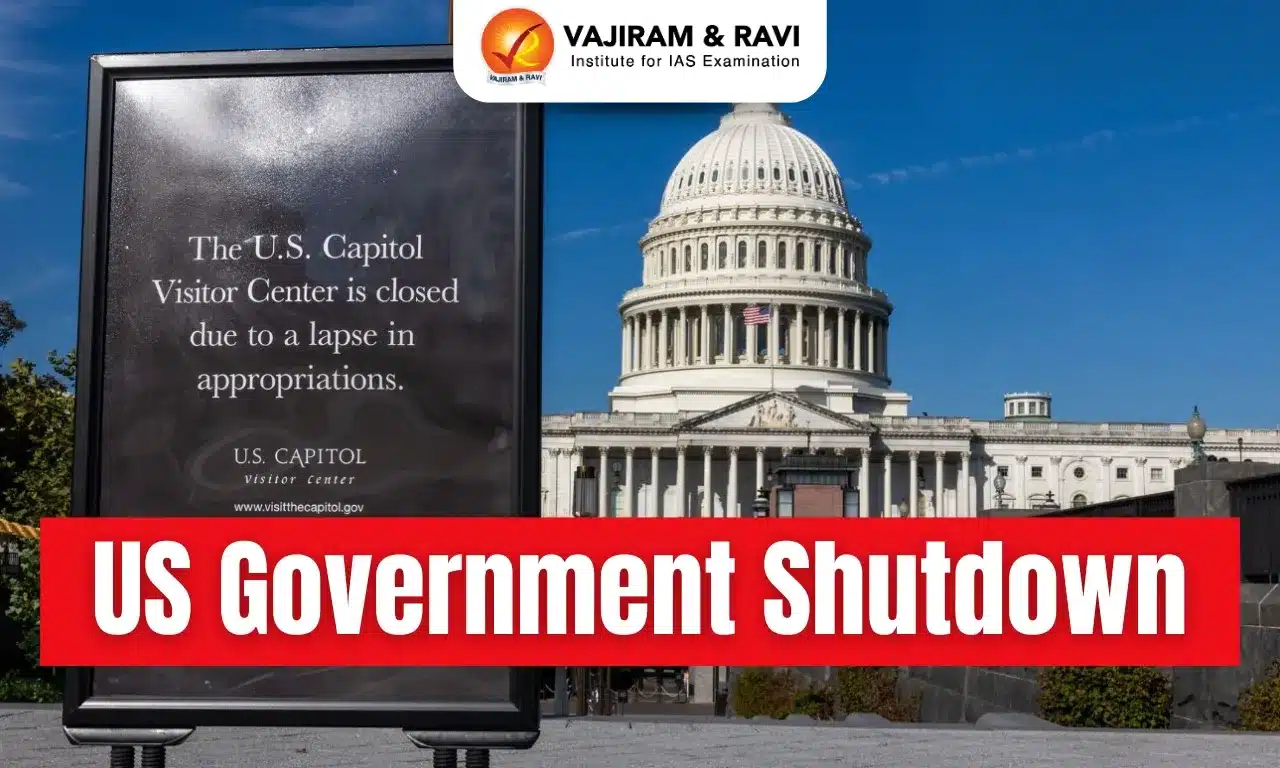
Inside America’s Government Shutdown: Budget Deadlock Explained

US Government Shutdown Oil

US Government Shutdown Oil Latest News

  • US President Donald Trump signed a stopgap bill recently, ending the longest government shutdown in US history. 
  • A shutdown occurs when the government runs out of funds, forcing federal agencies to halt operations and hurting the economy. 
  • Since the budget system began in 1976, the US has faced 11 shutdowns, with the latest lasting 43 days — surpassing the previous record of 34 days during Trump’s earlier term.

Why Government Shutdowns Happen in the US but Not in India

  • A US government shutdown occurs not because the country runs out of money, but because the government loses legislative permission to tax and spend
  • Unlike India — where the Executive is part of Parliament and a budget failure forces the government to resign — the US President is separate from Congress
  • This separation means the President cannot ensure passage of the budget and need not resign if it fails. 
  • When Congress, divided along party lines, cannot agree on the budget, the federal government shuts down. 
  • In the recent shutdown, Republicans lacked the 60 Senate votes needed, and the deadlock ended only when eight Democrats supported the resolution.

How the US Budget Cycle Works

  • The US fiscal year runs from October 1 to September 30. The shutdown began on October 1 because the Trump administration could not get its budget approved by Congress in time.

Budget Preparation Begins in February

  • The budget process starts much earlier. By the first Monday of February, the President must submit the budget proposal to Congress. 
  • Both chambers — the House and the Senate — then engage in months of deliberations, debates, and amendments on taxation and spending priorities. 
  • These discussions often become contentious.

Source of Conflict in the Recent Budget Debate

  • A key point of disagreement during this shutdown was the scope and funding of the Supplemental Nutrition Assistance Program (SNAP), formerly known as the food stamps programme. 
  • Such policy disagreements create delays in approving appropriations.

October 1: The Hard Deadline

  • According to the Congressional Research Service, October 1 is a strict deadline for Congress to pass appropriations. 
  • When the fiscal year ends, previous funding expires, and by law, the government cannot spend money without new appropriations.

Why a Shutdown Happens

  • If Congress does not approve funding by October 1 — creating a “funding gap” — federal agencies must begin shutting down affected programmes and activities. 
  • This legal requirement triggers a government shutdown until a new budget or stopgap bill is passed.

Rising US Budget Deficit

  • According to the Congressional Budget Office, the US recorded a $1.8 trillion budget deficit in FY2025
  • Government receipts were $5.2 trillion, while spending reached $7 trillion, creating a large fiscal gap.
    • For comparison, the entire Indian GDP is under $4 trillion, and the central government’s total budget expenditure is about $0.6 trillion.
    • This highlights the massive scale of US finances and deficits.
  • The FY2025 deficit equalled 5.9% of US GDP, much higher than the long-term average of 3.8% (1975–2025). 
    • A deficit means the government must borrow more to sustain its expenditure.
  • Larger deficits add to the rising mountain of public debt. One consequence is rising interest payments, which have now become the second-largest expenditure item for the US government, as shown in official data.

Presidential vs Parliamentary System: A Warning for India

  • The US shutdown illustrates how a presidential system can suffer severe governance breakdowns when the executive and legislature disagree. 
  • In contrast, India’s parliamentary system ensures continuity of government, even with its own limitations. 
  • While system choice depends on many factors, this episode highlights why a developing country like India may struggle to withstand long, disruptive shutdowns that a presidential model can trigger.

Source: IE | AJ | BBC

US Government Shutdown FAQs

Q1: What causes a US government shutdown?

Ans: A shutdown occurs when Congress fails to approve funding, blocking the government’s legal authority to spend. This happens due to political deadlocks between the executive and legislature.

Q2: How does the US budget cycle operate?

Ans: The fiscal year begins October 1. Budget proposals start in February, followed by extensive congressional debates. If appropriations aren’t passed by October 1, a shutdown begins.

Q3: Why is the US budget deficit a major concern?

Ans: The FY2025 deficit reached $1.8 trillion, or 5.9% of GDP—far above historical averages—leading to rising public debt and high interest payments.

Q4: Why does India avoid government shutdowns?

Ans: India’s parliamentary system links the executive to the legislature, ensuring budgets pass. Failure to pass a budget results in government resignation, preventing shutdowns.

Q5: What lesson does the US shutdown offer India?

Ans: The shutdown reveals vulnerabilities in presidential systems. A developing country like India may struggle to withstand prolonged governance disruptions caused by budget gridlocks.

National Migration Survey in 2026 to Map Internal Mobility

Migration Survey

Migration Survey Latest News

  • The Ministry of Statistics and Programme Implementation (MoSPI) has announced a year-long National Migration Survey to be conducted from July 2026 to June 2027.

Migration in India

  • Migration in India refers to the movement of people from one place to another within the country for reasons such as employment, marriage, education, or better living conditions.
  • As per the Periodic Labour Force Survey (PLFS) 2020-21, 28.9% of India’s population were migrants.
  • Female migration (48%) is far higher than male migration (5.9%) in rural areas, mainly due to marriage, while most male migration is employment-driven (67%).
  • Major migration flows are rural-to-urban (for jobs and education) and inter-state, especially from states like Bihar, Uttar Pradesh, and Odisha to industrial hubs such as Delhi, Maharashtra, and Gujarat.
  • Migration contributes to urbanisation, labour market flexibility, and remittance flows, but also poses challenges like informal employment, housing shortages, and social security gaps.

About the National Migration Survey 2026

  • The survey will be conducted under the aegis of the National Sample Survey (NSS), which has been India’s principal source of household-level socio-economic data since 1950. 
  • It will cover almost all states and union territories, except the Andaman and Nicobar Islands, due to logistical constraints.
  • The objective of the survey is to generate reliable and up-to-date estimates of:
    • Migration rates and trends (rural-to-urban, inter-state, and intra-state)
    • Short-term and seasonal migration patterns
    • Reasons for migration (economic, social, educational, or marital)
    • Employment and income profiles of migrants
    • Return migration and its socio-economic effects
    • Impact of migration on household welfare and community development
  • MoSPI has already released a draft questionnaire and concept note on its website and invited public feedback and expert comments by November 30, 2025.

Evolution of Migration Surveys in India

  • India has a long history of tracking internal migration through the NSS system. 
  • Migration data was first collected in the 9th NSS round (1955), followed by dedicated surveys such as the 18th round (1963-64) and the 64th round (2007-08).
  • Since 2008, migration data has only been gathered intermittently through:
    • The PLFS 2020-21 estimated India’s migration rate at 28.9% of the total population.
    • The Multiple Indicator Survey (2020-21) offered limited insights into internal mobility.
  • However, experts have noted that India lacks a continuous and updated dataset on migration, especially post-pandemic, when labour displacement and reverse migration became major socio-economic concerns. The new survey seeks to bridge this gap.

Key Features of the 2026 Migration Survey

  • Revised Definitions and Improved Coverage
    • The upcoming survey introduces updated definitions to capture modern migration trends more accurately. 
    • A person will now be classified as a short-term migrant if they have stayed away from their usual residence for 15 days to six months within the last year for employment or job search, a shift from the previous threshold of one to six months.
    • The survey will also focus on individual migration patterns rather than entire households, as the proportion of households migrating together has historically been low.
  • Comprehensive Scope of Data
    • The questionnaire includes new questions designed to assess the broader impact of migration on the individual’s quality of life, such as:
    • Changes in income, healthcare access, and social stability post-migration.
    • Experiences with housing, employment, and local integration.
    • Challenges faced at the destination and the intent to relocate again.
  • Integration with Policy Planning
    • MoSPI has emphasised that the data will support evidence-based policymaking in critical sectors:
    • Urban Development: Informing city-level housing, transport, and infrastructure planning.
    • Employment Generation: Identifying labour shortages and skill gaps across regions.
    • Social Protection: Enhancing portability of welfare benefits for migrant workers.
    • Regional Development: Assessing how migration affects remittance flows and rural economies.

Significance of the Migration Survey

  • Migration is a vital dimension of India’s economic and social landscape. Internal migration contributes to:
    • Urbanisation and industrial growth by supplying labour to construction, manufacturing, and services.
    • Rural resilience through remittances that support education, healthcare, and household consumption.
  • However, migration also poses challenges such as informal employment, lack of social security, and urban congestion. Comprehensive data is essential to address these issues effectively.
  • The upcoming survey will fill a critical data gap since the last dedicated migration study conducted in 2007-08, helping policymakers design more targeted interventions in urban planning, labour mobility, housing, and social security.

Source: IE | ET

Migration Survey FAQs

Q1: What is the purpose of the National Migration Survey 2026?

Ans: It aims to collect comprehensive data on migration rates, reasons, and socio-economic impacts to guide evidence-based policymaking.

Q2: Who will conduct the survey?

Ans: The survey will be carried out by the National Statistical Office (NSO) under the Ministry of Statistics and Programme Implementation.

Q3: When will the survey take place?

Ans: The survey will be conducted over a year, from July 2026 to June 2027.

Q4: What are the key focus areas of the survey?

Ans: It will study short-term migration, return migration, employment outcomes, income changes, and gender-based migration trends.

Q5: How will the survey benefit policymakers?

Ans: The data will help design targeted interventions in urban planning, employment generation, social security, and regional development.

Enquire Now