
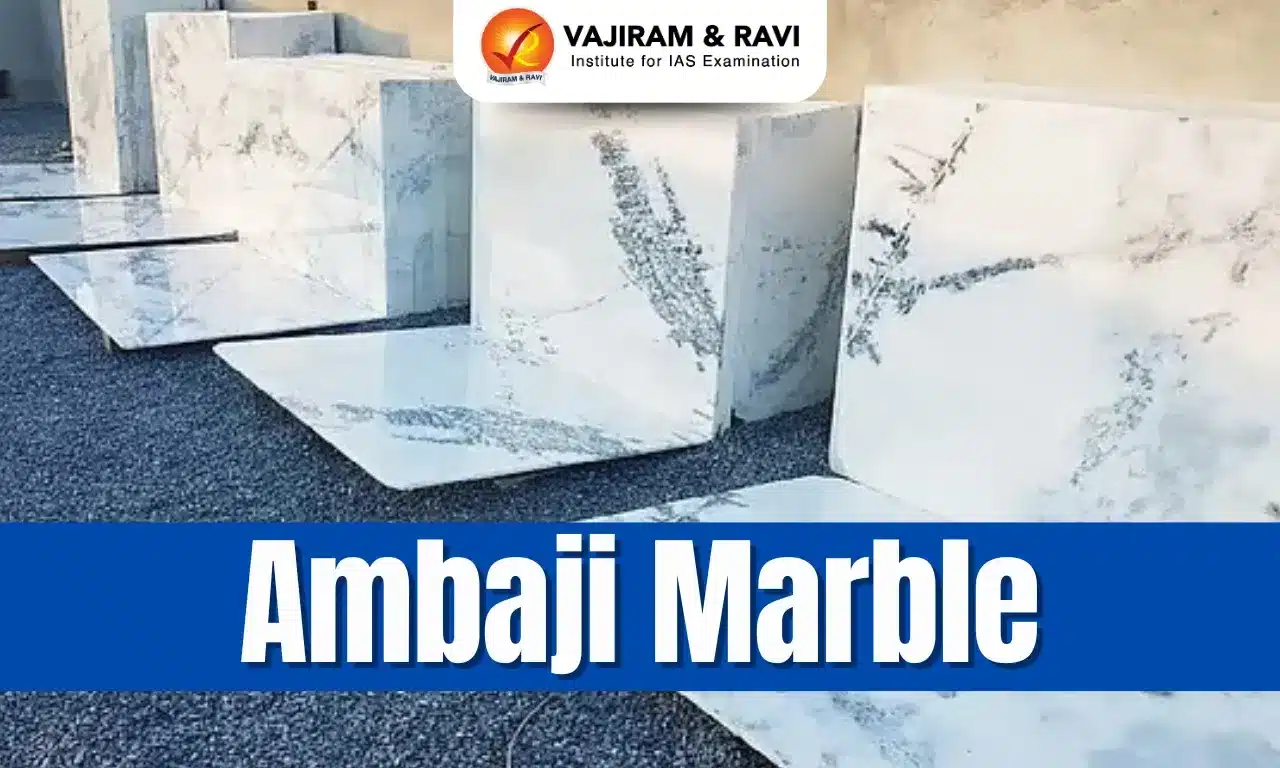
Ambaji Marble Latest News
Recently, the Ambaji Marble has been awarded the Geographical Indication (GI) tag for its high-quality white stone.
About Ambaji Marble
- It is named after the town of Ambaji in the state of Gujarat, where it is predominantly quarried.
- It is a type of marble known for its milky white colour, durability and natural beauty.
Features of Ambaji Marble
- Appearance: It is characterized by its pristine white color, which often features subtle gray or beige veining.
- The veins can vary in intensity and they occur naturally due to the presence of minerals and impurities during the marble formation process.
- Durability: It has very long-lasting shine and durability.
- Applications of Ambaji Marble: It has been used in the construction of Ambaji temple and many other religious places, memorials and grand buildings.
Key Facts about Marble
- It is a metamorphic rock that forms when limestone is subjected to the heat and pressure of metamorphism.
- Composition: It is composed primarily of the mineral calcite (CaCO3) and usually contains other minerals, such as clay minerals, micas, quartz, pyrite, iron oxides, and graphite.
Formation of Marble
- Under the conditions of metamorphism, the calcite in the limestone recrystallizes to form a rock that is a mass of interlocking calcite crystals.
- A related rock, dolomitic marble, is produced when dolostone is subjected to heat and pressure.
- The transformation of limestone into marble usually occurs at convergent plate boundaries, where large areas of Earth’s crustare exposed to the heat and pressure of regional metamorphism.
- Some marble also forms by contact metamorphism when a hot magma body heats adjacent limestone or dolostone.
Source: TH
Ambaji Marble FAQs
Q1: Where is Ambaji Marble primarily found?
Ans: Gujarat
Q2: What is the primary composition of Ambaji Marble?
Ans: Calcium carbonate
