
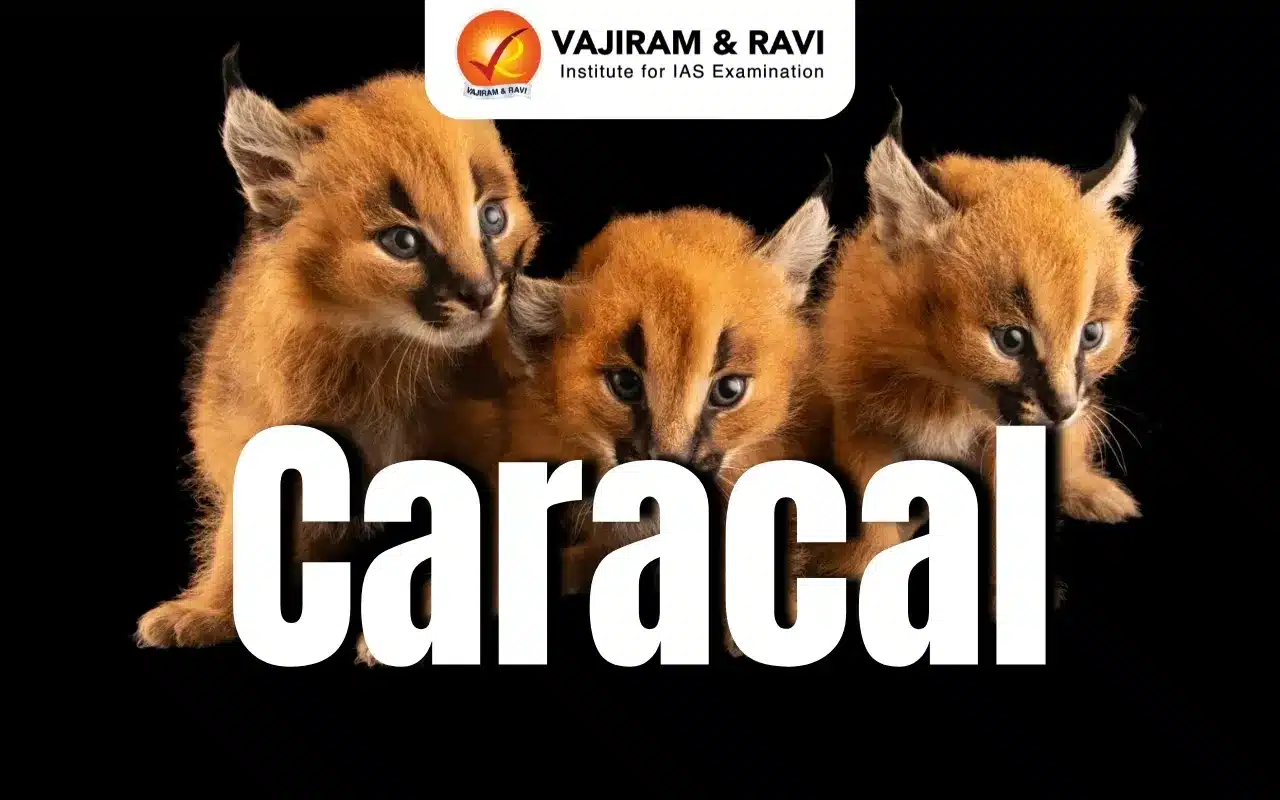
Caracal Latest News
In a groundbreaking discovery, the elusive Asiatic Caracal has been spotted at Ramgarh in Jaisalmer in Rajasthan.
About Caracal
- It is an elusive medium-sized wild cat species.
- Scientific Name: Caracal caracal.
- It is often referred to as the desert lyn;, however, they are more closely related to the African golden cat and the Serval.
- In India, it is called siya gosh, a Persian name that translates as ‘black Ear’.
Caracal Distribution
- It is native to Africa, Central Asia, the Middle East, northwestern India and arid areas of Pakistan.
- Their numbers in India have dwindled to an estimated 50, primarily in Rajasthan and Gujarat.
Caracal Habitat
- It can be found in many environments, such as semi-deserts, savannahs, shrublands, steppes, forests, and woodlands.
- It prefers dry areas with very little rainfall.
Caracal Features
- The caracal has a solid build, long legs, a short face, and tufted ears.
- They are the largest of Africa’s small wild cats, with males reaching 31 inches in length and females 29 inches in length.
- A vital feature of the cat is the black tufts on its ears.
- The cat’s fur is generally a red-tan or sand, although some black caracals have also been seen.
- Dark lines and white spots can be found near the nose and eyes.
- The fur is short and thick, and the cat’s back legs are longer than the front.
- They are remarkable jumpers and can jump up to 3 meters (10 feet) into the air to knock flushed birds down with their paw.
- They can reach speeds of up to 50 mph (80 kph) when in full flight.
- Like most species of cat, the caracal is predominantly nocturnal.
- They live in small herds and their shy and elusive nature makes them difficult to spot in the wild.
Caracal Conservation Status
It is classified as ' Least Concern' under the IUCN Red List.
Source: DH
Caracal FAQs
Q1: Caracals are most closely related to which wild cats?
Ans: African golden cat and serval.
Q2: In which regions of the world is the caracal naturally distributed?
Ans: It is native to Africa, Central Asia, the Middle East, northwestern India and arid areas of Pakistan.
Q3: In which Indian states are caracals primarily found today?
Ans: Rajasthan and Gujarat.
Q4: What is the IUCN Red List status of the caracal?
Ans: Least concern
