
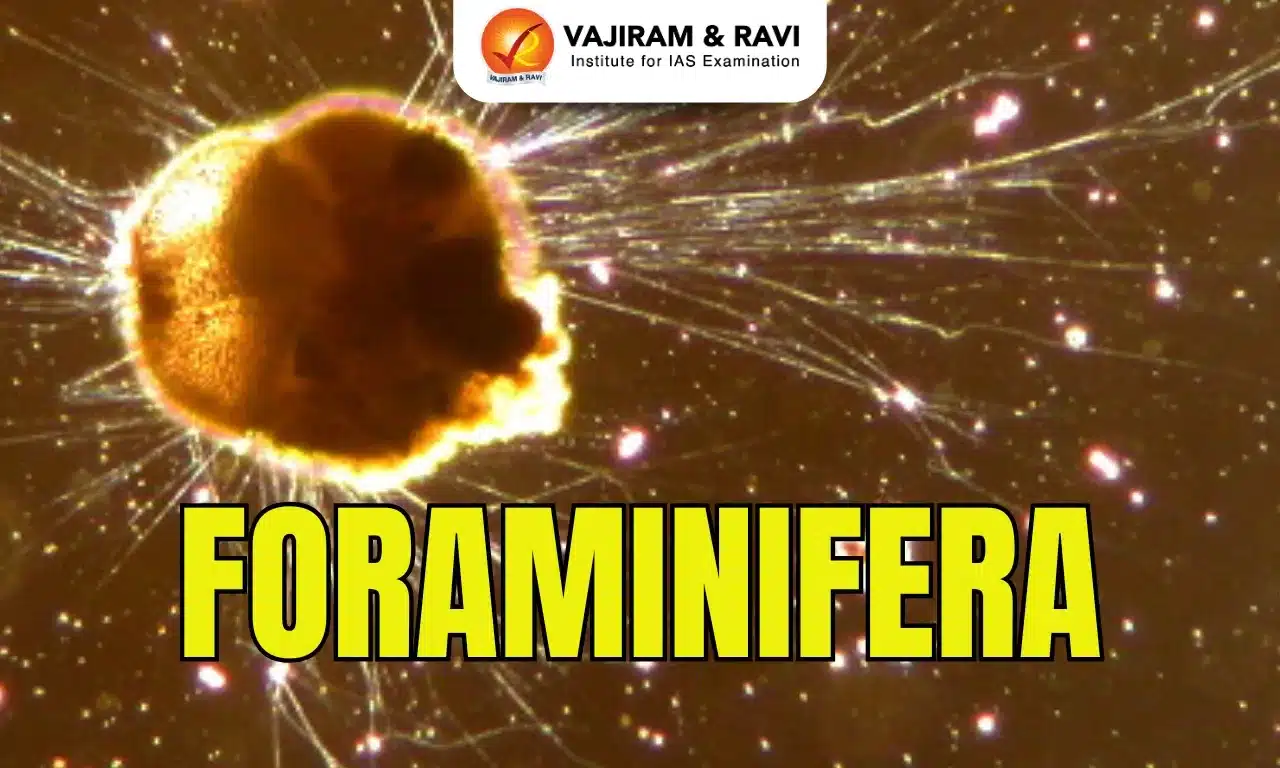
Foraminifera Latest News
A global review of tiny sea animals called foraminifera has identified 57 new living species.
About Foraminifera
- Foraminifera, or forams for short, are single-celled organisms that live in the open ocean, along the coasts, and in estuaries.
- Most have shells for protection and either float in the water column (planktonic) or live on the sea floor (benthic).
- Of the approximately 8,000 species living today, only about 40 species are planktonic, thus the vast majority of foraminifera live on the sea floor.
- They live in a number of different habitats at the sea bottom and most ‘crawl around’ using their pseudopodia.
- They are generally less than 500 microns (½ mm) in size, though some tropical species can grow to 20 cm.
- Because they don’t have a wall around their cell membranes, they are extremely flexible and can change shape.
- What does “foraminifera” mean?
- The shells have hundreds of tiny holes called foramen, the Latin word for window.
- The organism pushes extensions of its cytoplasm called pseudopodia (or false feet) through these holes to gather food.
- What Do They Eat?
- Foraminifera eat detritus on the sea floor and anything smaller than them: diatoms, bacteria, algae, and even small animals such as tiny copepods.
- How Do They Build Their Shells?
- Forams are unusual among single-celled organisms because they build shells made of calcium carbonate (calcareous) or from tiny grains of sand stuck together (agglutinate).
- Despite their small size and relatively simple biology, forams build complex shells, consisting at their simplest of one chamber (like a vase or tube) to many chambers that coil in elaborate ways.
Source: PHYS
Foraminifera FAQs
Q1: What is Foraminifera?
Ans: Foraminifera are single-celled organisms that live in the open ocean, along the coasts, and in estuaries.
Q2: What is the usual size of most foraminifera?
Ans: They are generally less than 500 microns (½ mm) in size.
Q3: Why are foraminifera extremely flexible?
Ans: They lack a wall around their cell membrane.
Q4: How do foraminifera build their shells?
Ans: They build shells made of calcium carbonate (calcareous) or from tiny grains of sand stuck together (agglutinate).

