
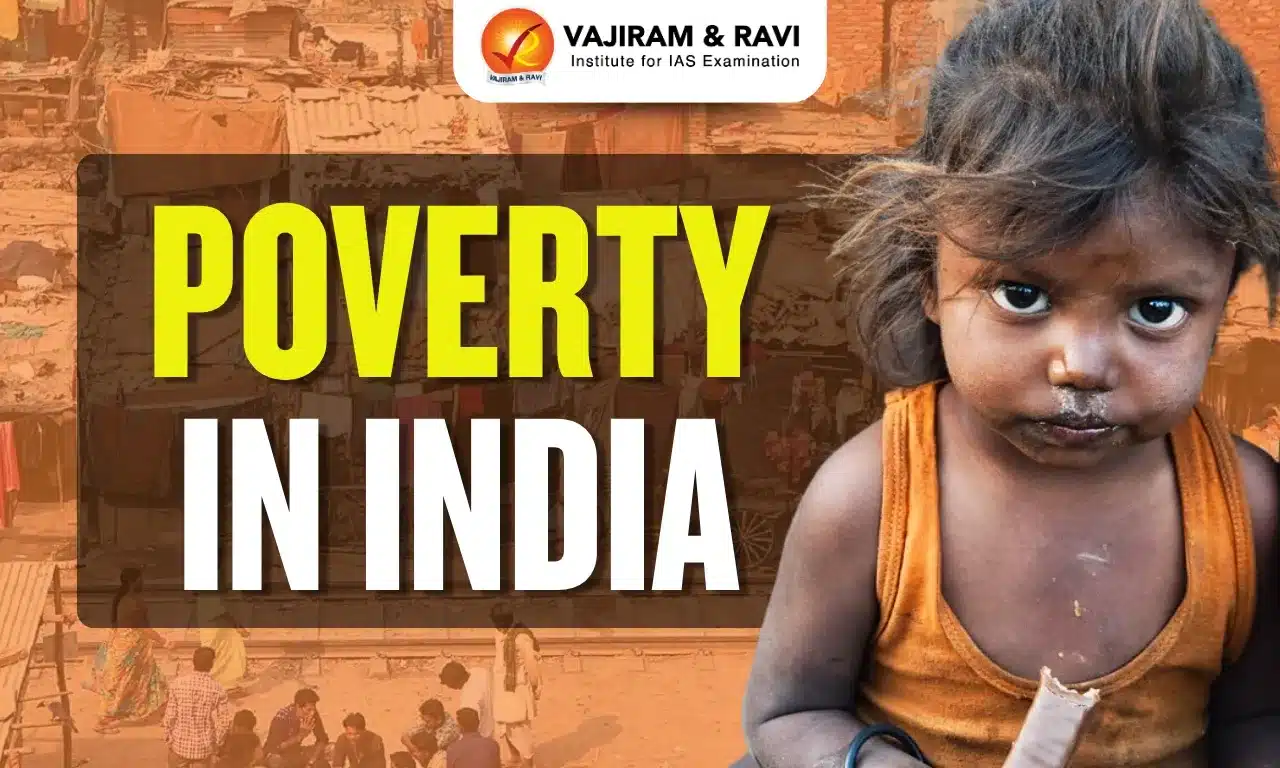
Poverty in India reflects both basic deprivation and widening inequality, seen through absolute poverty (lack of essentials for survival) and relative poverty (inequality compared to societal standards). It is driven by factors such as low agricultural productivity, unemployment, population pressure, and historical social disparities. To combat this, the government implements programmes like MGNREGA, NFSA, PMAY, and social security schemes targeting income support, food security, and basic services. Despite improvements, reducing multidimensional deprivation remains a core developmental challenge.
Poverty In India
Poverty in India has reduced significantly in its multidimensional form, yet extreme poverty has remained persistently high in the last five years, showing uneven progress. Poverty is a social condition where a section of society cannot meet basic needs like food, shelter, healthcare, and education. Structural inequalities, slow employment growth, and rising vulnerabilities have contributed to continued deprivation despite welfare improvements.
Poverty In India Historical Perspective
India’s poverty has deep historical roots shaped by colonial exploitation, post-Independence economic stagnation, and long-standing structural inequalities. While the country has made notable progress in recent decades, especially after economic reforms, the legacy of low productivity, unequal access to resources, and regional imbalance continues to influence today’s poverty patterns.
- Colonial Exploitation and Deindustrialisation: British rule destroyed traditional industries and drained wealth, causing mass unemployment; India’s share in world GDP fell from ~20% in 1700 to ~4% by 1950.
- Slow Economic Growth Post-Independence (1950–1980): The “Hindu Rate of Growth” of 3–3.5% was too low to significantly reduce poverty, despite planning and state-led development.
- Green Revolution but Uneven Gains: The 1960s–70s agriculture reforms boosted yields mainly in Punjab–Haryana, while Eastern and Central India remained trapped in chronic poverty.
- High Poverty Estimates in the 1970s–80s: Early official poverty assessments showed over 50% of India’s population living below the poverty line, highlighting widespread deprivation.
- Post-1991 Reforms and Accelerated Poverty Reduction: Liberalisation increased growth to 6–8%, helped lift millions out of poverty, and set the stage for the sharp MPI decline noted between 2013–14 and 2019–21.
Types of Poverty Absolute vs. Relative
Poverty may be understood as absolute, defined by minimum subsistence needs, or relative, defined by inequality and deprivation compared to societal standards.
- Absolute poverty: It refers to a condition where individuals or households are unable to meet the minimum basic necessities required for survival, such as adequate food, clothing, shelter, and healthcare. It is measured against a fixed and universal poverty line, such as the International Poverty Line (IPL) of $2.15/day (World Bank) based on 2017 Purchasing Power Parity.
- Relative Poverty: Relative poverty is defined as a condition where individuals have significantly lower income or resources compared to the average or median income of the society they live in. It highlights economic inequality, as people may meet basic needs but remain deprived relative to societal standards.
| Types of Poverty Absolute vs. Relative | ||
|
Aspect |
Absolute Poverty |
Relative Poverty |
|
Definition |
Lack of basic necessities (fixed, universal) |
Income/resources inadequate relative to society |
|
Measurement |
Fixed threshold (e.g., $2.15/day - WB IPL) |
Compared to median income |
|
Focus |
Survival and subsistence |
Inequality and social disparity |
|
Policy Implications |
Provide essential needs & services |
Reduce inequality & improve distribution |
|
Trends |
Stable unless standards change |
Changes with growth & income distribution |
[recap title="Differences Between Absolute Poverty and Relative Poverty" url="https://vajiramandravi.com/current-affairs/differences-between-absolute-poverty-and-relative-poverty/" new_tab="yes"]
Poverty Estimation in India: Methods and Committees
Poverty estimation in India is carried out primarily by NITI Aayog (earlier Planning Commission) using household consumption expenditure data from the NSSO under the Ministry of Statistics and Programme Implementation (MOSPI). These estimates determine the official poverty line, which helps identify beneficiaries for welfare schemes and assess long-term socio-economic trends.
The Ministry of Rural Development conducts the BPL Census for identifying poor households for specific schemes. India does not have a single fixed poverty line; instead, it has evolved with committees adapting to changing economic realities and nutritional standards.
Methods of Poverty Estimation
- Calorie-Based Method (Pre-1993)
- Adopted before the Lakdawala Committee.
- Poverty line defined by minimum calorie intake requirements (2400 rural, 2100 urban).
- Did not capture spending on health, education, housing, or inflation accurately.
- Consumption Expenditure Method (Post-1993)
- Shifted from pure calorie intake to a broader consumption-based approach.
- Captures household spending on food and non-food essentials.
- Committees refine the basket of goods, inflation indices, and regional variations.
- Mixed Reference Period (MRP) Method
- Used by NSSO: combines 30-day recall for some items and 365-day recall for infrequent purchases.
- Provides a more accurate picture of consumption.
- Modified Mixed Reference Period (MMRP) Method (Post-2011)
- Uses 7-day, 30-day, and 365-day recall depending on items.
- Became the basis for more recent committee recommendations.
Poverty Estimation Committees in India
- Alagh Committee (1979)
- First systematic poverty estimation post-independence.
- Used calorie-based norms:
- Rural: 2400 calories
- Urban: 2100 calories
- Developed a poverty line basket (PLB) of goods.
- Poverty Line was derived from the expenditure needed to meet these calorie norms.
- Lakdawala Committee (1993)
- Continued calorie norms but refined methodology.
- Did not update the basket of goods; relied on the same base year.
- Recommended poverty estimation based on state-specific poverty lines.
- MPCE Poverty Line:
- Rural: ₹328
- Urban: ₹454 (1993-94 prices)
- Tendulkar Committee (2009)
- Major methodological shift.
- Abandoned calorie norms and adopted a broader consumption approach.
- Included spending on health, education, clothing, shelter, etc.
- Recommended uniform poverty line basket across rural and urban areas.
- Poverty Line (2004-05 prices):
- Rural: ₹672
- Urban: ₹859
- Significantly increased the estimated number of poor in India.
- Rangarajan Committee (2012-2014)
- Reviewed Tendulkar’s method and increased thresholds.
- Used Modified Mixed Reference Period (MMRP).
- Higher poverty lines:
- Rural: ₹972
- Urban: ₹1,407 (2011-12 prices)
- Resulted in a higher poverty headcount than Tendulkar.
Causes of Poverty in India
- Low Agricultural Productivity: Agricultural output remains low because of fragmented landholdings and limited irrigation over 55% of India’s farmland is still rainfed. For example, states like Bihar and Jharkhand, dominated by small and marginal farmers, consistently report low yields compared to Punjab and Haryana.
- Population Explosion: India adds nearly 17 million people every year, creating intense pressure on food, housing, and employment systems. States like Uttar Pradesh and Bihar, with some of the highest population growth rates, also show some of the highest poverty levels.
- Unemployment and Underemployment: India’s unemployment rate has fluctuated between 6%-8% in recent years (PLFS), but the bigger issue is informal employment, where nearly 90% of workers are engaged in low-paying, insecure jobs. Youth unemployment remains high, especially among educated youth over 18% urban youth unemployed (PLFS 2023).
- Inefficient Resource Utilisation: Disguised unemployment in agriculture leads to low productivity as too many workers share limited work. Such labour underutilisation prevents households from earning sustainable incomes. Agriculture employs 45% of the workforce but contributes only 14-16% to GDP, reflecting major inefficiencies.
- Price Rise (Inflation): Persistent inflation reduces the purchasing power of the poor, especially when incomes don’t rise proportionately. Essential goods like food and fuel become less affordable.
- Low Rate of Economic Development: For decades after independence, slow industrialisation and state-controlled economic structures limited income growth and job creation. This delayed large-scale poverty reduction.
- Lack of Capital and Entrepreneurship: Limited access to credit, inadequate financial literacy, and weak entrepreneurial ecosystems inhibit investment in small businesses and agriculture. This restricts job creation and income opportunities. Only 10% of MSMEs in India have access to formal credit; the remaining depend on informal, high-interest borrowing (MSME Ministry).
- Social Inequalities and Structural Barriers: Caste discrimination, patriarchal norms, unequal inheritance, and social exclusion restrict access to land, education, and employment. Such structural barriers perpetuate intergenerational poverty. SCs and STs have an MPI (Multi-Dimensional Poverty Index) significantly higher than the national average, 32% for SCs and 43% for STs (NITI Aayog MPI 2023).
- Climatic and Environmental Vulnerability: Frequent floods, droughts, cyclones, and other disasters disrupt agriculture and livelihoods in vulnerable states, pushing households into repeated poverty cycles. Bihar and Assam face severe floods almost annually, affecting over 10 million people each year, damaging crops and homes (IMD & NDMA).
Trends in Poverty Reduction Post-Liberalisation
Post-1991 economic liberalisation significantly accelerated poverty reduction in India by boosting growth, increasing employment opportunities, and expanding social welfare schemes. Over the years, both consumption poverty and multidimensional poverty have shown a consistent decline, supported by targeted government interventions and rising rural development indicators.
- Sharp Decline in Poverty Ratio (1993–2011): Poverty fell from 45.3% in 1993–94 to 21.9% in 2011–12 (Planning Commission). Example: 133 million people were lifted out of poverty between 2004–05 and 2011–12 alone.
- Decline in Extreme Poverty as per World Bank (2022 Report): Extreme poverty in India reduced to less than 3% by 2019. Example: WB calculated poverty using the international poverty line of $2.15/day PPP.
- Significant Drop in Multidimensional Poverty (MPI): India saw a 55% reduction in MPI poverty between 2005–06 and 2019–21 (UNDP & NITI Aayog). Example: Over 415 million people exited multidimensional poverty in 15 years.
- Rural Poverty Reduction Accelerated Post-2005: Rural poverty declined faster due to schemes like MGNREGA, PMGSY, and NRLM. Example: Rural poverty dropped from 50.1% in 1993–94 to 25.7% in 2011–12.
- Urban Poverty Also Declined Steadily: Urban poverty fell from 31.8% in 1993-94 to 13.7% in 2011-12. Example: Growth in construction and service sectors pulled large numbers into informal urban jobs.
- Rise in Real Wages Post-2005 Contributed to Poverty Reduction: Real agricultural wages increased by ~3% annually from 2007-2013.
- Food Security Measures Reduced Extreme Deprivation: Schemes like TPDS reforms, NFSA 2013, and mid-day meals reduced hunger and child malnutrition. Example: NFSA covers 75% rural and 50% urban population with subsidised food grains.
- Expansion of Social Welfare and Direct Benefit Transfers: JAM trinity (Jan Dhan, Aadhaar, Mobile) reduced leakages and improved cash assistance. Example: Over ₹2.3 lakh crore transferred via DBT in 2021-22.
Rural vs. Urban Poverty in India
Rural and urban poverty in India differ significantly in terms of causes, intensity, and living conditions, though both reflect deep structural inequalities. Rural areas experience poverty driven mainly by agricultural distress, while urban poverty is shaped by informal employment and high living costs.
- Over 70% of India’s poor still reside in rural areas, showing the uneven spread of development and the continued dominance of agriculture-based livelihoods.
- Agriculture employs ~45% of the workforce but contributes only ~15% of GDP, resulting in low rural wages and pushing many households into chronic poverty.
- Urban poverty remains lower in percentage terms but intense in living conditions, as 35% of urban residents live in slums with overcrowding, poor sanitation, and limited social security.
- Average monthly per capita consumption is significantly lower in rural areas: Rural ₹3,773 vs. Urban ₹6,459 (NSO 2022–23), highlighting persistent income and affordability gaps.
- Access to healthcare and education remains poorer in rural regions, where shortages of doctors, teachers, and facilities reinforce long-term poverty traps.
- Inflation impacts the rural poor more severely, especially food inflation; even a 10% rise in food prices can push vulnerable rural households below the poverty line.
Poverty and Unemployment Linkages
Poverty and Unemployment in India are deeply interconnected, forming a cycle where one reinforces the other. High unemployment reduces household income, pushing families into poverty, while poverty limits access to education, skills, and opportunities, leading to structural unemployment.
- Unemployment reduces household income and consumption capacity, directly increasing poverty; for example, India’s youth unemployment crossed 18% (2023), disproportionately affecting poor households.
- Poverty limits access to quality education and skill training, resulting in low employability; ASER surveys show ~25% of rural children in Class 5 cannot read Class 2 text, indicating future unemployment risks.
- India faces widespread disguised unemployment in agriculture, where too many workers share limited farm output, keeping rural wages low and perpetuating poverty.
- Underemployment and informal work dominate the labour market, with ~92% of workers in informal jobs, often earning below minimum wages and lacking job security.
- Poor households lack access to credit and assets, preventing them from starting enterprises, which keeps them dependent on low-paying casual wage labour.
- Long-term poverty pushes people into vulnerable work like construction, domestic work, and street vending, where wages fluctuate and social security is minimal.
- Economic shocks such as the pandemic hit informal workers the hardest, as seen in 2020 when over 120 million informal workers lost jobs, driving millions back into poverty.
- Poverty leads to poor nutrition and ill health, lowering productivity and employability; for example, India’s 35.5% child stunting rate indicates future labour force weakness.
Impact of Poverty on Health, Education, and Human Development
Poverty deeply impacts health, education, and overall human development by limiting access to basic services, nutritious food, and learning opportunities. Poor households often face a cycle of illness, low learning outcomes, and reduced productivity, which restricts their earning potential and further reinforces poverty.
- Poor families cannot afford quality healthcare, leading to untreated illnesses and high mortality; for example, 63% of out-of-pocket health expenditure is paid directly by households, pushing millions into debt.
- Malnutrition is concentrated among poor households, reducing physical and cognitive development; India’s child stunting rate is 35.5% (NFHS-5), disproportionately affecting low-income groups.
- Poverty increases vulnerability to diseases like TB, malaria, and diarrhoea due to poor sanitation, unsafe water, and crowded living conditions. 50% of rural households still rely on non-piped water.
- Education outcomes decline due to poverty-driven absenteeism, child labour, and lack of learning resources; over 3.2% of children aged 6–14 are out of school, mostly from poor families (UNESCO).
- Poor nutrition and lack of healthcare impair learning ability, resulting in weak foundational skills; ASER 2023 shows 25% of Class 5 children cannot read Class 2 text.
- Poverty forces children into labour to support family income, reducing school attendance; India has 10.1 million child labourers (Census 2011), mainly in poor states.
Government’s Programmes to Reduce Poverty in India
The Government of India implements a wide range of poverty alleviation programmes focusing on employment generation, social security, food security, housing, and financial inclusion. These schemes aim to reduce multidimensional poverty by improving livelihoods, ensuring basic services, and creating safety nets for vulnerable groups.
- MGNREGA (2005) provides 100 days of guaranteed wage employment, reducing rural distress; it generated 3.2 billion person-days in 2022–23, offering a crucial safety net for rural poor.
- National Rural Livelihood Mission (DAY-NRLM) promotes self-employment through SHGs; over 8.7 crore women have been mobilised into SHGs, improving rural incomes and credit access.
- Pradhan Mantri Awaas Yojana (PMAY-Gramin & PMAY-Urban) provides pucca houses to poor families; PMAY has sanctioned over 2.3 crore rural houses and 1.2 crore urban houses.
- Pradhan Mantri Garib Kalyan Anna Yojana (PMGKAY) ensures free foodgrains to all NFSA beneficiaries; it benefits 81.35 crore people, preventing extreme poverty during crises.
- National Food Security Act (2013) provides subsidised foodgrains to 67% of India’s population, improving nutrition and reducing hunger-driven poverty.
- PM-KISAN offers ₹6,000 annually to farmers, supporting small and marginal families; 11 crore farmers are beneficiaries, reducing income volatility.
- Ayushman Bharat (PM-JAY) provides health insurance up to ₹5 lakh for poor families, reducing catastrophic health expenditure; it covers over 50 crore people.
- Atal Pension Yojana (APY) gives old-age income security to informal workers; over 5.6 crore subscribers, many from low-income households, have enrolled.
- PM-JDY (Jan Dhan Yojana) promotes financial inclusion, enabling direct benefit transfers; over 51 crore bank accounts opened, reducing leakages in welfare schemes.
- Pradhan Mantri Ujjwala Yojana (PMUY) provides free LPG connections to poor women; 9.6 crore connections have reduced indoor pollution and improved health.
- Deendayal Antyodaya Yojana–National Urban Livelihood Mission (DAY-NULM) enhances urban poor’s skills and employment; over 20 lakh beneficiaries trained under various components.
- Saubhagya Scheme ensures electricity connections to poor households; more than 2.8 crore homes have been electrified.
- Swachh Bharat Mission (SBM) improved sanitation access, reducing health-related poverty; rural sanitation coverage rose from 39% (2014) to nearly 100% (2023).
- Integrated Child Development Services (ICDS) provides nutrition and preschool education to children and mothers, reducing intergenerational poverty; 13.9 lakh Anganwadi centres provide services.
- Skill India Mission enhances employability for poor youth; more than 1.4 crore candidates trained under PMKVY.
- One Nation One Ration Card (ONORC) enables foodgrain portability across states, benefitting migrants and reducing urban poverty-related food insecurity.
Role of MGNREGA in Poverty Alleviation
The Mahatma Gandhi National Rural Employment Guarantee Act (MGNREGA) is one of India’s most significant anti-poverty programmes, offering 100 days of guaranteed wage employment to rural households. By providing an assured safety net during lean agricultural seasons, it reduces distress migration, stabilises incomes, and strengthens rural livelihoods.
- MGNREGA ensures minimum income security by guaranteeing 100 days of employment; in 2022–23, over 3.2 billion person-days of work were generated, directly supporting rural poor households.
- It raises rural wages by increasing bargaining power; studies by ILO and NSS show agricultural real wages rose significantly between 2007–2013, partly due to MGNREGA’s wage floor.
- The scheme reduces seasonal migration by providing local employment opportunities during lean agricultural months; states like MP and Rajasthan show reduced distress outmigration.
- A large share of its beneficiaries are women, enhancing gender empowerment; women’s participation consistently exceeds 50%, reaching 55–57% in several states.
- It enhances social inclusion, with strong participation of SC/ST households, who form nearly 40% of total person-days worked annually.
- During crises (e.g., COVID-19 pandemic), MGNREGA acted as an economic stabiliser; the highest-ever 389 crore person-days were generated in 2020–21 to support migrant and rural workers.
Women and Poverty: The Feminisation of Poverty
The feminisation of poverty refers to the growing trend of women experiencing higher levels of poverty than men, due to structural inequalities in employment, wages, education, healthcare, and access to resources. Women often face multiple layers of discrimination: economic, social, and cultural, which reduce their opportunities and increase vulnerability.
- Women have lower labour force participation (around 28% in 2023, PLFS), restricting their income-earning opportunities and increasing their risk of poverty.
- They are concentrated in informal, low-paid, and insecure jobs; over 90% of working women are in the informal sector, where wages are below minimum levels and job security is minimal.
- Wage inequality remains high; women earn 20–30% less than men for similar work (ILO estimates), limiting their long-term financial stability.
- Women shoulder a disproportionate burden of unpaid care and domestic work, averaging 5–6 hours per day, leaving them less time for paid employment.
- Women-led SHGs under NRLM play a major role in reducing feminisation of poverty, 8.7 crore women mobilised into SHGs have improved income, credit access, and entrepreneurship.
- Schemes like PMUY, PMMVY, PMJDY, MGNREGA (with >55% women participation) have contributed to reducing gendered poverty, but gaps remain in economic freedom and asset creation.
SDGs and India’s Progress on Poverty Eradication
India’s poverty reduction efforts are closely aligned with Sustainable Development Goal 1: No Poverty, which aims to end extreme poverty by 2030. Over the past decade, India has made steady progress through targeted social protection schemes, rural employment programmes, and direct benefit delivery reforms.
- Significant Decline in Multidimensional Poverty: According to NITI Aayog’s National MPI Report 2024, India lifted around 24 crore people out of multidimensional poverty between 2013–14 and 2022–23, showing accelerated progress in nutrition, housing, sanitation, and access to clean cooking fuel.
- Improvement in Social Indicators: India’s MPI dropped from 0.117 in 2015–16 to 0.066 in 2019–21, driven by better health outcomes (like reduced child mortality), improved school attendance, and wider electricity coverage.
- Expansion of Social Protection Schemes: Schemes such as PM-KISAN, PM-JAY, Ujjwala Yojana, and PMAY-Gramin have enhanced income security and basic living
- standards, reducing both consumption-based and multidimensional poverty.
Direct Benefit Transfer (DBT) Efficiency: DBT has enabled transparent delivery of subsidies to over 50 crore beneficiaries, cutting leakages and ensuring that welfare benefits reach the poorest households efficiently. - Progress towards SDG 1.3 (Social Security Coverage): India has expanded coverage through schemes like Atal Pension Yojana and PM-JAY, providing financial risk protection to vulnerable families.
- Challenges Ahead: Despite progress, issues such as rising urban poverty pockets, jobless growth, and rural distress still pose obstacles to achieving SDG-1 by 2030.
Way Forward
India’s fight against poverty requires a multi-dimensional, growth-oriented, and inclusive strategy that addresses structural inequalities and strengthens human capabilities.
- Strengthen Labour-Intensive Job Creation: Boost sectors like manufacturing, agro-processing, textiles, and construction to generate large-scale employment. For example, labour-intensive manufacturing accounts for less than 20% of total employment, showing the need for expansion.
- Enhance Quality of Education and Skills: Improve foundational learning and vocational training to make the workforce job-ready. ASER 2023 shows over 25% of rural youth lack basic employability skills, highlighting the need for skill-linked poverty reduction.
- Expand Social Protection Coverage: Build resilient safety nets including universal health coverage, pensions, and insurance for informal workers. Over 80% of India’s workforce is informal, making targeted protection essential.
- Improve Agricultural Productivity and Farmers’ Incomes: Promote MSP reforms, irrigation expansion, FPOs, and post-harvest infrastructure to raise rural incomes. Agriculture still employs around 45% of the workforce, but contributes only 15-17% of GDP.
- Strengthen Urban Poverty Alleviation Policies: Implement affordable housing, skilling, and social security for migrant and informal workers. Urban poverty pockets grew during Covid-19, revealing gaps in existing programmes.
- Promote Women-Centric Development: Improve women’s workforce participation, credit access, and asset ownership. India’s female LFPR, though rising, is still around 37%, much lower than global averages.
- Use Technology to Improve Targeting and Delivery: Expand DBT, Aadhaar-linked benefits, and digital monitoring to reduce leakage. JAM trinity has already saved over ₹2.7 lakh crore in leakages, indicating strong potential.
Poverty In India FAQs
Q1: What is poverty in the Indian context?
Ans: Poverty in India refers to a state of socioeconomic deprivation where individuals lack sufficient income, resources, and access to basic necessities such as food, housing, healthcare, and education.
Q2: How is poverty measured in India?
Ans: India measures poverty using income/consumption-based measures and multidimensional indicators. The Tendulkar Committee (2009) and Rangarajan Committee (2014) provide poverty lines, while NITI Aayog’s Multidimensional Poverty Index (MPI) uses health, education, and living standards indicators.
Q3: What is the current status of poverty in India?
Ans: According to NITI Aayog’s National MPI 2023, India reduced multidimensional poverty from 29% in 2013–14 to about 15% in 2019–21, lifting around 13.5 crore people out of poverty in six years.
Q4: What are the major causes of poverty in India?
Ans: Key causes include population pressure, low agricultural productivity, unemployment, low human development, inequality, inadequate social security, and climate vulnerability.
Q5: What is the difference between absolute and relative poverty?
Ans: Absolute poverty refers to the inability to meet basic survival needs such as food, shelter, and clothing. Relative poverty refers to inequality within a society, when people have significantly less income or resources compared to the average standard of living.

