
Four Labour Codes Latest News
- The Government of India notified all Four Labour Codes, consolidating 29 Central labour laws into a simplified, modern regulatory framework.
- This marks one of the most significant labour reforms since Independence, aimed at improving labour welfare, social security, workplace safety, and ease of doing business.
Background
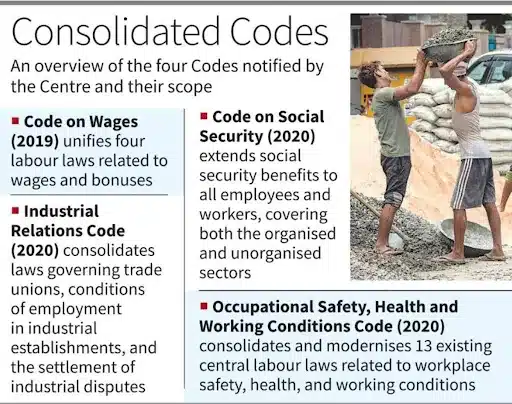
- Four labour codes: Code on Wages, 2019; Industrial Relations (IR) Code, 2020; Code on Social Security, 2020; and the Occupational Safety, Health and Working Conditions (OSHWC) Code, 2020.
- Pending implementation: These codes were pending implementation due to protests by Central Trade Unions (CTUs). Despite resistance, the Centre has now operationalised them.
- Systemic reforms introduced:
- Gender-neutral work policies
- Uniform safety standards
- Streamlined contract labour regulation
- India-wide ESIC and EPFO coverage
- National floor wages
- Move towards formalisation of labour market
Key Features of the Four Labour Codes
- Universal social security and expanded coverage:
- First-time statutory recognition of gig workers, platform workers, and aggregators.
- ESIC expanded to all districts, including hazardous units.
- Aadhaar-linked Universal Account Number (UAN) - fully portable benefits for migrant workers.
- Accident compensation extended to commuting accidents.
- Social security contributions - aggregators to contribute 1–2% of annual turnover (capped at 5%).
- Wages, minimum pay and timely payment:
- National Floor Wage introduced.
- Mandatory timely wage payments across establishments.
- Wage structure redefined to increase basic pay component, enhancing provident fund and gratuity provisioning.
- Women workers’ rights and safety:
- Women allowed to work night shifts, underground mines, heavy machinery operations—with consent and safety conditions.
- Equal pay for equal work mandated.
- Free annual health check-up for workers aged over 40.
- Fixed term employment (FTE):
- Workers can be hired for a fixed duration without compromising benefits.
- FTE employees get - same wages as permanent workers; medical, leave, and social security benefits; and gratuity eligibility after one year (earlier 5 years).
- Simplifying compliance and improving Ease of Doing Business:
- Single registration, licence and return system.
- Inspector-cum-facilitator model for supportive compliance.
- Two-member tribunals for faster dispute resolution.
- National OSH Board to harmonise safety standards.
Stakeholder Responses
- Government:
- Most comprehensive labour-oriented reform since Independence.
- Codes will formalise employment, ensure global alignment, and improve worker protections.
- Industry: CII welcomed the Codes as a “historic milestone," aiding a predictable labour regime and boosting economic growth.
- Trade unions (CTUs):
- Termed the Codes: “Anti-worker, pro-employer”, “Declaration of war on working masses”
- Concern areas - FTE misuse, restrictions on the right to strike, retrenchment norms.
- Nationwide protests planned for 26 November.
- Bharatiya Mazdoor Sangh (BMS): Partially supportive - backs Codes on Wages & Social Security but wants changes in OSHWC and IR Codes.
Challenges and Concerns
- CTUs: Oppose curtailment of strike rights, retrenchment rules, and fear dilution of worker protections.
- Implementation capacity: Labour is a Concurrent Subject—requires State cooperation. Many States are still finalising rules; implementation asymmetry is likely.
- Risk of FTE misuse: Fear that employers may replace permanent jobs with fixed-term contracts.
- Gig worker social security: Turning provisions into effective schemes remains a challenge. Past initiatives like e-Shram saw poor follow-through.
- Clarity on wage floor: National Floor Wage requires new methodology and agreements across States.
Way Forward
- Strengthening consultation mechanisms: Revive the Indian Labour Conference (ILC) for consensus-building. Continuous dialogue with unions, employers and States.
- Capacity building for States: Technical and financial support to implement new digital compliance systems.
- Clear scheme design for gig workers: Transparent rules for aggregator contribution. Seamless portability using UAN.
- Monitoring and preventing misuse of FTE: Strong checks to avoid replacing permanent jobs with FTE roles.
- Awareness campaigns: Workers, especially in informal sectors, need awareness of new rights.
Conclusion
- The implementation of the Four Labour Codes represents a historic restructuring of India’s labour governance framework.
- By consolidating 29 outdated laws, the Codes aim to create a future-ready labour ecosystem that promotes worker welfare, social security, gender equality, and ease of doing business.
- However, implementation challenges, trade union resistance, and risks of misapplication remain significant.
- Effective stakeholder engagement and transparent rule-making will be crucial for the Codes to fulfil their objective of creating an inclusive, formalised, and equitable labour market in India.
Four Labour Codes FAQs
Q1: What is the significance of the Four Labour Codes?
Ans: It consolidated 29 archaic laws into a unified framework to enhance social security, formalisation, worker safety, and ease of doing business.
Q2: How the Labour Codes aim to extend social security to gig and platform workers?
Ans: The Social Security Code provides first-time statutory recognition to gig/platform workers and mandates aggregator contributions.
Q3: What are the concerns raised by trade unions regarding the Labour Codes?
Ans: Trade unions argue that the Codes dilute worker rights through restrictive strike provisions, flexible retrenchment norms, etc.
Q4: How does the introduction of Fixed Term Employment (FTE) impact labour market flexibility and worker welfare?
Ans: FTE offers employers flexibility while ensuring workers receive benefits equal to permanent staff, including gratuity after one year.
Q5: What is the role of the National Floor Wage under the Code on Wages?
Ans: The National Floor Wage sets a nationwide minimum benchmark, reducing inter-state wage disparities and ensuring timely, uniform wage payments.
