

India’s IPO Boom Masks Heavy Promoter Exits and Overpricing Risks

IPO

IPO Latest News

  • Chief Economic Advisor (CEA) V. Anantha Nageswaran has raised red flags about the changing nature of India’s initial public offerings (IPO) market. 
  • He warned that IPOs are increasingly being used as exit routes for early-stage investors rather than for raising long-term productive capital. 
  • His remarks come at a time when India’s primary market is witnessing a surge in IPO approvals and record fundraising plans, prompting concerns over overpricing and retail investors entering at inflated valuations.

IPOs Tilt Toward Promoter Payouts Instead of Capital Raising

  • Recent IPO data shows a worrying shift: instead of raising fresh capital for business expansion, most new listings are being dominated by offers for sale (OFS) — allowing promoters and early investors to cash out.
    • OFS is a mechanism on the stock exchange that allows existing shareholders, such as promoters or large institutional investors, to sell their existing shares to the public. 
  • Between SEBI-approved and pending applications, over 200+ companies are seeking to raise nearly ₹2.8 lakh crore, yet the structure of recent IPOs reveals that:
    • LG’s entire ₹11,000 crore IPO went to the Korean promoter.
    • Tata Capital’s IPO: Over ₹8,600 crore went to promoter Tata Sons and early investors.
    • Lenskart: More than ₹5,000 crore was cashed out by founders and pre-IPO shareholders.
    • WeWork India: The full ₹3,000 crore issue was an OFS by existing stakeholders.
  • In short, the majority of recent IPOs have become monetisation events rather than instruments for raising long-term growth capital.

OFS Dominates Recent IPO Structures

  • A major share of recent IPO issue sizes comprises Offer for Sale (OFS), where existing shareholders — mainly promoters and pre-IPO investors — sell their stakes.
  • OFS proceeds do not benefit the company, as the money goes directly to the selling shareholders.
  • OFS is not inherently problematic, but when it overshadows fresh issue components and valuations appear inflated, it raises serious concerns.

Overpricing Becomes a Red Flag

  • Market experts warn that overpriced IPOs are becoming a new systemic risk.
  • They note that hype-driven valuations, heavy anchor investor activity, and unrealistic growth assumptions are creating a dangerous disconnect between market prices and actual earnings potential — leaving retail investors exposed.
  • Companies - with modest profits, short operating history, or uncertain future cash flows - are demanding valuations that exceed even those of well-established, profitable listed firms.
  • These valuations are often justified using optimistic projections and aggressive accounting to project stronger growth ahead of listing.

Promoters and PE Funds Cashing Out at High Valuations

  • Promoters and private equity investors — who understand the company’s real financial health — often acquired shares at very low valuations earlier.
  • The IPO gives them a chance to exit at peak valuations, transferring nearly all the risk to public investors.
  • The biggest concern associated with this the is information asymmetry:
    • Promoters and early investors know far more about the company’s weaknesses and risks.
    • When they sell aggressively at high valuations, it raises the question: if the future is so bright, why are insiders exiting now?
  • This makes public investors wonder whether:
    • the company really needed fresh capital, or
    • the IPO was simply an opportunity to encash a favourable market sentiment.

Promoter Exits: Sign of a Maturing Market

  • Some experts argue that high promoter and private equity exits through IPOs reflect market maturity rather than malfunction.
  • They note that many IPOs criticised for high valuations have later become multibaggers, including several new-age tech companies that have delivered ~50% average returns since listing.
  • They emphasised that early investors take significant risk in backing young companies. 
  • They deserve viable exit routes to recycle capital into new ventures—exactly how mature Western markets operate.
  • Many IPOs do very well, but investors forget that early funds also invest in many companies that fail. So, they need exits to recover money and keep investing.

Retail Investors at Risk in an Overheated IPO Market

  • Retail investors often rush into IPOs believing they guarantee quick profits. 
  • While some stocks list with a big pop, many fall or stagnate once excitement fades and prices adjust to real fundamentals. 
  • As a result, small investors end up holding overpriced shares while promoters and early investors walk away with huge gains.

Not All IPOs Are Bad — But Caution Is Needed

  • Several good companies have used IPOs responsibly. However, the current trend of inflated valuations, heavy offers for sale (OFS), and aggressive marketing has made the IPO space riskier than before. 
  • Experts say transparency on pricing, profitability, and peer comparisons is essential to protect retail investors.

Why Retail Investors Are Vulnerable

  • Even though regulators have tightened disclosure norms, pricing remains market-driven. 
  • When liquidity is high and sentiment is bullish, promoters and investment bankers naturally push valuations beyond fundamentals, leaving small investors exposed.

IPO Market at a Turning Point

  • If IPOs continue to be used mainly as exit avenues rather than genuine fundraising routes:
    • public trust will decline
    • retail participation will shrink
    • and the market may face a sharp correction
  • For a healthy ecosystem, companies must price more realistically, investors must look beyond narratives, and regulators must strengthen oversight. 
  • The bottom line: too many IPOs channel money to promoters instead of funding new projects or capacity expansion.

Source: IE | IT

IPO FAQs

Q1: Why are India’s recent IPOs raising concerns?

Ans: Most IPOs now function as exit routes for promoters and private equity investors through large offers for sale, limiting fresh capital for expansion and raising valuation concerns.

Q2: What is the issue with high OFS components in IPOs?

Ans: OFS-heavy IPOs send proceeds to selling shareholders, not companies, raising red flags when paired with aggressive pricing and limited track records of listing firms.

Q3: Why are retail investors vulnerable in the current IPO environment?

Ans: Retail buyers often enter at inflated valuations, driven by hype, only to face corrections once stocks trade on fundamentals while insiders exit with profits.

Q4: How do experts view high promoter exits in IPOs?

Ans: Some analysts argue promoter exits reflect a maturing market, offering early investors essential liquidity to reinvest despite occasional criticism of high valuations.

Q5: What could happen if IPOs remain dominated by exits?

Ans: Trust in the market may erode, retail participation could fall, and valuations may correct sharply unless pricing becomes realistic and disclosures strengthen.

e-KYC Drive Triggers Mass Deletions in MGNREGA Worker Records

MGNREGA

MGNREGA Latest News

  • The Mahatma Gandhi National Rural Employment Guarantee Act (MNREGA) covers nearly 26 crore registered workers across 2.69 lakh gram panchayats. Over the past six months, around 15 lakh workers were removed from the database. 
  • However, within just one month — from October 10 to November 14, 2025 — deletions spiked to 27 lakh, far exceeding the 10.5 lakh new additions during the same period.
  • This unprecedented rise in deletions coincides with the Union government’s intensified push for mandatory e-KYC verification to identify and remove ineligible or duplicate beneficiaries. 
  • Concerns are growing that the verification drive may be excluding genuine workers who struggle with documentation or biometric-related issues.

Legal Provisions on Job Cards

  • Under Para 2 of Schedule II, Gram Panchayats must issue job cards within 15 days of receiving an application.
  • Job cards must include a unique number, registration details, insurance details, and Aadhaar numbers (if any).
  • As per Para 3 of Schedule II, job cards must be renewed every five years after proper verification.
  • States, through Panchayati Raj Institutions, are responsible for issuance, verification, and renewal.

Government’s Rationale for e-KYC Push

  • The Union Ministry of Rural Development has stated that verifying MGNREGA workers is an ongoing exercise, and e-KYC is an additional step to enhance transparency and efficiency. 
  • According to the Ministry, the digital verification process is intended to improve service delivery and reduce inclusion errors. 
  • So far, over 56% of active workers have completed e-KYC across States, indicating steady progress in the verification drive.

Methods of Worker Verification

  • Before the introduction of e-KYC, the government relied on multiple digital and Aadhaar-linked verification measures to prevent ineligible beneficiaries under MGNREGA:
    • Digital Attendance (NMMS App): After a year-long pilot from May 2022, workers’ attendance had to be captured via the National Mobile Monitoring System. Mates/supervisors uploaded geotagged photos twice daily from worksites.
    • Aadhaar-Based Payment System (ABPS): Made mandatory in January 2023, ABPS required workers’ Aadhaar to be linked with job cards and bank accounts.
    • NPCI Mapping Requirements: Workers’ Aadhaar numbers and banks’ IINs had to be mapped with the NPCI database to enable Aadhaar-based payments.
  • These steps aimed to tighten verification, reduce duplication, and ensure payments reached genuine workers.

e-KYC Process

  • Under the e-KYC system integrated into the NMMS app, supervisors photograph each MNREGA worker at the worksite. 
  • This image is then digitally matched with the worker’s Aadhaar database photo to verify identity instantly.
  • Since 99.67% of active workers have Aadhaar seeded, e-KYC provides a quick, accurate, and reliable verification method.

Link Between e-KYC Drive and MNREGA Worker Deletions

  • Earlier digital measures — NMMS for attendance and Aadhaar-Based Payment System (ABPS) — were introduced to improve transparency but instead caused widespread exclusion.
  • Issues included poor network connectivity, limited digital literacy, and technical failures that prevented attendance capture, leading to wage loss.

Aadhaar Seeding and Data Mismatch Problems

  • ABPS required perfect matching of Aadhaar details with job cards and bank accounts.
  • Minor spelling differences in names or demographic discrepancies frequently caused workers’ records to be rejected.
  • During ABPS rollout, deletions surged by 247% between 2021-22 and 2022-23.

Failures in NMMS Implementation

  • NMMS did not deliver the intended transparency. Problems included:
    • Uploading irrelevant or fake photos
    • Photo-to-photo capturing instead of live images
    • Large mismatches between actual and recorded attendance
  • To fix this, the government introduced a multi-level verification system, with 100% verification at gram panchayat level and reduced checks at higher levels.

Introduction of e-KYC Due to NMMS Shortcomings

  • e-KYC was introduced partly because NMMS verification was unreliable.
  • The new system seeks to validate identity using live photo matching with Aadhaar.

Government Denies a Direct Link

  • The government claims deletions follow a strict SOP issued in January, ensuring transparency and allowing appeals before deletion.
  • It rejects claims that e-KYC itself is causing deletions.
  • Despite government denial, States with high e-KYC completion rates are reporting massive deletions:
    • Andhra Pradesh: 78.4% e-KYC done → 15.92 lakh deletions
    • Tamil Nadu: 67.6% → 30,529 deletions
    • Chhattisgarh: 66.6% → 1.04 lakh deletions
  • This raises questions about whether the e-KYC drive is indirectly contributing to exclusion.

Overall Assurance

  • The Ministry affirms its dedication to:
    • Protecting the rights of every genuine MGNREGA worker
    • Ensuring uninterrupted wage employment
    • Maintaining transparency, accountability, and effectiveness in scheme implementation

Source: TH | PIB

MGNREGA FAQs

Q1: Why has the e-KYC drive become controversial in MGNREGA?

Ans: The e-KYC push coincided with a sudden rise in worker deletions, raising concerns that technical failures, Aadhaar mismatches, and network gaps may be excluding genuine beneficiaries.

Q2: What are the government’s reasons for implementing e-KYC?

Ans: The government says e-KYC enhances transparency, reduces fraud, and improves service delivery by digitally verifying workers’ identities and linking records with Aadhaar for accurate payments.

Q3: How were MGNREGA workers verified before e-KYC?

Ans: Earlier verification involved NMMS-based digital attendance, Aadhaar-Based Payment System requirements, and NPCI mapping—processes that often caused disruptions due to connectivity and data mismatch issues.

Q4: How does the e-KYC verification process function?

Ans: Supervisors capture a worker’s live photo through the NMMS app, which is automatically matched with Aadhaar data in real time to confirm identity efficiently.

Q5: Why do high-deletion States raise concerns about e-KYC?

Ans: States with high e-KYC completion, like Andhra Pradesh and Tamil Nadu, report heavy deletions, suggesting the verification process may indirectly contribute to exclusion despite government denial.

2025 G-20 Leaders’ Summit – Johannesburg Declaration Affirms Multilateralism and Global South Priorities

G20 Summit 2025

2025 G20 Leader’s Summit Latest News

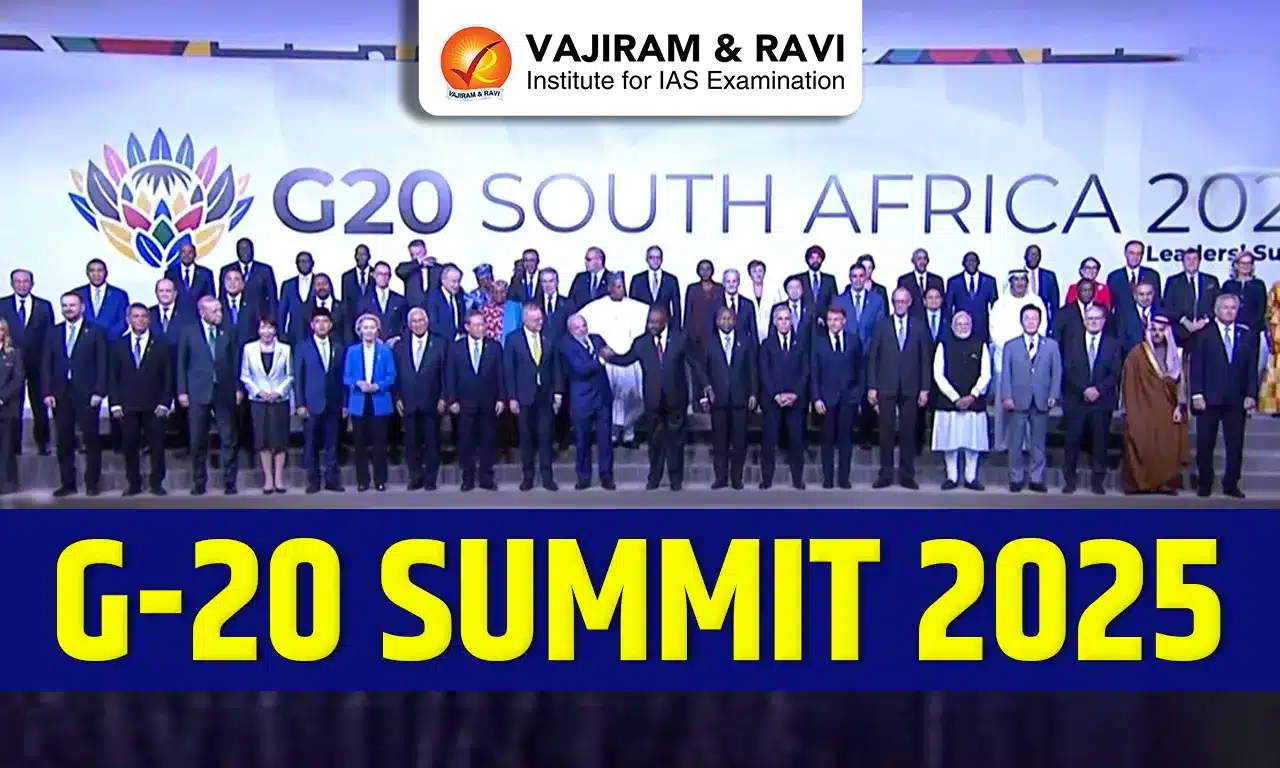
  • At the 2025 G-20 Leaders’ Summit in Johannesburg, the host South Africa achieved the adoption of the G-20 Leaders’ Declaration by consensus—despite the U.S. boycott and attempts to block the text.
  • This was the first G-20 Summit held in Africa, marking an important moment for the Global South, African development, and the evolving global governance architecture.

Adoption of the Declaration

  • Unusual early adoption:
    • The Declaration was adopted at the start of the Summit, not at the end—an unprecedented step.
    • Negotiated and finalised by Sherpas, enabling early clearance.
  • South Africa’s stand:
    • Declared the adoption an “affirmation of multilateralism.”
    • Asserted that the G20 cannot be paralysed due to the absence of any single country, including the U.S.
  • US opposition: The U.S. did not participate and attempted to block the Declaration. Boycott due to deteriorating Washington–Pretoria ties.

Key Themes and Priorities in the G-20 Declaration

  • Multilateralism and global cooperation:
    • Reiterated commitment to the UN Charter, international law and peaceful settlement of disputes.
    • Emphasised the African philosophy Ubuntu: “I am because we are.”
  • Weak position on conflicts: 
    • Minimal references to Russia–Ukraine war, Gaza conflict, Middle East tensions.
    • Single-line condemnation of terrorism - “Terrorism in all its forms and manifestations.”
    • Still included a key line - states must refrain from use of force for territorial acquisition.
  • Global South issues:
    • Strong emphasis on debt sustainability, development financing, inequality, African priorities.
    • India ensured Global South concerns, a continuation of India’s 2023 G20 presidency.
  • UN Security Council (UNSC) reform: Called for “transformative reform” of UNSC. Sought increased representation for Africa, Asia-Pacific, Latin America & Caribbean.
  • Women-led development: Reaffirmed commitment to empowerment of women and girls, removing socio-economic barriers, promoting women-led development, and recognising women as agents of peace.

South Africa’s Bilateral Balancing with the US

  • Balanced diplomacy: Acknowledged the economic importance of the U.S. - U.S. is South Africa’s second largest trading partner. Rejected U.S. claims of “genocide of white farmers” as baseless.
  • Debt sustainability push: Highlighted issue of risk-parity - countries with same risk but higher interest rates.

India’s Priorities and Contributions

  • Reconsidering global parameters of growth: 
    • The Indian PM argued current economic models have left many deprived of resources and caused over-exploitation of nature.
    • He stressed the need to rethink development, especially as Africa remains most affected.
  • “Integral Humanism”: 
    • The Indian PM promoted Deen Dayal Upadhyay’s Integral Humanism - holistic development of individuals and society through the integration of material and spiritual well-being.
    • It will provide an alternative to Western ideologies such as individualism, secularism, communism.
  • Key initiatives proposed by India:
    • Global traditional knowledge repository: For sustainable, culturally rooted, eco-balanced lifestyles.
    • G20–Africa Skills Multiplier initiative: India to train 1 million Africans in skill sectors.
    • G20 Global Healthcare Response Team.
    • G20 Initiative on Countering the Drug–Terror nexus: Highlighted fentanyl, drug trafficking, and terror financing.
    • G20 Open Satellite Data Partnership: Sharing agriculture, fishing, disaster data.
    • Critical Minerals Circularity Initiative: Recycling, sustainable mining, strategic minerals.
  • India’s diplomatic engagements: ACITI Partnership (Australia–Canada–India) launched for technology and innovation, AI, clean energy, supply chain resilience.

Broader Geopolitical Backdrop

  • Rising geopolitical fragmentation: Declaration notes trade wars (US tariff wars under Trump), geoeconomic competition, conflicts, inequalities, uncertainty in global economy.
  • Absence of U.S.: First-ever G20 Summit boycotted by the U.S. Raises questions on global leadership transitions.

Challenges Ahead

  • Weak consensus on global conflicts: Almost no mention of Ukraine, Gaza. Makes it one of the weakest declarations in G20 history.
  • Debt sustainability for developing nations: High interest rates for the same risk profile.
  • Geopolitical fragmentation: US–South Africa tensions, rise of competing blocs.
  • Inequality and resource deprivation: Current growth models unsustainable.
  • Climate change: G20 responsible for the majority of emissions—yet slow collective action.

Way Forward

  • Strengthen multilateral institutions: Reform UNSC, empower Global South.
  • Sustainable development framework: Integrate traditional knowledge, eco-balanced growth, and integral humanism.
  • Gender-inclusive development: Remove socio-economic barriers, promote women-led governance.
  • Digital cooperation and technology partnerships: Example, ACITI partnership, Satellite data sharing, etc.
  • Counter Drug–Terror nexus: Multilateral intelligence-sharing; regulation of fentanyl, synthetic opioids.
  • Climate action: Promote critical mineral recycling, clean energy supply chains.

Conclusion

  • The 2025 Johannesburg G20 Declaration marks a pivotal moment in global governance, with Africa asserting leadership, the Global South shaping priorities, and the G20 adopting consensus despite U.S. boycott.
  • While the declaration is symbolically strong on multilateralism, it is weak on major global conflicts and hard security issues. 
  • India played a crucial role in embedding developmental, gender, and sustainability priorities and propelled new initiatives aligned with integral humanism and South–South cooperation.

Source: TH | IE | TH

2025 G-20 Leaders’ Summit FAQs

Q1: What is the significance of the early adoption of the 2025 G-20 Johannesburg Declaration?

Ans: It symbolises a strong affirmation of multilateralism and Global South leadership despite U.S. opposition and geopolitical fragmentation.

Q2: How the 2025 G-20 Declaration reflects the priorities of the Global South?

Ans: The Declaration highlights debt sustainability, inequality, development financing, UNSC reform, etc.

Q3: How does the philosophy of Integral Humanism influence India’s stance at the G-20 Summit?

Ans: It offers a holistic, culturally rooted alternative to Western models and underpins India’s push for sustainable, human-centric development.

Q4: What are the challenges highlighted by South Africa regarding debt sustainability in the G-20 Declaration?

Ans: Countries with similar risk profiles face unequal interest rates, deepening financial distress and limiting developmental capacity.

Q5: What is the implication of the limited mention of global conflicts in the 2025 G-20 Declaration?

Ans: Minimal references to Ukraine and Gaza make it one of the weakest G-20 declarations on geopolitical issues, reflecting consensus-building constraints.

Enquire Now