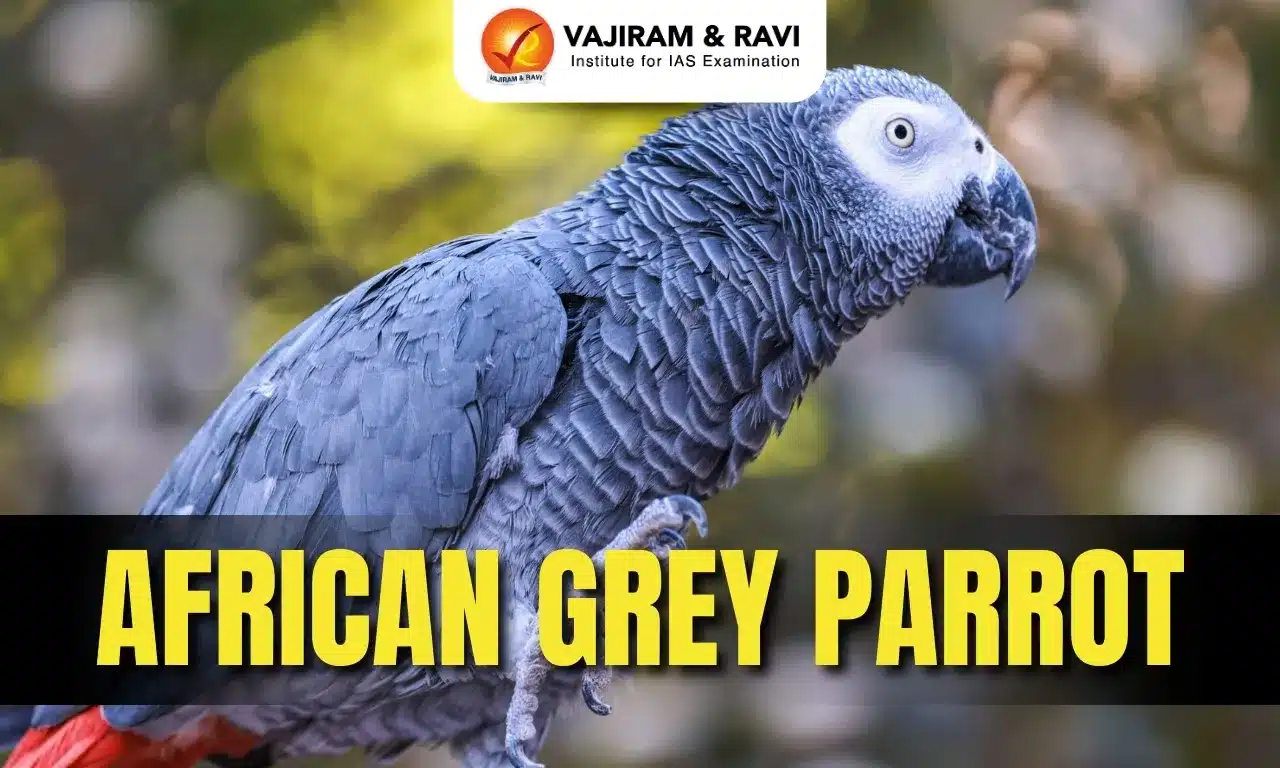
African Grey Parrot

African Grey Parrot

African Grey Parrot Latest News

There are no registered breeders or authorised pet shops to sell African grey parrots (Psittacus erithacus) – one of the most easily procurable animals in the country.

About African Grey Parrot

  • It is a medium-sized, dusty-looking gray bird.
  • Scientific Name: Psittacus erithacus
  • It is one of the most talented talking/mimicking birds on the planet.

African Grey Parrot Habitat and Distribution

  • African grey parrots are native to West and Central Africa.
  • They inhabit different types of lowland forest, including rainforest, woodlands, and wooded savannah
  • They can be seen along forest edges and in clearings as well, and sometimes feeding in gardens and cultivated fields.
  • They are kept as pets in many parts of the world, and their popularity dates back centuries.

African Grey Parrot Features

  • It is a mottled grey-colored, medium-sized parrot
  • It has a large black bill and white mask enclosing a yellow eye and has a striking red vent and tail. 
  • Females have a pale gray crown with dark gray edges, a gray body, and scarlet tail feathers. 
  • The male looks similar to the female but becomes darker with age.
  • Lifespan: 50+ years

African Grey Parrot Conservation Status

It is classified as 'Endangered' under the IUCN Red List. 

Source: TH

African Grey Parrot FAQs

Q1: What is the scientific name of the African grey parrot?

Ans: Psittacus erithacus

Q2: Where are African grey parrots naturally found in the wild

Ans: African grey parrots are native to West and Central Africa.

Q3: What is the conservation status of the African grey parrot according to the IUCN Red List?

Ans: Endangered

Hussain Sagar Lake

Hussain Sagar Lake

Hussain Sagar Lake Latest News

In a fresh move to tackle algal blooms, persistent foul odour and declining water quality in Hussainsagar lake, the Hyderabad Metropolitan Development Authority (HMDA) proposes to introduce an advanced bioremediation process using enzyme solutions and biochar-based Bokashi balls.

About Hussain Sagar Lake

  • It is an artificial lake located in Hyderabad, Telangana.
  • It is also called Tank Bund and lies on a tributary of River Musi. 
  • It spreads across an area of 5.7 sq.km. It is one of the largest man-made lakes in Asia.
  • It is the largest heart-shaped mark among the marks formed by 78 heart-shaped lakes and 9 heart-shaped islands on the face of the earth.
  • It was built during the reign of Ibrahim Quli Qutub Shah by Hussain Shah Wali in 1562 AD. 
  • It is renowned for its monolith of Lord Buddha that stands right in its centre. 
  • It had been of significance in the early days since it connected the twin cities of Hyderabad and Secunderabad.
  • Till 1930, the lake was used for irrigation and drinking water requirements.
  • Over the years, Hussain Sagar Lake has become polluted through the entry of untreated sewage and industrial effluents through the nalas that flow into the lake.

Source: NIE

Hussain Sagar Lake FAQs

Q1: Hussain Sagar Lake is located in which Indian state?

Ans: Telangana

Q2: Hussain Sagar Lake was constructed during the reign of which Sultan?

Ans: It was built during the reign of Ibrahim Quli Qutub Shah by Hussain Shah Wali in 1562 AD.

Q3: Hussain Sagar Lake lies on a tributary of which river?

Ans: Musi

Moss

Moss

Moss Latest News

Recently, a team of scientists has found that moss can survive a prolonged trip to space.

About Moss

  • It is a small nonvascular spore-bearing land plant belongs to the taxonomic division Bryophyta.
  • It is among the earliest land plants and has colonised some of the harshest environments on the planet, including Antarctica, volcanic fields, and deserts.
  • Mosses existed as early as the Permian Period and more than 100 species have been identified from fossils of the Paleogene and Neogene periods.
  • Types of Moss: Of the 10,000 and more types of mosses on the planet, there are three main types: peat moss, granite moss and true moss.
  • Distribution:  Mosses are distributed throughout the world except in salt water.
  • Habitat: It is the small plant commonly found in damp, shady spots is already known for its resilience on Earth.
  • Moss reproduces through spores, which are the equivalent to a flowering plant’s seed

Ecological Significance of Moss

  • Ecologically, mosses break down exposed substrata, releasing nutrients for the use of more-complex plants that succeed them.
  • They also aid in soil erosion control by providing surface cover and absorbing water.
  • They are important in the nutrient and water economy of some vegetation types.
  • Mosses can be effective indicators of c02 emissions that pollute the air. They can also signal if an ecosystem has been damaged or harmed by acid rain.

Source: IE

Moss FAQs

Q1: What is the primary method of reproduction in Moss plants?

Ans: Spores

Q2: What is the role of Moss plants in the ecosystem?

Ans: They are primary producers

Limestone

Limestone

Limestone Latest News

The first-ever auction of limestone mineral blocks in the Union Territory of Jammu & Kashmir will be formally launched in Jammu.

About Limestone

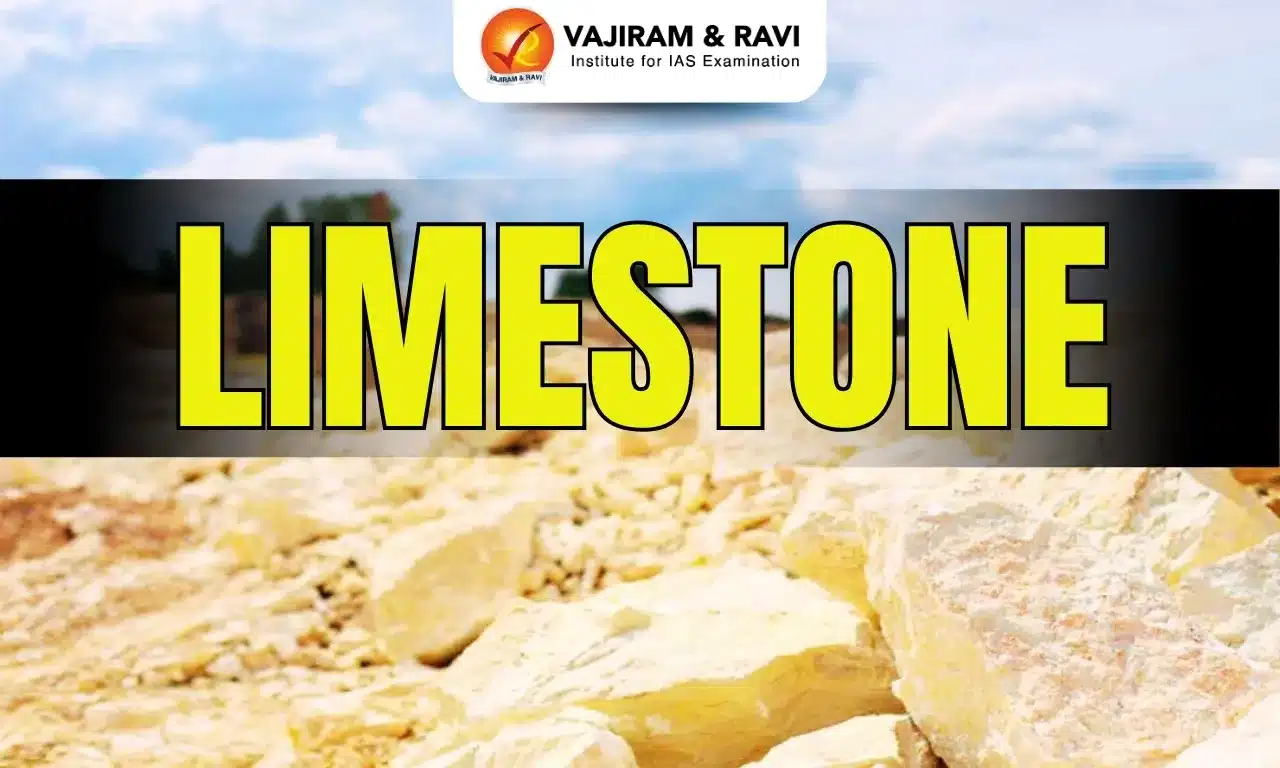
  • Limestone is a sedimentary rock made of calcium carbonate (CaCO3), usually in the form of calcite or aragonite.
  • It occurs across almost all geological sequences from Pre-Cambrian to Recent, except in Gondwana formations.

Composition of Limestone

  • It contains considerable amounts of magnesium carbonate (dolomite).
  • It also contains minor constituents of clay, iron carbonate, feldspar, pyrite, and quartz.
  • In many cases, the grains are microscopic fragments of fossil animal shells that are also present.

Distribution of Limestone in India

  • Karnataka has the largest share (28%) of total resources, followed by Andhra Pradesh, Rajasthan, Gujarat, Meghalaya, and Chhattisgarh.
  • Production Centers: Over three-fourths of India’s limestone is produced in just six states: Andhra Pradesh & Telangana, Rajasthan, Madhya Pradesh, Gujarat, Tamil Nadu, and Karnataka.

Uses of Limestone

  • The principal use of limestone is in the Cement Industry.
  • Metallurgical Processes: It is used as a flux in iron and steel production.
  • Other Industries: Glass, Ceramic, Paper, Textile, and Tanning
  • Chemical Production: Calcium carbide, alkali, bleaching powder
  • Agriculture: It is used as soil conditioning agent, fertilizer (calcium ammonium nitrate)
  • Consumer Products: Whiting (chalk and precipitated limestone) in rubber, paint, cosmetics, toothpaste, and shoe polish

Source: PIB

Limestone FAQs

Q1: What is the primary component of limestone?

Ans: Calcium carbonate

Q2: What is the process by which limestone is formed?

Ans: Sedimentation

Exercise AUSINDEX

Exercise AUSINDEX

Exercise AUSINDEX Latest News

Recently, the Indian Naval Ship INS Sahyadri participated in the exercise AUSINDEX 2025 which was held in the Northern Pacific.

About Exercise AUSINDEX

  • It is a bilateral exercise held between India and Australia.
  • It is a major biennial maritime exercise which has been conducted since 2015.
  • Aim: The exercise is aimed at significantly boosting interoperability and deepening the strategic partnership between the two maritime nations.

Key Facts about Exercise AUSIDEX 2025

  • The warships and aircraft of both navies conducted intense joint operations, focusing on anti-submarine warfare, gunnery exercises, and advanced flying operations.
  • The Indian Naval Ship INS Sahyadri, alongside HMAS Ballarat participated in the Exercise.

Other Exercises Conducted between Australia and India

  • Ex AUSTRA HIND (Bilateral Exercise with Army)
  • EX PITCH BLACK (Australia’s multilateral air combat training exercise)
  • Malabar Naval Exercise
  • Quad (Multilateral Naval Exercise)

Source: ET

Exercise AUSINDEX FAQs

Q1: What is AUSINDEX?

Ans: A bilateral naval exercise between India and Australia

Q2: What is the objective of AUSINDEX?

Ans: To promote maritime cooperation and interoperability between India and Australia.

Key Facts about Georgia

Key Facts about Georgia

Georgia Latest News

Recently, India has strengthened its textile and sericulture partnership with Georgia following a high-level multi-sectoral engagement.

About Georgia

  • Location: It is located in the far south eastern region of the European continent.
  • Georgia is a Transcaucasian country, situated at the dividing line of the continents of Asia and Europe.
  • Bordering Countries: It is bordered by 4 countries: by Russia in the north and northeast; by Azerbaijan in the east and southeast; and by Armenia and Turkey in the south.
  • Maritime Border: Georgia is bounded by the Black Sea in the west.
  • Capital City: Tbilisi

Geographical Features of Georgia

  • Terrain: It is largely mountainous with Great Caucasus Mountains in the north and Lesser Caucasus Mountains in the south.
  • Climate: It is temperate and ranges from subtropical mediterranean in the west to arid and warm in the east.
  • Highest Peak: Mount Shkhara (5,068 metres) is the highest point of Georgia.
  • Major Rivers: Inguri, Kodori, Mtkvari and Rioni
  • Natural Resources: It mainly consists of manganese deposits, iron ore, copper, minor coal and oil deposits.

Source: DD News

Georgia FAQs

Q1: Which mountain range runs through Georgia?

Ans: Caucasus

Q2: What is the official language of Georgia?

Ans: Georgian

Methamphetamine

Methamphetamine

Methamphetamine Latest News

Recently, the joint team of Narcotics Control Bureau (NCB) and Delhi Police busted Mega Trans-National Methamphetamine Cartel under Operation “Crystal Fortress”.

About Methamphetamine

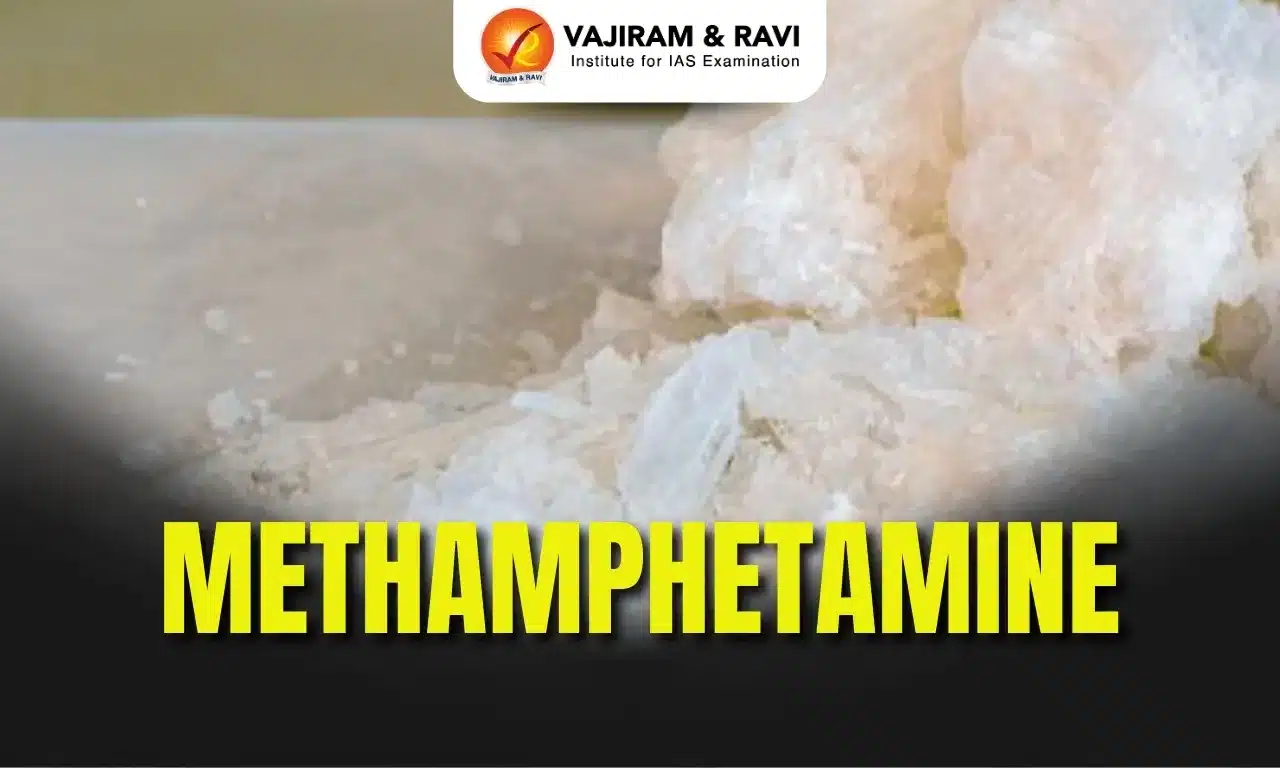
  • Methamphetamine is a powerful, highly addictive stimulant that affects the central nervous system.
  • It is also known as meth, chalk, ice, and crystal.
  • It was developed early in the 20th century from its parent drug, amphetamine, and was used originally in nasal decongestants and bronchial inhalers.

Properties of Methamphetamine

  • It is a member of the class of amphetamines.
  • It takes the form of a white, odorless, bitter-tasting crystalline powder that easily dissolves in water or alcohol.
  • Methamphetamine is potent and easy to produce.
  • It has a role as a neurotoxin, a psychotropic drug, a central nervous system stimulant, a xenobiotic and an environmental contaminant.

How does Methamphetamine Affect Humans?

  • It causes increased activity and talkativeness, decreased appetite, and a pleasurable sense of well-being or euphoria. 
  • The use of methamphetamine in higher doses can induce psychosis, bleeding in the brain, skeletal muscle breakdown, and seizures. 
  • It can cause violent behavior, mood swings, and psychosis such as paranoia, delirium, auditory and visual hallucination, and delusions when used chronically.
  • Chronic long-term methamphetamine use can be highly addictive, and if it is discontinued abruptly, it might lead to withdrawal symptoms.

Source: PIB

Methamphetamine FAQs

Q1: What is the chemical name of Methamphetamine?

Ans: N-methylamphetamine

Q2: What is the primary effect of Methamphetamine on the human brain?

Ans: It increases the levels of dopamine and norepinephrine.

Dorjilung Hydroelectric Power Project

Dorjilung Hydropower Project

Dorjilung Hydroelectric Power Project Latest News

Tata Power Company Ltd recently said it has signed commercial agreements with Druk Green Power Corporation Ltd (DGPC) for the development of the 1,125 MW Dorjilung hydroelectric power project in Bhutan.

About Dorjilung Hydroelectric Power Project

  • It is a planned 1125 MW run-of-river project situated in the eastern Lhuentse and Mongar Districts of Bhutan on the Kurichhu River, a tributary of the Drangmechhu that flows into India.
  • At a height of approximately 139.5 m, the concrete-gravity dam channels nearly 287 m3/s through a 15 km headrace tunnel to an underground powerhouse housing six Francis turbines, designed to generate around 4.5 terawatt-hours (TWh) annually.
  • At a total project cost of ₹13,100 crore, Dorjilung will be Bhutan’s second-largest hydropower project, and the largest Public–Private Partnership (PPP) hydro project ever undertaken in the country. 
  • The project is financed by the World Bank.
  • In November 2024, Bhutan’s Druk Green Power Corporation (DGPC) signed an MoU with Tata Power Company Limited for the joint development of the project.
  • The Project will be implemented through a Special Purpose Vehicle (SPV), with DGPC and Tata Power holding equity shares of 60% and 40%, respectively.
  • The project is expected to be commissioned by early 2032.

Source: CNBC

Dorjilung Hydroelectric Power Project FAQs

Q1: Dorjilung Hydroelectric Power Project is being developed on which river in Bhutan?

Ans: It is being on Kurichhu River, a tributary of the Drangmechhu that flows into India.

Q2: What is the planned power generation capacity of the Dorjilung Hydroelectric Project?

Ans: 1125 MW

Q3: What type of hydropower project is Dorjilung?

Ans: Run-of-river project.

Q4: Which Indian company signed an MoU with Bhutan’s Druk Green Power Corporation for the development of the project?

Ans: Tata Power Company Limited

Brihadeeswarar Temple

Brihadeeswarar Temple

Brihadeeswarar Temple Latest News

Marking World Heritage Week, the Archaeological Survey of India (ASI) organised a heritage walk and clean-up drive at the Brihadeeswarar Temple (Big Temple) in Thanjavur recently.

About Brihadeeswarar Temple

  • It is a Hindu temple dedicated to Shiva located in Thanjavur, Tamil Nadu.
  • It is also known as Periya Kovil, RajaRajeswara Temple and Rajarajesvaram. 
  • It is one of the largest temples in India and is an example of Dravidian architecture during the Chola period.
  • It was built by emperor Raja Raja Chola I and completed in 1010 AD.
  • It is part of the UNESCO World Heritage Site known as the “Great Living Chola Temples”, with the other two being the Brihadeeswarar Temple, Gangaikonda Cholapuram and Airavatesvara temple.

Brihadeeswarar Temple Architecture

  • The temple stands amidst fortified walls that were probably added in the 16th century. 
  • ‘The vimanam (temple tower) is 216 ft (66 m) high and is the tallest in the world. 
  • The Kumbam (the apex or the bulbous structure on the top) of the temple is carved out of a single rock and weighs around 80 tons.
  • The temple complex spans over 40 acres and is decorated with masses of sculptures and inscriptions that spotlight the era's devotion and craftsmanship.
  • There is a big statue of Nandi (sacred bull), carved out of a single rock measuring about 16 ft (4.9 m) long and 13 ft (4.0 m) high at the entrance. 
  • The entire temple structure is made out of granite.

Source: TH

Brihadeeswarar Temple FAQs

Q1: Where is the Brihadeeswarar Temple located?

Ans: Thanjavur, Tamil Nadu.

Q2: Who built the Brihadeeswarar Temple?

Ans: It was built by emperor Raja Raja Chola I.

Q3: Brihadeeswarar Temple is part of which UNESCO World Heritage Site group?

Ans: Great Living Chola Temples

Mid-Cap Stocks Rally: Why Inflows Are Surging in 2025

Mid-Cap Stock Inflows

Mid-Cap Stock Inflows Latest News

  • Mid-cap stocks continue to attract strong inflows as investors chase the high double-digit returns these stocks have generated in recent years. 
  • The Nifty midcap indices recently hit record highs, supported by steady retail SIP inflows and robust earnings growth. Over the last two-and-a-half months, mid-caps have significantly outperformed the Nifty 50. 
  • However, analysts are cautioning investors against excessive optimism, warning that stretched valuations and herd behaviour could lead to risks if the momentum reverses.

Mid-Cap Stocks

  • Mid-cap stocks, as defined by SEBI, are companies ranked 101 to 250 by market capitalisation, typically valued between ₹5,000 crore and ₹20,000 crore. 
  • They offer higher return potential than large-cap stocks but come with greater risk.
  • Investor interest in mid-caps remains strong, with Nifty Midcap 50, 100, and 150 hitting record highs in November 2025. 
  • Since the beginning of 2025, mid-cap indices have delivered 8–11% returns, outpacing the 6.5% return of the Nifty 50.
  • Retail investors pumped ₹8,892 crore into mid-cap funds between September–October 2025, driving mid-cap AUM (assets under management) to ₹4.55 lakh crore, surpassing large-cap AUM at ₹4.1 lakh crore.
  • This indicates a clear shift in preference toward mid-cap equities.

Factors Driving Mid-Cap Stock Inflows

  • Mid-cap inflows are being fuelled by strong domestic institutional buying, especially through mutual funds and SIPs, alongside robust quarterly earnings from many mid-cap companies. 
  • Analysts note that overall market sentiment remains bullish, pushing investors to seek value outside large-caps, particularly as the Nifty trades near record highs.
  • Several mid-cap stocks — including BSE, Federal Bank, Muthoot Finance, Biocon, NALCO, BHEL and Vodafone Idea — have attracted heavy buying due to positive news and improved financial performance. 
  • With mid-caps being more sensitive to earnings cycles, recent upgrades have triggered sharp price movements.
  • A shift in investor behaviour is also driving inflows: after years of strong returns (2020–2024), retail investors expect the momentum to continue, leading to higher allocations towards mid-cap equities. 
  • Additionally, fund managers are rotating from large-caps to mid-caps in search of better growth opportunities.

Investor Sentiment: Bullish but Cautious

  • Investor confidence in mid-cap stocks remains strong. 
  • As long as broader indices like the Nifty and Sensex trend positively, stock-specific buying in the mid-cap segment is expected to continue. 
  • Robust liquidity from domestic institutions is also sustaining long-term value buying.

Elevated Valuations Raise Red Flags

  • Mid-cap valuations have become stretched.
  • The P/E ratio for mid- and small-caps is around 33, compared to 22 for large-caps, which traditionally command higher valuations due to safety and stability.
    • The P/E ratio, or price-to-earnings ratio, is a stock valuation metric that indicates how much investors are willing to pay for each dollar of a company's earnings.
    • This ratio shows how a company's stock price compares to its earnings, helping investors determine if it is overvalued or undervalued.
  • Analysts warn of structural misallocation toward mid- and small-caps driven more by sentiment than fundamentals.
  • They call the current inflows “irrational exuberance”.

Retail Investors Must Exercise Caution

  • Experts advise that retail investors should:
    • Be selective in stock picking
    • Enter positions gradually
    • Limit position sizes
    • Prefer high-quality stocks or professional active management
  • For most retail investors, especially beginners, the mutual fund route is considered safer for diversified exposure to mid-cap companies.

Source: IE | LM

Mid-Cap Stock Inflows FAQs

Q1: Why are mid-cap stocks seeing strong inflows?

Ans: Mid-caps are benefiting from robust SIP contributions, domestic institutional buying, strong quarterly earnings and investor rotation from large-caps in search of better growth.

Q2: How does SEBI define mid-cap stocks?

Ans: Mid-caps are companies ranked 101–250 by market capitalisation, typically valued between ₹5,000 crore and ₹20,000 crore, offering higher returns but greater risk.

Q3: What has driven mid-cap indices to record highs?

Ans: Positive sentiment, steady liquidity, corporate earnings upgrades and attractive valuations relative to large-caps have pushed Nifty Midcap indices to all-time highs.

Q4: What risks do mid-cap investors face now?

Ans: Mid-cap valuations are stretched, with P/E ratios far above large-caps, signalling possible overvaluation and irrational exuberance driven more by sentiment than fundamentals.

Q5: How should retail investors approach mid-caps?

Ans: Experts recommend staggered investments, controlled exposure, focus on quality companies, and using mutual funds for safer diversified access to mid-cap opportunities.

Pobitora Wildlife Sanctuary

Pobitora Wildlife Sanctuary

Pobitora Wildlife Sanctuary Latest News

Pobitora Wildlife Sanctuary in Assam’s Morigaon district is witnessing an early influx of migratory birds with the onset of winter, attracting species from Europe, America, and the Tibetan region.

About Pobitora Wildlife Sanctuary

  • It is located in the eastern region of Guwahati, Assam.
  • It is in close proximity to the Mayong village that is renowned as the Black magic capital of India.
  • This wildlife sanctuary was established in 1998 with a total area of 48.81 sq.km.
  • The sanctuary consists of the Rajamayong Reserve Forest and Pobitora Reserve Forest.
  • The region was once part of the vast floodplains of the Brahmaputra River and was known for its rich flora and fauna. 
  • History: 
    • Pobitora became a reserved wooded area in the year of 1971 with the approval of the Government of Assam Tourism. 
    • The Government of India included Pobitora Wildlife Sanctuary with the association of a rhino breeding program named “Indian Rhino Vision 2020”.
    • The landscape is dominated by alluvial grasslands and dense patches of tall elephant grass.
  • Flora
    • 72% of Pabitora consists of the wet savannah of Arundo donax, Erianthus ravennae, Phragmites karka, Imperata cylindrica, and Saccharum spp.
    • Water hyacinth (Eichornia crassipes) is a major problem, especially to waterfowl, as it forms thick mats on the water surface.
  • Fauna
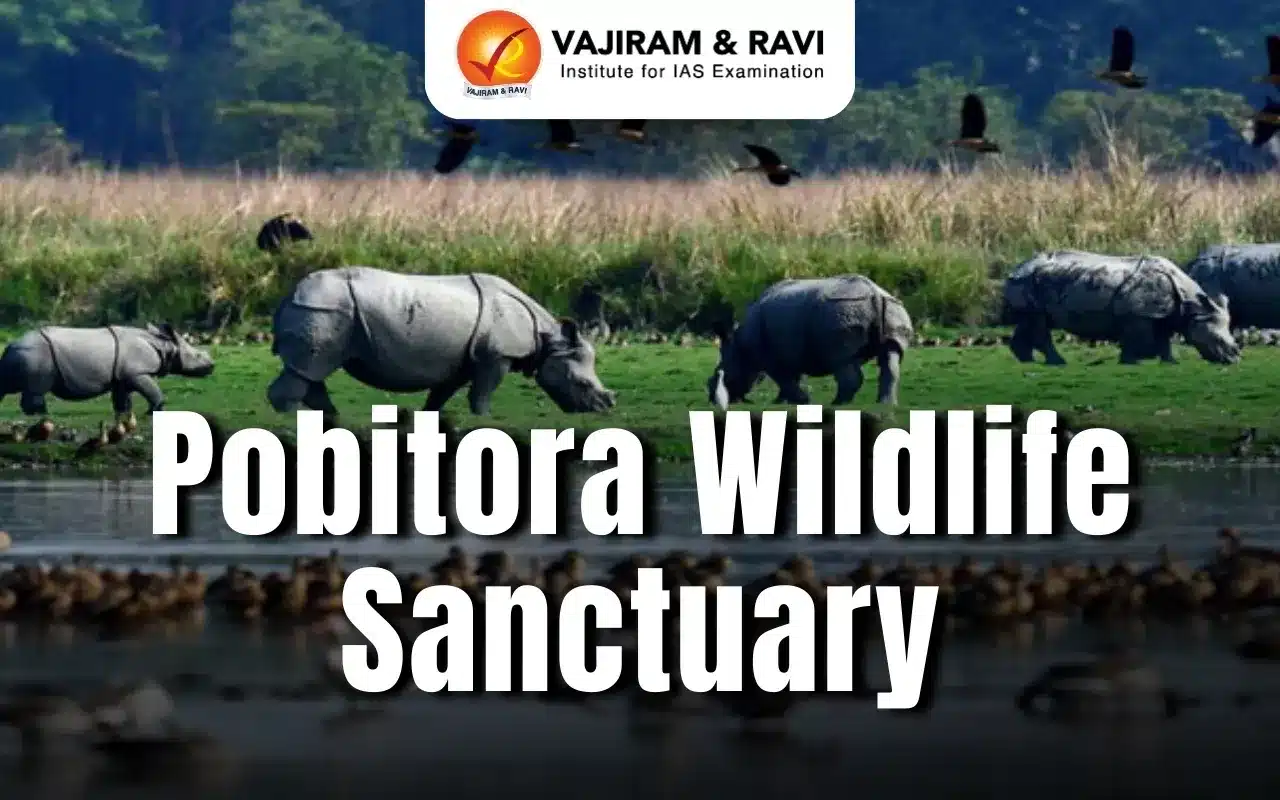
    • It is known for holding the highest density of Greater One Horned Rhinoceros in the country.
    • Besides rhinoceros, the other animals are leopard, wild boar, Barking deer, wild buffalo, etc. 
    • It is also home to more than 2000 migratory birds and various reptiles.

Source: NET

Pobitora Wildlife Sanctuary FAQs

Q1: Pobitora Wildlife Sanctuary is located in which Indian state?

Ans: Assam

Q2: What is the total area covered by Pobitora Wildlife Sanctuary?

Ans: 48.81 sq.km.

Q3: What type of vegetation dominates the landscape of Pobitora?

Ans: 72% of Pabitora consists of the wet savannah of Arundo donax, Erianthus ravennae, Phragmites karka, Imperata cylindrica, and Saccharum spp.

Reforming State Public Service Commissions – Explained

Public Service Commission

Public Service Commissions Latest News

  • The 2025 National Conference of State Public Service Commissions (PSCs), hosted by the Telangana State PSC, has brought renewed focus on the longstanding challenges affecting State PSCs. 

Evolution of Public Service Commissions in India

  • Public Service Commissions have their origins in India’s struggle for self-governance. 
  • According to the historical overview, the demand for merit-based entry into civil services was central to the early nationalist movement. This led to:
    • The Montagu-Chelmsford Reforms, which proposed an independent office regulating service matters,
    • Establishment of the first Public Service Commission in 1926,
    • Provisions in the Government of India Act, 1935, mandating PSCs for each province, which the Constitution later retained; today, we have the UPSC and State PSCs

Structural Differences Between UPSC and State PSCs

  • UPSC’s Strong Governance Framework
    • The UPSC operates in a politically insulated environment, ensuring independence and professionalism. Members generally:
      • Are above 55 years of age,
      • Have rich experience in public administration,
      • Come from diverse zones of the country.
    • The Union government further institutionalised recruitment processes by creating the Ministry of Personnel, Public Grievances and Pensions (1985), enabling regular manpower planning and timely declaration of vacancies. 
  • State PSCs’ Politicised Environment
    • In contrast, State PSCs function in a “politically osmotic environment”, where:
      • Appointments tend to reflect political proximity rather than experience,
      • States lack dedicated personnel ministries,
      • Vacancies are declared irregularly due to fiscal constraints,
      • Exams are conducted infrequently, leading to widespread litigation and delays.
    • These structural factors form the foundation of the credibility crisis facing State PSCs.

Procedural Challenges Undermining State PSC Efficiency

  • Irregular Syllabus Updates and Academic Limitations
    • Unlike the UPSC, which periodically appoints committees of academicians, civil servants, and experts, State PSCs do not frequently update their syllabi. They also:
      • Depend heavily on limited academic resources within the State,
      • Struggle to ensure objective evaluation due to weak moderation mechanisms. 
  • Complex Reservation and Regional Quota Calculations
    • State PSCs face significant challenges in applying:
      • Vertical reservations,
      • Horizontal reservations,
      • Regional (zonal) reservations are especially visible in States like Telangana and Andhra Pradesh. This often leads to errors and legal disputes.
  • Recurring Examination Controversies
    • Paper leaks,
    • Frequent judicial interventions,
    • Errors in evaluation and translation,
    • Lack of confidentiality protocols. 
  • As a result, aspirants increasingly claim they “have lost faith in State Commissions” and express a preference for UPSC-like centralised examinations.

Reform Measures to Strengthen State PSCs

  • Institutional and Manpower Reforms
    • Institutionalise manpower planning,
    • Provide a five-year roadmap of vacancies,
    • Ensure predictable exam cycles. 
  • Constitutional Amendments for Professional Appointments
    • The 41st Constitutional Amendment (1976) raised the PSC member age limit from 60 to 62. Experts suggest further modifications:
      • Minimum age: 55 years,
      • Maximum age: 65 years,
      • Mandatory qualifications, e.g., former State Secretary for official members, 10 years’ professional experience for non-officials,
      • Consultation with the Leader of the Opposition, ensuring bipartisan selection.
    • Such criteria would help constitute panels of individuals with proven integrity, expertise, and independence. 
  • Exam Reforms for Fairness and Transparency
    • Periodic syllabus revision with public consultation,
    • Objective-type testing for State-specific subjects,
    • Mixed question formats (objective + descriptive) in mains,
    • Improved translation processes using technology plus human verification,
    • Frequent changes in question patterns to reduce overreliance on AI tools by candidates. 
  • Strengthening Administrative Leadership
    • The Secretary of State PSC should be a senior officer with experience in school or intermediate education boards.
    • This would enhance oversight of examination processes and replicate UPSC’s emphasis on balanced confidentiality and transparency.

Source: TH

Public Service Commission FAQs

Q1: Why do State PSCs face frequent controversies?

Ans: Irregular recruitment cycles, politicised appointments, and procedural lapses trigger repeated disputes.

Q2: What historical development led to PSC creation?

Ans: The Montagu-Chelmsford Reforms proposed independent, merit-based recruitment bodies.

Q3: Why is UPSC more efficient than State PSCs?

Ans: UPSC benefits from political insulation, expert appointments, and regular manpower planning.

Q4: What key structural reform is recommended for States?

Ans: Establishing a dedicated Ministry of Personnel for scientific workforce planning.

Q5: What exam reforms are suggested for State PSCs?

Ans: Periodic syllabus updates, mixed-format exams, better translation processes, and public consultation.

Sheikh Hasina Death Verdict: Bangladesh’s Political Crisis Explained

Sheikh Hasina Death Verdict

Sheikh Hasina Death Verdict Latest News

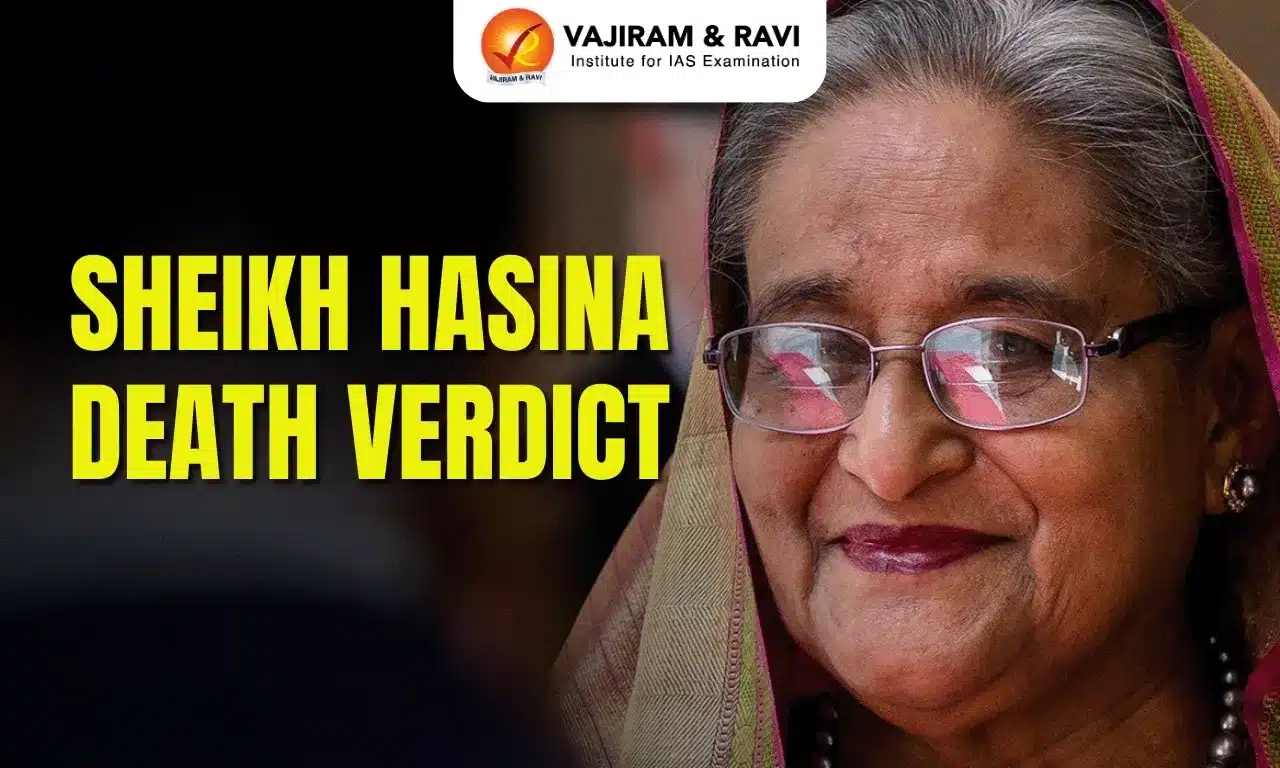
  • Bangladesh’s former Prime Minister Sheikh Hasina has been sentenced to death by the International Crimes Tribunal for crimes against humanity committed during the 2024 student-led protests. 
  • Living in India since her government collapsed in August 2024, Hasina was convicted for ordering the killing of 12 unarmed protesters in Dhaka and Ashulia on August 5, 2024. Five of the victims were burned after death, and one was allegedly burned alive.
  • She also received a life-term sentence for inciting violence, directing the use of lethal weapons, and authorising attacks using helicopters and drones.
  • The verdict has triggered intense political reactions across Bangladesh and is expected to shape the run-up to the February 2026 national elections.

International Crimes Tribunal 

  • The International Crimes Tribunal (ICT) is a special Bangladeshi court established in 2009 by then PM Sheikh Hasina to try individuals accused of committing atrocities during the 1971 Liberation War. 
  • Hasina had promised during the 2008 election campaign to bring “war criminals” — especially those who allegedly collaborated with Pakistan — to justice.
  • Once set up, the ICT aggressively prosecuted many individuals, often from the Jamaat-e-Islami, the country’s largest Islamist political party.
  • However, the tribunal faced strong criticism from international rights groups. Human Rights Watch, in 2012, described the trials as “deeply problematic”, raising concerns about political bias, judicial independence, and fairness.

Hasina’s Fate: Exiled, Convicted, and Politically Isolated

  • Former PM Sheikh Hasina, now living in India since August 5, has dismissed her death sentence as politically motivated. 
  • The verdict, tied to her brutal 2024 protest crackdown that killed 1,400 people, seals her political future for now. 
  • Her return to Bangladesh appears impossible, effectively removing her from national politics.

Awami League in Leadership Crisis

  • Hasina left Bangladesh without establishing a successor, creating deep uncertainty within the Awami League. 
  • The party, currently banned from elections, is struggling without a clear strategy or leadership, and many leaders feel abandoned amid widespread public hostility.

Yunus’s Rise: Interim PM and Symbol of Justice

  • Interim leader Muhammad Yunus, who returned during the 2024 chaos, has positioned himself as a reformist figure. 
  • He welcomed the verdict as a signal that “no one is above the law.” 
  • While the Army and political parties grow impatient over delayed elections, the ruling strengthens his image as a leader delivering justice and stabilising the nation.

BNP’s Position: Seeking Political Revival

  • The Bangladesh Nationalist Party (BNP) hailed the verdict as justice served. 
  • After decades of political marginalisation and legal battles, BNP sees an opportunity to regain power in upcoming elections. 
  • However, internal challenges remain—particularly how Khaleda Zia will project her exiled son Tarique Rahman as the party’s PM candidate.

Jamaat-e-Islami’s Unexpected Strategy

  • Jamaat-e-Islami, gaining momentum after major student union victories, has surprisingly demanded Hasina’s return from India—a move aimed at pressuring New Delhi and strengthening its nationalist credentials. 
  • The party aims to emerge as a powerful force in the 2026 election, either allying with BNP or becoming the primary opposition.

India’s Calculated and Cautious Stand on the Hasina Verdict

  • New Delhi responded by saying it has “noted the verdict” issued by the International Crimes Tribunal of Bangladesh against former PM Sheikh Hasina. 
  • The Ministry of External Affairs (MEA) refrained from condemning or endorsing the ruling, signalling a carefully calibrated position.

Commitment to Bangladesh’s People — Not Its Current Regime

  • India emphasised its commitment to the “best interests of the people of Bangladesh” — focusing on peace, democracy, inclusion, and stability.
  • The wording is significant: India did not echo support for the Bangladesh government but referenced the broader population. 
  • The term “inclusion” implicitly signals India’s preference for allowing the Awami League to participate in the coming elections.

Shelter for Hasina, No Extradition Signals

  • India continues to shelter Sheikh Hasina — as it did earlier from 1975–1981 after Sheikh Mujibur Rahman’s assassination.
  • Despite growing calls within Bangladesh for Hasina’s extradition, India has not yielded. 
  • Delhi views the case as political and has legal grounds to deny extradition on concerns of fairness and the political nature of the charges.

Non-Interference: Framing It as Bangladesh’s Internal Issue

  • While India sees Hasina as a long-time ally who curbed radicalism and supported strong bilateral ties, it does not want to intervene in Bangladesh’s domestic political battles
  • The MEA’s restrained response signals that Delhi considers the developments an internal matter for Bangladesh.

Strategic Calculus: No Gain in Sending Hasina Back

  • Delhi believes that extraditing Hasina would not improve its standing with Bangladesh’s current political establishment. 
  • Therefore, turning her over offers no strategic benefit. Under these circumstances, India remains the safest refuge for her.

Source: IE | FP | IE

Sheikh Hasina Death Verdict FAQs

Q1: Why is the Sheikh Hasina death verdict significant?

Ans: It marks a dramatic political turning point in Bangladesh, removing Hasina from future politics, reshaping party dynamics and influencing the run-up to the 2026 elections.

Q2: What is the International Crimes Tribunal?

Ans: A special Bangladeshi court formed in 2009 by Hasina to try 1971 war criminals, but often criticised for political bias and questionable judicial independence.

Q3: How does the verdict affect the Awami League?

Ans: The party faces a leadership vacuum, internal confusion, and declining public support, with no clear successor or electoral strategy after Hasina’s exile.

Q4: What role is Muhammad Yunus playing now?

Ans: As interim leader, Yunus is positioning himself as a reformist bringing justice and stability, though political parties and the Army are impatient over delayed elections.

Q5: How is India responding to the situation?

Ans: India has “noted” the verdict, continues sheltering Hasina, avoids direct interference, and stresses peace, democracy and inclusion for Bangladesh’s future stability.

Enquire Now