
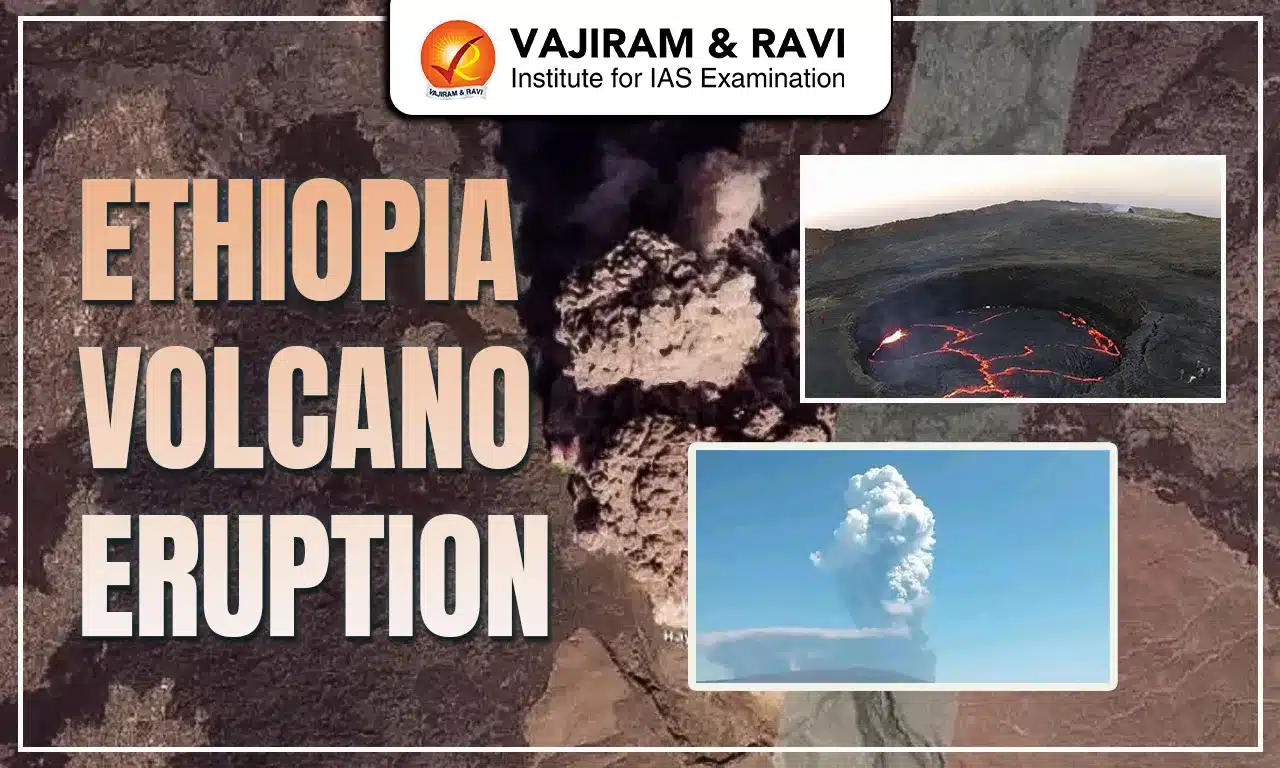
A massive eruption from Ethiopia’s Hayli Gubbi volcano, dormant for nearly 12,000 years, released an enormous volcanic ash cloud rising to 45,000 ft (FL450). The plume has drifted across the Red Sea and the Arabian Peninsula and is now moving toward western India, raising concerns over aviation safety, visibility, and atmospheric impacts. While it is a high-altitude ash event, its indirect effects on India’s aviation and upper-atmosphere pollution remain under watch.
Ethiopia Volcano Eruption Hayli Gubbi
Hayli Gubbi is a shield volcano located in Ethiopia’s Afar Region, known for its wide, gently sloping structure formed by highly fluid basaltic lava. It lies within the Afar Depression, one of the most tectonically active rift zones on Earth. The volcano is part of the broader Erta Ale volcanic range, famous for continuous lava activity and rift-related Ethiopia Volcano Eruption. Its geological setting makes it a part of the ongoing rifting process shaping the East African landscape.
- Broad, low-gradient volcanic shield built from thin basaltic lava flows.
- Located in the Afar Depression at the southern end of the Erta Ale range.
- Part of the divergent boundary where the African Plate is splitting.
- Known for geothermal features, fissure vents, and low-viscosity lava fields.
| Ethiopia Volcano Eruption Hayli Gubbi | |
| Parameter | Details |
|
Volcano Type |
Shield Volcano |
|
Location |
Afar Region, Ethiopia |
|
Last Known Eruption |
~10,000–12,000 years ago |
|
Latest Eruption |
23 November 2025 |
|
Eruption Style |
Sub-Plinian |
|
Ash Cloud Height |
45,000 ft |
|
Key Components |
Ash, SO₂, glass shards |
|
Drift Path |
Yemen → Oman → Arabian Sea → Western India |
Tectonic Background: East African Rift System (EARS)
The Hayli Gubbi volcano lies within the East African Rift System, where the Nubian Plate and the Somali Plate are gradually separating. This rifting process thins the crust, allowing magma from the mantle plume beneath Afar to rise easily. The Afar Triple Junction, where the Red Sea Rift, Gulf of Aden Rift, and East African Rift meet, makes this region a hotspot for volcanic and seismic activity.
- One of the world’s most active continental rift zones.
- Mantle plume beneath Afar contributes high heat flow.
- Frequent earthquakes precede volcanic events.
- Produces both fissure eruptions and shield-type eruptions.
Hayli Gubbi Volcano Location
Hayli Gubbi Volcano is situated in the Afar Depression, a sunken rift valley characterised by salt flats, lava fields, and deep fissures. This area is geologically unique for being below sea level and directly above a thinning continental crust. Its proximity to the Red Sea and the Erta Ale range places it in a zone that frequently experiences tectonic stretching and geothermal activity.
[my_image src="https://vajiramandravi.com/current-affairs/wp-content/uploads/2025/11/ethopia-volcanic-eruption.webp" size="full" align="none" width="auto" height="1280px" alt="ethopia-volcanic-eruption" title="ethopia-volcanic-eruption"]
Ethiopia Volcano Eruption Hayli Gubbi History
The Hayli Gubbi volcano had no confirmed eruption for nearly 10,000-12,000 years, making its 2025 Ethiopia Volcano Eruption a major geological event. On 23 November 2025, it produced a sub-plinian eruption, characterised by a strong vertical ash column and widespread dispersal. The ash plume travelled across Yemen and Oman before drifting eastward towards India.
- Last major activity was during the Holocene period.
- 2025 eruption classified as sub-plinian due to eruption column height.
- Ash plume reached 45,000 ft, entering commercial flight altitudes.
- Carried volcanic ash, SO₂, glass shards, and fine rock particles.
Ethiopian Volcanic Eruptions Causes
Ethiopian volcanic Eruptions occur primarily due to the active rifting process underway in the East African Rift System (EARS), where the Nubian and Somali plates are gradually pulling apart.
- Divergent Plate Boundary: Separation of the Nubian and Somali plates creates fissures for magma ascent.
- Afar Mantle Plume: Deep mantle hotspot enhances heat and magma supply.
- Crustal Thinning: Stretching crust reduces pressure, enabling magma movement.
- Fissure Eruptions: Long cracks release large volumes of basaltic lava.
- Seismic Activity: Earthquakes indicate magma movement and precede eruptions.
Composition of the Volcanic Plume
The ash cloud contains a mix of volcanic ash, sulphur dioxide, glass shards, and rock fragments, transported at high altitudes between 15,000-45,000 ft. These aerosols can persist in the atmosphere for days to weeks depending on wind patterns and atmospheric stability.
- Ash particles (silicates and rock debris).
- SO₂ gas responsible for haze and acid formation.
- Volcanic glass shards that pose risks to aircraft engines.
- Fine aerosols that affect visibility and solar radiation.
Ethiopia Volcano Eruption Economic Implications
Ethiopian Volcano Eruption impose significant economic burdens, especially in the Afar and Rift Valley regions where agriculture, pastoralism, and trade routes dominate livelihoods. Ashfall damages crops, grazing land, and livestock, directly affecting food security and rural income.
- Agricultural Losses: Ash destroys crops, contaminates soil, and reduces livestock productivity.
- Transport & Aviation Disruption: Flight cancellations and road blockages raise logistics costs.
- Relief & Rehabilitation Costs: Government spending increases sharply during resettlement and recovery.
- Tourism Decline: Adventure tourism in Afar and Danakil suffers temporary slowdown.
- Trade Impact: Exports and regional supply chains may face delays due to restricted routes.
Ethiopia Volcano Eruption Environmental Consequences
Ethiopian Volcano Eruption significantly alter the physical environment by releasing ash, lava, and sulphur-rich gases into the atmosphere. Ashfall disrupts vegetation, contaminates water sources, and affects soil chemistry, impacting local ecosystems.
- Air Pollution: SO₂, ash, and aerosols degrade air quality and reduce visibility.
- Water Contamination: Ash deposits pollute rivers, lakes, and groundwater sources.
- Habitat Disruption: Lava flows and ash burial damage wildlife habitats and vegetation.
- Soil Alteration: Volcanic materials change soil pH and nutrient composition.
- Climate Effects: Aerosols can cool the atmosphere and alter rainfall patterns.
- Landscape Modification: Formation of new lava fields, fissures, and geothermal features.
Other Major Volcanoes in Africa
Africa contains several prominent volcanic systems, especially along the East African Rift. These volcanoes vary from shield types to stratovolcanoes and caldera systems.
- Mount Nyiragongo (DR Congo) – Known for extremely fast-moving lava.
- Mount Silali (Kenya) – Extinct caldera with past massive eruptions.
- Dabbahu Volcano (Ethiopia) – Famous for large fissure eruptions.
- Mount Alayta (Ethiopia) – A shield volcano within the Afar Rift.
- Ardoukoba (Djibouti) – Last erupted in 1978.
- Mallahle (Ethiopia) – Stratovolcano in Danakil Depression.
- Asavyo (Ethiopia) – Large volcanic field with widespread vents.
Ethiopia Neighbouring Countries
Ethiopia shares its borders with six countries: Eritrea, Djibouti, Somalia, Kenya, South Sudan, and Sudan. It is bordered by Eritrea in the north, Djibouti in the northeast, and Somalia along the eastern frontier. To the south lies Kenya, while South Sudan borders Ethiopia on the west, and Sudan forms the northwestern boundary.
Why the Ash Reached India
Upper-level westerly winds and jet streams transported the ash cloud across continents. The altitude of the plume allowed it to bypass local weather systems and move efficiently toward India. Because the ash layer is positioned high above the troposphere, its descent toward the surface is slow and unlikely to significantly impact ground-level air quality.
Ethiopia Volcano Eruption FAQs
Q1: Why does Ethiopia experience frequent volcanic eruptions?
Ans: Because Ethiopia lies on the East African Rift System, where the Nubian and Somali plates are diverging, creating fissures that allow magma to rise easily.
Q2: Which volcanic regions of Ethiopia are most active?
Ans: The Afar Depression, Erta Ale Range, and Central Rift Valley are the most active volcanic belts.
Q3: What type of eruptions commonly occur in Ethiopia?
Ans: Most eruptions are fissure eruptions or shield-volcano eruptions, producing basaltic lava and high-altitude ash plumes.
Q4: How does volcanic ash affect local communities?
Ans: Ashfall damages crops, contaminates water, reduces visibility, affects livestock, and poses respiratory health risks.
Q5: Can volcanic eruptions in Ethiopia impact India?
Ans: Yes, high-altitude ash clouds transported by jet streams can reach India, affecting aviation routes, visibility, and upper-atmosphere pollution, but not usually ground-level air quality.
