
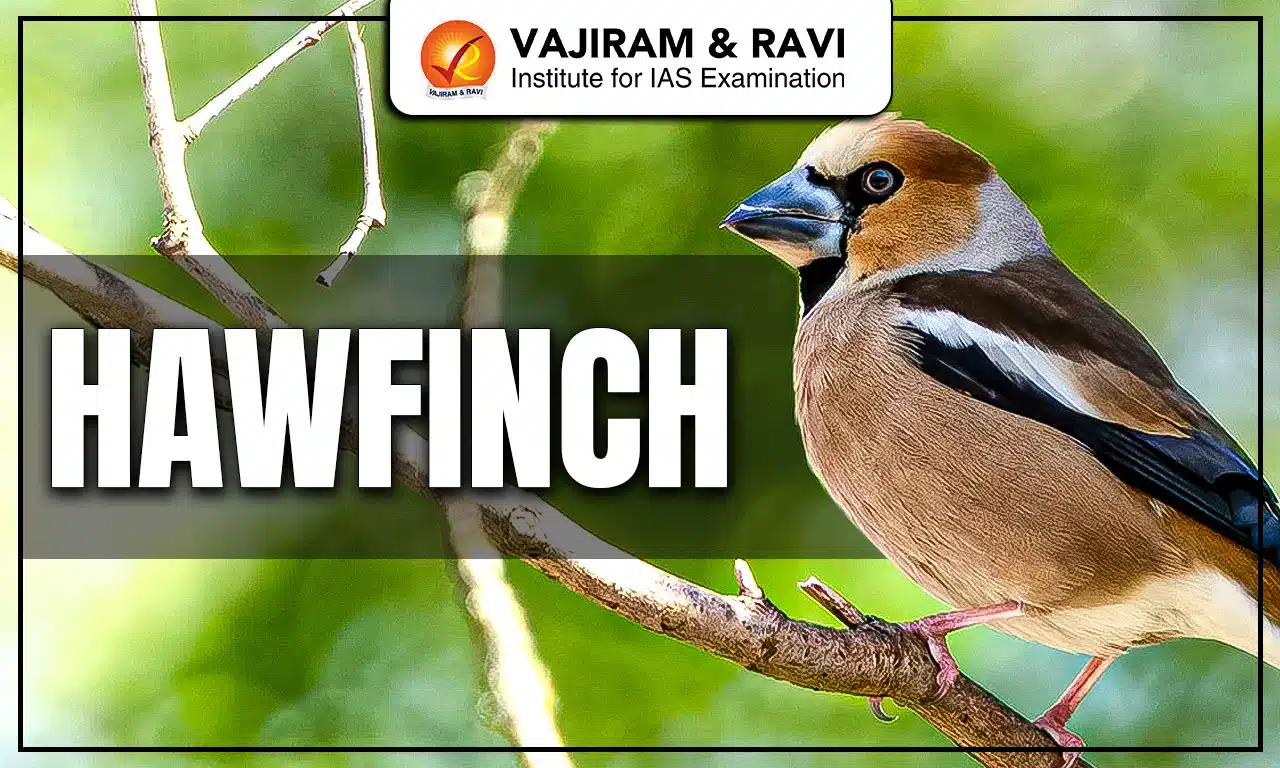
Hawfinch Latest News
A Hawfinch bird, a species native to Europe, North Africa, and East Asia, was recently recorded at Jim Corbett National Park in Uttarakhand.
About Hawfinch
- It is a large passerine bird native to Europe, North Africa, and East Asia.
- It is the biggest bird of the Fringillidae family.
- Scientific Name: Coccothraustes coccothraustes
Hawfinch Distribution
- Hawfinches are found across Europe, Eastern Asia (the Palearctic including North Japan), and North Africa (Morocco, Tunisia, and Algeria).
- They are mainly resident in Europe, but many Asian birds migrate further south in the winter.
- Habitat: The hawfinch frequents deciduous and mixed forests, orchards, parks, and also the vegetation along the streams.
Hawfinch Features
- It is a robust, heavy-billed finch about 18 cm long, with a wingspan of 29–33 cm.
- It has a thick neck, a large round head, and a wide, strong conical beak with a metallic appearance.
- It has short pinkish legs with a light hue, and it has a short tail. It has brown eyes.
- The plumage of the female is slightly paler than that of the male.
- The overall color is light brown, its head having an orange hue to it.
- Its eyes have a black circle around them.
- Its powerful beak allows it to crack hard seeds, nuts, and berries.
Hawfinch Conservation Status
It is classified as 'Least Concern' under the IUCN Red List.
Key Facts about Jim Corbett National Park
- It is located in the Nainital district of Uttarakhand.
- It is part of the larger Corbett Tiger Reserve.
- It is part of the sub-Himalayan ecosystem.
- It is India’s oldest national park.
- It was established in 1936 as Hailey National Park.
- It was later renamed in 1957 in memory of Jim Corbett, a famous hunter and conservationist who played a key role in the establishment of the park.
- It covers an area of over 520 sq.km.
- Rivers:
- The eastern periphery of Corbett National Park is entirely fed by the Kosi River.
- The Ramganga River (West), along with its significant tributaries Sonanadi, Palain, and Mandal, forms the prominent hydrological resource for the Corbett.
- Flora: Almost three-quarters of the park is encompassed by deciduous forest, including peepal, rohini, and mango trees. Another 10% of the park is accounted for by grasslands.
- Fauna: Bengal tigers, Indian elephants, leopards, sloth bears, deer, and over 600 species of birds.
Source: HT
Hawfinch FAQs
Q1: The Hawfinch is native to which of the following regions?
Ans: Europe, North Africa, and East Asia.
Q2: What is the scientific name of the Hawfinch?
Ans: Coccothraustes coccothraustes
Q3: What is the IUCN conservation status of the Hawfinch?
Ans: Least Concern

