MH-60R Seahawk Helicopter

MH-60R Seahawk Helicopter

MH-60R Seahawk Helicopter Latest News

Recently, India sealed a ₹7,995-crore deal with the U.S. as part of a “follow on support” package for the Indian Navy's fleet of 24 MH-60R Seahawk helicopters for five years.

About MH-60R Seahawk Helicopter

  • It is often called the “Romeo” is a state-of-the-art naval helicopter.
  • It is manufactured by US defence major Lockheed Martin.

Features of MH-60R Seahawk Helicopter

  • All Weather Capability: It is an all-weather helicopter designed with state-of-the-art avionics and sensors.
  • Multi mission: It is designed for anti-submarine warfare (ASW), anti-surface warfare (ASuW), maritime surveillance, search and rescue, medical evacuation, and ship-borne operations.
  • Advanced Sensors: It is one of the world’s best submarine-hunting helicopters, equipped with advanced sensors like the AN/AQS-22 ALFS dipping sonar, sonobuoys, and multi-mode radar.
  • It also carries the powerful Mk-54 torpedo, allowing it to detect, track, and engage underwater threats.
  • For surface warfare missions, the MH-60R can carry AGM-114 Hellfire missiles, lightweight torpedoes, and machine guns.
  • It is combined with electro-optical sensors and radar systems that can identify hostile ships, fast attack craft, or suspicious vessels and neutralise them with precision.

Source: TH

MH-60R Seahawk Helicopter FAQs

Q1: What is the nickname of the MH-60R Seahawk Helicopter?

Ans: Romeo

Q2: What is the range of the MH-60R Seahawk Helicopter?

Ans: 400 km (approx.)
National Mission for Mentoring

National Mission for Mentoring

National Mission for Mentoring Latest News

Recently, the University Grants Commission (UGC) has called on all higher educational institutions (HEIs) across India to nominate teaching faculty under the National Mission for Mentoring (NMM). 

About National Mission for Mentoring

  • It is the flagship initiative of the Department of School Education and Literacy, Ministry of Education.
  • It is in line with the National Education Policy (NEP) 2020.
  • It provides platforms for professionals and experts where they can share knowledge, skills and expertise as a Mentor with Mentee teachers and help them in their journey to become effective teachers. 
  • It was launched on 29th July 2022 in selected 30 Central Schools (15 KVs, 10 JNVs, 5 CBSE) across the country.
  • It aims to create a supportive environment, enhance mentorship experiences and contribute to individual and collective growth.
  • National Council for Teacher Education (NCTE) has been assigned to develop and design the modalities for National Mission for Mentoring (NMM).
    • NCTE released a comprehensive document on the mission (NMM – The Blue Book) with a detailed roadmap of its framework and implementation strategy.
  • Important stakeholders: Mentor (the guide), Mentee (the teacher) and The Nodal officers/administration
  • Implementation strategy
    • Pilot phase: It was first tested in 30 Central Schools (15 Kendriya Vidyalayas, 10 Jawahar Navodaya schools, and 5 CBSE schools) with 60 mentors, some even Padma Awardees.
    • Building capacity: Seminars and workshops are conducted to teach “Master Mentors” who can subsequently teach others.
    • Incentivisation: Although participation is voluntary, the NMM manual encourages participants to do so with certificates, performance credits and other incentives.

 Source: TH

National Mission for Mentoring FAQs

Q1: What is the primary objective of the National Mission for Mentoring?

Ans: To enhance teacher training and professional development

Q2: Who is leading the National Mission for Mentoring initiative?

Ans: National Council of Teacher Education (NCTE)

Rustic Bunting

Rustic Bunting

Rustic Bunting Latest News

Birders recently spotted a rare species, the rustic bunting (emberiza rustica) at Najafgarh Jheel on the Delhi-Gurugram border, marking the first time the passerine bird, which is also elusive across India, was spotted in the national capital region (NCR).

About Rustic Bunting

  • It is a passerine bird in the bunting family Emberizidae.
  • Scientific Name: Emberiza rustica

Rustic Bunting Distribution

  • Its breeding range extends from the Nordic regions to eastern Siberia.
  • It migrates to southeast Asia and parts of East Asia, including Japan, Korea, and eastern China, during the winter months. 
  • There are only a handful of records of it being seen across India – predominantly in the northeast and across the Himalayan belt.

Rustic Bunting Features

  • It is relatively small but with a stocky body.
  • The compact body measures around 15-16 cm in length and weighs about 20-25 grams. 
  • Males and females exhibit some differences in their plumage, especially during the breeding season. 
  • Males boast a striking appearance with their black heads adorned with white stripes above and below the eyes, creating a distinctive facial pattern. 
  • Their upperparts are a combination of brown and black, with the brown being more prominent on the wings and back, creating a beautifully mottled effect. 
  • The breast and underparts are a soft pinkish-buff, transitioning to white on the belly. 
  • In contrast, females and non-breeding males are more subdued in color, featuring browner heads with less distinct facial patterns, and overall, their plumage is more uniformly brown and less vibrant.

Rustic Bunting Conservation Status

It is classified as 'Near Threatened' under the IUCN Red List.

Source: HT

Rustic Bunting FAQs

Q1: In which regions does the Rustic Bunting typically breed?

Ans: Its breeding range extends from the Nordic regions to eastern Siberia.

Q2: To which parts of Asia does the Rustic Bunting migrate during winter?

Ans: It migrates to southeast Asia and parts of East Asia.

Q3: What is the IUCN Red List status of Rustic Bunting?

Ans: Near Threatened

Syntactic Foam

Syntactic Foam

Syntactic Foam Latest News

A crucial set of tests on the Samudrayaan, India’s first manned-submersible dive into the ocean, is likely only mid-next year following a delay in the procurement of syntactic foam cladding from France.

About Syntactic Foam

  • A syntactic foam is a composite material that is produced by filling a metal, polymer, or ceramic with pre-formed inorganic hollow spheres known as micro balloons.
  • Syntactic’ is a term that refers to the ordered positioning of the spheres, and the word ‘foam’ alludes to the closed cellular structure.
  • Most of the advantageous features of the material are a result of the hollow spheres inside of the syntactic foam.

Syntactic Foam Properties

  • Lightweight with High Strength: The use of hollow microspheres allows foam to maintain a low weight while offering excellent compressive strength.
  • Superior Buoyancy: Its inherent low density makes it ideal for subsea applications where buoyancy is critical.
  • Thermal and Acoustic Insulation: It reduces thermal conductivity and dampens noise, improving performance in marine and aerospace environments.
  • Corrosion and Water Resistance: The closed-cell structure prevents water absorption, enhancing its longevity in saltwater and chemically aggressive environments.

Syntactic Foam Applications

  • Subsea and Offshore: Ideal for remotely operated vehicles (ROVs), autonomous underwater vehicles (AUVs), and pipeline insulation.
  • Aerospace: Used in satellite components and structural parts where weight reduction is essential without sacrificing strength.
  • Defense and Military: Employed in sonar domes, buoyancy modules, and lightweight armor due to its impact resistance.
  • Automotive and Sports: Increasingly adopted for lightweight, high-impact applications such as crash protection and performance gear.

What is the Samudrayaan Project?

  • It is India’s first manned mission to explore the deep ocean. 
  • It is aimed to develop a self-propelled manned submersible to carry three human beings to a water depth of 6,000 meters in the ocean with a suite of scientific sensors and tools for deep ocean exploration. 
  • It is designed to study the deep ocean resources and conduct biodiversity assessments as well. 
  • The mission will not disturb the ecosystem as the submersible is used solely for exploration purposes. 
  • The project is part of the larger Deep Ocean Mission, which supports the Central Government’s Blue Economy policy.
  • Nodal Ministry: Ministry of Earth Sciences (MoES).

What is MATSYA 6000?

  • It is a manned submersible vehicle developed by the National Institute of Ocean Technology (NIOT), Chennai. 
  • It was developed under the Samudrayaan mission to facilitate humans in the deep ocean in exploring mineral resources.

Source: TH

Syntactic Foam FAQs

Q1: What is syntactic foam?

Ans: A composite made by filling a matrix with hollow inorganic microspheres.

Q2: What does the term ‘syntactic’ refer to in syntactic foam?

Ans: It refers to the ordered positioning of the spheres.

Q3: Why is syntactic foam preferred for subsea applications?

Ans: Because of it's excellent compressive strength and superior buoyancy.

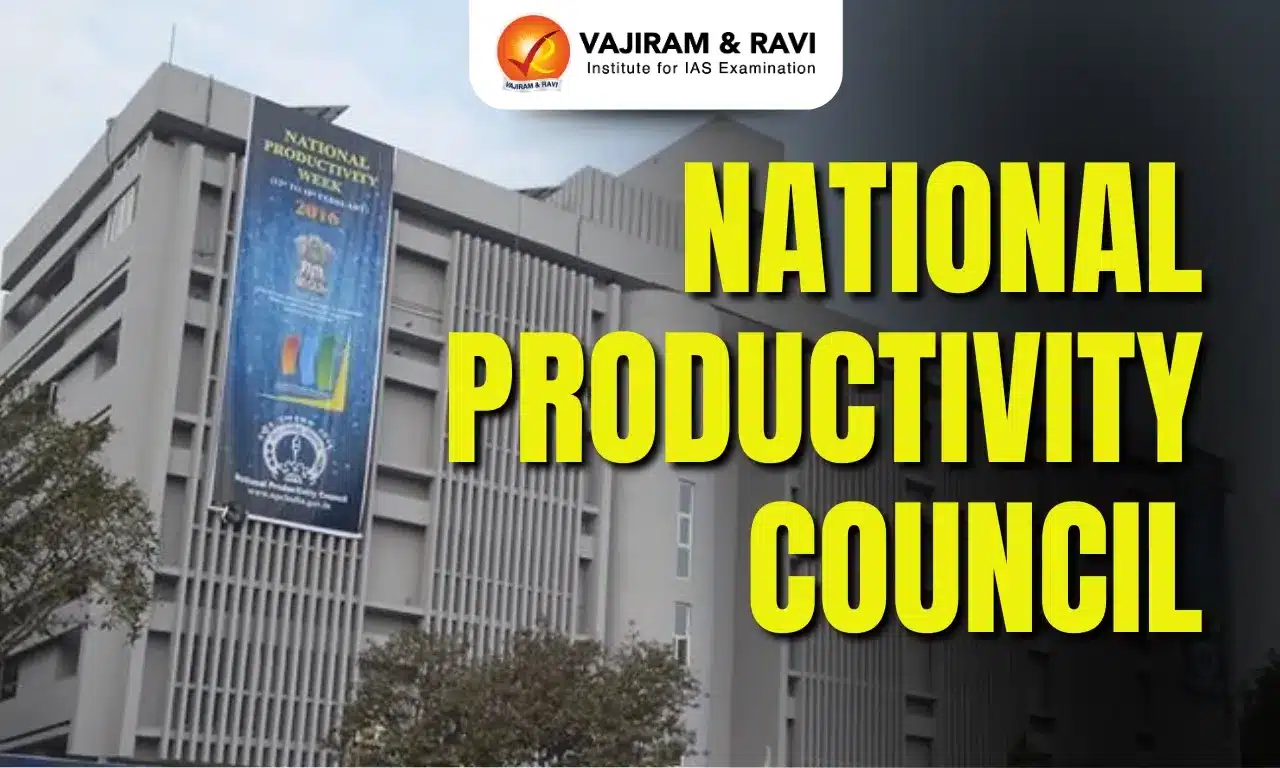
National Productivity Council (NPC)

National Productivity Council

National Productivity Council Latest News

The Delhi High Court recently quashed the Lokpal of India’s proceedings against Defence Secretary Rajesh Kumar Singh, a 1989-batch IAS officer, and other officials in a case alleging irregularities in promotions at the National Productivity Council (NPC).

About National Productivity Council

  • NPC, established in 1958, is an autonomous organization under the Department for Promotion of Industry & Internal Trade, Ministry of Commerce and Industry.
  • It is a multipartite, non-profit organization with equal representation from employers’ & workers’ organizations and the Government, apart from technical & professional institutions and other interests. 
  • Headquarters: New Delhi
  • National Productivity Council Objectives:
    • To increase awareness of productivity in general, especially of the concepts and techniques aimed at strengthening the microeconomic foundations of economic development, rooted in operating practices and strategies of the organizations.
    • To function as a think tank of the Government on measures needed to enhance focus on productivity
    • To be among the premier productivity consultancy and training organizations of the country in the first phase and of the South & Southeast Asian region in the long run.
    • To raise financial resources to sustain its operations on its own on a self-generating and continuing basis.
  • National Productivity Council Functions:
    • Consultancy to organizations on productivity improvement.
    • Training of personnel at different levels.
    • Dissemination of productivity information through seminars, workshops, conferences, etc.
    • Productivity Research and Database.
    • Productivity Publications.
    • Productivity Awards.
  • NPC has professionals from diverse fields to provide Consultancy, Capacity Building, and Project Monitoring Unit (PMU) services to various organisations, including Central Government Ministries and State Governments.
  • It is a constituent of the Tokyo-based Asian Productivity Organisation (APO), an Inter-Governmental Body of which the Government of India is a founding member.

Source: TP

National Productivity Council FAQs

Q1: The National Productivity Council (NPC) was established in which year?

Ans: 1958

Q2: National Productivity Council (NPC) functions under which ministry?

Ans: Ministry of Commerce and Industry

Q3: Where is the headquarters of the National Productivity Council located?

Ans: New Delhi

Q4: National Productivity Council is a constituent of which international organisation?

Ans: It is a constituent of the Tokyo-based Asian Productivity Organisation (APO).

Central Board of Indirect Taxes and Customs (CBIC)

Central Board of Indirect Taxes and Customs (CBIC)

Central Board of Indirect Taxes and Customs (CBIC) Latest News

The Central Board of Indirect Taxes and Customs (CBIC) ‘GST & Customs Pavilion’ has bagged the Gold Prize in the ‘Public Outreach and Communication’ category at the India International Trade Fair (IITF) 2025 in New Delhi recently.

About Central Board of Indirect Taxes and Customs 

  • CBIC, formerly known as the Central Board of Excise and Customs (CBEC), is one of the Boards constituted under the statute the Central Boards of Revenue Act, 1963.
  • It is the apex body under the Department of Revenue, Ministry of Finance, responsible for administering indirect taxes in India.
  • It deals with the tasks of 
    • Formulation of policy concerning levy and collection of Customs, Central Excise duties, Central Goods & Services Tax and IGST. 
    • Prevention of smuggling and administration of matters relating to Customs, Central Excise, Central Goods & Services Tax, IGST, and Narcotics to the extent under CBIC's purview.
  • The Board is the administrative authority for its subordinate organizations, including Custom Houses, Central Excise and Central GST Commissionerates, and the Central Revenues Control Laboratory.
  • The CBIC is headed by a Chairman and has 6 members in addition to the Chairman.

Source: PIB

Central Board of Indirect Taxes and Customs (CBIC) FAQs

Q1: Central Board of Indirect Taxes and Customs (CBIC) is constituted under which act?

Ans: Central Boards of Revenue Act, 1963

Q2: Central Board of Indirect Taxes and Customs (CBIC) functions under which ministry?

Ans: It is the apex body under the Department of Revenue, Ministry of Finance.

Q3: What subordinate organisations fall under the administrative control of Central Board of Indirect Taxes and Customs (CBIC)?

Ans: Custom Houses, Central Excise and Central GST Commissionerates, and the Central Revenues Control Laboratory.

Lake Biwa

Lake Biwa

Lake Biwa Latest News

Researchers recently unearthed a remarkably well-preserved ancient relic, a nearly intact pottery vessel, in Japan, dating back over 10,000 years.

About Lake Biwa

  • It is the largest freshwater lake in Japan.
  • It is located in Shiga ken (prefecture), west-central Honshu. 
  • Approximately 64 km long from north to south, the lake covers an area of 672 sq.km.
  • Its name refers to the biwa, a Japanese musical instrument that the lake resembles in shape.
  • It is believed to be one of the world's oldest lakes, formed at least four million years ago.
  • The lake occupies a structural depression and is fed by small rivers flowing from the encircling mountains. 
  • The sole outlet, the Yodo River, flows from Lake Biwa’s southern tip, past Seta southwest to Ōsaka Bay.
  • Lake Biwa is a breeding ground for freshwater fish, including trout, and supports a pearl culture industry. 
  • It also serves as a reservoir for the cities of Kyōto and Ōtsu and is a valuable resource for nearby textile industries.
  • It was designated as a Ramsar site in 1993.

Source: IDR

Lake Biwa FAQs

Q1: Lake Biwa is located in which country?

Ans: Japan

Q2: Which river serves as the sole outlet of Lake Biwa?

Ans: Yodo River

Q3: In which year was Lake Biwa designated as a Ramsar site?

Ans: 1993

Q4: Which major Japanese cities depend on Lake Biwa as a reservoir?

Ans: Kyōto and Ōtsu

Golden Jackal

Golden Jackal

Golden Jackal Latest News

The Golden Jackal Ambassadors’ scheme is to be launched by Tenkasi District Forest Division of Tamil Nadu for conserving the rapidly dwindling Golden Jackals.

About Golden Jackal

  • It is also known as the common jackal or reed wolf is a medium-sized wolf-like canid.
  • It is strictly nocturnal in areas inhabited by humans, but may be partly diurnal elsewhere.
  • They dig caverns for shelter, or use crevices in rocks, or caverns that were dug by other animals.
  • They live in mated pairs and are strictly monogamous.
  • Habitat: These animals are abundant in valleys and along rivers and their tributaries, canals, lakes, and seashores, but are rare in foothills and low mountains.
  • Distribution: North and East Africa, Southeastern Europe and South Asia to Burma.
    • They are quite widespread across India. Right from the Himalayan foothills, down to the Western Ghats, the Golden Jackal has a wide distribution.
  • Diet: They are omnivores. These opportunistic foragers have a rather diverse diet.

Conservation Status of Golden Jackal

  • IUCN: Least Concern
  • CITES: Appendix III
  • Wildlife Protection Act, 1972: Schedule I

 Source: TH

Golden Jackal FAQs

Q1: What is the scientific name of the Golden Jackal?

Ans: Canis aureus

Q2: What is the diet of the Golden Jackal?

Ans: Omnivorous

Indian Pharmacopoeia Commission

Indian Pharmacopoeia Commission

Indian Pharmacopoeia Commission Latest News

Recently, Indian Pharmacopoeia Commission signs 3 MoUs with Nagaland Medical Council, Nagaland State Drugs Control Administration (NSDCA) and Nagaland State Pharmacy Council.

About Indian Pharmacopoeia Commission

  • It is an autonomous Institution of the Ministry of Health and Family Welfare, Govt. of India.
  • It is created to set standards of drugs in the country.

Functions of Indian Pharmacopoeia Commission

  • Its basic function is to regularly update the standards of drugs commonly required for treatment of diseases prevailing in this region.
  • It publishes official documents for improving Quality of Medicines by way of adding new and updating existing monographs in the form of Indian Pharmacopoeia (IP).
  • It further promotes rational use of generic medicines by publishing National Formulary of India.
  • It prescribes standards for identity, purity and strength of drugs essentially required from the health care perspective of human beings and animals.
  • It also provides IP Reference Substances (IPRS) which act as a fingerprint for identification of an article under test and its purity as prescribed in IP.

What is Pharmacopoeia?

  • The Pharmacopoeias are official compendia of quality standards of the drugs being imported, manufactured for sale, stocked or exhibited for sale or distributed in India.

Source: PIB

Indian Pharmacopoeia Commission FAQs

Q1: Under which ministry does the Indian Pharmacopoeia Commission function?

Ans: Ministry of Health and Family Welfare

Q2: What is the Indian Pharmacopoeia Commission?

Ans: A standards-setting body for pharmaceuticals in India

Enquire Now