
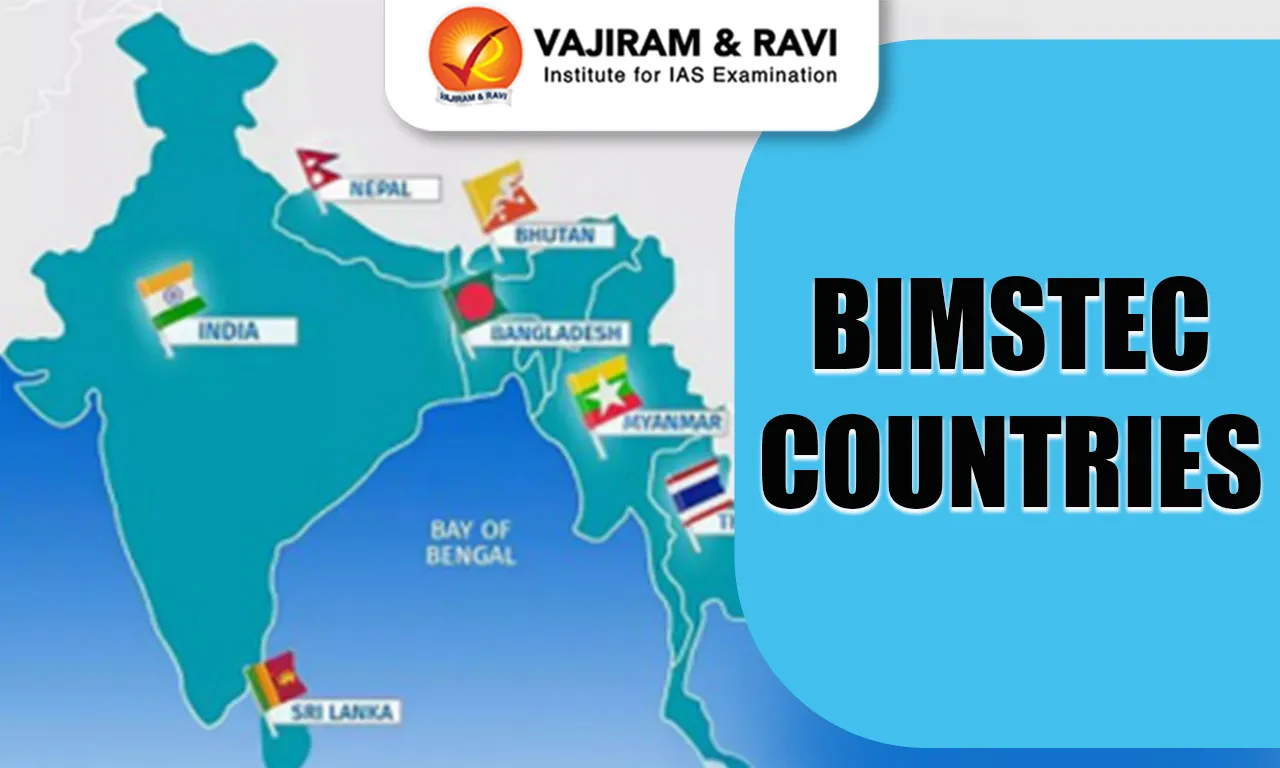
The Bay of Bengal Initiative for Multi-Sectoral Technical and Economic Cooperation (BIMSTEC) is a regional organisation that brings together countries from South Asia and Southeast Asia, united by the Bay of Bengal. Formed in 1997, it was envisioned as an alternative to SAARC, with a focus on promoting collaboration across key sectors such as trade, transport, energy, and security.
By 2025, BIMSTEC has gained strategic importance, especially in the context of shifting global alliances and rising tensions in the Indo-Pacific. In this evolving landscape, BIMSTEC is positioning itself as an important forum for enhancing regional connectivity, promoting economic integration, and maintaining geopolitical balance.
The headquarters for the Bay of Bengal Initiative for Multi-Sectoral Technical and Economic Cooperation (BIMSTEC) is located in Dhaka, Bangladesh.
BIMSTEC Countries 2025
BIMSTEC is a multilateral regional organisation that brings together countries located along the coastlines and surrounding regions of the Bay of Bengal. It serves as a bridge between South and Southeast Asia, while also being surrounded by the ecological diversity of both the Himalayan region and the Bay of Bengal basin.
| BIMSTEC Countries 2025 | |
|
Full Form |
Bay of Bengal Initiative for Multi-Sectoral Technical and Economic Cooperation |
|
Established |
1997 (as BIST-EC); Renamed BIMSTEC in 2004 |
|
Headquarters |
Dhaka, Bangladesh |
|
Total Members |
7 |
|
Member Countries |
Bangladesh, Bhutan, India, Nepal, Myanmar, Sri Lanka, Thailand |
|
Regions Covered |
South Asia & Southeast Asia |
|
Population (2025) |
Over 1.7 billion (~22% of the global population) |
|
Combined GDP (2025) |
Approx. $4 trillion |
|
Key Waterbody |
Bay of Bengal (connects the Indian Ocean to Southeast Asia) |
|
Official Language |
English |
|
BIMSTEC Charter Signed |
March 2022 (at the 5th Summit in Sri Lanka) |
BIMSTEC History
The table below includes the BIMSTEC History from its establishment till the present day scenario.
| BIMSTEC History | |
|
Year |
Milestone |
|
1997 |
Formation as BIST-EC (Bangladesh, India, Sri Lanka, Thailand Economic Cooperation). |
|
1998 |
Renamed to BIMST-EC with the addition of Myanmar. |
|
2004 |
Fully transformed into BIMSTEC (Bay of Bengal Initiative for Multi-Sectoral Technical and Economic Cooperation). |
|
2022 |
BIMSTEC Charter signed at the 5th Summit in Sri Lanka, formally institutionalizing the organization. |
|
2025 |
BIMSTEC enhances sectoral cooperation, with each member state leading specific areas of collaboration. |
BIMSTEC Objectives
The BIMSTEC Objectives are to strengthen technical and economic cooperation among its seven member nations situated around the Bay of Bengal. By leveraging shared resources and regional strengths, the organisation aims to deepen integration across key sectors. Its broader mission is to advance peace, prosperity, and sustainable development throughout South and Southeast Asia, promoting collaboration in areas such as trade, connectivity, energy, environment, and security.
| BIMSTEC Objectives | |
|
Objective |
Explanation |
|
Accelerated Economic Growth |
Promote regional prosperity by enhancing trade, investment, and technology-sharing to uplift socio-economic conditions. |
|
Regional Connectivity |
Strengthen links via roads, railways, ports, and energy grids to enable smoother trade and people-to-people movement. |
|
Multisectoral Cooperation |
Deepen collaboration across 14 sectors such as trade, transport, energy, agriculture, health, and security. |
|
Poverty Alleviation |
Reduce poverty through inclusive growth strategies, joint projects, and economic reforms. |
|
Bridge Between South & Southeast Asia |
Serve as a strategic connector between SAARC and ASEAN, fostering deeper regional integration. |
|
Sustainable Development |
Work together on climate action, disaster resilience, environmental protection, and marine sustainability. |
|
Peace and Security |
Address terrorism, cross-border crimes, and cyber threats via intelligence-sharing and joint capacity-building efforts. |
|
People-to-People Contact |
Promote cultural ties, tourism, academic exchange, and local diplomacy to foster mutual trust and understanding. |
BIMSTEC Countries Origin
BIMSTEC was originally established as BIST-EC (Bangladesh, India, Sri Lanka, and Thailand Economic Cooperation) through the Bangkok Declaration in June 1997. Later that year, with the inclusion of Myanmar, the group was renamed BIMST-EC. In 2004, the entry of Nepal and Bhutan expanded the organisation further, and it officially became the Bay of Bengal Initiative for Multi-Sectoral Technical and Economic Cooperation (BIMSTEC). As of 2025, BIMSTEC consists of the following seven member countries:
- Bangladesh
- India
- Bhutan
- Nepal
- Myanmar
- Sri Lanka
- Thailand
BIMSTEC Full Form
BIMSTEC stands for the Bay of Bengal Initiative for Multi-Sectoral Technical and Economic Cooperation. The organisation was initially formed as BIST-EC in 1997. It was officially renamed to BIMSTEC during the First BIMSTEC Summit held in Bangkok on 31 July 2004, marking the formal inclusion of all seven member countries and expanding the group's vision to cover a broader multi-sectoral agenda.
BIMSTEC Countries List with Capital City
BIMSTEC comprises a total of seven member countries, strategically located around the Bay of Bengal. Among them, five nations belong to South Asia, The remaining two countries are from Southeast Asia:
| BIMSTEC Countries List with Capital City | ||
|
S. No. |
Name of BIMSTEC Countries |
Capital City |
|
1. |
Bangladesh |
Dhaka/Dacca |
|
2. |
Bhutan |
Thimphu |
|
3. |
India |
New Delhi |
|
4. |
Nepal |
Kathmandu |
|
5. |
Sri Lanka |
Colombo (Executive and Judicial); Sri Jayewardenepura Kotte (Legislative) |
|
6. |
Myanmar |
Naypyidaw |
|
7. |
Thailand |
Bangkok |
BIMSTEC Countries Map
BIMSTEC Countries Map highlights the seven member nations across South and Southeast Asia, all linked through the Bay of Bengal region. This map helps illustrate BIMSTEC’s strategic position as a bridge between the two subregions.
Area of Cooperation in BIMSTEC
BIMSTEC operates as a sector-driven organisation, with each member country taking the lead in specific areas of cooperation. Initially, in 1997, collaboration focused on six core sectors: trade, technology, energy, transport, tourism, and fisheries. As the organisation evolved, its scope broadened. In 2008, new sectors were added, including agriculture, public health, poverty alleviation, counterterrorism, environment, culture, people-to-people contact, and climate change.
| Area of Cooperation in BIMSTEC | |
|
Member Country |
Sectors |
|
Bangladesh |
Trade, Investment and Development |
|
Bhutan |
Environment & Climate Change |
|
India |
Security: Counter-Terrorism and Transnational Crime, Energy and Disaster Management |
|
Nepal |
People-to-People Contact: Tourism, Culture, (forums of think tanks, media etc.) |
|
Sri Lanka |
Science, Technology & Innovation (Human Resource Development, Health, Technology) |
|
Myanmar |
Agriculture and Food Security (Agriculture, Livestock, Fisheries) |
|
Thailand |
Connectivity |
BIMSTEC Working Mechanism
Policy-Making in BIMSTEC is structured through a tiered system of regular meetings that ensure coordination, decision-making, and implementation across all sectors:
- Summit Meetings: These are held every two years at the level of Heads of State or Government. They provide overall direction and make key strategic decisions for the grouping.
- Ministerial Meetings: Foreign Ministers and Commerce Ministers convene annually to review progress, set priorities, and address major policy and economic matters.
- Senior Official’s Meetings: These are held twice a year, bringing together high-level bureaucrats from each member country to monitor, evaluate, and coordinate the implementation of BIMSTEC’s initiatives.
Institutional Mechanisms of BIMSTEC
- BIMSTEC Summit
- Ministerial Meeting
- Senior Officials’ Meeting
- BIMSTEC Working Group
- Business Forum & Economic Forum
BIMSTEC for India Significance
- Facilitates Key Foreign Policy Objectives: BIMSTEC supports India in advancing three major foreign policy strategies-
- Act East Policy: Strengthens economic and strategic ties with Southeast Asia.
- Neighborhood First Policy: Reinforces cooperation with India’s immediate neighbours.
- Development of the Northeast Region: Enhances connectivity of northeastern states to the Bay of Bengal through Bangladesh and Myanmar.
- Alternative to SAARC: With SAARC’s functionality weakening due to political friction, particularly the India-Pakistan divide-BIMSTEC serves as a more practical and cooperation-oriented regional platform.
- Counterbalancing China: The grouping allows India to counter China’s growing influence in the Bay of Bengal littoral states, especially in light of the Belt and Road Initiative’s expanding footprint in the region.
Challenges in India - BIMSTEC Relations
India have faced various challenges while being a part of BIMSTEC which are discussed in the table below:
| Challenges in India - BIMSTEC Relations | ||
|
Challenge |
Description |
Example |
|
Economic Disparities |
Wide gap between member economies makes equitable implementation of projects difficult. |
India has far more economic resources than Bhutan or Nepal, leading to funding and implementation issues. |
|
Infrastructure & Connectivity |
Poor roads, ports, and communication systems limit regional trade and collaboration. |
Kaladan project between India and Myanmar delayed due to weak infrastructure and coordination problems. |
|
Institutional Weaknesses |
BIMSTEC’s Secretariat lacks adequate staff and resources, reducing efficiency. |
Dhaka-based Secretariat struggles to coordinate initiatives due to capacity constraints. |
|
Political Instability |
Frequent regime changes and internal conflicts disrupt cooperation. |
Political unrest in Myanmar hinders regional projects and policy alignment. |
|
Security Concerns |
Maritime threats like piracy, trafficking, and illegal fishing affect trade and stability. |
Piracy and unregulated fishing in Bay of Bengal require better joint maritime security efforts. |
|
Environmental Issues |
Climate risks like cyclones and sea-level rise demand regional disaster response. |
Coastal nations like Bangladesh and Sri Lanka frequently suffer cyclone damage, affecting regional planning. |
|
Geopolitical Challenges |
China's growing influence undercuts India’s regional position and leadership ambitions. |
China’s investments in Myanmar and Bangladesh challenge India’s strategic leverage. |
|
Uneven Member Engagement |
Some countries show more interest in ASEAN or SAARC, weakening BIMSTEC’s unity. |
Inconsistent participation affects policy follow-through and trust in BIMSTEC’s effectiveness. |
BIMSTEC Countries 2025 FAQs
Q1: What is BIMSTEC?
Ans: BIMSTEC is the Bay of Bengal Initiative for Multi-Sectoral Technical and Economic Cooperation, a regional organization for cooperation among South and Southeast Asian countries.
Q2: How many countries are in BIMSTEC?
Ans: There are 7 member countries in BIMSTEC.
Q3: Which countries are members of BIMSTEC?
Ans: Bangladesh, Bhutan, India, Myanmar, Nepal, Sri Lanka, and Thailand are BIMSTEC members.
Q4: When was BIMSTEC established?
Ans: BIMSTEC was established on June 6, 1997.
Q5: Where is the BIMSTEC headquarters?
Ans: BIMSTEC headquarters is located in Dhaka, Bangladesh.
