
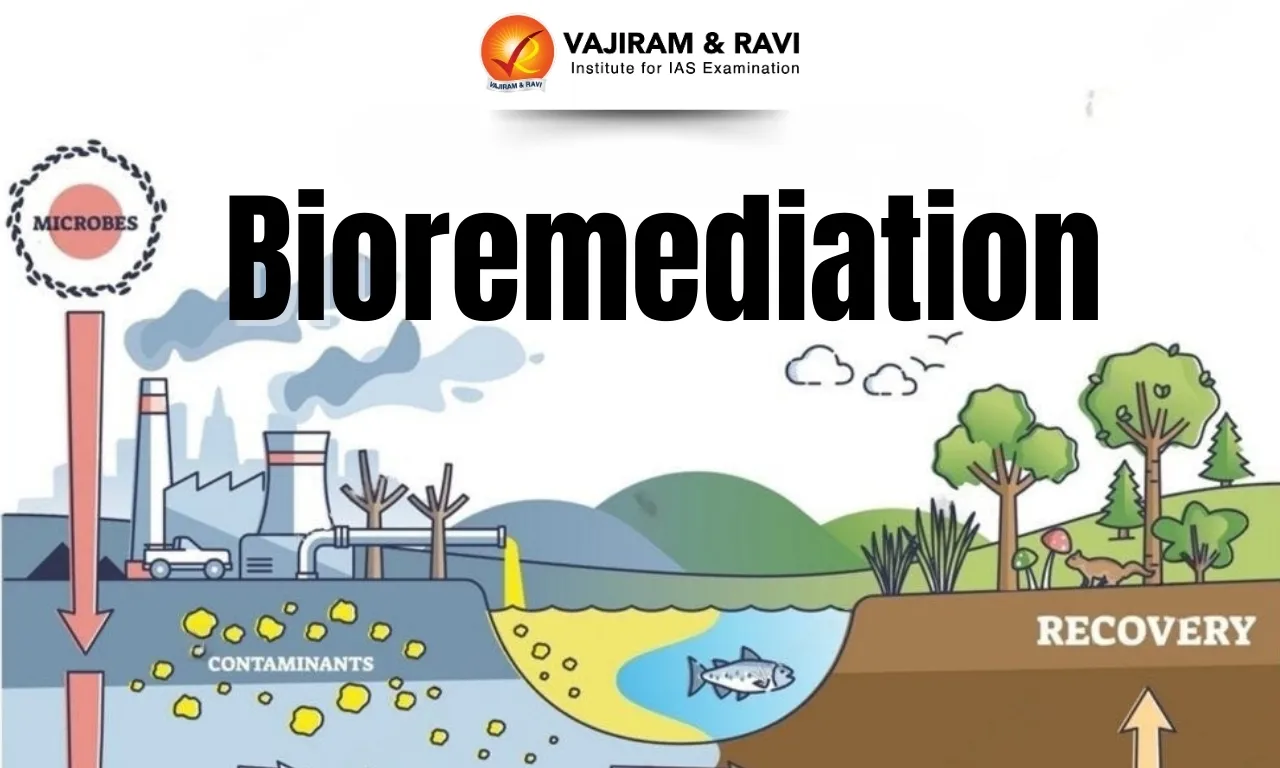
Bioremediation

Bioremediation

Bioremediation Latest News

Bioremediation offers a cheaper, scalable, and sustainable alternative, especially in a country like India where vast stretches of land and water are affected but resources for remediation are limited.

About Bioremediation

  • Bioremediation literally means “restoring life through biology.” 
  • It is the use of living organisms, primarily microorganisms, to degrade environmental contaminants into less toxic forms.
  • It is used to clean up contaminated soil, air, and water.
  • It harnesses microorganisms such as bacteria, fungi, algae, and plants to sequester or transform toxic substances such as oil, pesticides, plastics, or heavy metals. 
  • These organisms metabolise these pollutants as food, breaking them down into harmless by-products such as water, carbon dioxide, or organic acids. 
  • In some cases, they can convert toxic metals into less dangerous forms that no longer leach into the soil or groundwater.
  • Two Broad Types of Bioremediation:
    • In situ bioremediation, where treatment happens directly at the contaminated site, such as when oil-eating bacteria is sprayed on an ocean spill; 
    • Ex situ bioremediation, where contaminated soil or water is removed, treated in a controlled facility, and returned once cleaned.
  • For bioremediation to be effective, the right temperature, nutrients, and food also must be present. 
  • Proper conditions allow the right microbes to grow and multiply—and eat more contaminants.

Bioremediation Advantages

  • It cleans up the environment naturally without the use of toxic chemicals. So, it is an environmentally friendly method. 
  • Contaminants are converted into water and harmless gases.
  • It is cost-effective, as extensive equipment and labor are not needed.
  • It is a permanent solution, as the degraded material cannot revert back to the previous one.
  • It is a recommended method for removing oil stains.

Bioremediation Disadvantages

  • It takes a large area and time from months to years.
  • It is limited to the compounds which are degradable.
  • It is not able to remove all kinds of impurities from the contaminated site. Like, some kind of inorganic contaminants cannot be treated with this bioremediation method.
  • Some heavy metals cannot be completely broken down, resulting in toxic by-products.

Source: TH

Bioremediation FAQs

Q1: What does bioremediation use to degrade environmental contaminants?

Ans: Bioremediation use of living organisms, primarily microorganisms, to degrade environmental contaminants into less toxic forms.

Q2: Which organisms are commonly harnessed in bioremediation processes?

Ans: It harnesses microorganisms such as bacteria, fungi, algae, and plants to sequester or transform toxic substances.

Q3: What is in situ bioremediation?

Ans: In situ bioremediation is a method where contaminants are treated directly at the site without removing the polluted soil or water.

Q4: Why is bioremediation considered an environmentally friendly method?

Ans: It cleans up the environment naturally without the use of toxic chemicals.

Bioremediation in India – Explained

Bioremediation

Bioremediation Latest News

  • India is witnessing an urgent environmental crisis triggered by decades of unchecked waste generation, industrial pollution, pesticide accumulation, oil spills, and heavy-metal contamination.  

Understanding Bioremediation

  • Bioremediation literally means “restoring life through biology.” It relies on naturally occurring or engineered microorganisms, bacteria, fungi, algae, or plants to break down dangerous pollutants into harmless by-products. 
  • These pollutants range from oil and pesticides to plastics and toxic heavy metals.
  • Microbes metabolise pollutants as food, converting them into water, carbon dioxide, or organic acids, while certain organisms transform metals into safer, non-leaching forms. 

Types of Bioremediation Techniques

  • In Situ Bioremediation
    • Treatment occurs directly at the contaminated site.
    • Examples include oil-eating bacteria deployed over ocean spills.
  • Ex Situ Bioremediation
    • Contaminated soil or water is removed, treated in a facility, and then returned.
    • This approach allows controlled treatment for complex pollutant mixtures.
  • Modern bioremediation blends traditional microbiology with advanced biotechnology, enabling precise identification of biomolecules and replication of microbes tailored for specific environments like sewage systems or agricultural fields.
  • Synthetic biology has introduced:
    • GM microbes for tough pollutants such as plastics and oil residues,
    • Biosensing organisms that change colour or fluoresce when detecting toxins, aiding early warnings and monitoring. 

Urgent Need for Bioremediation in India

  • India’s rapid industrialisation and urbanisation have come with steep environmental costs. 
  • Heavily polluted rivers like the Ganga and Yamuna, untreated sewage, toxic effluents, oil leaks, pesticide residues, and heavy metals have created widespread ecological degradation.
  • Traditional clean-up systems, thermal treatments, chemical neutralisation, and mechanical extraction are expensive, energy-intensive, and often produce secondary pollution.
  • Bioremediation stands out as a cost-effective, scalable, and environmentally sustainable alternative, especially critical for a country dealing with:
    • Large polluted land areas,
    • Limited resources for remediation,
    • Dense urban centres are overwhelmed by waste. 
  • India’s natural biodiversity gives it an additional advantage. Indigenous microbes adapted to extreme environments (heat, salinity, acidity) can outperform imported strains in cleaning local contamination.

India’s Current Progress in Bioremediation

  • India’s bioremediation ecosystem is growing but remains mostly at the pilot-project stage. Key developments include:
  • Government-Led Initiatives
    • The Department of Biotechnology (DBT) supports bioremediation projects through its Clean Technology Programme, encouraging partnerships between universities, research institutes, and industries.
    • The CSIR–NEERI has a mandate to develop and implement bioremediation programmes nationwide. 
  • Research Innovations
    • IIT researchers created a nanocomposite material from cotton to clean oil spills.
    • Scientists have identified bacteria capable of degrading soil pollutants.
  • Start-up Participation
    • Companies now offer microbial formulations for cleaning wastewater and soil, indicating growing commercial adoption. 

Global Trends in Bioremediation

  • Japan uses plant- and microbe-based systems in urban waste strategies.
  • The European Union funds multinational collaborations for oil spill clean-up and mining land restoration.
  • China applies engineered bacteria to restore industrial wastelands under its soil pollution control programme. 
  • These global examples underline how bioremediation can be mainstreamed in national environmental management.

Opportunities for India

  • India has immense opportunities to integrate bioremediation into:
    • River rejuvenation (e.g., Namami Gange), Sewage treatment infrastructure, Land reclamation, Industrial clean-up missions.
  • Beyond environmental benefits, bioremediation can create jobs in:
    • Biotechnology research, Waste management, Environmental consulting, Local start-up ecosystems.

Risks and Regulatory Challenges

  • Bioremediation also carries risks, especially when using genetically modified organisms (GMOs). 
  • Poor containment or inadequate testing can harm ecosystems. India currently faces:
    • A lack of unified national standards for bioremediation, Insufficient site-specific data, Weak biosafety guidelines, and Limited trained personnel. 

Way Forward

  • Creating national bioremediation standards and certification systems,
  • Building regional bioremediation hubs linking universities, industries, and local governments,
  • Supporting start-ups under the DBT-BIRAC ecosystem,
  • Engaging communities to dispel myths and build acceptance of microbial clean-up technologies. 

Source: TH

Bioremediation FAQs

Q1: What is bioremediation?

Ans: It is the use of microbes, algae, or plants to break down or neutralise toxic pollutants.

Q2: Why is bioremediation important for India?

Ans: It offers a low-cost, sustainable solution to widespread pollution in land and water bodies.

Q3: Which organisations are leading bioremediation research in India?

Ans: DBT, CSIR–NEERI, and institutions like IITs.

Q4: What are the major types of bioremediation?

Ans: In situ (on-site) and ex situ (off-site) remediation methods.

Q5: What risks does bioremediation pose?

Ans: GM microbes can cause ecological harm if not rigorously tested and regulated.

Enquire Now
