Bioremediation in India – Explained

Bioremediation

Bioremediation Latest News

  • India is witnessing an urgent environmental crisis triggered by decades of unchecked waste generation, industrial pollution, pesticide accumulation, oil spills, and heavy-metal contamination.  

Understanding Bioremediation

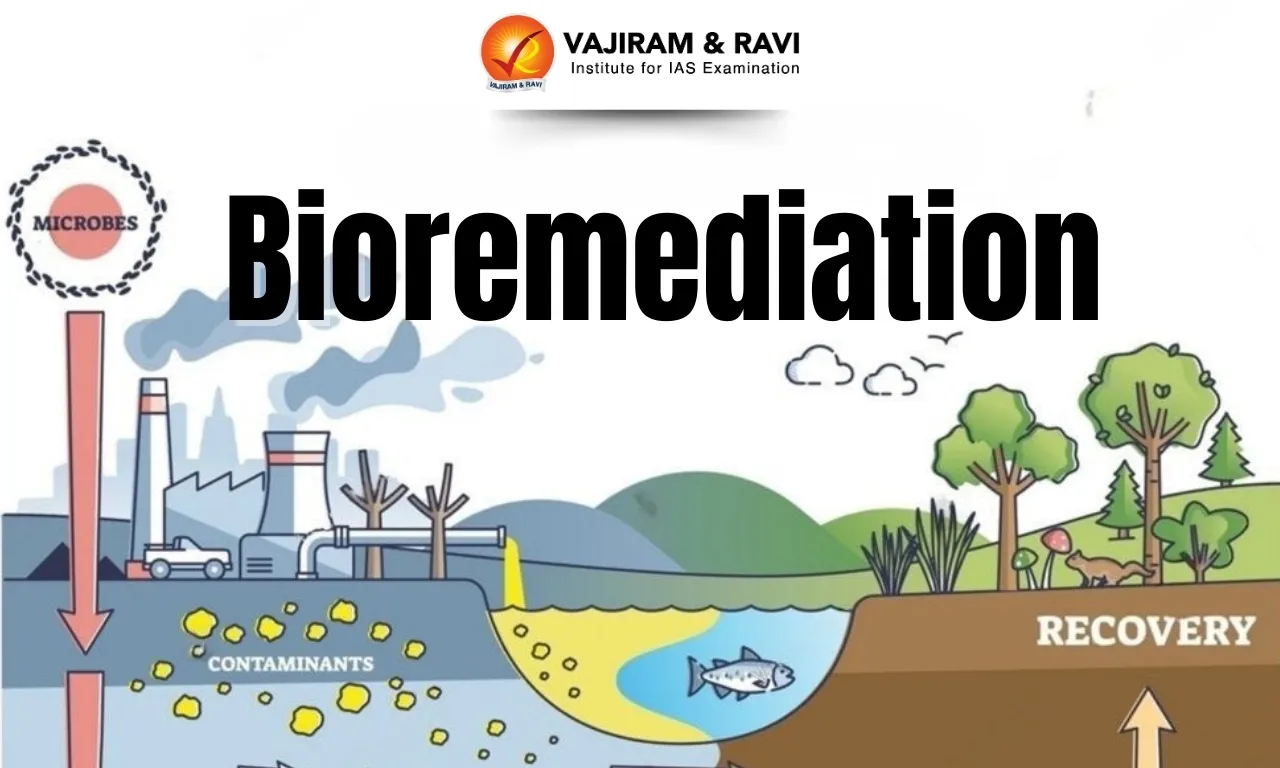
  • Bioremediation literally means “restoring life through biology.” It relies on naturally occurring or engineered microorganisms, bacteria, fungi, algae, or plants to break down dangerous pollutants into harmless by-products. 
  • These pollutants range from oil and pesticides to plastics and toxic heavy metals.
  • Microbes metabolise pollutants as food, converting them into water, carbon dioxide, or organic acids, while certain organisms transform metals into safer, non-leaching forms. 

Types of Bioremediation Techniques

  • In Situ Bioremediation
    • Treatment occurs directly at the contaminated site.
    • Examples include oil-eating bacteria deployed over ocean spills.
  • Ex Situ Bioremediation
    • Contaminated soil or water is removed, treated in a facility, and then returned.
    • This approach allows controlled treatment for complex pollutant mixtures.
  • Modern bioremediation blends traditional microbiology with advanced biotechnology, enabling precise identification of biomolecules and replication of microbes tailored for specific environments like sewage systems or agricultural fields.
  • Synthetic biology has introduced:
    • GM microbes for tough pollutants such as plastics and oil residues,
    • Biosensing organisms that change colour or fluoresce when detecting toxins, aiding early warnings and monitoring. 

Urgent Need for Bioremediation in India

  • India’s rapid industrialisation and urbanisation have come with steep environmental costs. 
  • Heavily polluted rivers like the Ganga and Yamuna, untreated sewage, toxic effluents, oil leaks, pesticide residues, and heavy metals have created widespread ecological degradation.
  • Traditional clean-up systems, thermal treatments, chemical neutralisation, and mechanical extraction are expensive, energy-intensive, and often produce secondary pollution.
  • Bioremediation stands out as a cost-effective, scalable, and environmentally sustainable alternative, especially critical for a country dealing with:
    • Large polluted land areas,
    • Limited resources for remediation,
    • Dense urban centres are overwhelmed by waste. 
  • India’s natural biodiversity gives it an additional advantage. Indigenous microbes adapted to extreme environments (heat, salinity, acidity) can outperform imported strains in cleaning local contamination.

India’s Current Progress in Bioremediation

  • India’s bioremediation ecosystem is growing but remains mostly at the pilot-project stage. Key developments include:
  • Government-Led Initiatives
    • The Department of Biotechnology (DBT) supports bioremediation projects through its Clean Technology Programme, encouraging partnerships between universities, research institutes, and industries.
    • The CSIR–NEERI has a mandate to develop and implement bioremediation programmes nationwide. 
  • Research Innovations
    • IIT researchers created a nanocomposite material from cotton to clean oil spills.
    • Scientists have identified bacteria capable of degrading soil pollutants.
  • Start-up Participation
    • Companies now offer microbial formulations for cleaning wastewater and soil, indicating growing commercial adoption. 

Global Trends in Bioremediation

  • Japan uses plant- and microbe-based systems in urban waste strategies.
  • The European Union funds multinational collaborations for oil spill clean-up and mining land restoration.
  • China applies engineered bacteria to restore industrial wastelands under its soil pollution control programme. 
  • These global examples underline how bioremediation can be mainstreamed in national environmental management.

Opportunities for India

  • India has immense opportunities to integrate bioremediation into:
    • River rejuvenation (e.g., Namami Gange), Sewage treatment infrastructure, Land reclamation, Industrial clean-up missions.
  • Beyond environmental benefits, bioremediation can create jobs in:
    • Biotechnology research, Waste management, Environmental consulting, Local start-up ecosystems.

Risks and Regulatory Challenges

  • Bioremediation also carries risks, especially when using genetically modified organisms (GMOs). 
  • Poor containment or inadequate testing can harm ecosystems. India currently faces:
    • A lack of unified national standards for bioremediation, Insufficient site-specific data, Weak biosafety guidelines, and Limited trained personnel. 

Way Forward

  • Creating national bioremediation standards and certification systems,
  • Building regional bioremediation hubs linking universities, industries, and local governments,
  • Supporting start-ups under the DBT-BIRAC ecosystem,
  • Engaging communities to dispel myths and build acceptance of microbial clean-up technologies. 

Source: TH

Bioremediation FAQs

Q1: What is bioremediation?

Ans: It is the use of microbes, algae, or plants to break down or neutralise toxic pollutants.

Q2: Why is bioremediation important for India?

Ans: It offers a low-cost, sustainable solution to widespread pollution in land and water bodies.

Q3: Which organisations are leading bioremediation research in India?

Ans: DBT, CSIR–NEERI, and institutions like IITs.

Q4: What are the major types of bioremediation?

Ans: In situ (on-site) and ex situ (off-site) remediation methods.

Q5: What risks does bioremediation pose?

Ans: GM microbes can cause ecological harm if not rigorously tested and regulated.

India’s REPM Scheme: ₹7,280-Crore Push to Reduce China Dependence in Rare Earth Magnets

REPM Scheme

REPM Scheme Latest News

  • To counter China’s overwhelming dominance in rare earth magnet manufacturing, the Indian government has approved a ₹7,280-crore scheme to promote domestic production of rare earth permanent magnets (REPMs).
  • REPMs are critical components for EVs, renewable energy systems, electronics, aerospace, and defence. China currently controls over 90% of global REPM manufacturing and processing.
  • This gives it significant geopolitical leverage, which it has used during trade disputes.

Why India Needs Urgent Diversification

  • India plans large-scale expansion in renewable energy and electric mobility, sharply increasing domestic demand for REPMs.
  • The government estimates that India’s magnet consumption will double by 2030.
  • However, India imports almost all of its REPM needs, making the country highly vulnerable to external shocks and supply disruptions.
  • Also, in April 2025, China imposed export controls on magnets in response to US tariff measures, intensifying global supply concerns.
  • The newly approved scheme aims to develop domestic capabilities and reduce over-reliance on China.
  • While modest compared to China’s scale, the initiative marks a crucial strategic shift as global stakes rise due to prolonged restrictions and supply chain uncertainty.

Government’s REPM Scheme: What It Aims to Achieve

  • The scheme marks the beginning of a long, challenging journey for India.
  • The scheme targets creation of 6,000 MTPA of integrated rare earth permanent magnet (REPM) manufacturing capacity. 
  • This capacity will be divided among five beneficiaries, each eligible for up to 1,200 MTPA through a competitive bidding process.

Incentives and Financial Support

  • Selected companies will receive:
    • ₹6,450 crore in sales-linked incentives over five years
    • ₹750 crore as capital subsidy for setting up integrated facilities
  • The financial support is designed to encourage large-scale, commercially viable manufacturing.

Focus on High-Demand NdFeB Magnets

  • The scheme prioritises sintered rare-earth permanent magnets, specifically neodymium–iron–boron (NdFeB) magnets, which are the strongest and most widely used.
  • These magnets rely on:
    • Light rare-earths: Neodymium (Nd), Praseodymium (Pr)
    • Heavy rare-earths: Dysprosium (Dy), Terbium (Tb) for better high-temperature performance

What Integrated REPM Manufacturing Involves

  • The REPM production chain includes:
    • Mining
    • Beneficiation
    • Processing
    • Extraction
    • Refining to rare earth oxides
    • Conversion of oxides to metal
    • Metal to alloy
    • Alloy to magnet
  • The scheme will support facilities capable of performing the final three stages:
    • Rare earth oxide → metal
    • Metal → alloy
    • Alloy → rare earth permanent magnet

India’s Heavy Dependence on China

  • India imported over 53,000 tonnes of rare earth magnets in 2024–25, with more than 90% coming from China.
  • The new scheme aims to reduce this reliance and build domestic capacity, but major challenges remain.

Where India Stands in the Global REPM Landscape

  • Outside China, only countries like Japan and Vietnam produce REPMs, and their global share is limited.
  • India currently has no commercial-scale manufacturing, only small-scale capabilities at select firms.
  • China produces around 2,40,000 tonnes of REPMs annually—far beyond India’s planned 6,000-tonne capacity under the new scheme, underscoring the vast gap.

Raw Material Bottlenecks: A Key Constraint

  • India produces some light rare-earth oxides through IREL—such as neodymium–praseodymium (NdPr) oxides—but no heavy rare-earth oxides like dysprosium and terbium.
  • These heavy rare earths are essential for high-strength, high-temperature NdFeB magnets.
  • Thus, India will still need to import critical raw materials, limiting true self-reliance.

The Scale and Cost Challenge

  • China’s dominance comes from:
    • Massive production scale
    • Fully integrated value chain
    • Significant subsidies
  • These factors make China’s magnets far cheaper, making cost competitiveness a major hurdle for Indian manufacturers.
  • Unless mandated through policy, users are unlikely to buy magnets that are significantly more expensive than Chinese imports.

Global Diversification Efforts Are Growing

  • A 2022 US Department of Energy report shows that 93% of the global NdFeB magnet market is dominated by sintered magnets—and China controls almost the entire supply chain, from mining to magnet manufacturing. 
  • This has pushed countries worldwide to reduce dependency on China.

International Initiatives to Secure Critical Minerals

  • Quad Initiative (2024) - In July, the Quad countries — India, Australia, Japan, and the US — launched a supply chain initiative to secure access to critical minerals, reducing reliance on China.
  • G7 Critical Minerals Action Plan (2024) - India endorsed the G7’s Critical Minerals Action Plan, which focuses on building diversified and resilient global supply chains.

India’s National Critical Mineral Mission (NCMM)

  • Launched in January 2024 for seven years (2024–25 to 2030–31), the NCMM aims to secure India’s critical mineral supply chain through:
    • Reliable domestic and overseas mineral access
    • Strengthening exploration, processing, and recycling
    • Improving technology, regulation, and financing
  • The mission has an outlay of ₹16,300 crore.

Reforming Domestic Mineral Governance

  • In 2023, India identified 30 minerals as “critical”.
  • The government amended the MMDR Act, 1957, giving the Centre exclusive powers to auction critical and strategic minerals such as lithium, cobalt, and rare earth elements.
  • Since the amendment, 34 critical mineral blocks have been auctioned.

Securing Overseas Resources: The Role of KABIL

  • India established Khanij Bidesh India Limited (KABIL), a joint venture tasked with identifying and developing critical mineral assets abroad.
  • KABIL has signed an agreement with Camyen, a state-owned firm in Catamarca, Argentina, to explore and mine five lithium brine blocks, expanding India’s access to essential battery minerals.

Source: IE | TH

REPM Scheme FAQs

Q1: Why has India launched the REPM manufacturing scheme?

Ans: To reduce heavy dependence on China, secure critical supply chains, and meet rising demand for magnets used in EVs, renewable energy, electronics, and defence technologies.

Q2: What does the REPM scheme aim to achieve?

Ans: The scheme targets 6,000 MTPA of integrated magnet capacity, offering ₹6,450 crore in incentives and ₹750 crore capital support across five selected manufacturers.

Q3: Why is China’s dominance a key concern?

Ans: China controls over 90% of REPM production, holds major cost advantages, and has used export restrictions during trade tensions, creating global supply vulnerabilities.

Q4: What raw material challenges does India face?

Ans: India produces some light rare-earth oxides but has no heavy rare-earth production, requiring imports of critical materials like dysprosium and terbium for high-grade magnets.

Q5: What steps is India taking to secure critical minerals?

Ans: India launched NCMM, amended the MMDR Act, auctioned 34 critical blocks, and created KABIL to secure overseas lithium and rare-earth assets for long-term supply.

Insurance Laws Amendment Bill 2025: Big Reform Push for India’s Insurance Sector

Insurance Laws Amendment Bill 2025

Insurance Laws Amendment Bill 2025 Latest News

  • The government plans to introduce the Insurance Laws (Amendment) Bill, 2025 in the sixth session of the 18th Lok Sabha, paving the way for a major reform push in India’s underpenetrated insurance sector. 
  • The Bill is expected to receive approval and is viewed by industry stakeholders as a transformative step that could drive growth, attract capital, and spur innovation over the coming decade.

Background: FDI in Insurance Raised to 100%

  • On February 1, 2025, Finance Minister Nirmala Sitharaman announced a major reform: increasing FDI in insurance from 74% to 100%
  • This paves the way for significant foreign capital and participation from global insurance giants, boosting competition and operational efficiency.
  • To implement the higher FDI cap, amendments will be made to:
    • Insurance Act, 1938
    • Life Insurance Corporation Act, 1956
    • IRDAI Act, 1999
  • The Finance Minister had indicated that the draft Insurance Laws (Amendment) Bill will soon be placed before Parliament.

Opening the Door for Global Players

  • Of the world’s top 25 insurers, nearly 20 do not operate in India. The new regime may encourage them to enter the market. 
  • Existing joint ventures may also see restructuring, with foreign partners choosing to buy out Indian stakeholders and set up fully owned subsidiaries.
  • According to an industry experts, India could move towards a 1,000-insurer ecosystem within the next decade, signalling massive expansion, innovation, and increased consumer choice.

Why 100% FDI Could Transform India’s Insurance Sector

  • Raising FDI in insurance to 100% is expected to infuse much-needed capital, enabling insurers to expand their reach, design better products, and upgrade services. 
  • The move aims to improve India’s low insurance penetration, which was 3.7% in 2023–24, far below the global average of 7%.
  • Greater foreign ownership is likely to bring global expertise in underwriting, digital claims processing, and advanced risk assessment—strengthening efficiency, innovation, and customer experience. 
  • It also opens the door for new players to target underserved markets, especially with complementary reforms such as composite licences and streamlined capital norms.
  • Experts say affordability remains the biggest barrier to wider insurance adoption. 
  • Higher FDI, they argue, will help insurers expand offerings, improve underwriting quality, and scale distribution to reach more customers.

Easier Entry Norms to Attract More Reinsurers

  • The Bill proposes lowering the net owned funds requirement for foreign reinsurers from ₹5,000 crore to ₹500 crore, addressing a long-pending industry demand. 
  • This relaxation is expected to attract smaller and new-age global reinsurers to India, increasing competition in a market currently dominated by GIC Re.

Composite Licensing: A Unified Framework for Integrated Insurance

  • The Bill proposes introducing composite licensing, allowing insurers to sell both life and non-life products under a single licence
  • This replaces the current rigid structure of the Insurance Act, 1938, which limits insurers to their designated segments.
  • By breaking this long-standing compartmentalisation, composite licences would enable insurers to offer bundled, holistic products—combining life, health, and general coverage. 
  • This shift is expected to attract strong interest from established players and align the industry with customer demand for seamless, integrated insurance solutions.

Lower Capital Requirements to Encourage New and Niche Insurers

  • The Bill proposes reducing minimum capital requirements—currently ₹100 crore for insurers and ₹200 crore for reinsurers—to make market entry easier. 
  • This inclusion-focused reform aims to attract specialised and regional players, especially those targeting rural, informal, and underserved markets. 
  • By broadening participation, it supports India’s long-term vision of achieving “insurance for all” by 2047.

Captive Insurers and Flexible Capital Norms for Corporate Risk Management

  • The Bill proposes allowing large corporations to establish captive insurance entities, enabling them to underwrite their own risks and manage claims more efficiently. 
  • This strengthens self-insurance capabilities and offers greater control over risk exposure.
  • It also introduces differentiated capital norms based on an insurer’s size and category, replacing the current uniform requirements. 
  • This flexibility is expected to foster a more diverse, competitive, and innovation-friendly insurance ecosystem.

Simplified Registration and Greater Flexibility for Insurance Intermediaries

  • The Bill proposes one-time, perpetual registration for insurance intermediaries—ending the three-year renewal cycle and reducing regulatory friction. 
  • Intermediaries would only need to pay annual IRDAI fees.
  • It also plans to allow individual agents to sell products from multiple insurers, removing the current restriction of one life and one general insurer. 
  • This reform is expected to expand distribution, boost competition, and give customers more choice.

Source: IE

Insurance Laws Amendment Bill 2025 FAQs

Q1: What is the aim of the Insurance Laws (Amendment) Bill 2025?

Ans: The Bill seeks to modernise India’s insurance sector through 100% FDI, simplified licensing, lower capital norms, and improved competition to boost penetration and innovation.

Q2: Why is 100% FDI important for the insurance industry?

Ans: Full foreign ownership will bring more capital, global expertise, advanced underwriting, better products, and stronger distribution—helping expand insurance access across underserved markets.

Q3: How will the Bill change reinsurer entry norms?

Ans: It reduces net-owned fund requirements for foreign reinsurers from ₹5,000 crore to ₹500 crore, encouraging smaller and new-age players to enter and diversify the market.

Q4: What is composite licensing and why does it matter?

Ans: Composite licences will allow insurers to offer both life and non-life products, enabling integrated solutions and breaking long-standing regulatory silos.

Q5: How will the Bill help new and niche insurers?

Ans: By lowering capital requirements and allowing captive insurers, the Bill encourages regional, specialised, and corporate players to enter, supporting India’s “insurance for all by 2047” vision.

Enquire Now