
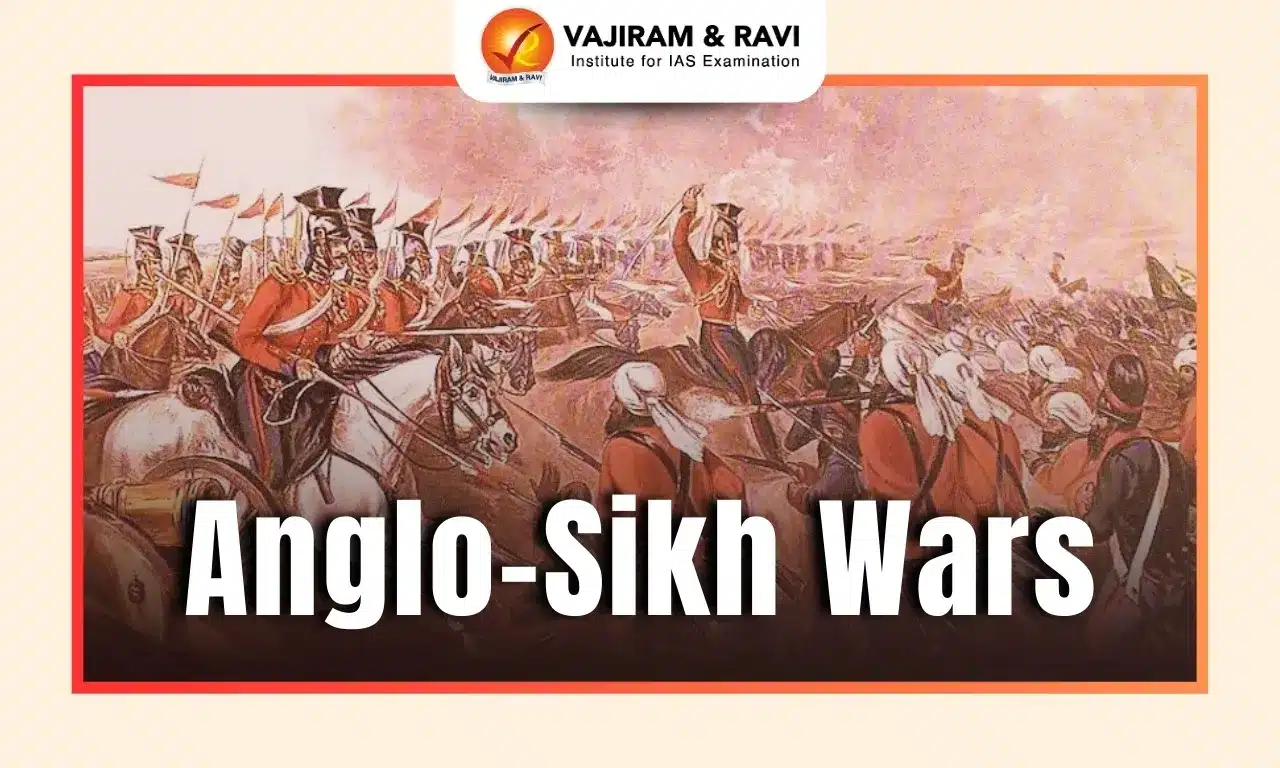
The Anglo-Sikh Wars were two significant battles fought between the Sikh Empire and the British East India Company in the mid-19th century. These wars led to the fall of the Sikh Empire and British control over Punjab. The First Anglo-Sikh War happened in 1845 whereas the Second Anglo-Sikh War in 1848. The fall of the Sikh Empire marked the end of one of the last major independent Indian states before the Revolt of 1857.
Anglo-Sikh Wars
In the early 19th century, the British East India Company aimed to extend its dominance over Punjab, a region governed by the Sikh Empire under Maharaja Ranjit Singh. However, after Ranjit Singh’s death in 1839, internal conflicts and political instability weakened the empire. Utilising this opportunity, the Britishers increased their influence, escalating tensions that eventually led to open conflict. The Anglo-Sikh Wars, fought between 1845-1849, resulted in British control over the Sikh Empire, reshaping the political landscape of the region.
First Anglo-Sikh War
In the between 1845-1846, Maharaja Ranjit Singh expanded and consolidated the Sikh kingdom of Punjab, creating a powerful buffer state as British-controlled territories steadily advanced toward Punjab’s frontiers. To maintain balance, he pursued a cautious alliance with the British, even ceding territories south of the Sutlej River.
Ranjit Singh modernized his army by including Hindu and Muslim contingents and employing European and American officers to train Sikh forces on modern lines. While the British viewed this with suspicion, the deeper causes of conflict were more complex.
First Anglo-Sikh War Course
The British began with around 20,000-30,000 soldiers, while the Sikh army, under Lal Singh and Teja Singh, fielded nearly 50,000 troops. Despite their numerical advantage, the treachery of Lal Singh and Teja Singh weakened Sikh resistance. Major Battles includes:
- Battle of Mudki (18 December 1845): The British won despite strong Sikh resistance.
- Battle of Ferozeshah (21-22 December 1845): A battle where the British barely managed to secure victory.
- Battle of Baddowal ( 21 January 1846):Ranjodh Singh Majithia led the battle and burned a portion of British cantonment.
- Battle of Aliwal (28 January 1846): The British gained the upper hand by defeating the Sikh army.
- Battle of Sobraon (10 February 1846): This decisive battle led to the end of the First Anglo-Sikh War.
First Anglo-Sikh War Treaty
- Treaty of Lahore (8 March 1846): The First Anglo-Sikh War concluded with the Treaty of Lahore, which imposed humiliating terms on the Sikhs. The strength of the Sikh army was reduced, and political control shifted to the British. Maharaja Duleep Singh was proclaimed ruler, with Rani Jindan as regent and Lal Singh as wazir. Since the Sikhs could not pay the full war indemnity, Kashmir (including Jammu) was transferred to Gulab Singh, who agreed to pay the Company ₹75 lakhs.
- Treaty of Amritsar (16 March 1846): A follow-up treaty formally ceded Kashmir to Gulab Singh, establishing him as the independent ruler of Jammu and Kashmir.
- Treaty of Bhairowal (December 1846): Dissatisfaction over the Kashmir settlement led to Sikh unrest. The Treaty of Bhairowal removed Rani Jindan from the regency. A Council of Regency, composed of eight Sikh sardars, was set up to govern Punjab under the supervision of Henry Lawrence, the British Resident
Second Anglo-Sikh War
Rising tensions between the British and the Sikhs following the Treaty of Lahore led to the Second Anglo-Sikh War in 1848. The treaty had significantly weakened the Sikh Empire by territorial losses and a weakened Sikh military. This led to uprisings in regions like Multan and Hazara, where the killing of two British officers escalated tensions into a full-scale conflict.
Second Anglo-Sikh War Course
Lord Dalhousie personally supervised the campaign in Punjab. The war was marked by three major battles that decided the fate of the Sikh kingdom:
- Battle of Ramnagar (22 November 1848): The first clash took place at Ramnagar under Sir Hugh Gough, the British commander-in-chief. The battle ended inconclusively, with neither side gaining a decisive advantage.
- Battle of Chillianwala (13 January 1849): The second major engagement occurred at Chillianwala. It was one of the bloodiest encounters of the Anglo-Sikh wars, with heavy losses on both sides. Although the British claimed success, the outcome was far from clear, and the Sikhs fought with great determination.
- Battle of Gujarat (21 February 1849): The battle was fought near Gujarat, close to the Chenab River. The Sikh army suffered a crushing defeat. Their Afghan allies were expelled from India, and the Sikh resistance collapsed soon after.
Meanwhile, at Multan, the British secured victory after a long siege. Mulraj surrendered in January 1849, marking the end of his rebellion. Following the defeat at Gujarat, Sikh commanders like Sher Singh and Chattar Singh surrendered in March 1849.
Second Anglo-Sikh War Impact
The annexation of Punjab was formally completed in March 1849, following the conclusion of the Second Anglo-Sikh War. Under the terms imposed by Lord Dalhousie, the young Maharaja Duleep Singh, only eleven years old at the time, was deposed and later sent to England on a pension. His mother, Rani Jindan (Jind Kaur), was forcibly separated from him, confined at Firozpur, and stripped of her wealth and allowances.
To administer the newly acquired province, Sir John Lawrence was appointed as the first Chief Commissioner of Punjab. His tenure laid the foundation of British rule in the region, combining military control with administrative reorganisation. In recognition of his role in the conquest, Dalhousie was elevated to the rank of Marquis.
One of the most symbolic spoils of conquest was the Koh-i-Noor diamond, which the British appropriated. Originally part of the Sikh royal treasury, Maharaja Ranjit Singh had expressed in his will that the gem should be donated to the Jagannath Temple in Puri, Odisha. The British ignored this wish and instead claimed the diamond under the Treaty of Lahore (1849), transferring it to the British Crown.
Anglo-Sikh Wars Impact
The Anglo-Sikh Wars significantly shaped India’s history, leaving lasting political and social effects.
- The wars led to the downfall of the Sikh Empire, bringing Punjab under British control.
- The annexation of Punjab further strengthened British dominance in India.
- The British administration introduced new policies, impacting governance, military structure, and society in Punjab.
- The conflicts played a key role in shaping Sikh consciousness and promoting a spirit of resistance.
- The Sikh defeat served as a reminder of colonial oppression, inspiring future uprisings against British rule.
Anglo-Sikh Wars FAQs
Q1: How many Anglo-Sikh wars are there?
Ans: There were two Anglo-Sikh Wars: the First (1845–1846) and the Second (1848–1849), both leading to the British annexation of Punjab and the fall of the Sikh Empire.
Q2: Who won the 2nd Anglo-Sikh war?
Ans: The British East India Company won the Second Anglo-Sikh War (1848–1849), defeating the Sikh forces and annexing Punjab, marking the complete end of Sikh sovereignty in India.
Q3: Who was the bravest Sikh warrior?
Ans: Hari Singh Nalwa (1791–1837), chief commander of the Sikh Khalsa Fauj, is renowned for leading conquests in Kasur, Sialkot, Attock, Multan, Kashmir, Peshawar, and Jamrud.
Q4: Who led First Anglo-Sikh War?
Ans: The First Anglo-Sikh War (1845–1846) was led by Governor-General Sir Henry Hardinge and Sir Hugh Gough for the British, while Lal Singh and Tej Singh led the Sikhs.
Q5: Which Treaty ended the First Anglo-Sikh War?
Ans: The First Anglo-Sikh War concluded with the Treaty of Lahore, signed on March 9, 1846.
