
Deforestation Latest News
- The 30th UN Climate Conference (COP30) in Belem, Brazil, ended with a political agreement, known as the Global Mutirao Agreement, that commits nations to prepare two major roadmaps: one to halt and reverse deforestation, and another to “transition away” from fossil fuels.
- While the forest roadmap received broad support, the final text avoided binding commitments on fossil fuel phase-out, underscoring sharp geopolitical divisions.
Roadmap Focused on Ending Deforestation
- The centrepiece of the conference was a strong political push to address global deforestation.
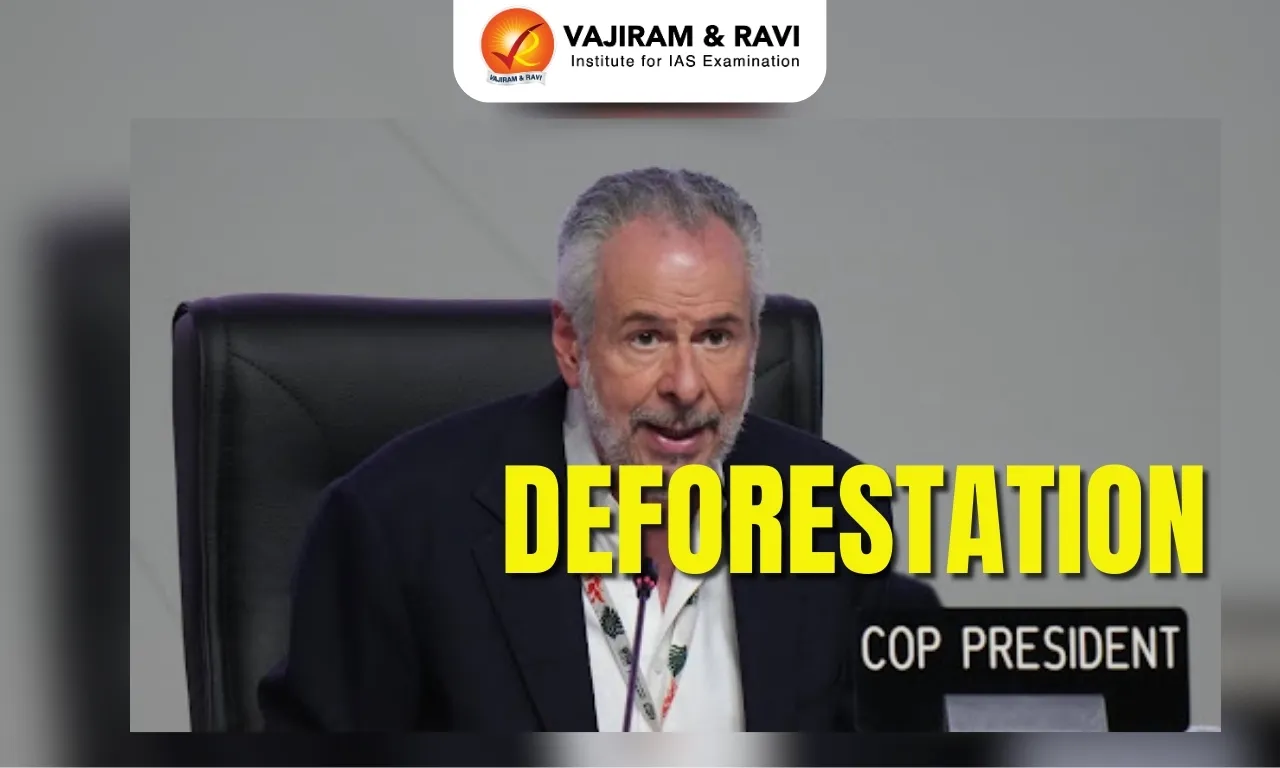
- COP30 President announced a dedicated deforestation roadmap, which countries will develop over the coming year.
- This aligns with host country Brazil’s emphasis that climate action must prioritise forest protection, biodiversity conservation, and indigenous rights.
- The roadmap is expected to mobilise:
- Additional finance for forest conservation,
- Cross-border cooperation to curb illegal logging,
- Long-term strategies for restoring degraded landscapes,
- Support systems for forest and indigenous communities.
- With COP30 held in the heart of the Amazon biome, the emphasis on forest protection carried both symbolic and strategic significance.
Fossil Fuels: The Most Divisive Issue at COP30
- Demands for a Phase-Out
- Over 80 countries, including the EU and small island nations, pushed for explicit language requiring a phase-out of fossil fuels, the world’s largest source of greenhouse gas emissions.
- They sought a clear timeline and measurable commitments.
- Resistance from Developing Nations
- Major developing economies, India, China, Russia, Saudi Arabia, and South Africa, opposed binding phase-out language. Their arguments included:
- National energy needs and development priorities,
- Concerns over inadequate climate finance,
- Rejection of uniform global timelines that disregard domestic realities.
- India and several BRICS members insisted that energy transitions must be nationally determined, not externally imposed.
- Major developing economies, India, China, Russia, Saudi Arabia, and South Africa, opposed binding phase-out language. Their arguments included:
- Outcome: A Non-Binding ‘Transition Away’ Roadmap
-
- As a compromise, COP30 adopted:
- A broad commitment to “transition away from fossil fuels”, but
- No timeline,
- No mandatory reduction pathway, and
- A separate voluntary roadmap, announced by the President, outside the formal COP text.
- This reflects a politically negotiated midpoint, with developing nations effectively shaping the narrative.
- As a compromise, COP30 adopted:
The Emerging Power Shift in Climate Diplomacy
- A COP Without the United States
- For the first time in three decades, the United States did not send an official delegation.
- This absence dramatically changed the negotiation landscape, weakening the bargaining influence of developed countries.
- BRICS’ Ascendance
- In the US vacuum, BRICS countries emerged as a decisive bloc. They influenced:
- The removal of fossil phase-out language,
- The insertion of flexibility for developing nations,
- Greater focus on equity and economic justice,
- Attention to trade-related climate barriers, such as the EU’s Carbon Border Adjustment Mechanism (CBAM).
- This marks a new era in climate governance, one where negotiating power is more distributed and multipolar.
- In the US vacuum, BRICS countries emerged as a decisive bloc. They influenced:
Climate Finance: The Central Fault Line
- Finance remained one of the most contentious issues at COP30.
- A Two-Year Finance Work Programme
- Countries agreed to launch a two-year programme to address global climate finance needs, including:
- Clearer methodologies for estimating finance gaps,
- Strengthening transparency on financial flows,
- Designing mechanisms for predictable and adequate funds.
- Countries agreed to launch a two-year programme to address global climate finance needs, including:
- Adaptation Finance Commitments
-
- COP30 highlighted the severe shortfall in adaptation finance and called for:
- Tripling global adaptation finance by 2035,
- Prioritising support to vulnerable nations.
- COP30 highlighted the severe shortfall in adaptation finance and called for:
- Paris Agreement Article 9.1 Reaffirmed
- Developing countries secured a key recognition:
- Under Article 9.1, developed countries have a mandatory obligation to provide climate finance to developing countries, not voluntary or negotiated.
- This acknowledgement was a major diplomatic win for the Global South.
- Developing countries secured a key recognition:
Other Agreements Adopted Under the Global Mutirao
- COP30 also adopted 10 thematic agreements, covering:
- Technology transfer,
- Loss and damage,
- Global Goal on Adaptation,
- Just energy transition and livelihood protection,
- Implementation and transparency frameworks.
- These agreements will shape negotiations leading to COP31.
Significance of COP30
- COP30 may not have delivered a dramatic breakthrough like a fossil fuel phase-out, but it represents an important political turning point.
- It rebalanced global climate negotiations, giving developing nations a stronger voice.
- It produced a realistic agreement centred on equity, rather than overly ambitious but unattainable targets.
- It reinforced the importance of forests, particularly the Amazon, in stabilising global climate systems.
- It highlighted deep divides on fossil fuels that will dominate future COP discussions.
Deforestation FAQs
Q1: What roadmaps were announced at COP30?
Ans: Roadmaps to halt deforestation and pursue a voluntary fossil fuel transition.
Q2: Why did COP30 not include a fossil fuel phase-out?
Ans: Developing nations opposed binding timelines, citing national circumstances and inadequate finance.
Q3: What is the Global Mutirão agreement?
Ans: A political package addressing finance, adaptation, technology, and cooperation frameworks.
Q4: How did COP30 address climate finance?
Ans: By launching a two-year finance programme and calling for tripling adaptation finance by 2035.
Q5: Why is COP30 geopolitically significant?
Ans: The US absence enabled BRICS nations to shape the outcome, shifting negotiation power balances.

