
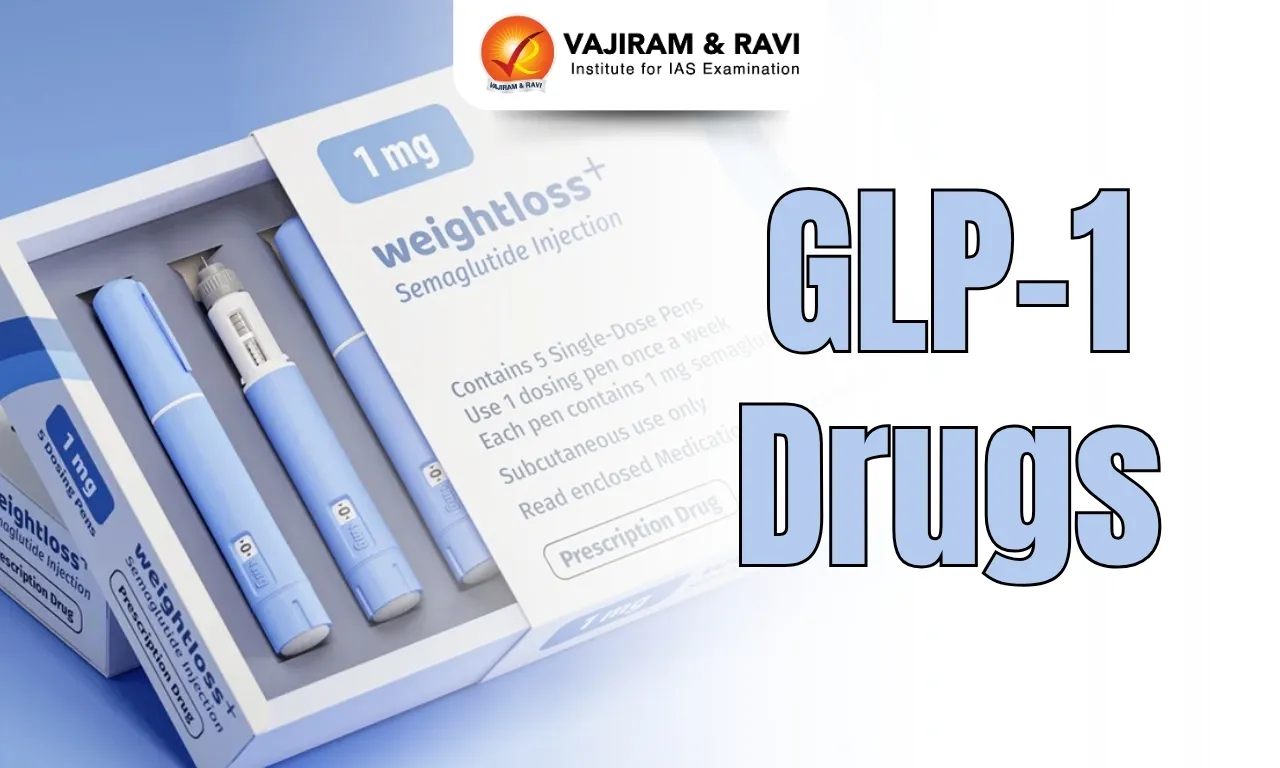
GLP-1 Drugs Latest News
Recently, the World Health Organization has finally issued global guidelines on the use of popular GLP-1 drugs for weight loss.
About GLP-1 Drugs
- The Glucagon-like peptide-1 (GLP-1) or GLP-1 receptor agonists are synthetic drugs which are being used for the treatment of obesity in adults.
- These drugs are mainly injectables, though oral versions are under development.
- Examples: Two leading GLP-1 drugs are: Semaglutide and Tirzepatide (by Eli Lilly)
- Both have been introduced in India and are transforming obesity and diabetes treatment.
How Do GLP-1 Drugs Work?
- These drugs act by:
- Increasing insulin secretion when glucose is high.
- Inhibiting glucagon release, reducing liver glucose output.
- Slowing gastric emptying, preventing sudden spikes in blood sugar.
- Suppressing appetite, making the person feel full sooner.
Key Facts about Glucagon-like peptide-1
- GLP-1 is both an incretin hormone and a neurotransmitter.
- It is a naturally occurring gut hormone (incretin) released after food intake.
- It is secreted from the small intestine and from the hindbrain after we eat a meal.
- It travels to the pancreas, where it helps to regulate our blood sugar by increasing insulin and decreasing glucagon.
- It works for just a few minutes, so after you eat a meal and GLP-1 is secreted naturally, it gives an immediate effect that lasts maybe 30 minutes.
- GLP-1 also has beneficial effects in many organs, such as the kidney, liver, and cardiovascular system.
Source: TH
GLP-1 Drugs FAQs
Q1: What is the primary use of GLP-1 drugs?
Ans: To manage type-2 diabetes and obesity
Q2: How do GLP-1 drugs work?
Ans: It works by suppressing glucagon and slowing stomach emptying.
