Judiciary Flags Major Lapses in Critical Care for Acid Attack Survivors

Acid Attack

Acid Attack Latest News

  • The Supreme Court has raised serious concerns over continued delays in victim compensation and non-compliance by private hospitals in offering free critical treatment to acid attack survivors, despite judicial orders issued more than a decade ago. 

Judicial Intervention in Acid Attack Cases

  • Acid attacks in India have long prompted judicial attention due to their devastating physical, psychological, and economic impact on survivors, many of whom are young women. 
  • The Supreme Court initiated sustained oversight beginning in 2006, following the horrific case of Laxmi, who was attacked at the age of 15. 
  • In subsequent years, the Court issued landmark directives:
    • Minimum Rs. 3 lakh compensation for survivors, with Rs. 1 lakh to be paid within 15 days of the incident.
    • Free and immediate medical treatment in private hospitals, including medicines, food, and specialised care.
    • Ban on the over-the-counter sale of acid to curb misuse.
    • Designation of District Legal Services Authorities (DLSA) as criminal injuries compensation boards to streamline claims.
  • Despite these orders, survivors continue to face procedural delays and denial of essential services.

Current Supreme Court Proceedings

  • The present plea before the Supreme Court, filed by the Acid Survivors Saahas Foundation, argues that many survivors have either not received full compensation or were denied free critical care by private hospitals. 
  • The Bench acknowledged that these issues persisted despite “repeated judicial orders spanning years.” 
  • During the hearing, significant revelations came to light:
    • Victims in several States, including Maharashtra and Uttar Pradesh, received only the initial Rs. 1 lakh payout, with no support for expensive reconstructive surgeries.
    • Private hospitals, in violation of Supreme Court directives, demanded full payment up front before admitting survivors.
    • Incomplete compliance reports were being furnished, often listing aggregated payments rather than victim-wise details.
    • As many as eight States and five Union Territories had not yet filed their affidavits explaining compensation delays.
  • This prompted the Bench to emphasise the urgent need for system-wide accountability.

Supreme Court’s Directions to Authorities

  • Strengthening Financial Accountability
    • The Bench ordered State Chief Secretaries to personally ensure that funds flow promptly from State governments to State Legal Services Authorities, and then onward to district bodies, enabling final payment to survivors. 
    • It also highlighted the need for updated compensation amounts, recognising that the earlier fixed sum of Rs. 3 lakh is insufficient given rising medical costs and the need for multiple reconstructive surgeries.
  • Ensuring Compliance by Private Hospitals
    • Principal Health Secretaries in States and UTs have been directed to ensure that private hospitals cannot deny free treatment, including critical and emergency care. 
    • Any refusal would amount to a violation of Supreme Court orders and can attract criminal liability.
  • Demand for Detailed Data from NALSA
    • NALSA informed the Court that approximately Rs. 484 crore had been disbursed as compensation between March 2024 and April 2025, but agreed to furnish a detailed report on State-wise and victim-wise distribution. 
  • Maintaining Transparent Records
    • Names of victims
    • Date of compensation applications
    • Date of actual payment
    • Remarks on delays or pending claims

Implications for Victim Rights and Governance

  • The Supreme Court’s renewed push marks a critical attempt to ensure States honour their obligations toward one of the most marginalised groups. 
  • Acid attack survivors often face lifelong trauma, disfigurement, disability, and stigma, making immediate medical intervention and financial support indispensable.
  • By directing personal accountability at the highest administrative levels and demanding data transparency from NALSA, the Court is reinforcing a rights-based framework where compensation and healthcare access are guaranteed entitlements, not discretionary support.

Source: TH | ETV

Acid Attack FAQs

Q1: What compensation amount is mandated for acid attack survivors?

Ans: A minimum of Rs. 3 lakh, with Rs. 1 lakh payable within 15 days of the incident.

Q2: Who is responsible for processing compensation claims?

Ans: District Legal Services Authorities (DLSA) function as criminal injuries compensation boards.

Q3: Are private hospitals required to treat acid attack survivors for free?

Ans: Yes, they must provide free emergency and critical care as directed by the Supreme Court.

Q4: What concerns did the Supreme Court raise in the recent hearing?

Ans: Delays in compensation, partial payments, and private hospitals refusing free treatment.

Q5: What data has the Court asked NALSA to submit?

Ans: State-wise details of compensation disbursed, pending payments, and compliance records.
Rupee at 90 Per Dollar: Why the Fall Happened and What It Means for India

Rupee at 90 Per Dollar

Rupee at 90 Per Dollar Latest News

  • India’s rupee fell below the crucial ₹90-per-dollar mark, unsettling financial markets and raising broader macroeconomic concerns. The currency has now weakened over 5% this year.
  • Analysts say the rupee’s movement reflects both domestic and global pressures, including a strong US dollar and delays in the first tranche of the India–US trade agreement.

Rupee Breaches the 90-Per-Dollar Mark

  • The rupee slipped below the psychologically crucial ₹90-per-dollar level, unsettling markets and intensifying concerns over India’s macroeconomic outlook. 
    • The ₹90 mark is a critical psychological threshold for the rupee. Once breached, it can trigger buy-stop orders and fuel sharper depreciation, pushing the currency toward ₹91 or beyond.
  • The currency has fallen over 5% this year, and the breach reflects a cumulative build-up of pressures, not a single shock.

Strong Domestic Fundamentals Haven’t Stopped the Slide

  • India’s macro indicators appear supportive:
    • Crude oil prices have eased
    • Inflation has dropped below 1%
    • GDP growth hit 8.2% in Q2
  • Yet the rupee continues to face sustained downward pressure, revealing a disconnect between strong domestic fundamentals and the currency trend.

Foreign Outflows and Trade Deal Uncertainty Weigh on Sentiment

  • Persistent foreign portfolio investor (FPI) outflows, driven by profit booking and shifts to other markets, have drained liquidity and raised demand for the US dollar.
  • Meanwhile, delays in concluding the India–US trade deal have heightened uncertainty about future trade flows, tariff competitiveness, and the balance-of-payments outlook, dampening market confidence.
  • Exports remain under pressure, while a surge in gold imports during the festive season has amplified dollar demand. 

India’s Trade Deficit Shows Signs of Widening

  • India’s external sector is under growing pressure as early indicators point to a widening trade deficit — a situation where imports exceed exports, increasing demand for dollars and weakening the rupee.
  • India’s merchandise exports fell 11.8% year-on-year in October 2025, dropping to an 11-month low of $34.4 billion. The decline was driven by:
    • Lower shipments to the US, a major export market
    • Higher US tariffs
    • A high base from strong export growth in 2024
  • In contrast, imports surged 16.6% year-on-year to a record $76.1 billion in October 2025. 

Why the Trade Gap Is Widening

  • The widening deficit is being shaped by:
    • Softening demand from major export markets
    • Strong domestic demand for imported goods
    • Unfavourable tariff conditions, especially with the US
    • Weak export competitiveness across major sectors

Gold’s Role in Widening the Trade Deficit

  • The biggest contributor was gold imports, which tripled to $14.7 billion amid festive-season demand.
  • Surging gold prices and massive import volumes have become a key force shaping India’s trade dynamics.
  • They have intensified pressure on the rupee, contributed to a widening trade deficit, and added stress to the overall balance of payments outlook.

Implications for the Rupee and Economy

  • If these trends continue, India’s trade deficit is likely to worsen, putting additional pressure on the rupee, widening the balance-of-payments gap, and intensifying broader macroeconomic challenges.

Uncertainty Over India–US Trade Deal Adds Pressure on the Rupee

  • Markets are increasingly worried as the long-awaited India–US trade agreement remains unresolved. 
  • Without a deal, analysts say, the rupee may act as a “pressure valve,” gradually weakening to offset tariff disadvantages faced by Indian exporters.
  • Until a clear announcement is made, markets are likely to price in the uncertainty—with the rupee reflecting it most visibly.

Foreign Investors Continue to Pull Out of Indian Markets

  • India’s equity markets have underperformed for over a year, prompting foreign portfolio investors (FPIs) to steadily withdraw funds. 
  • Since January 2025, FPIs have pulled out ₹1.48 lakh crore, exerting consistent downward pressure on the rupee.

Why FPIs Are Selling Despite Strong Macro Indicators

  • Although India’s macroeconomic backdrop appears stable, stock market performance tells a different story.
  • Over the past year, India has been one of the weakest performers among major global markets.
  • Despite occasional record highs, returns have significantly lagged those in faster-growing international markets.
  • As a result, investors have increasingly treated India as a liquidity source, redirecting capital to more profitable regions.

RBI Allowing the Rupee to Weaken

  • There is growing debate over whether the RBI is intentionally letting the rupee depreciate.
  • Many economists argue the central bank is not pushing the rupee down, but simply responding to global shifts and India’s current macroeconomic dynamics.
  • They note that RBI has been selling dollars only to curb volatility, not to target a specific exchange rate.

Behavioural Factors Driving Sentiment

  • According to experts:
    • Importers are buying dollars aggressively
    • Exporters are holding back, waiting for better rates
    • The dollar index is below 100, which should normally support the rupee
  • They note that RBI’s relative silence, combined with IMF criticism of the rupee’s movement, is fueling negative sentiment.

RBI’s Soft-Touch Strategy

  • RBI appears to be conserving firepower:
    • Its forward book is already substantially drawn down, including in offshore NDF markets
    • It is using a measured approach, intervening only to prevent disorderly volatility, not to defend a specific level
  • This suggests a deliberate balancing act:
    • Allowing the rupee to find its market-determined level, while remaining poised to step in if the slide becomes excessively disruptive.

Source: IE | ToI

Rupee at 90 Per Dollar FAQs

Q1: Why did the rupee breach the ₹90-per-dollar level?

Ans: A convergence of pressures—FPI outflows, trade deficit widening, gold import surge, and delayed India–US trade deal—pushed the rupee below the key psychological threshold.

Q2: Why is ₹90 a crucial psychological level?

Ans: Breaching ₹90 can trigger buy-stop orders, fuel speculative bets, and accelerate depreciation toward ₹91 unless the RBI steps in to manage volatility effectively.

Q3: How is India’s trade deficit affecting the rupee?

Ans: Exports fell 11.8% in October 2025 while imports surged 16.6%, especially gold. Rising import bills and weak export competitiveness increase dollar demand and weaken the rupee.

Q4: How are foreign investors impacting the rupee?

Ans: FPIs withdrew ₹1.48 lakh crore in 2025 as India underperformed global markets. Persistent outflows reduced liquidity and placed sustained pressure on the currency.

Q5: Is the RBI allowing the rupee to weaken?

Ans: RBI is intervening minimally, smoothing volatility rather than defending a rate. Analysts say it’s conserving reserves and allowing a market-driven depreciation unless disorderly.

Putin’s India Visit 2025: How India–Russia Ties Are Evolving Amid Global Pressures

India–Russia Ties

India–Russia Ties Latest News

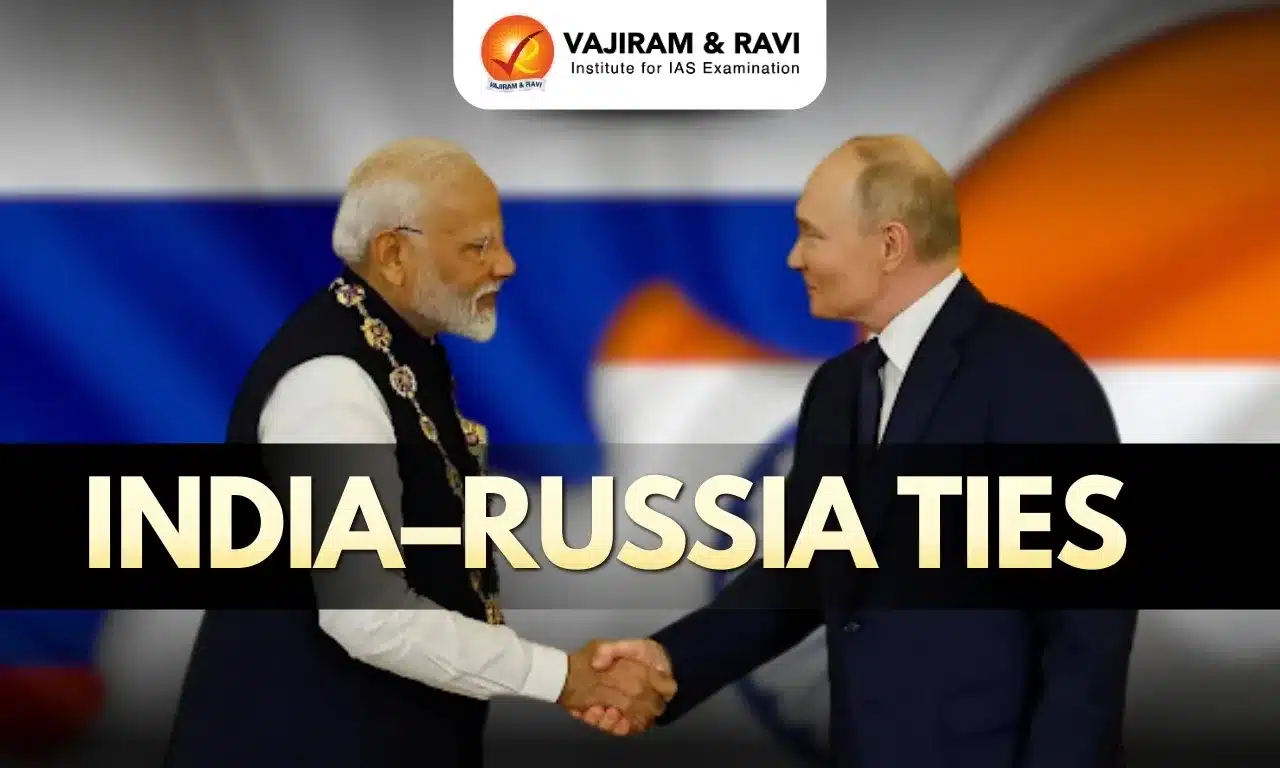
  • India is preparing to host President Vladimir Putin for a two-day visit, even as it faces punitive U.S. tariffs over its imports of Russian oil. 
  • President Putin is visiting India to attend 23rd India–Russia annual summit.
  • The visit underscores New Delhi’s intent to deepen ties with Moscow. Analysts say India views Russia as a crucial partner at a time when the U.S. appears unreliable and China increasingly hostile.

Putin’s India Visits: Then and Now

  • When Putin first visited India in October 2000, both countries were navigating turbulent times:
    • Putin was newly elected President.
    • India was under Western sanctions for Pokhran-II.
    • Russia was weakened after the Soviet collapse.
    • The U.S. dominated a unipolar world.
    • India–Pakistan tensions were high after Kargil and IC-814 hijack.
    • The visit came just months before the Red Fort attack (Dec 2000).
    • India and Russia were both struggling, albeit for different reasons.

Putin’s 2025 Visit: Striking Parallels, Changed Realities

  • Putin’s upcoming visit (on December 4–5, 2025) — the 23rd annual summit — is his first since the Ukraine invasion (2022).
  • Today:
    • Russia faces sweeping Western sanctions.
    • India faces secondary U.S. sanctions and steep tariffs on Russian oil purchases.
    • India–Pakistan tensions have resurfaced after May 2025 clashes.
    • Delhi again saw a blast near the Red Fort.
  • Despite the parallels, both nations hold stronger positions than 25 years ago.

India’s Evolving Global Alignments

  • In the past two decades, India has significantly expanded ties with the West:
    • Deep security and defence cooperation
    • Strong economic partnerships
    • Growing people-to-people engagement
    • Strategic alignment with the U.S. on the Indo-Pacific
  • At the same time, India has retained its defence partnership with Russia, a Soviet-era legacy, while gradually diversifying to other technology providers.

Russia’s Changing Global Role

  • Russia is now more isolated due to the Ukraine war but remains strategically important for India:
    • Defence cooperation
    • Energy supplies
    • Diplomatic alignment on some geopolitical issues
  • Both countries, though facing external pressure, continue to pursue a relationship shaped by mutual strategic interests.

India’s Defence Dependence on Russia: Shrinking but Still Significant

  • India has diversified its defence imports, but around 60% of its military equipment remains of Russian origin, requiring ongoing spares and maintenance.
  • Key systems like the S-400 air defence system illustrate this reliance: Russia has delivered 3 of 5 batteries, and India now wants five more.
  • However, the Ukraine war and Western sanctions have slowed Russia’s ability to supply equipment on time. 
  • While European analysts say sanctions have weakened Russia’s capacity to produce advanced systems, Moscow disputes this claim.

India–Russia Oil Trade: From Discount Bonanza to Sanctions Pressure

  • After the Ukraine war began, India bought discounted Russian oil, helping keep domestic fuel prices stable. 
  • This pushed bilateral trade to a record $68.7 billion in FY 2024–25, but the balance is heavily one-sided — India exported just $4.9 billion, while imports, mostly oil, were $63.8 billion.
  • Both countries had set a $100-billion trade target by 2030, but that goal is now uncertain.
  • With U.S. tariffs, secondary sanctions from the U.S. and Europe, and shrinking cost advantages, Indian refiners are expected to cut Russian oil purchases. 
  • This shift jeopardizes the trade target and places India in a strategic bind between energy security and geopolitical pressures.

What to Expect from Putin’s India Visit

  • Putin’s visit to Delhi will be closely watched as India faces growing U.S. and European pressure over its ties with Russia. 
  • The trip will feature high optics — a private dinner, state banquet, bilateral talks, and a CEOs’ address — echoing the warm public gestures seen earlier between Modi and Putin.
  • Substantive outcomes are expected, including:
    • Progress on a labour mobility pact
    • Movement on a trade deal with the Eurasian Economic Union
    • Potential new defence purchases, including additional S-400 systems and the latest Sukhoi aircraft
    • Expanded market access for Indian goods, from perishables to pharmaceuticals
  • Overall, the visit is expected to reinforce strategic cooperation even as geopolitical pressures intensify.

India’s Strategic Balancing Between the West and Russia

  • India seeks deeper ties with the US and Europe for technology, investment, and ambitious trade agreements. 
  • Yet Russia remains indispensable for long-term defence needs.
  • Delhi is also wary of Russia’s “no-limits” partnership with China, especially with 50,000 Indian troops deployed along the tense India–China border. 
  • Maintaining a careful equilibrium between these major powers remains India’s core strategic challenge.

Source: IE | CNBC

India–Russia Ties FAQs

Q1: Why is Putin’s 2025 visit to India significant?

Ans: Putin’s visit comes amid U.S. tariffs on India and sanctions on Russia, underscoring India’s intent to deepen strategic ties despite geopolitical pressure from the West.

Q2: How have India–Russia ties changed since Putin’s first visit in 2000?

Ans: Both countries were weaker in 2000; today India has stronger Western ties while maintaining defence links with Russia, and both face sanctions-driven external pressure.

Q3: How dependent is India on Russian defence equipment?

Ans: Around 60% of India’s military platforms remain Russian-made, including the S-400 system. Deliveries have slowed due to the Ukraine war and sanctions impacting Russian capacity.

Q4: What is the status of India–Russia oil trade?

Ans: Trade hit $68.7 billion, driven by discounted Russian oil. But U.S. tariffs and secondary sanctions reduce incentives, threatening the $100-billion trade target for 2030.

Q5: What outcomes are expected from Putin’s India visit?

Ans: Likely outcomes include progress on labour mobility, Eurasian trade talks, new defence deals, and expanded Russian market access for Indian perishables and pharmaceuticals.

Enquire Now