Assam Accord

Assam Accord

Assam Accord Latest News

The Supreme Court recently asked the Centre if a new order allowing persecuted minorities entry to India violates the Assam Accord's 1971 deadline.

About Assam Accord

  • The Assam Accord was signed on 15th August, 1985, amongst the Union of India, the Govt. of Assam, the All Assam Students' Union (AASU), and the All Assam Gana Sangram Parishad. 
  • The signing of the Accord brought an end to the 6-year-long agitation, the Assam Movement (1979-1985), aimed at dispelling foreigners from the state of Assam. 
  • The aim of the accord was to detect and deport all immigrants in the state who had come to the territory post-24 March 1971.

Main Provisions of Assam Accord

  • It determined 1st January 1966 as the cut-off date for the purpose of detection and deletion of foreigners.
  • It allowed for citizenship for all persons coming to Assam from “Specified Territory” before the cut-off date. 
  • It further specifies that all persons who came to Assam prior to 1st January 1966 (inclusive) and up to 24th March 1971 (midnight) shall be detected in accordance with the provisions of the Foreigners Act, 1946, and the Foreigners (Tribunals) Order, 1939. 
    • The names of foreigners so detected will be deleted from the Electoral Rolls in force.
    • Such persons will be required to register themselves before the Registration Officers of the respective districts in accordance with the provisions of the Registration of Foreigners Act, 1939, and the Registration of Foreigners Rules, 1939. 
    • The Assam Accord does not call for their deportation, but they were to get voting rights only after expiry of 10 years from the date of their detection or declaration as foreigner.
  • Foreigners who came to Assam on or after 25th March 1971 shall continue to be detected, deleted, and expelled in accordance with law.
  • Clause 6:
    • It promises to provide constitutional, legislative, and administrative safeguards to protect, preserve, and promote the cultural, social, and linguistic identity, and heritage of the Assamese people.
    • These safeguards aim to address concerns regarding the state’s demographic and cultural integrity amidst the influx of migrants.

Source: HT

Assam Accord FAQs

Q1: When was the Assam Accord signed?

Ans: 15th August 1985.

Q2: Which groups were parties to the Assam Accord?

Ans: Union of India, the Govt. of Assam, the All Assam Students' Union (AASU), and the All Assam Gana Sangram Parishad.

Q3: What was the primary aim of the Assam Movement?

Ans: To detect and expel foreigners from Assam.

Q4: What is the cut-off date mentioned in the Accord for the detection of illegal immigrants?

Ans: 24th March 1971.

Tensor Processing Unit (TPU)

Tensor Processing Unit (TPU)

Tensor Processing Unit Latest News

According to reports, Meta is in advanced talks with Google to use its Tensor Processing Units (TPUs).

About Tensor Processing Unit

  • A TPU is a specialized chip designed to accelerate AI and machine learning (ML) tasks. 
  • Unlike traditional computer processors (CPUs) or graphics processing units (GPUs), TPUs are specifically built to handle the complex calculations required for deep learning models.
  • TPUs were developed by Google in 2016 to improve the performance of their AI applications, such as Google Search, Google Translate, and Google Photos. 
  • Since then, TPUs have become a key component in AI infrastructure and are widely used in data centers and cloud computing.
  • How Do TPUs Work?
    • AI models rely on a type of mathematical operation called tensor computation. 
    • A tensor is a multi-dimensional array of numbers, similar to a table of data. 
    • Deep learning models use these tensors to process large amounts of information and make predictions.
    • TPUs are optimized for tensor computations, allowing them to process large datasets much faster than CPUs or GPUs. 
    • They achieve this through:
      • Massive parallelism: TPUs can perform many calculations at once, making them highly efficient.
      • Low power consumption: Compared to GPUs, TPUs use less energy while delivering high performance.
      • Specialized circuits: TPUs have circuits specifically designed for AI workloads, reducing the need for unnecessary computations.
  • While CPUs are great for general tasks and GPUs are an excellent choice for gaming and AI, TPUs are specifically designed to make AI models work faster and more efficiently.

Source: MSN

Tensor Processing Unit FAQs

Q1: What is a Tensor Processing Unit (TPU)?

Ans: A TPU is a specialized chip designed to accelerate AI and machine learning (ML) tasks.

Q2: Which company developed TPUs?

Ans: TPUs were developed by Google in 2016.

Q3: What is a tensor in the context of machine learning?

Ans: A tensor is a multi-dimensional array of numbers, similar to a table of data.

Q4: How are Tensor Processing Units (TPUs) different from CPUs and GPUs?

Ans: TPUs are specifically built to handle the complex calculations required for deep learning models.

World Soil Day 2025

World Soil Day 2025

World Soil Day Latest News

World Soil Day 2025 underscores the urgent need to restore and protect soil health as cities expand and environmental threats intensify.

About World Soil Day

  • It is held annually on 5 December as a means to focus attention on the importance of healthy soil and to advocate for the sustainable management of soil resources.
  • History:
    • The idea of dedicating a day to soil conservation first emerged in 2002, when the International Union of Soil Sciences proposed the observance to create global awareness. 
    • With support from the Food and Agriculture Organisation (FAO) and guidance from the Kingdom of Thailand, the initiative gained momentum. 
    • In 2013, the United Nations General Assembly officially declared December 5 as World Soil Day, with the first celebration held in 2014.
  • WSD 2025 Theme: It carries the theme “Healthy Soils for Healthy Cities,” shifting attention from rural farmlands to the often-overlooked soil beneath urban landscapes.

Source: HANS

World Soil Day 2025 FAQs

Q1: World Soil Day is observed every year on which date?

Ans: 5 December

Q2: In which year did the UN General Assembly officially declare 5 December as World Soil Day?

Ans: 2013

Q3: What is the theme of World Soil Day 2025?

Ans: Healthy Soils for Healthy Cities

ICGS Vigraha

ICGS Vigraha

ICGS Vigraha Latest News

Recently, Indian Coast Guard Ship (ICGS) Vigraha undertook an operational visit to Indonesia as part of its overseas deployment to ASEAN countries.

About ICGS Vigraha

  • It is the Offshore Patrol Vessels of the Indian Coast Guard which is commissioned in  2021.
  • It is indigenously built by L&T Ship Building Limited.
  • It is based in Visakhapatnam & operates on the eastern seaboard.

Features of ICGS Vigraha

  • It is designed to carry one twin-engine Helicopter & four high speed boats.
  • Displacement Capacity: The ship displaces approx. 2200 tons (GRT).
  • Propulsion: It is propelled by two 9100 KW diesel engines.
  • Speed: 26 knots with endurance of 5000 nm.
  • Equipment: It is also equipped with Integrated Bridge System (IBS), Integrated Platform Management System (IPMS), Automated Power Management System (APMS) and High-Power External Firefighting (EFF) system.
  • It is fitted with advanced technology Radars, Navigation and Communication Equipment, Sensor and Machinery capable of operating in tropical sea conditions.
  • It is exclusively deployed for Exclusive Economic Zone (EEZ) surveillance, maritime law enforcement, and search and rescue operations.

Source: PIB

ICGS Vigraha FAQs

Q1: What is ICGS Vigraha?

Ans: An offshore patrol vessel of the Indian Coast Guard.

Q2: When was ICGS Vigraha commissioned?

Ans: In the year 2021 it was commissioned.

Horn-Eyed Ghost Crab

Horn-Eyed Ghost Crab

Horn-Eyed Ghost Crab Latest News

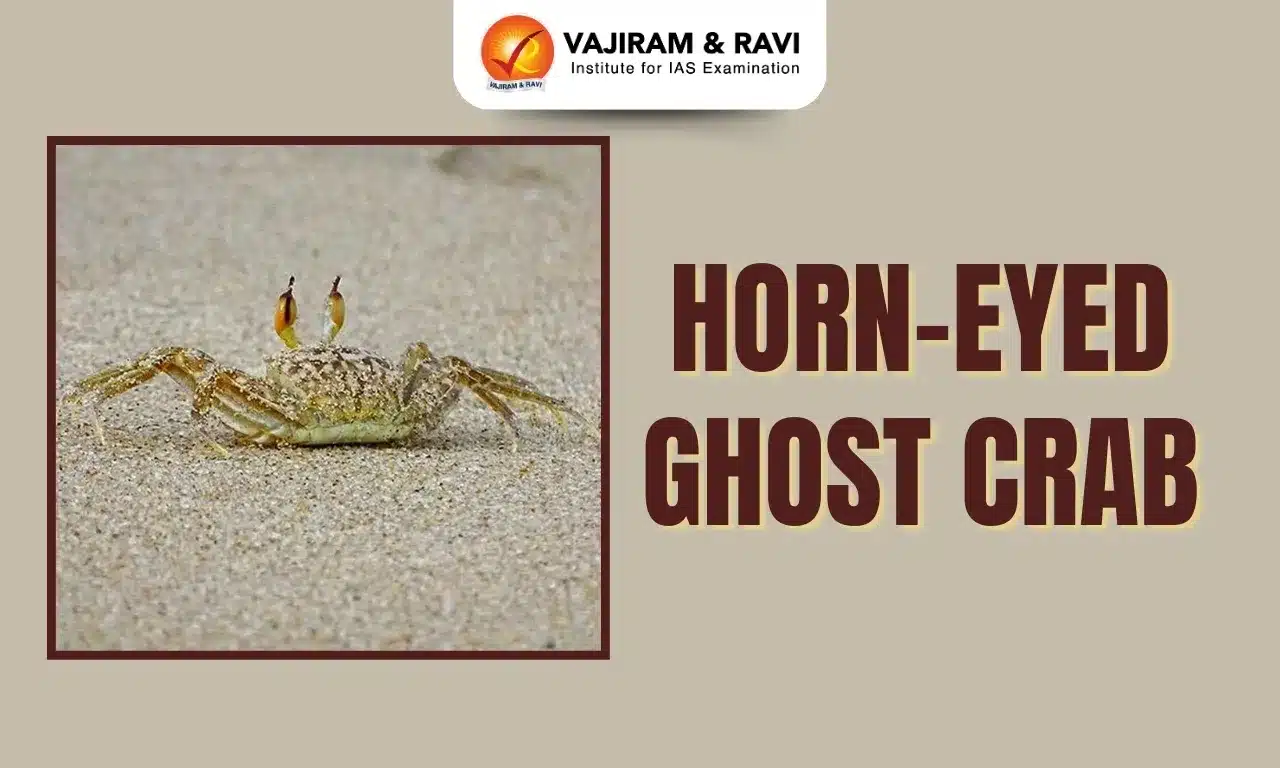
Recently, researchers documented unique predatory behaviour of horn-eyed ghost crab at Rushikonda Beach.

About Horn-Eyed Ghost Crab

  • It belongs to the genus Ocypode.
  • Their pale bodies blend seamlessly with the sand, and combined with their swift movements during dawn and dusk, this has led to their common name, "ghost crabs".
  • It is widely regarded as a keystone species and indicator of coastal health.
  • Six species of ghost crabs have been reported along the Indian coastline.
  • Habitat: It is usually found in the intertidal zones.
  • Distribution:  It lives in the Indo-Pacific region (except the Red Sea); from the coast of East Africa to the Philippines and from Japan to the Great Barrier Reef.
  • Threats: Pollution, changes in sediment distribution, rising sea temperatures and altered tidal patterns may prompt species to explore new microhabitats in search of food.

Characteristics of Horn-Eyed Ghost Crab

  • It has traditionally been described as a scavenger within the intertidal food web.
  • Diet: They hunt clams, snails, worms, isopods, shrimps and a variety of insects. They also prey on other crabs, including smaller hermit crabs.

Ecological Role of Horn-Eyed Ghost Crab

  • It plays a crucial ecological role in sandy intertidal environments. 
  • They influence the distribution and abundance of smaller organisms through their feeding habits and the deep burrows they build. 

Source: TH

Horn-Eyed Ghost Crab FAQs

Q1: What is the scientific name of the Horn-eyed Ghost Crab?

Ans: Ocypode ceratophthalma

Q2: What is the habitat of the Horn-eyed Ghost Crab?

Ans: Intertidal zones of sandy beaches

Digital Hub for Reference and Unique Virtual Address

Digital Hub for Reference and Unique Virtual Address

Digital Hub for Reference and Unique Virtual Address (DHRUVA) Latest News

The Department of Posts recently released a draft amendment to the Post Office Act, 2023, aimed at introducing an interoperable, standardised, and user-centric addressing system called the Digital Hub for Reference and Unique Virtual Address, or DHRUVA.

About Digital Hub for Reference and Unique Virtual Address (DHRUVA)

  • Developed by the Department of Posts, DHRUVA sets the foundation for a nationwide Digital Address Digital Public Infrastructure (DPI).
  • It envisions a standardized, interoperable, and geocoded digital addressing system that supports secure, consent-based, and seamless sharing of address information. 
  • At its core is the concept of Address-as-a-Service (AaaS) — the array of services associated with address data management to support secure and efficient interactions between users, government entities, and private sector organizations.
  • The AaaS Framework Ensures:
    • Interoperability across different address systems used by various sectors.
    • Standardization of address formats and geolocation tagging.
    • Consent-based sharing to empower user control and privacy.
    • Public-private integration for seamless adoption and innovation.
  • By recognizing digital addresses as core infrastructure, akin to Aadhaar and Unified Payments Interface (UPI), DHRUVA sets out to streamline everything from e-governance and online commerce to urban planning and emergency services.
  • The policy also places emphasis on user-centric design, ensuring that citizens have meaningful control over how their address data is used and shared.
  • Citizens will retain full control over their digital address identity, with options to manage access, update details, and share their verified address securely for various use cases. 
  • The DHRUVA platform will also feature multilingual support, mobile-first access, and integration with identity systems like Aadhaar, thereby improving usability and accessibility for all demographics.
  • The DHRUVA policy builds upon the earlier launch of the Digital Postal Index Number (DIGIPIN)—the National Addressing Grid introduced by the Department of Posts. 

Key Facts about DIGIPIN

  • It is an open-source nationwide geo-coded addressing system developed by the Department of Posts in collaboration with IIT Hyderabad and NRSC, ISRO. 
  • It divides India into approx. 4m x 4m grids and assigns each grid a unique 10-character alphanumeric code based on latitude and longitude coordinates.
  • The DIGIPIN system is publicly accessible and supports improvements in emergency response, logistics efficiency, and citizen service delivery.

Source: TH

Digital Hub for Reference and Unique Virtual Address (DHRUVA) FAQs

Q1: Which government department developed the DHRUVA platform?

Ans: Department of Posts

Q2: What national objective does DHRUVA aim to support?

Ans: Creation of a nationwide Digital Address Digital Public Infrastructure (DPI).

Q3: What type of digital system does DHRUVA envision for India?

Ans: A standardized, interoperable, and geocoded digital addressing system.

Q4: What is the core concept behind DHRUVA?

Ans: At its core is the concept of Address-as-a-Service (AaaS).

National Forensic Infrastructure Enhancement Scheme

National Forensic Infrastructure Enhancement Scheme

National Forensic Infrastructure Enhancement Scheme Latest News

Recently, the Minister of State in the Ministry of Home Affairs informed the Rajya Sabha about the National Forensic Infrastructure Enhancement Scheme.

About National Forensic Infrastructure Enhancement Scheme

  • It is a Central Sector Scheme launched in 2024.
  • Aim: The aim of the scheme is to help create a sound forensic laboratory infrastructure and prepare world class trained forensic professionals in the country.
  • Nodal Ministry: Ministry of Home Affairs.
  • Implementation Period: 2024–25 to 2028–29.

Components of National Forensic Infrastructure Enhancement Scheme

  • Establishment of campuses of the National Forensic Sciences University (NFSU) in the country.
  • Establishment of Central Forensic Science Laboratories (CFSLs) in the country.
  • Enhancement of existing infrastructure of the Delhi Campus of the NFSU.

What is the NFIES?

  • With the enactment of the New Criminal Laws, which mandates forensic investigation for offences involving punishment of 7 years or more, there is significant increase in workload.
  • An increase in the workload of forensic science laboratories is expected.
  • To address the significant shortage of trained forensic manpower in the Forensic Science Laboratories (FSL) in the country.
  • To alleviate the case load / pendency of forensic laboratories, and align with the Government of India’s goal of securing a high conviction rate of more than 90%.

Source: PIB

National Forensic Infrastructure Enhancement Scheme FAQs

Q1: What is the primary objective of NFIES?

Ans: To improve forensic infrastructure

Q2: What is the component of NFIES?

Ans: Establishment of NFSU campuses and CFSLs and training of forensic professionals.

Key Facts about Thailand

Key Facts about Thailand

Thailand Latest News

Recently, Thailand has formally expressed its ambition to join BRICS and is seeking India’s backing ahead of New Delhi’s chairmanship of the grouping in 2026.

About Thailand

  • Location: Thailand is located in the center of mainland Southeast Asia.
  • Bordering Countries:  It shares boundaries with Myanmar (North West), Laos (North Easst), Cambodia (East), and Malaysia (South).
  • Maritime boundary: Bordered by Andaman Sea (SW) and Gulf of Thailand (S)
  • Capital City: Bangkok

Geographical Features of Thailand

  • Highest Peak: Doi Inthanon (Approx. 2,565 m)
  • Plateau: Khorat Plateau in the northeast region which is a vast tableland bounded by the Mekong River on the north and east.
  • Major Rivers: Chao Phraya River and Mekong River (Forms a natural border with Laos)
  • Climate: It is influenced by Southwest and Northeast Monsoons
    • The Tropical Wet and Dry (Savanna) Climate (Köppen’s classification) dominates most areas.
    • Tropical Monsoon Climate in the south and east; some areas also have a Tropical Rainforest Climate.
  • Natural Resources: Rubber, Rice, Tin, Natural Gas, Timber, Tungsten, Tantalum
  • Thailand is a leading global exporter of rubber, fruits, vegetables, and rice.

Source: WION

Thailand FAQ's

Q1: What is the capital of Thailand?

Ans: Bangkok

Q2: What is the official language of Thailand?

Ans: Thai

Exercise Garuda Shakti

Exercise Garuda Shakti

Exercise Garuda Shakti Latest News

Recently, the 10th edition of the Exercise GARUDA SHAKTI has commenced at the Special Forces Training School, Bakloh, Himachal Pradesh.

About Exercise Garuda Shakti

  • It is the joint special forces  exercise conducted between India– Indonesia.
  • The Indian contingent is represented by troops from THE PARACHUTE REGIMENT (Special Forces).
  • The exercise aims to strengthen mutual understanding, cooperation and interoperability between the Special Forces of the two nations.
  • Focus: Its scope includes troop-level tactics, techniques and procedures in a counter-terrorism environment, covering unarmed combat techniques, combat shooting, sniping, heliborne operations and planning for drone, counter-UAS and loiter-munition strikes in semi-mountainous terrain.
  • Objectives
    • It features the exchange of expertise and information on weapons, equipment and operational practices.
    • Validate joint training through a simulated real-world operational scenario.
    • Test the endurance, coordination and combat readiness of both contingents.
  • Significance: It helps in advancing defence cooperation and further strengthening bilateral relations between the two friendly nations.

Source: PIB

Exercise Garuda Shakti FAQs

Q1: What is Exercise Garuda Shakti?

Ans: A joint Special Forces exercise between India and Indonesia

Q2: Which regiment represents India in Exercise Garuda Shakti?

Ans: The Parachute Regiment (Special Forces)

Keoladeo National Park

Keoladeo National Park

Keoladeo National Park Latest News

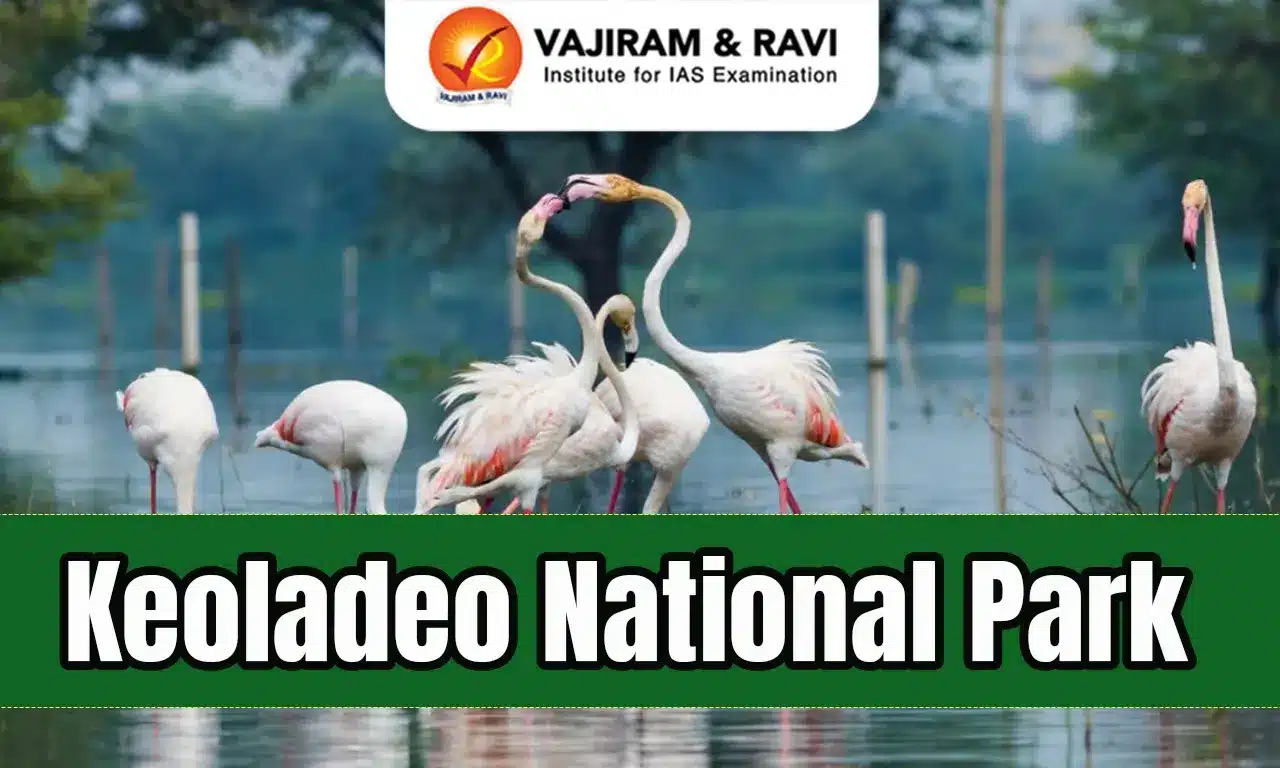
Migratory birds such as stork cranes, pelicans, painted storks, and bar-headed geese returned to the Keoladeo National Park after heavy rains in the monsoon.

About Keoladeo National Park

  • It is situated in the Bharatpur district of Rajasthan.
  • It was earlier known as Bharatpur Bird Sanctuary.
  • It is recognised as one of the world’s most important bird breeding and feeding grounds. 
  • It was founded in the late 19th century as a hunting preserve by Suraj Mal, the maharaja of the Bharatpur princely state, and became a bird sanctuary in 1956. 
  • Declared a national park in 1981, it was renamed Keoladeo for the ancient temple in the park dedicated to the Hindu god Shiva.
  • It has an area of 29 sq.km.
  • It is the only one of its kind in India which is enclosed by a 2-meters boundary wall to fend off encroachments.
  • It is a Ramsar site and also a UNESCO World Heritage Site. 
  • Vegetation
    • Woodlands, swamps, and wet grasslands cover a large part of the park.
    • The vegetation here is of a dry deciduous type, with medium-sized trees and shrubs found inside its forest. 
  • Flora: Some of the trees which can be commonly spotted inside the park are kadam, jamun, babul, kandi, ber, kair, and piloo.
  • Fauna
    • It is home to a range of mammals and reptiles—including pythons and other snakes, deer, sambars, blackbucks, jackals, monitor lizards, and fishing cats.
    • It is strategically located in the middle of the Central Asian migratory flyway.
    • It is home to more than 360 species of permanent and migratory birds. 
    • During the annual period of migratory visitors (about October to March), birds from throughout the world can be found in the park.
    • Among those wintering in the park are waterfowl from Afghanistan, Turkmenistan, China, and Siberia, including species such as gadwalls, shovellers, common teals, tufted ducks, pintails, white spoonbills, Asian open-billed storks, Oriental ibises, and the rare Siberian crane.

Source: ETVB

Keoladeo National Park FAQs

Q1: Keoladeo National Park is located in which state?

Ans: Rajasthan

Q2: What was the earlier name of Keoladeo National Park?

Ans: It was earlier known as Bharatpur Bird Sanctuary.

Q3: Is Keoladeo National Park a Ramsar Site?

Ans: Yes, Keoladeo National Park is a Ramsar Site.

Q4: Is Keoladeo National Park recognised as a UNESCO World Heritage Site?

Ans: Yes, Keoladeo National Park is a UNESCO World Heritage Site.

Enquire Now