
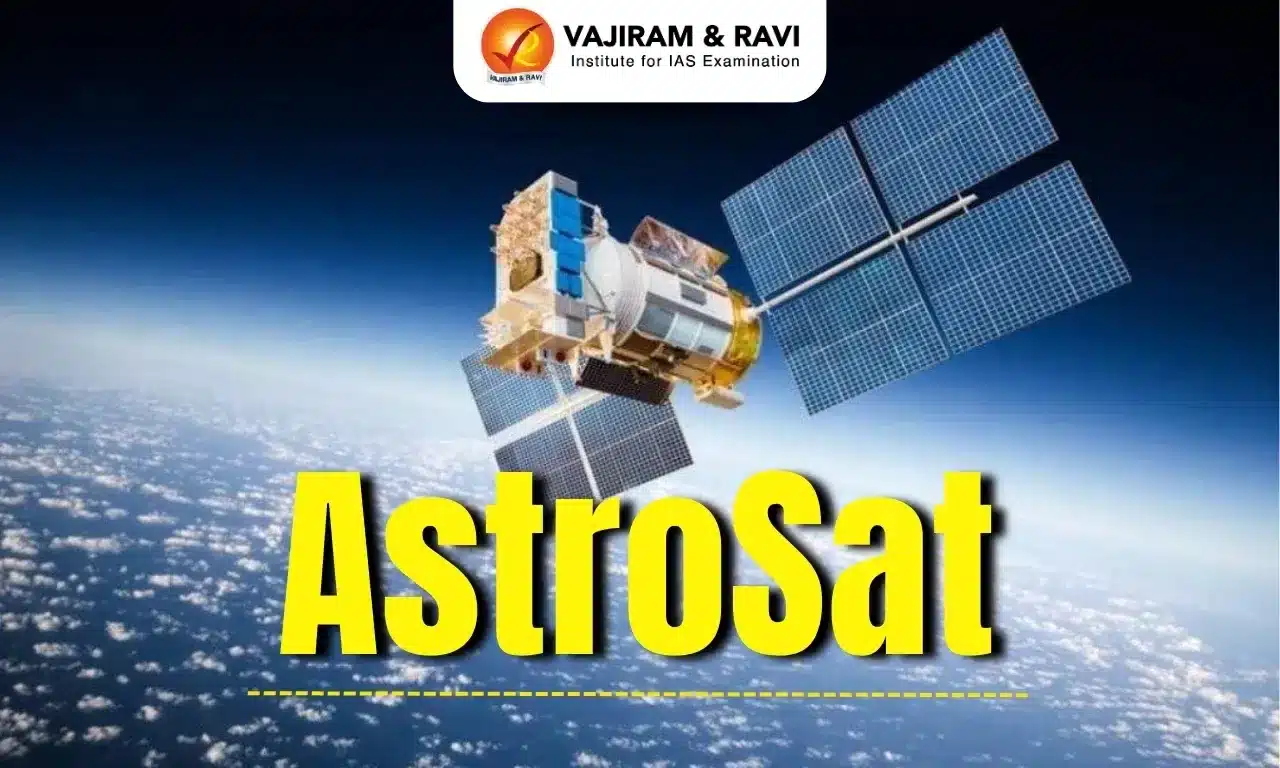
AstroSat Latest News
Recently, the Indian Institute of Astrophysics (IIA) celebrated a decade of successful operation of the UltraViolet Imaging Telescope (UVIT) on AstroSat.
About AstroSat
- It is the first dedicated Indian astronomy mission aimed at studying celestial sources in X-ray, optical and UV spectral bands simultaneously.
- The payloads cover the energy bands of Ultraviolet (Near and Far), limited optical and X-ray regime (0.3 keV to 100keV).
- It enables the simultaneous multi-wavelength observations of various astronomical objects with a single satellite.
- Payloads of Astrosat: Ultra Violet Imaging Telescope (UVIT), Large Area X-ray Proportional Counter (LAXPC), Cadmium–Zinc–Telluride Imager (CZTI), Soft X-ray Telescope (SXT) and Scanning Sky Monitor (SSM).
- UVIT consists of two telescopes: one dedicated to near-ultraviolet and visible wavelengths, and the other to far-ultraviolet observations.
- The spacecraft control centre at Mission Operations Complex (MOX) of ISRO Telemetry, Tracking and Command Network (ISTRAC), Bengaluru manages the satellite during its entire mission life.
Objectives of AstroSat
- To understand high energy processes in binary star systems containing neutron stars and black holes.
- Estimate magnetic fields of neutron stars.
- Study star birth regions and high energy processes in star systems lying beyond our galaxy.
- Detect new briefly bright X-ray sources in the sky.
- Perform a limited deep field survey of the Universe in the Ultraviolet region.
Source: DD News
AstroSat FAQs
Q1: What is Astrosat?
Ans: It is India's first dedicated multi-wavelength space observatory.
Q2: When was Astrosat launched?
Ans: in the year 2015
