Centre for Chronic Disease Control (CCDC)

Centre for Chronic Disease Control

Centre for Chronic Disease Control Latest News

A new study by the Centre for Chronic Disease Control (CCDC) for the first time concurrently estimated the daily salt and iodine consumption levels of the adult population in India and examined the effect of the World Health Organization (WHO) recommended salt intake levels on iodine levels.

About Centre for Chronic Disease Control 

  • Established in 2000, CCDC is an independent, not-for-profit, biomedical research organization based in New Delhi.
  • It aims to reduce the burden of chronic diseases in India and low- and middle-income countries through surveillance, capacity building, and translational research in cardio-metabolic diseases. 
  • It is a Scientific & Industrial Research Organization recognized by the Department of Scientific & Industrial Research, Ministry of Science and Technology, Government of India.
  • It has been designated as a WHO Collaborating Centre for Surveillance, Capacity Building, and Translational Research in Cardio-Metabolic Diseases. 
  • Recently, CCDC received the recognition of a collaborating Centre of Excellence (CoE) by the Indian Council of Medical Research.
  • It also holds registration under the Foreign Contribution (Regulation) Act, 1976.
  • CCDC undertakes clinical research with special emphasis on chronic non-communicable diseases (NCD). 
    • Within the spectrum of chronic diseases, CCDC’s main focus areas are: cardiology, diabetes and metabolic disease, vascular diseases, cancers, and mental health. 
  • In addition, basic science research in diet/nutrition and cardiac biochemistry are also carried out.

Source: ANI

Centre for Chronic Disease Control FAQs

Q1: Where is the Centre for Chronic Disease Control (CCDC) headquartered?

Ans: New Delhi

Q2: Centre for Chronic Disease Control (CCDC) has been designated as a WHO Collaborating Centre in which field?

Ans: Surveillance and translational research in cardio-metabolic diseases.

Q3: Recently, Centre for Chronic Disease Control (CCDC) was recognized as a Centre of Excellence (CoE) by which Indian institution?

Ans: Recently, CCDC received the recognition of a collaborating Centre of Excellence (CoE) by the Indian Council of Medical Research.

Dolomedes indicus

Dolomedes indicus

Dolomedes indicus Latest News

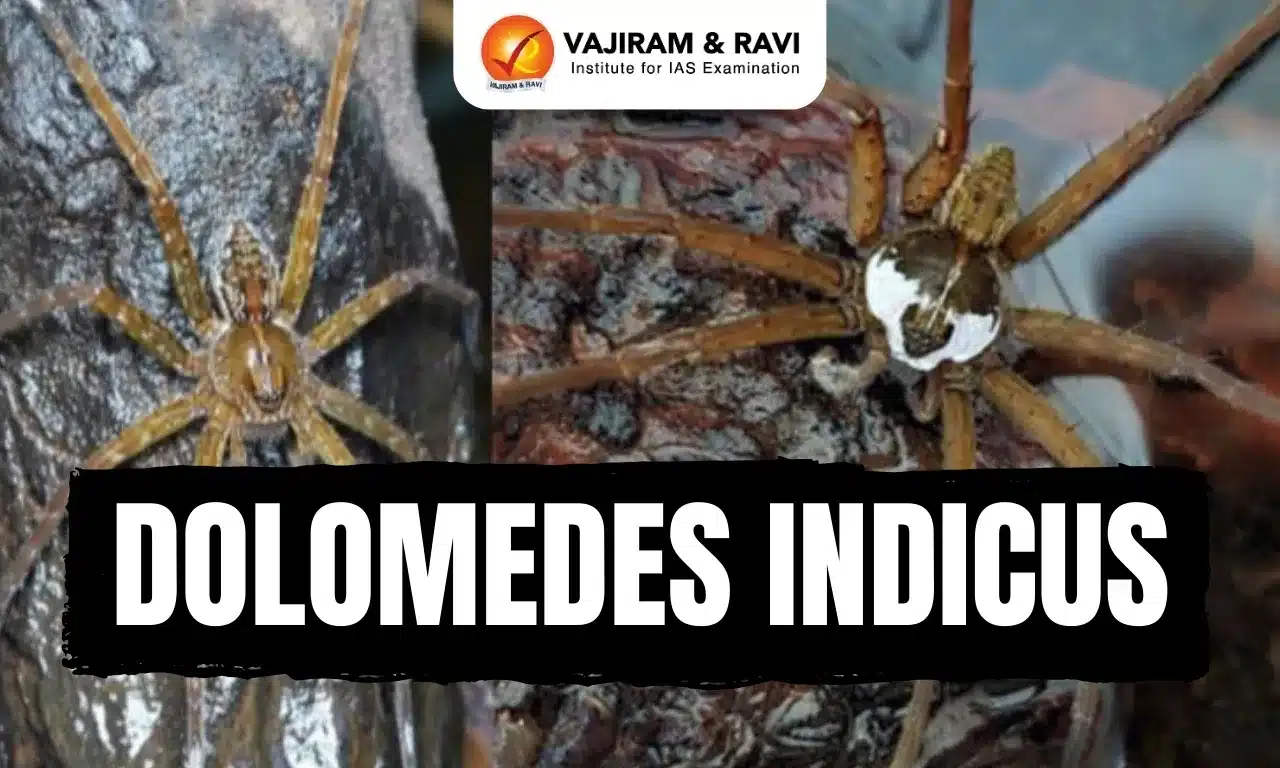
In the evergreen rainforests of the Western Ghats, researchers recently identified a new species of spider named Dolomedes indicus.

About Dolomedes indicus

  • It is a new species of spider.
  • It was discovered in the evergreen rainforests of the Western Ghats, in the Wayanad district of Kerala.
  • It marks the first time a spider of the Dolomedes genus, commonly known as raft or fishing spiders, has been described in India. 
    • Unlike the common house spiders that wait passively in webs, Dolomedes indicus is an active, semi-aquatic predator that uses the water’s surface tension to its advantage. 
    • These spiders rest their legs on the water to detect the tiny vibrations from struggling insects or small fish, then launch themselves across the surface to capture prey with lightning speed. 
    • They are also capable swimmers and divers. 
  • The new species is distinguished by specific physical traits, particularly in males, which sport a striking snow-white marking running from their faces down to the centre of their backs. 
  • Females are larger and greenish-brown, allowing them to blend perfectly with the mossy rocks and foliage along the stream banks.
  • It appears to be highly sensitive to its environment, thriving only in pristine, cool waters under a forest canopy.
  • It could serve as a vital indicator species, helping conservationists monitor the health of freshwater ecosystems.

Source: RM

Dolomedes indicus FAQs

Q1: What is Dolomedes indicus?

Ans: It is a new species of spider.

Q2: Dolomedes indicus was discovered in which region of India?

Ans: It was discovered in the evergreen rainforests of the Western Ghats, in the Wayanad district of Kerala.

Q3: What type of predator is Dolomedes indicus?

Ans: Semi-aquatic active predator.

Q4: Dolomedes indicus thrives in which type of habitat?

Ans: Pristine, cool forest streams.

INTERPOL Red Notice

INTERPOL Red Notice

INTERPOL Red Notice Latest News

Recently, the Madhya Pradesh State Tiger Strike Force in a coordinated operation with the Wildlife Crime Control Bureau has successfully apprehended an international wildlife offender wanted under an INTERPOL Red Notice (RN). 

About INTERPOL Red Notice

  • A Red Notice is a request to law enforcement worldwide to locate and provisionally arrest a person pending extradition, surrender, or similar legal action.
  • It is based on an arrest warrant or court order issued by the judicial authorities in the requesting country.
  • Member countries apply their own laws in deciding whether to arrest a person.
  • Purpose: International alert for a wanted person, but it is not an arrest warrant.
  • It contains two main types of information:
    • Information to identify the wanted person, such as their name, date of birth, nationality, hair and eye colour, photographs and fingerprints if available.
    • Information related to the crime they are wanted for, which can typically be murder, rape, child abuse or armed robbery.
  • Issuance: Red Notices are published by INTERPOL at the request of a member country, and must comply with INTERPOL’s Constitution and Rules.
  • Red Notices are issued for fugitives wanted either for prosecution or to serve a sentence in relation to serious ordinary law crimes such as murder, rape and fraud. 
  • Interpol cannot compel the law enforcement authorities in any of the countries to arrest someone who has a RN issued.
  • The Central Bureau of Investigation is India's National Central Bureau (NCB) for INTERPOL, handling Red Notices for all crimes, including wildlife offenses.

Source: PIB

INTERPOL Red Notice FAQs

Q1: What is an INTERPOL Red Notice?

Ans: A request to law enforcement to locate and provisionally arrest a person

Q2: Where is INTERPOL headquartered?

Ans: Lyon, France

Shani Shingnapur Temple

Shani Shingnapur Temple

Shani Shingnapur Temple Latest News

The Ahilyanagar police cyber cell recently arrested two Shani Shingnapur Temple Trust employees for allegedly diverting over ₹50 lakh each into their personal accounts by manipulating online applications used for booking pooja services.

About Shani Shingnapur Temple

  • It is a Hindu temple located in the Ahmednagar district, Maharashtra.
  • It is dedicated to Lord Shanidev, the popular Hindu god associated with the planet Saturn.
  • The deity here is a five-and-a-half-feet-high black rock standing on a platform and is believed to be swayambhu (self-emerged). 
  • Apart from the temple, Shingnapur is a small village which is also famous for the fact that in the whole village no house has doors, and despite this, no theft has been reported in the village.

Shani Shingnapur Temple Architecture

  • It has no roofs, doors, or walls around. 
  • The temple is unique, as it is the only one where Lord Shani is worshipped in an open-sky setting.  
  • On the idol of Lord Shani, mustard oil is poured continuously from a copper vessel which hangs just above the idol. 
  • There is a Trishul alongside the stone as well as a Nandi on its south. In front are the small images of Shiva and Hanuman. 
  • An east-facing multi-deity temple was built west of the Shani idol later. 
  • The premises also contain a tomb of Saint Udasi Baba and a temple dedicated to Dattatreya.

Source: HT

Shani Shingnapur Temple FAQs

Q1: Shani Shingnapur Temple is located in which Indian State?

Ans: Maharashtra

Q2: Shani Shingnapur Temple is dedicated to which deity?

Ans: It is dedicated to Lord Shanidev, the popular Hindu god associated with the planet Saturn.

Q3: Which feature makes the village of Shingnapur famous?

Ans: It is famous for the fact that in the whole village no house has doors.

Q4: What is unique about the architecture of Shani Shingnapur Temple?

Ans: It has no roofs, doors, or walls.

Organization for Security and Cooperation in Europe

Organization for Security and Cooperation in Europe

Organization for Security and Cooperation in Europe Latest News

Recently, foreign minister of Ukraine said at the Organization for Security and Cooperation in Europe that Ukraine wants "real peace, not appeasement" with Russia.

About Organization for Security and Cooperation in Europe

  • It is a dynamic organization that is dedicated to promoting peace, stability, and security throughout Europe and Central Asia. 
  • It is the world’s largest regional security organization.
  • Origin: The OSCE’s origins date back to the early 1970s, to the Helsinki Final Act (1975) and the creation of the Conference on Security and Co-operation in Europe (CSCE), which during the Cold War served as an important multilateral forum for dialogue and negotiations between East and West.
    • In 1994, the CSCE was renamed the Organization for Security and Cooperation in Europe (OSCE) to reflect these changes more accurately.
  • Member Countries: It consists of 57 participating States in North America, Europe and Asia. (India is not a member country).
  • Objective: It works for stability, peace and democracy through political dialogue about shared values and through practical work that makes a lasting difference.
  • Decision-making bodies of OSCE: There are four decision-making bodies with delineated, distinct mandates namely;
    • Summits: It is the highest decision-making body of the OSCE
    • Ministerial Councils: The OSCE’s central decision-making and governing body
    • Permanent Council:  It is responsible for the day-to-day business of the Organization
    • Forum for Security Co-operation: It  deals with the politico-military dimension of security
  • Leadership: The OSCE’s leadership includes the Chairperson-in-Office, the Secretary General, and the heads of its institutions and field operations.
  • Headquarter: Vienna

Source: Reuters

Organization for Security and Cooperation in Europe FAQs

Q1: Where is the headquarters of OSCE located?

Ans: Vienna, Austria

Q2: What is the primary objective of OSCE?

Ans: To ensure security and stability in Europe

Afar Region

Afar Region

Afar Region Latest News

Scientists predict that Africa’s Afar region could become Earth’s next ocean basin.

About Afar region

  • Location: It is the northeastern part of Ethiopia, where the Red Sea meets the Gulf of Aden. 
  • The Afar depression, also known as the Danakil depression, forms the northern part of the region and is largely desert scrubland with shallow salty lakes and long chains of volcanoes. 
  • The Awash River valley forms the southern part of the area.
  • Tectonic Significance: It is situated at a unique triple junction where the Red Sea, Gulf of Aden, and East African Rift converge.
  • Terrain: The region’s landscape is marked by deep rift valleys, volcanic plateaus, and extensive fissures, reflecting the dynamic forces reshaping the Earth’s crust. 
  • It offers scientists a rare opportunity to observe the processes of continental break-up and ocean genesis in action.
  • The region is well known for its early hominid fossil finds including 'Lucy', an Australopithecus afarensis, discovered in 1974.

Source: IE

Afar Region FAQs

Q1: What is the climate of the Afar region like?

Ans: Arid and hot

Q2: What is significant about the Afar region in terms of human evolution?

Ans: It is home to the oldest known human fossils (e.g., Lucy, Australopithecus afarensis).

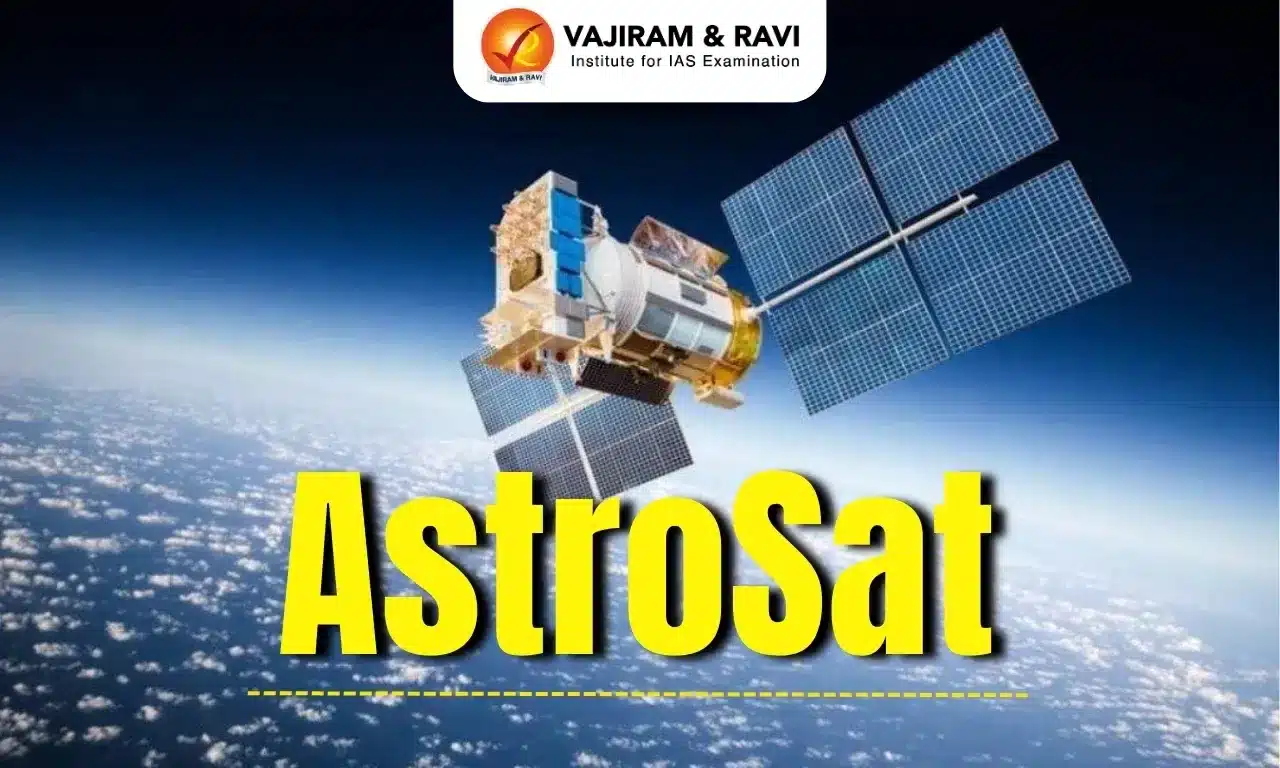
AstroSat

AstroSat

AstroSat Latest News

Recently, the Indian Institute of Astrophysics (IIA) celebrated a decade of successful operation of the UltraViolet Imaging Telescope (UVIT) on AstroSat.

About AstroSat

  • It is the first dedicated Indian astronomy mission aimed at studying celestial sources in X-ray, optical and UV spectral bands simultaneously.
  • The payloads cover the energy bands of Ultraviolet (Near and Far), limited optical and X-ray regime (0.3 keV to 100keV).
  • It enables the simultaneous multi-wavelength observations of various astronomical objects with a single satellite.
  • Payloads of Astrosat: Ultra Violet Imaging Telescope (UVIT), Large Area X-ray Proportional Counter (LAXPC), Cadmium–Zinc–Telluride Imager (CZTI), Soft X-ray Telescope (SXT) and Scanning Sky Monitor (SSM).
    • UVIT consists of two telescopes: one dedicated to near-ultraviolet and visible wavelengths, and the other to far-ultraviolet observations.
  • The spacecraft control centre at Mission Operations Complex (MOX) of ISRO Telemetry, Tracking and Command Network (ISTRAC), Bengaluru manages the satellite during its entire mission life.

Objectives of AstroSat

  • To understand high energy processes in binary star systems containing neutron stars and black holes.
  •  Estimate magnetic fields of neutron stars.
  • Study star birth regions and high energy processes in star systems lying beyond our galaxy.
  •  Detect new briefly bright X-ray sources in the sky.
  •  Perform a limited deep field survey of the Universe in the Ultraviolet region.

Source: DD News

AstroSat FAQs

Q1: What is Astrosat?

Ans: It is India's first dedicated multi-wavelength space observatory.

Q2: When was Astrosat launched?

Ans: in the year 2015

Exercise Harimau Shakti

Exercise Harimau Shakti

Exercise Harimau Shakti Latest News

Recently, the Fifth edition of “Exercise Harimau Shakti -2025” commenced in Mahajan Field Firing Range, Rajasthan.

About Exercise Harimau Shakti

  • It is a joint military exercise conducted between India and Malaysia.
  • The Indian contingent is being represented mainly by troops from the DOGRA Regiment.
  • The aim of the exercise is to jointly rehearse conduct of Sub Conventional Operations under Chapter VII of United Nations Mandate.
  • Both sides will practice tactical actions such as cordon, search and destroy missions, heliborne operations, etc.

Key Facts about Exercise Harimau Shakti – 2025

  • In this exercise both sides will rehearse drills to secure helipads and undertake casualty evacuation during counter-terrorist operations.
  • Both sides will exchange views and practices of joint drills on a wide spectrum of combat skills that will facilitate the participants to mutually learn from each other.
  • Sharing of best practices will further enhance the level of defence cooperation between Indian Army and Royal Malaysian Army.
  • Significance: The exercise will also foster strong bilateral relations between the two nations.

Source: PIB

Exercise Harimau Shakti FAQs

Q1: What is Exercise Harimau Shakti?

Ans: A bilateral military exercise between India and Malaysia.

Q2: Where is the 5th edition of Exercise Harimau Shakti being held?

Ans: India (Mahajan Field Firing Range, Rajasthan)

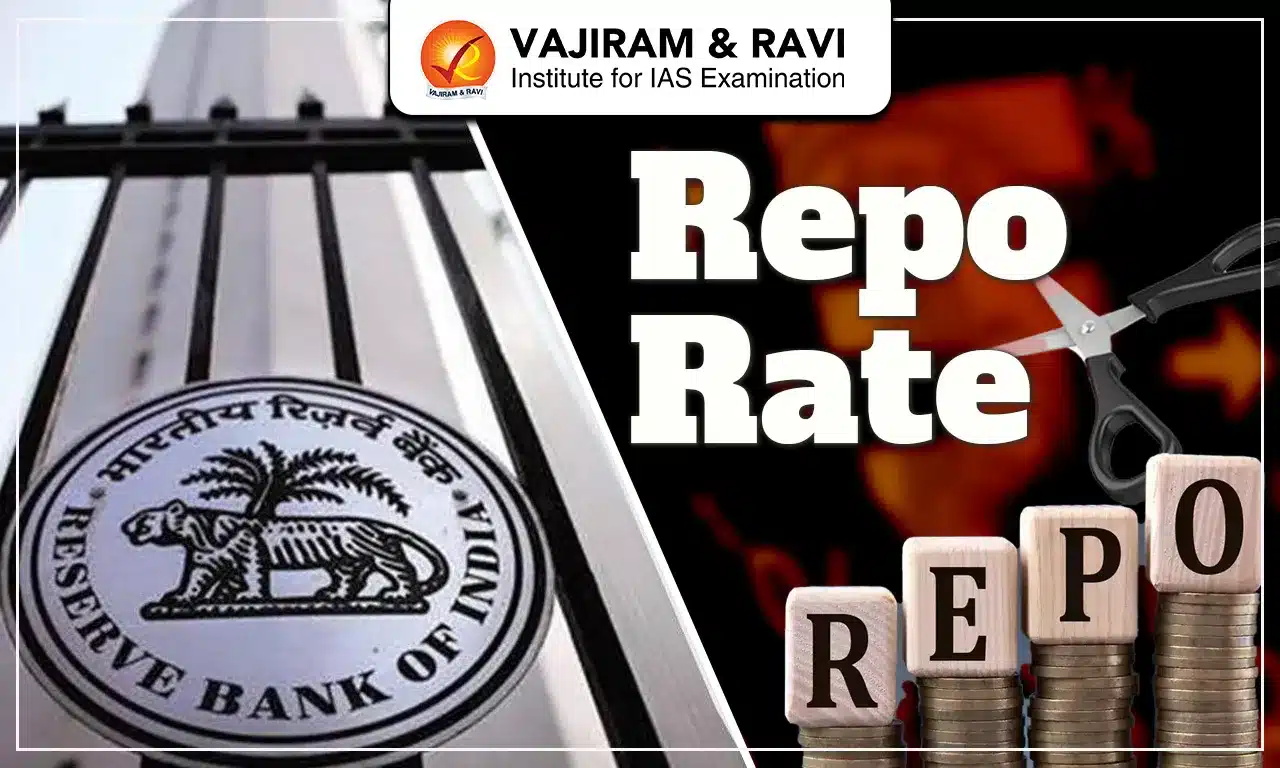
Repo Rate, Meaning, Importance, Impact, Current Rate, Latest News

Repo Rate

Repo Rate News

Recently, The RBI has cut the repo rate to 5.25%, easing borrowing costs for homebuyers and boosting real estate sentiment. The RBI has kept the reverse repo rate unchanged to 3.35%.

Basis Points Meaning

  • Basis points (bps) are a standard financial unit used to measure small changes in interest rates, yields, or other percentage-based values.
  • They provide precision when expressing movements in financial indicators. For example, a 25 bps hike means a 0.25% increase.
  • Basis points are widely used to describe changes in interest rates on loans, savings, bonds, and other financial instruments, ensuring clarity where even minor shifts matter.

RBI Repo Rate

  • The repo rate is the interest rate at which the RBI lends short-term funds to commercial banks against government securities. 
  • It serves as a primary tool for the RBI to regulate liquidity, control inflation, and influence overall economic activity.
  • By adjusting the repo rate, RBI can either encourage banks to borrow more (by lowering the rate) or discourage borrowing (by raising the rate), thus influencing the money supply in the economy.
  • The reverse repo rate is the interest rate at which the central bank (such as the RBI) borrows surplus funds from commercial banks, thereby absorbing excess liquidity from the system. 
    • It is the opposite of the repo rate, where commercial banks borrow from the central bank.

Also Read: RBI Monetary Policy 2025

Impact of RBI Repo Rate Cut

  • Lower Borrowing Costs: Commercial banks benefit from reduced borrowing costs, enabling them to offer loans at more competitive interest rates.
  • Fixed Deposit (FD) Interest Rates: Banks likely lower FD rates after a repo rate cut, as their own cost of funds decreases. This means new FDs may offer lower returns, while existing FDs remain unaffected until maturity
  • Enhanced Credit Flow: Lower interest rates encourage increased borrowing by businesses and consumers, stimulating investment and consumption.
  • Boost to Real Estate and Infrastructure: Due to more affordable financing options, sectors like real estate and infrastructure may see heightened activity.
  • Support Amid Global Challenges: The RBI's accommodative stance aims to bolster the Indian economy against global uncertainties, such as increased U.S. tariffs impacting exports.

Repo Rate FAQs

Q1: What is the repo rate?

Ans: The repo rate is the interest rate at which commercial banks borrow money from the RBI by pledging government securities.

Q2: What is the current repo rate?

Ans: As of December 05, 2025, the RBI repo rate is 5.25%.

Q3: What is the repo rate of RBI in 2025?

Ans: In December 2025, the RBI reduced the repo rate to 5.25% during its December Monetary Policy Committee meeting.

Q4: What is the current reverse repo rate?

Ans: As of December 05, 2025, the reverse repo rate is 3.35%.

Powai Lake

Powai Lake

Powai Lake Latest News

Flagging a series of non-compliances by the Brihanmumbai Municipal Corporation (BMC) in checking untreated sewage flowing into Powai Lake, a National Green Tribunal (NGT)-mandated committee recently recommended that the BMC face a penalty of Rs 5 lakh per month per inlet if the new action plan is violated.

About Powai Lake

  • It is an artificial lake situated in the northern suburb of Mumbai, Maharashtra.
  • The lake was built by the British in 1890, after constructing two dams about ten metres high across two hillocks, to augment the water supply to Bombay.
  • The hillocks seen on the south end of the lake are the lowest slopes of the Western Ghats.
  • The catchment area of the lake is 6.6 sq.km., with the depth varying from 3 to 12 metres.
  • Around Powai Lake are two famed institutions-Indian Institute of Technology-Bombay (IIT-B) and the National Institute of Industrial Engineering (NITIE).
  • The Padmavati Devi Temple, situated on the bank of the lake inside IIT Bombay campus dates back to the 10th century AD.
  • The lake is surrounded by the Powai Bird Sanctuary.
  • It is an important resting, feeding, and breeding site of several bird species, resident and migratory. 
  • Among some of the lake’s rare and distinguished residents and visitors are the Watercock, Pheasant-tailed Jacana, Slaty-legged Crake, Ruddy-breasted Crake, Woolly-necked Stork, Caspian Tern, and Peregrine Falcon.
  • In recent times, 40% of the lake has disappeared. The lake has deteriorated due to accelerated growth of residential, commercial, and industrial areas around the lake.

Source: DH

Powai Lake FAQs

Q1: Powai Lake is located in which Indian state?

Ans: Maharashtra

Q2: Powai Lake was constructed in which year?

Ans: 1890

Q3: Powai Lake was originally built by the British for what purpose?

Ans: Drinking water supply to Bombay.

Q4: Which two major institutions are located around Powai Lake?

Ans: Indian Institute of Technology-Bombay (IIT-B) and the National Institute of Industrial Engineering (NITIE)

Enquire Now