
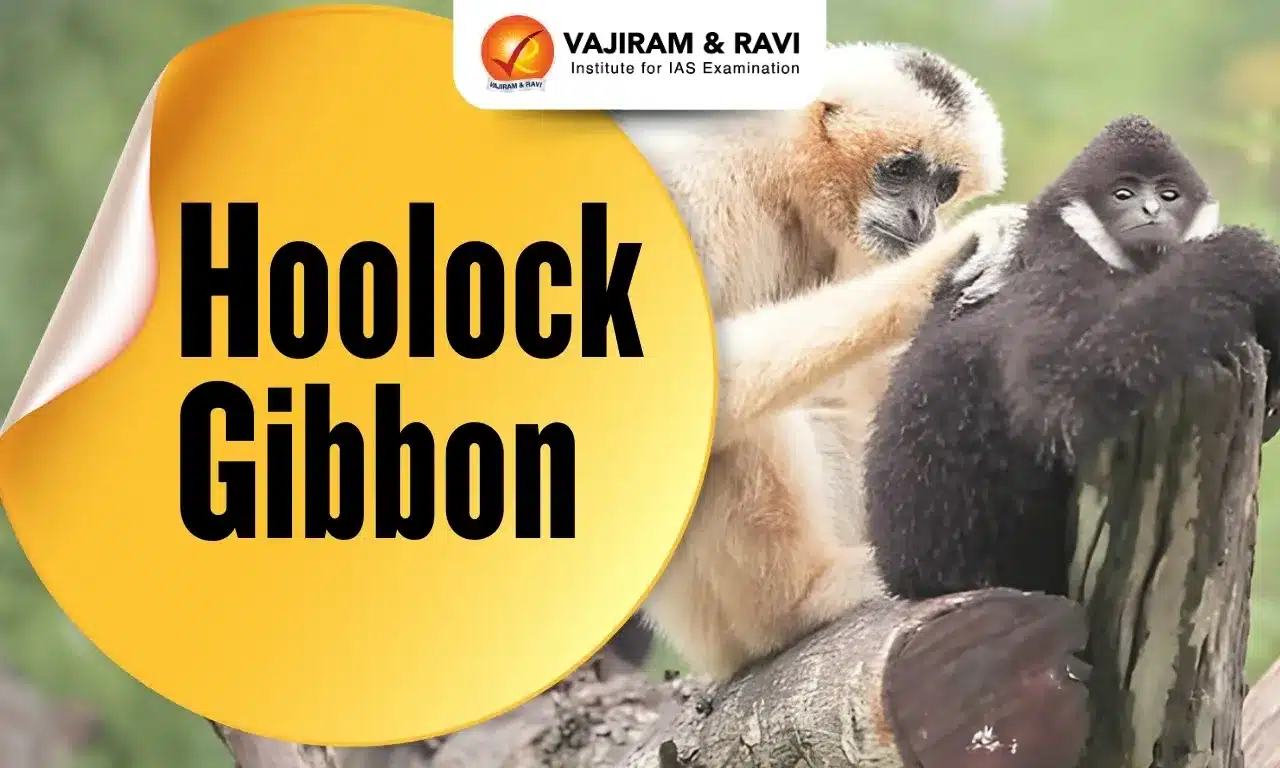
Hoolock Gibbon Latest News
Recently, a stranded family of Hoolock gibbons was rescued in Arunachal Pradesh’s Lower Dibang Valley district by officials.
About Hoolock Gibbon
- Gibbons, the smallest and fastest of all apes, live in tropical and subtropical forests in the southeastern part of Asia.
- The hoolock gibbon is one of 20 species of gibbons on Earth.
Distribution of Hoolock Gibbon
- Its distribution in Southeast Asia spans India, Myanmar, Bangladesh, and southern China.
- It is the only ape found in India.
- In India, it is found in Assam, Meghalaya, Arunachal Pradesh, Nagaland, Manipur, Mizoram, and Tripura, south of the Brahmaputra.
- Hollongapar Gibbon Sanctuary in Assam has the largest concentration of the hoolock gibbon.
- It is categorised into Eastern Hoolock Gibbon (Hoolock leuconedys) found in a specific region of Arunachal Pradesh and Western Hoolock Gibbon (Hoolock hoolock) distributed elsewhere in the northeast.
Characteristics of Hoolock Gibbon
- They are diurnal and arboreal, brachiating through the trees with their long arms.
- They are monogamous (same partner throughout life).
- They live in small families and communicate with other gibbons by vocalisation.
- Life span: 25 years
Conservation Status of Hoolock Gibbon
- IUCN Red List
-
- Eastern Hoolock Gibbon: Vulnerable
- Western Hoolock Gibbon: Endangered
- Both are on Schedule I of the Wildlife (Protection) Act of India, 1972.
Source: The Print
Hoolock Gibbon FAQs
Q1: What is the scientific name of Hoolock Gibbon?
Ans: Hylobates hoolock
Q2: What is unique about Hoolock Gibbons?
Ans: They are known for their distinctive vocalizations
